Key Points
- Morocco has issued a new decree, numbered 2.26.342, published on April 30, 2026, in the Official Gazette.
- The decree sets the legal and training framework for medical, pharmacy, and dental students during hospital internships and clinical placements.
- Students are formally classified as observers, externs, interns, or residents, depending on their year of study and training stage.
- Observer status applies to first- and second-year medical and dental students, and pharmacy students in their first three years.
- Externs must take part in supervised hospital work, including patient care, note-taking, on-call duties, prescription execution, dispensing medication, and biological analyses.
- Sixth-year externs are formally included in medical care teams.
- Hospital training for externs will run from September to July, and attendance will be mandatory.
- Intern status is awarded through a competitive examination after completion of the first four years of study in medicine, dentistry, or pharmacy.
- Internships last two years full-time and include rotations in different specialties, hospital management, research, supervision of externs, and emergency services.
- Residents admitted to specialisation programmes, including military hospital candidates, must sign a commitment to work for at least three years in public health structures after qualification.
- Those who seek release from the obligation must obtain formal approval and repay salaries and training costs received during residency.
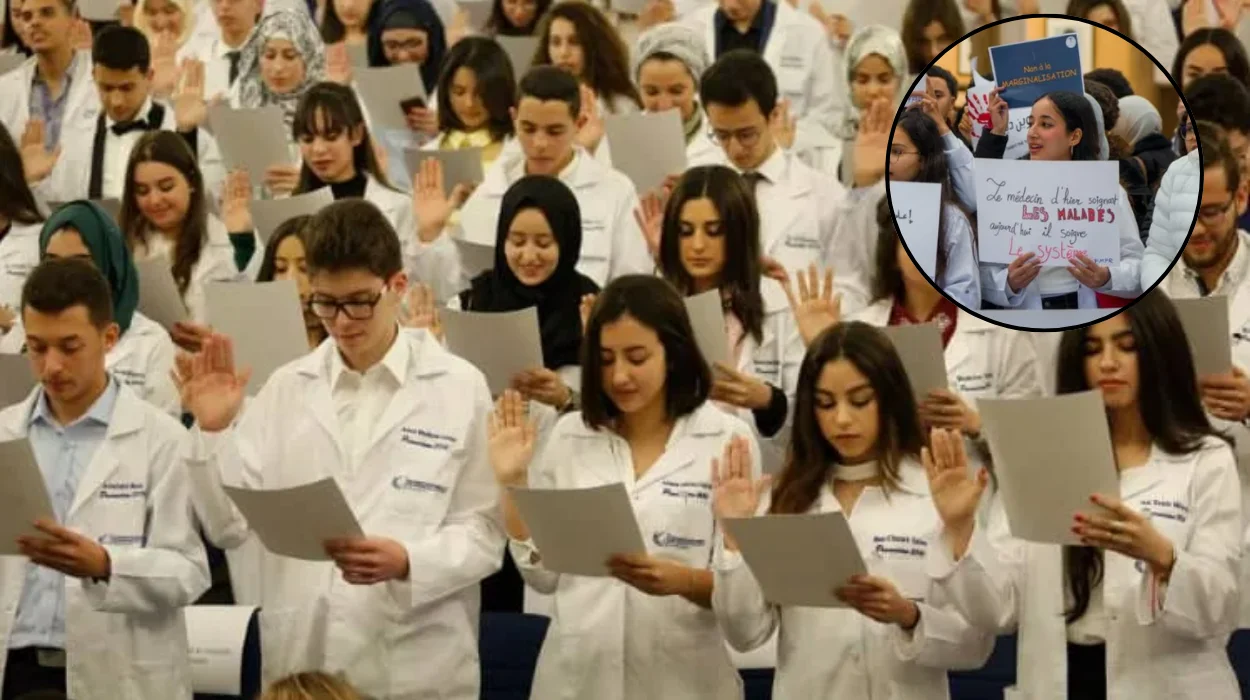
- The decree comes after years of student protests, exam boycotts, disputes over training length, delayed allowances, concerns over the Territorial Health Groups, overcrowded hospitals, and fears of medical brain drain.
Rabat (Britain Today News) May 13, 2026 — Morocco has introduced a sweeping new legal and training framework for students in public faculties of medicine, pharmacy and dentistry, setting out clear rules for their hospital internships, clinical placements and post-specialisation obligations.
- Key Points
- What does the new Moroccan decree say about medical student status?
- How will extern training be organised in hospitals?
- What role will interns play under the decree?
- Why are residents being required to work in public health structures?
- What happens if residents want to be released from the obligation?
- Why was this decree issued now?
- What does this mean for Morocco’s health system?
- Can the decree ease student unrest and staff shortages?
In the Official Gazette and is designed to regulate the status, duties and responsibilities of trainees in health institutions linked to territorial health groups, military hospitals and partner institutions. The move comes at a sensitive moment for Morocco’s health and higher education systems, which have been under pressure from student unrest, concerns over hospital training conditions and the wider challenge of retaining qualified medical staff in the public sector.
The decree defines students as trainees if they are preparing national diplomas in medicine, dentistry, pharmacy, or medical and pharmaceutical specialisations, provided they hold the authorisation or appointment documents required to complete mandatory training placements. It creates a structured system based on four categories — observers, externs, interns and residents — each with specific rights and duties.
What does the new Moroccan decree say about medical student status?
According to the decree, observer status is granted to first- and second-year medical and dental students, as well as pharmacy students in their first three years. This stage is intended to give students early exposure to the hospital environment without placing them in front-line clinical responsibilities. The framework distinguishes clearly between observation and active participation, with the aim of ensuring that training is progressive and aligned with academic level.
Extern status begins from the third year in medicine and dentistry and from the fourth year in pharmacy. At this stage, students are no longer limited to observing hospital work; instead, they are required to participate in core activities under supervision. Medical and dental externs will be involved in patient care, medical note-taking and on-call duties. Pharmacy externs will help with prescription execution, medication dispensing and biological analyses in hospitals.
The decree adds that sixth-year externs are formally considered part of medical care teams. This is a significant recognition of their role within hospital services, as it places them closer to the operational side of care delivery while still maintaining the status of trainees rather than fully qualified professionals.
How will extern training be organised in hospitals?
Hospital training for externs will run from September through July, with attendance mandatory and monitored by supervisors. The duration of the training will vary depending on the student’s year and discipline, ranging from part-time placements in earlier years to full-day hospital rotations in the final stages of training.
This structure appears designed to balance academic study with practical learning, while also ensuring consistent hospital presence. In effect, the state is formalising the bridge between university teaching and frontline health service exposure. For students, this means clearer expectations; for hospitals, it means more defined supervision and accountability.
The decree places emphasis on attendance, supervision and structured progression, suggesting that the authorities want to reduce ambiguity around student obligations. It also reflects an effort to standardise training across institutions, which could be important in a system where overcrowding and uneven conditions have been recurring concerns.
What role will interns play under the decree?
Intern status will be granted through a competitive examination open to students who successfully complete the first four years of study in medicine, dentistry or pharmacy. The internship will last two years full-time and will include compulsory rotations in different specialties, depending on the discipline.
Interns will not only work in clinical settings but also take part in broader hospital duties. These include hospital management activities, research work, supervision of externs, emergency response and on-call services. The decree therefore positions interns as a more advanced tier of trainees, expected to contribute actively to the functioning of the hospital while still under formal training.
This stage is especially important because it prepares students for the transition from education to professional practice. It also gives hospitals a structured way to involve trainees in service delivery, which may help with staffing pressures, particularly in public facilities.
Why are residents being required to work in public health structures?
One of the most notable features of the decree is the rule governing residents. Resident status will be granted to graduates admitted into specialisation programmes or to successful military hospital candidates. Residents will be appointed as trainee doctors, pharmacists or dentists from their first year.
Under the decree, they must sign a commitment to work for at least three years in territorial health groups or in institutions under the Ministry of Health after obtaining their specialisation diploma. This obligation is intended to strengthen Morocco’s public health workforce and improve access to specialised care in state-run facilities.
The rule is likely to be seen as one of the most consequential elements of the decree, because it directly links advanced training to public service. In practical terms, the government is asking specialists-in-training to give back several years of work in the public system after receiving highly subsidised professional education and training.
What happens if residents want to be released from the obligation?
The decree also spells out the conditions for release. Those who seek to be exempted from the service obligation must obtain formal approval and reimburse the salaries and training costs they received during residency.
That provision is likely intended to discourage casual avoidance of the public service requirement. It also signals that residency is being treated not simply as an academic phase, but as an investment by the state with a corresponding duty attached. For the authorities, this is a way of protecting public resources and ensuring that trained specialists do not immediately leave for other sectors or private opportunities.
Why was this decree issued now?
The publication of the decree comes after a period of intense turbulence in Morocco’s medical education and healthcare sectors. Over recent years, the landscape has been marked by prolonged student strikes and exam boycotts, largely triggered by the government’s decision to reduce medical training from seven years to six.
The tensions were deepened by delays in internship allowances, uncertainty over the legal status of the newly formed Territorial Health Groups, and concerns about the quality of training in overcrowded hospitals. These problems have not only affected day-to-day learning conditions, but have also contributed to wider frustration among students and trainee doctors.
There has also been a continuing worry over medical brain drain, with many graduates leaving the country or avoiding public-sector careers. That broader challenge appears to have pushed the Ministry of Higher Education and the Ministry of Health to put more formal and binding rules in place. The new decree can therefore be seen as an attempt to stabilise the training system and secure a more reliable pipeline of specialists for the public health sector.
What does this mean for Morocco’s health system?
The new framework may bring greater clarity and order to a training system that has been under strain for several years. By defining the roles of observers, externs, interns and residents, the government is trying to reduce confusion and create a more predictable pathway through medical, pharmaceutical and dental education.
At the same time, the decree places stronger obligations on trainees, especially at the residency level. That could help Morocco address shortages in public health institutions, but it may also remain a point of debate among students and young professionals if they feel the balance between service and training is unfair.
The success of the policy will likely depend on implementation. If hospitals are overcrowded, supervision is weak or allowances are delayed again, the new legal framework may not be enough on its own to ease tensions. However, if applied consistently, it could become a central part of Morocco’s efforts to modernise medical education and retain skilled practitioners in the public sector.
Can the decree ease student unrest and staff shortages?
That is the central question now facing policymakers, students and health institutions. The decree offers structure, but it also introduces obligations that may be closely scrutinised by those directly affected. For the government, the challenge is to show that the new rules are not simply administrative controls, but a genuine effort to improve training quality and strengthen public healthcare delivery.
In the coming months, the real test will be whether the rules are implemented in a way that restores trust, improves hospital training and supports the supply of specialists across Morocco’s health system.