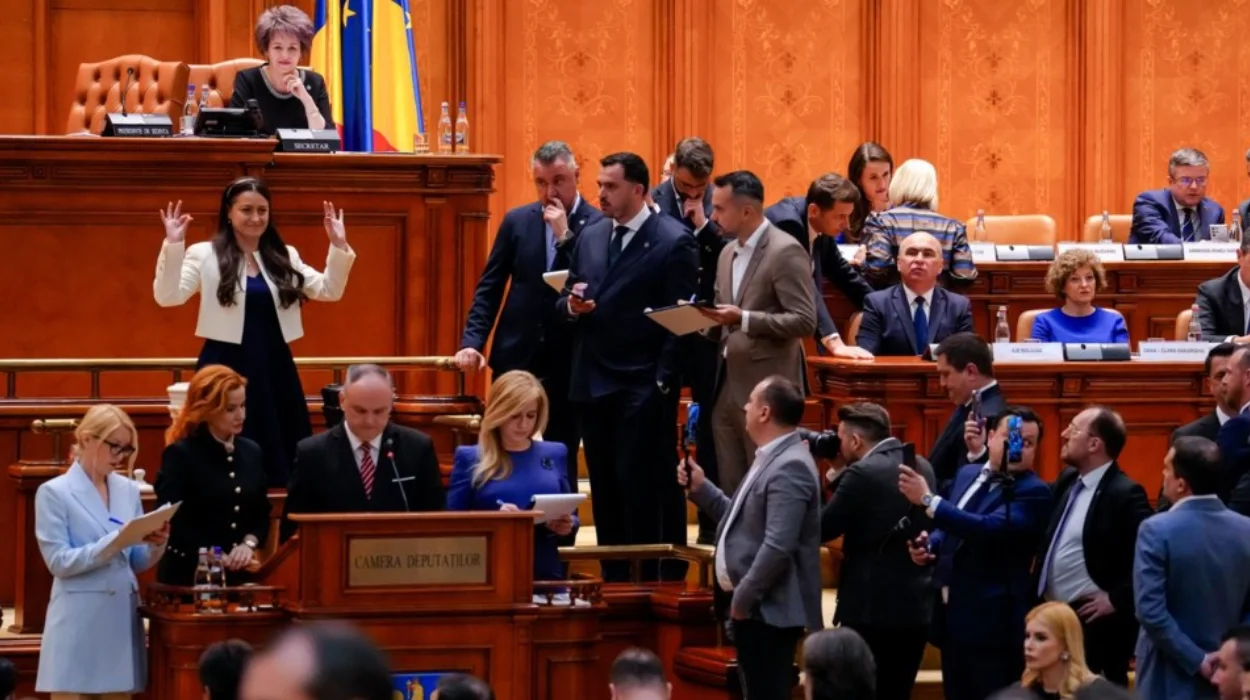
Romania’s government collapsed after a no-confidence vote in May 2026, creating a major political and fiscal crisis centered on coalition breakdown, deficit control, EU funding, and market confidence. The crisis matters because Romania is a European Union and NATO member with a constitutional system that depends on parliamentary confidence and presidential nomination of a prime minister .
What does Romania’s government collapse mean?
Romania’s government collapse means parliament withdrew confidence from the cabinet, forcing the prime minister to remain only in an interim role until a new government wins approval. The collapse disrupts budget policy, coalition discipline, EU negotiations, and market stability.
A government collapse in Romania is not the same as a state collapse. It is a loss of parliamentary support under a constitutional system in which the government needs a majority in parliament to govern . Under Article 85 of the Romanian Constitution, the president designates a prime minister candidate and appoints the government only after a vote of confidence in parliament .
In practical terms, the fallen cabinet stays in office with limited powers until a replacement is approved. That interim period matters because Romania still has to pass laws, manage public finances, and negotiate with the European Union on reforms and funding conditions.
Why did the coalition fall?
The coalition fell after the Social Democrats quit the governing alliance, joined the far-right opposition on a no-confidence motion, and turned a minority cabinet into a majority defeat. The split reflected conflict over austerity, patronage, and reform pace.
Romania’s pro-European coalition had only been in power for about 10 months when it collapsed. Reuters reported that the Social Democrats, the largest party in parliament, first called for Prime Minister Ilie Bolojan’s resignation and then walked out of the four-party coalition before joining the no-confidence effort with the far-right opposition. The vote passed with 281 votes, far above the 233 required.
The political conflict was tied to austerity measures and fiscal reform. Bolojan’s agenda aimed to reduce Romania’s deficit and unlock EU recovery money, but those measures hit voter bases linked to the Social Democrats and their local political networks. This kind of breakdown shows how coalition governments in parliamentary systems can unravel when one major partner decides the political cost of reforms is too high.
Who is Ilie Bolojan?
Ilie Bolojan is Romania’s prime minister at the center of the collapse, a reform-focused liberal politician who led the minority government and defended spending restraint. He remains interim premier until parliament approves a new cabinet.
Bolojan led the government after the coalition formed to contain the rise of the far right and stabilize Romania’s finances. Reuters described him as the most popular politician in the ruling coalition, even as his austerity measures angered supporters of other parties. He told lawmakers that Romania could not govern effectively without respect for public money.
His position became weaker when the Social Democrats withdrew support. In Romania’s system, a prime minister can remain politically visible and still lose governing authority if the parliamentary majority disappears . That is what happened here, and it is why the collapse triggered a national crisis instead of a simple cabinet reshuffle.
How does Romania form a government?
Romania forms a government through a presidential nomination followed by parliamentary confidence. The president proposes a prime minister, and parliament must approve the cabinet before it can govern.
This process is written into the Constitution of Romania. Article 80 says the president represents the state and helps ensure the proper functioning of public authorities . Article 85 says the president designates a candidate for prime minister and appoints the government only after a vote of confidence in parliament .
This mechanism creates a balance between the presidency and parliament. It also means coalition stability is essential. If the coalition fractures, the president must consult parties and nominate a new prime minister candidate who can win parliamentary support. In Romania’s current crisis, President Nicușor Dan is expected to begin that process.
What is at stake economically?
Romania faces pressure on its debt ratings, currency, budget deficit, and EU funding because investors and institutions expect a stable government to deliver reforms. The collapse raises doubts about fiscal discipline and policy continuity.
Reuters said the collapse put Romania’s sovereign debt ratings, access to EU funds, and currency stability at risk. The leu fell to a record low against the euro before the vote, showing how quickly political instability can affect markets. Investors care about Romania’s ability to reduce its deficit, because the country has the European Union’s biggest budget shortfall.
Romania also has a hard deadline linked to EU recovery and resilience funds. Reuters reported that the country must keep implementing reforms to access about 10 billion euros in recovery money before an August cutoff date. A separate Reuters report in 2025 said Romania had negotiated a recovery package worth about 21.6 billion euros, with roughly 9 billion euros already tapped and the remainder tied to deadlines and reforms. That makes political disruption directly relevant to financing, not just party politics.
Why does the EU care?
The European Union cares because Romania’s reforms, deficit reduction, and recovery fund compliance depend on stable political leadership. A weak or divided government delays decisions and threatens access to EU money.
Romania’s case shows how EU membership links domestic politics to financial oversight. Recovery and resilience funds come with conditions on reforms, deadlines, and implementation. When the government falls, the state does not lose membership or funding automatically, but it does weaken its ability to meet those obligations on time.
This is especially serious when the fiscal deficit is already high. Reuters reported that Romania was expected to narrow its deficit to 6.2% of economic output in 2026 from more than 9% in 2024. That scale of adjustment requires tax decisions, spending restraint, and administrative follow-through. Political instability slows all three.
What role did the far right play?
The far right helped turn a coalition breakdown into a national crisis by aligning with the Social Democrats on the no-confidence motion. Its strength in polls gives the crisis extra pressure and limits easy coalition options.
Reuters reported that the opposition hard-right Alliance for Uniting Romanians, known as AUR, joined the no-confidence push. This matters because Romania’s political crisis is not only about one cabinet. It also reflects the growth of anti-system and nationalist forces after recent electoral turmoil.
The Bertelsmann Transformation Index reported rising polarization, institutional instability, and weakening democratic norms in Romania. Deutsche Welle also linked the crisis to the annulment of the 2024 presidential election and to wider public distrust in democratic institutions. The collapse of the government therefore sits inside a longer pattern of political fragmentation, not a one-off dispute.
What happened before this crisis?
Romania entered the 2026 collapse after a long period of election turmoil, constitutional disputes, and coalition instability that began in 2024 and deepened through 2025. The current crisis is part of that broader sequence.
In late 2024, Romania’s Constitutional Court annulled the presidential election after allegations of foreign interference and disinformation. That decision triggered protests and deepened distrust in institutions. In May 2025, the resignation of Prime Minister Marcel Ciolacu after the presidential vote added to the instability.
By 2026, that earlier turmoil had already weakened the political system. The new collapse therefore reflects cumulative damage: electoral legitimacy disputes, coalition strain, and public exhaustion with repeated crisis management. In political systems, repeated instability reduces the time available for reforms and increases the cost of compromise.
What happens next?
Next, the president consults parties and tries to build a majority for a new prime minister and cabinet. If that fails, Romania stays in prolonged caretaker mode, which delays reforms and keeps pressure on markets and EU negotiations.
Reuters reported that President Nicușor Dan is expected to invite parties for negotiations and attempt to rebuild a pro-EU coalition, possibly with another Liberal politician or a technocrat as prime minister. The Social Democrats have said they would consider rejoining a pro-EU coalition under a different premier. That leaves room for a negotiated reset, but not a quick one.
Romania is unlikely to hold an early election, according to Reuters, because snap elections have never been used and the opposition AUR leads in polls. That means the most likely path is coalition bargaining, not a fresh vote. During that period, the interim government handles only limited functions, which keeps uncertainty alive.
Why this crisis matters globally
Romania’s collapse matters beyond Bucharest because it affects a NATO and EU member state on Europe’s eastern flank, at a time when fiscal stability, democratic legitimacy, and institutional resilience are under close scrutiny.
For European policymakers, Romania is important because it sits at the intersection of enlargement, security, and fiscal discipline. For investors, it is important because political stability shapes borrowing costs and exchange rates. For democratic institutions, it is important because Romania’s crisis shows how quickly constitutional tension, electoral distrust, and party fragmentation can reinforce each other.
The broader lesson is structural. Parliamentary systems depend on durable majorities, credible fiscal plans, and public trust in institutions. When those three weaken at the same time, a government collapse becomes a national crisis rather than a routine change of cabinet.