Key Points
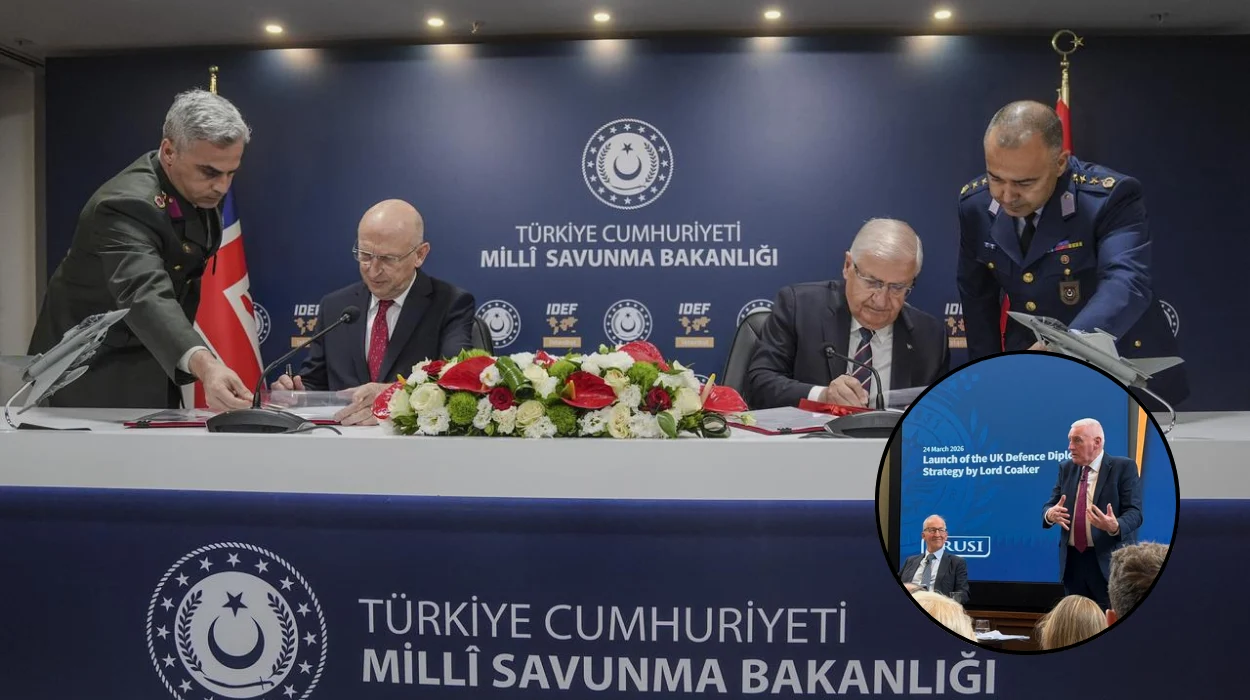
- UK Minister of State for Defense Lord Coaker stated “NATO is Türkiye,” emphasising Ankara’s pivotal role in the alliance during the launch of the UK’s 2026 Defense Diplomacy Strategy.
- Lord Coaker highlighted close UK-Türkiye engagement and the UK’s enormous respect for Türkiye’s contributions to NATO operations.
- Turkish Defense Minister Yasar Guler arrived in London on Tuesday, March 24, 2026, with the third implementation document of the Typhoon jet agreement set to be signed on Wednesday.
- Türkiye signed an £8 billion ($10.7 billion) deal last year with the UK to buy 20 Eurofighter Typhoon jets, following overcoming a German veto in 2024.
- Britain, a leading partner in the Eurofighter program, has been Türkiye’s most vocal supporter in the deal.
- Coaker expressed pleasure over the fighter jet deal and commitment to work closely with Türkiye to deliver shared objectives.
- On Iranian missile threats claimed by Israel, Coaker downplayed risks, stating there is “no intent on the part of Iran to target the UK.”
- Coaker stressed the “fundamental” US-UK relationship, dismissing concerns over political shifts in Washington and warning against public divisions that could benefit adversaries.
- The UK’s 2026 Defense Diplomacy Strategy introduces a “NATO First” doctrine, positioning NATO as the unshakeable foundation of British security while focusing on industrial resilience through ties with capable members like Türkiye.
- The strategy cites the Türkiye Typhoon deal as a “record-breaking” benchmark for future defense-industrial cooperation.
London (Britain Today News) March 24, 2026 – The United Kingdom has signalled a strategic pivot towards deeper defence-industrial ties with Türkiye, with Minister of State for Defense Lord Coaker declaring “NATO is Türkiye” on Tuesday amid Turkish Defense Minister Yasar Guler’s visit to London for the signing of a key Typhoon jet agreement document.
- Key Points
- What Did Lord Coaker Say About Türkiye’s Role in NATO?
- Why Is the Typhoon Jet Deal a Milestone for UK-Türkiye Ties?
- How Does the UK View Iranian Missile Threats to London?
- What Is the US-UK Relationship’s Role in UK’s Strategy?
- What Does the ‘NATO First’ Doctrine Entail?
- How Does Türkiye’s NATO Contribution Factor into UK Priorities?
- What Are the Broader Implications for UK Defence Diplomacy?
Lord Coaker made the remarks while launching the UK Ministry of Defence’s 2026 Defense Diplomacy Strategy, answering questions from Anadolu Agency. He underscored the close and regular engagement between London and Ankara, stating that the UK “respects enormously” Türkiye’s contributions to NATO operations. This comes as the two nations advance a landmark £8 billion deal for 20 Eurofighter Typhoon jets, with the third implementation document scheduled for signing on Wednesday.
What Did Lord Coaker Say About Türkiye’s Role in NATO?
Lord Coaker’s bold assertion that “NATO is Türkiye” captured headlines, positioning Ankara as indispensable to the alliance. As reported by Anadolu Agency journalists at the strategy launch event, Coaker elaborated:
“We work very closely with Türkiye. We understand its importance, and we respect it enormously for the work that it does within NATO. So that’s good. And we were very pleased with the fighter jet deal that’s been done… we will work with them to deliver our shared objectives.”
This relationship has rapidly ascended Whitehall’s priority list, with Coaker highlighting a recent fighter jet agreement as a milestone in defence-industrial cooperation. The UK, as a leading partner in the Eurofighter program, supported Türkiye through months of negotiations after overcoming a German veto on the sale in 2024. Last year, Türkiye finalised the £8 billion ($10.7 billion) purchase of 20 Typhoon jets, marking a significant boost to bilateral ties.
Turkish Defense Minister Yasar Guler’s arrival in London on Tuesday sets the stage for Wednesday’s signing of the third implementation document. This step advances delivery and integration, reinforcing practical collaboration beyond rhetoric.
Why Is the Typhoon Jet Deal a Milestone for UK-Türkiye Ties?
The Typhoon agreement exemplifies the UK’s shift towards linking defence diplomacy with industrial and economic growth. Britain’s vocal support proved crucial, navigating geopolitical hurdles like the 2024 German veto. As per details from the Ministry of Defence’s strategy document, the deal is hailed as “record-breaking,” serving as a benchmark for future engagements.
Coaker emphasised shared objectives in bolstering NATO’s capabilities.
“We were very pleased with the fighter jet deal,”
he told Anadolu Agency, pledging ongoing work to ensure its success. This pact not only equips Türkiye with advanced multi-role fighters but also stimulates UK defence exports, aligning with London’s economic priorities.
Guler’s visit underscores momentum. Arriving Tuesday, he represents Ankara’s commitment to diversifying its air fleet amid regional tensions. The third document signing will cover technical implementation, training, and logistics, ensuring seamless integration into Turkish forces.
How Does the UK View Iranian Missile Threats to London?
Addressing Israeli army claims that Iran possesses missiles capable of reaching London, Lord Coaker downplayed the immediate threat.
“Israel will have to know why it said what it said,”
he remarked to Anadolu Agency.
“But from our point of view, the important thing… is to reassure the public, is that there is no intent on the part of Iran to target the UK.”
This measured response reflects Whitehall’s approach to Middle East dynamics, prioritising de-escalation and public confidence. Coaker’s comments come amid heightened regional scrutiny, yet he focused on intent over capability, avoiding escalation.
What Is the US-UK Relationship’s Role in UK’s Strategy?
Coaker described the US-UK partnership as “fundamental” to strategic alignments, brushing off concerns over potential Washington shifts.
“The US-UK relationship is fundamental to the strategic partnerships that we have,”
he stated.
“The President is the President, and he will say what he says… It would be easy to say, well, he said this, you say that—that is not diplomacy.”
He warned that perceived divisions would benefit adversaries:
“I’ll tell you who would benefit from that. Our adversaries across the world, that’s what they want to hear. They’re not going to hear it from me.”
This stance reinforces transatlantic solidarity, integral to the NATO framework.
What Does the ‘NATO First’ Doctrine Entail?
At the core of the 2026 Defense Diplomacy Strategy lies the “NATO First” principle, reaffirming the alliance as the “unshakeable foundation” of British security. Yet, it introduces pragmatism by emphasising “industrial resilience” through deepened ties with capable members like Türkiye.
The document positions the Ministry of Defence as an “engine for growth,” explicitly citing the Typhoon deal as a model. This pivot integrates defence with economic goals, fostering supply chain robustness and technological edge within NATO.
How Does Türkiye’s NATO Contribution Factor into UK Priorities?
Türkiye’s role extends to operations across NATO’s spectrum, from deterrence to crisis management. Coaker’s praise—
“we respect it enormously”
—acknowledges Ankara’s strategic geography and military capabilities. Regular engagements ensure alignment on Black Sea security, counter-terrorism, and alliance burdensharing.
The UK’s strategy elevates such partnerships, viewing Türkiye as key to collective defence. This respects Ankara’s positions, including on Sweden and Finland’s accessions, while advancing mutual interests.
What Are the Broader Implications for UK Defence Diplomacy?
The 2026 strategy marks a holistic approach, blending diplomacy, industry, and security. By prioritising NATO while pursuing growth-oriented deals, London aims to counter rivals like Russia and China. Türkiye exemplifies this: a reliable ally with industrial potential.
Guler’s visit and the Typhoon milestone signal acceleration. As Coaker noted, close collaboration delivers “shared objectives,” from air superiority to economic resilience.
This deepening bond arrives amid global flux—Ukraine conflict, Middle East tensions, and US transitions. Yet, Coaker’s messaging remains steady: unity strengthens, division weakens.
In total, these developments position UK-Türkiye ties as a cornerstone of NATO’s future, with industrial pacts underpinning strategic trust. As the third document signs Wednesday, expect further announcements solidifying this pivot.