Key Points
- Iran’s Revolutionary Guard navy has warned of a “heavy assault” on US bases and vessels if Iranian ships are attacked.
- The warning follows US strikes on two Iranian oil tankers amid a fragile ceasefire.
- The United States insists the ceasefire remains in effect despite escalating incidents.
- Washington is awaiting Iran’s response to a proposal to end the war, reopen the Strait of Hormuz, and curb Tehran’s nuclear programme.
- Bahrain has arrested 41 individuals allegedly linked to Iran’s Revolutionary Guard.
- Iran has issued a direct warning to Bahrain over siding with US-backed actions.
- The Strait of Hormuz remains largely blocked, disrupting global energy flows and increasing fuel prices.
- US Central Command says it has intercepted dozens of vessels attempting to breach its blockade.
- Reports indicate casualties from a US strike on an Iranian-linked cargo vessel.
- Questions persist over the health and visibility of Iran’s Supreme Leader Mojtaba Khamenei.
- The UK and France are preparing a multinational maritime security mission in the region.
- Satellite imagery reveals a major oil spill near Iran’s Kharg Island export terminal.
- Global diplomatic efforts intensify, with Russia, Saudi Arabia, Egypt, Qatar, and Pakistan urging de-escalation.
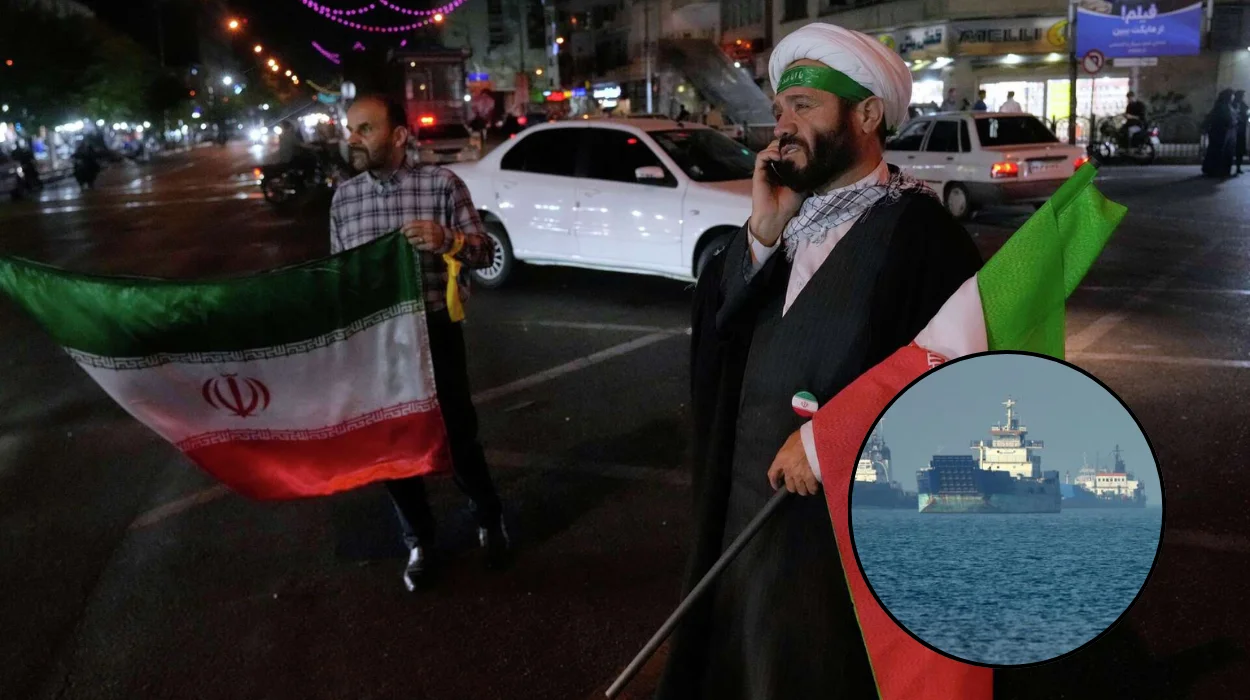
Iran (Britain Today News) May 9, 2026 – Iran has issued a stark warning to the United States, threatening a “heavy assault” on American military bases and naval assets in the region if Iranian oil tankers or commercial vessels come under attack, as tensions continue to simmer despite a fragile ceasefire agreement.
- Key Points
- What triggered Iran’s latest warning to the United States?
- Is the ceasefire between the US and Iran still holding?
- What is happening in the Strait of Hormuz?
- What role is Bahrain playing in the crisis?
- Have there been casualties in recent strikes?
- What is known about Iran’s leadership during the conflict?
- How are the UK and France responding to the situation?
- What diplomatic efforts are underway globally?
- What does this mean for global markets and stability?
What triggered Iran’s latest warning to the United States?
Iranian state television reported that the warning was delivered by the naval wing of the Islamic Revolutionary Guard Corps (IRGC) following US strikes on two Iranian oil tankers. According to coverage by international agencies including the Associated Press, the incident occurred on Friday, raising immediate concerns about the durability of the ceasefire.
The US military, as reported by unnamed Pentagon officials cited in Reuters and AP coverage, stated that its forces had “disabled” the tankers after they allegedly attempted to breach an American-imposed blockade of Iranian ports. Earlier the same day, US forces claimed they had thwarted attacks on three naval ships and carried out strikes on Iranian military facilities in the Strait of Hormuz.
Is the ceasefire between the US and Iran still holding?
Despite the escalation, US President Donald Trump has maintained that the ceasefire remains intact. As reported by multiple outlets including Reuters, President Trump reiterated that Washington is still pursuing a diplomatic resolution but warned that full-scale bombing could resume if Iran fails to agree to terms.
Those terms include reopening the Strait of Hormuz—a critical artery for global oil shipments—and rolling back Iran’s nuclear programme.
Iran, however, appears unmoved by US timelines. As reported by Esmail Baghaei, Iran’s foreign ministry spokesperson, via the state-run IRNA news agency, Tehran is not paying attention to imposed “deadlines” and continues to review Washington’s proposal at its own pace.
What is happening in the Strait of Hormuz?
The Strait of Hormuz remains at the centre of the crisis. Iran has largely blocked the strategic waterway since the outbreak of hostilities on February 28, significantly disrupting global energy markets.
According to US Central Command statements cited by AP, American forces have turned back 58 commercial vessels and disabled four ships since enforcing the blockade on April 13. The US has also released video footage showing fighter jets striking Iranian tankers.
Satellite imagery analysed by maritime intelligence firm Windward AI reveals an additional environmental concern. As reported by Associated Press journalist Jon Gambrell, a large oil spill—estimated at around 80,000 barrels—has been detected near Iran’s Kharg Island.
Ami Daniel, chief executive of Windward AI, stated that the spill spans approximately 27 square miles and could reach the coastlines of the UAE, Qatar, or Saudi Arabia within weeks. The cause remains unclear, with possibilities including technical failure or military action.
What role is Bahrain playing in the crisis?
Bahrain has emerged as a key flashpoint in the regional tensions. The country, which hosts the US Navy’s Fifth Fleet, announced the arrest of 41 individuals allegedly linked to Iran’s Revolutionary Guard.
According to Bahrain’s Ministry of Interior, investigations are ongoing. However, no detailed evidence has been publicly disclosed.
Rights organisations, as cited in international reporting including Al Jazeera and AP, have raised concerns that Bahrain may be using the broader conflict as justification for domestic crackdowns, particularly given its majority Shiite population under Sunni leadership.
Iran has responded sharply. Ebrahim Azizi, head of the Iranian parliament’s national security commission, warned via social media that Bahrain would face “severe consequences” for supporting US-led initiatives.
Have there been casualties in recent strikes?
Yes, though details remain limited. A news agency affiliated with Iran’s judiciary reported that a US strike hit a cargo vessel overnight, killing at least one sailor and injuring ten others.
As noted in Associated Press reporting, it remains unclear whether the vessel was among the two tankers the US acknowledged striking. The Pentagon has not provided further clarification on this specific incident.
What is known about Iran’s leadership during the conflict?
Speculation continues to surround the status of Iran’s Supreme Leader Mojtaba Khamenei, who has not appeared publicly since the conflict began.
Mazaher Hosseini, described in Iranian state-linked reporting as affiliated with the office of the former supreme leader, stated at a pro-government gathering that Mr Khamenei is in “complete health” and will eventually appear in public.
Analysts cited in regional media suggest such statements may be aimed at countering rumours about his wellbeing, which have intensified due to the absence of verified images or recordings.
How are the UK and France responding to the situation?
Britain and France are actively preparing for a potential maritime security operation in the region. The UK Ministry of Defence confirmed it is deploying HMS Dragon to the Middle East.
According to the MoD statement reported by BBC News defence correspondents, the destroyer will “pre-position” itself to support a joint UK-French initiative aimed at safeguarding commercial shipping routes once conditions stabilise.
France has also mobilised its aircraft carrier strike group to the Red Sea. Both nations are leading discussions with dozens of countries to form a coalition focused on restoring freedom of navigation in the Strait of Hormuz.
However, officials stress that the mission will only proceed once a “sustainable ceasefire” is firmly in place and shipping risks are reduced.
What diplomatic efforts are underway globally?
Diplomatic activity has intensified as global powers seek to prevent further escalation.
Russia’s foreign ministry, as reported by TASS and echoed in Reuters coverage, has called alongside Saudi Arabia for continued negotiations to achieve a long-term settlement.
Egypt and Qatar have also reaffirmed their commitment to diplomacy. According to a readout cited by Al Jazeera, Egyptian Foreign Minister Badr Abdelatty and Qatari Prime Minister Sheikh Mohammed bin Abdulrahman Al Thani emphasised that dialogue remains the only viable path forward.
Pakistan has taken an active mediating role. Prime Minister Shehbaz Sharif stated, as reported in regional media briefings, that Islamabad has been in continuous contact with both Washington and Tehran “day and night” to preserve the ceasefire and advance peace talks.
What does this mean for global markets and stability?
The ongoing disruption in the Strait of Hormuz continues to reverberate across global energy markets. Oil prices have surged due to supply uncertainty, while shipping routes remain volatile.
The combination of military confrontation, environmental risks such as the Kharg Island spill, and geopolitical manoeuvring has created a highly unstable environment.
While the ceasefire technically holds, the repeated incidents and escalating rhetoric suggest it remains fragile, with any miscalculation potentially triggering a broader conflict.