Key Points
- EU officials are preparing to allow the UK to maintain its ban on live animal exports in a new agricultural agreement.
- The concession is seen as a political boost for Prime Minister Keir Starmer amid internal Labour Party pressure.
- The proposed agreement forms part of a broader UK-EU reset, including emissions trading and youth mobility.
- Negotiations are ongoing, with no final confirmation from the European Commission.
- The UK government claims the deal could deliver up to £5.1 billion in economic benefits.
- The ban on live animal exports was introduced in 2024 under former Prime Minister Rishi Sunak.
- Animal welfare groups strongly support retaining the ban, citing concerns over cruelty in transport.
- Legal experts say a specific exemption is required for the UK to keep stricter rules than the EU.
- Disagreements remain, particularly over tuition fees for EU students under youth mobility proposals.
- The UK has already made concessions on other welfare issues, including foie gras and fur imports.
Brussels (Britain Today News) May 11, 2026 – The European Union is preparing to grant the United Kingdom a significant concession in ongoing negotiations over a post-Brexit agricultural agreement, potentially allowing Britain to retain its ban on live animal exports. The development is being viewed as a key political win for Prime Minister Keir Starmer as he attempts to stabilise his leadership and strengthen ties with Brussels.
- Key Points
- What concession is the EU offering to the UK?
- Why is the live animal export ban significant?
- How does this affect Keir Starmer politically?
- What is the UK government’s stance on the negotiations?
- What are the remaining obstacles in UK-EU talks?
- How have animal welfare groups responded?
- What compromises has the UK already made?
- What happens next in the negotiations?
What concession is the EU offering to the UK?
European officials involved in the negotiations have indicated that the UK could be permitted to maintain its prohibition on exporting live animals for slaughter or fattening, despite the EU itself not enforcing such a restriction.
This proposed carve-out would allow Britain to uphold stricter animal welfare standards without breaching the terms of a joint sanitary and phytosanitary (SPS) agreement. Sources on both sides of the negotiations suggest that the EU is willing to accommodate this divergence, provided it does not disrupt trade across member states.
One Brussels-based source pointed to the existing framework agreed between the UK and EU in May last year, noting that exemptions are possible where national rules exceed EU standards. According to this interpretation, the UK’s ban would not disadvantage EU farmers, as it applies solely within British jurisdiction.
Why is the live animal export ban significant?
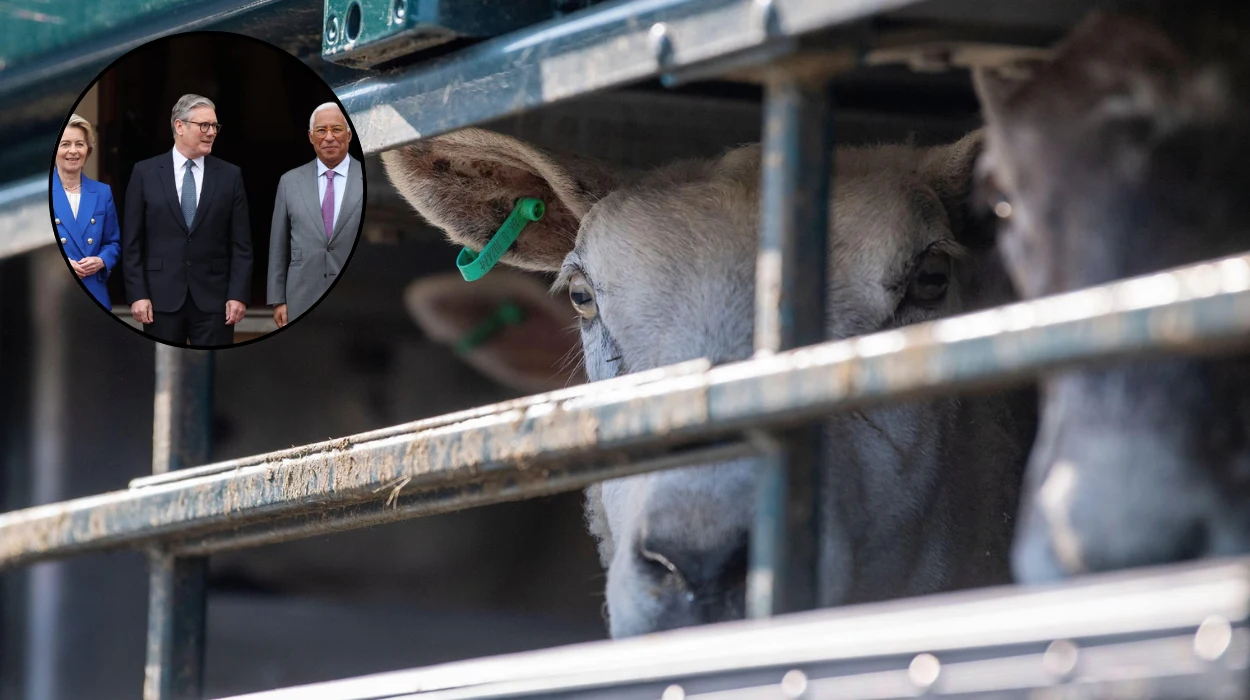
The issue of live animal exports has long been contentious in both the UK and EU, with campaigners arguing that transporting animals over long distances leads to overcrowding, dehydration, exhaustion, and significant distress.
The UK introduced its ban in 2024 under then-Prime Minister Rishi Sunak, who described it as an example of
“capitalising on post-Brexit freedoms”
while reinforcing Britain’s reputation as a global leader in animal welfare.
Legal experts have emphasised that without explicit permission from the EU, the UK could be forced to abandon the ban under a harmonised regulatory framework. Catherine Barnard, Professor of European Law at the University of Cambridge, explained that a clear exemption is essential.
As reported by The Guardian, Catherine Barnard stated:
“There would need to be an express carve-out in the SPS agreement. People in the UK care very much about this.”
How does this affect Keir Starmer politically?
The timing of the concession is particularly significant for Keir Starmer, who is currently facing mounting pressure from within the Labour Party following disappointing local election results.
The Prime Minister has framed the evolving EU negotiations as a cornerstone of his leadership, contrasting his approach with that of previous Conservative governments. During a speech described as pivotal to his premiership, Starmer emphasised his commitment to rebuilding ties with Europe.
As reported by The Guardian, Keir Starmer stated:
“The last government was defined by breaking our relationship with Europe; this Labour government will be defined by rebuilding our relationship with Europe.”
The agricultural deal is expected to be one of three central components of a broader UK-EU agreement, alongside arrangements on emissions trading and youth mobility. Securing tangible progress in these areas is seen as critical for Starmer’s political survival.
What is the UK government’s stance on the negotiations?
The UK government has remained cautious in its public comments, emphasising that negotiations are still ongoing. However, officials have expressed confidence that an agreement can be reached without compromising key national policies.
A British government spokesperson highlighted the economic potential of the deal while reinforcing the importance of maintaining domestic standards.
The spokesperson said:
“We have a strong track record of delivering for animal welfare and the EU has accepted that there needs to be a number of areas where we need to retain our own rules.”
The spokesperson added:
“We are negotiating those now and won’t provide a running commentary on negotiations. What we will do is secure a deal that could be worth up to £5.1bn for the British economy and delivers the best outcome for the British people.”
What are the remaining obstacles in UK-EU talks?
Despite progress on agricultural issues, broader negotiations between the UK and EU remain complex. One of the primary sticking points is a dispute over university tuition fees for European students as part of a proposed youth mobility scheme.
This disagreement has slowed the overall pace of talks, even as negotiators suggest that the agricultural component may be easier to finalise.
Officials on both sides acknowledge that while compromises are being made, certain areas remain politically sensitive, particularly where domestic policies intersect with EU regulatory frameworks.
How have animal welfare groups responded?
Animal welfare organisations have strongly welcomed the prospect of the UK retaining its ban on live animal exports, describing it as a crucial safeguard for animal rights.
David Bowles, Head of Public Affairs at the RSPCA, stressed the importance of preserving the ban and extending protections across related areas.
As reported by The Guardian, David Bowles said:
“It is vital – in the interests of these animals – that this successful ban is protected.”
He added that securing an exemption would also help maintain other welfare measures, including restrictions on puppy imports and the use of cages in farming.
What compromises has the UK already made?
While the potential concession on live animal exports represents a win for the UK, it comes alongside notable compromises in other areas of animal welfare policy.
Previous negotiations revealed that the EU is likely to block the UK from implementing bans on the import of foie gras and fur products—both of which had been part of Labour’s pre-election commitments.
Environment Secretary Emma Reynolds defended these concessions, arguing that the broader economic and regulatory benefits of the agreement outweigh the drawbacks.
As reported by The Guardian, Emma Reynolds said:
“The prize is big. We can talk about the detail, but the overall prize here is to bring down the barriers at the border.”
What happens next in the negotiations?
The UK and EU are expected to continue discussions in the lead-up to a major summit scheduled for this summer, where the final agreement could be formally announced.
Negotiators will need to resolve outstanding issues while ensuring that any deal is politically acceptable on both sides. For the UK, this includes balancing economic benefits with domestic policy priorities, particularly in areas such as animal welfare.
For the EU, the challenge lies in maintaining regulatory consistency across member states while accommodating a non-member seeking closer alignment.
The outcome of these talks will likely shape the next phase of UK-EU relations, marking a potential shift away from the tensions that have defined the post-Brexit period.