Key Points
- United States Defense Secretary Pete Hegseth compared modern irregular maritime migration to the Axis threat of World War II during an official address in France.
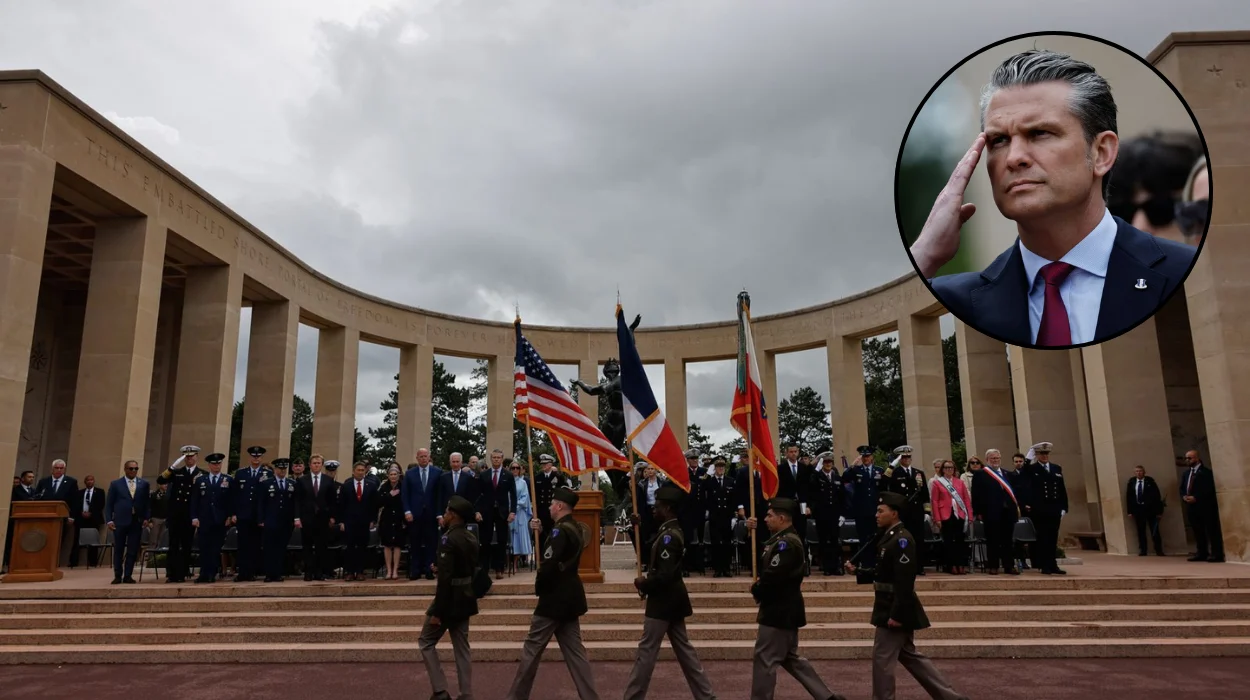
- The comments were delivered at the Normandy American Cemetery during the 82nd-anniversary events honoring Allied forces who fought on 6 June 1944.
- Hegseth’s rhetoric directly aligned with a wider US National Security Strategy paper asserting that Europe faces “civilisational erasure.”
- The speech followed public claims by US Vice President JD Vance, who blamed the murder of British student Henry Nowak on a migrant “invasion.”
- Downing Street officially hit back at the White House interventions, condemning foreign actors for seeking to interfere in British democracy.
- The broader, solemn D-Day commemorative events across Normandy saw just six surviving British veterans in attendance at key memorial locations.
Normandy (Britain Today News) June 6, 2026 – United States Defense Secretary Pete Hegseth has sparked an international diplomatic dispute by warning that modern Europe faces an “invasion of dangerous ideologies” arriving by sea. Speaking during the official 82nd-anniversary commemorations of the D-Day landings in northwestern France, Hegseth explicitly linked contemporary irregular migration networks to the historic maritime theater where Allied forces died to liberate Western Europe from Nazi occupation. The speech, delivered before rows of military graves at the Normandy American Cemetery, marks an aggressive escalation in the White House’s rhetorical posture toward its traditional European partners, directly echoing domestic nationalist talking points regarding borders, sovereignty, and demographic shifts.
- Key Points
- What Did Pete Hegseth Say on the Beaches of Normandy?
- How Does the Speech Reflect White House Views on Europe?
- What is the “Civilisational Erasure” Warning in US Strategy?
- Why Did JD Vance Intervene in a British Murder Trial?
- What Statements Did the US Vice President Issue on the Case?
- How Did the State Department Describe “Two-Tiered Policing”?
- How Did Downing Street Respond to the US Claims?
- How Did Allied Personnel Commemorate the D-Day Anniversary?
- Which Key Figures of the 1944 Landings Were Honored?
- What are the True Human Costs of the Normandy Campaign?
- Who are the Final Six Surviving British Veterans Present?
- How Will the Transatlantic Security Alliance Handle This Tension?
The extraordinary remarks from the Pentagon chief have fundamentally altered the tone of what is traditionally a solemn, non-partisan display of transatlantic solidarity. By using the setting of the 1944 liberation to critique contemporary European domestic border policies, Hegseth has aligned the top tier of American defense leadership with controversial geopolitical assessments circulating within Washington. The comments have drawn sharp condemnation from European allies, who view the statements as a historical distortion and an unwarranted violation of diplomatic decorum during a sensitive memorial sequence.
What Did Pete Hegseth Say on the Beaches of Normandy?
As documented in official transcripts, United States Defense Secretary Pete Hegseth used his platform at the Normandy American Cemetery in Colleville-sur-Mer to draw a direct line between the military threats of World War II and contemporary maritime migration. Addressing an audience that included active-duty military personnel, international delegates, and some of the last surviving veterans of the conflict, Hegseth suggested that the continent’s current political trajectory threatens to undermine the very freedoms secured by the blood of Allied soldiers more than eight decades ago.
“Sadly, today, different European beaches are stormed by different, dangerous ideologies. Beaches in Spain, Italy, Greece and Bulgaria, boats and men arrive,”
Hegseth stated during his address.
The Defense Secretary then pivoted to a direct rhetorical challenge aimed squarely at European heads of state, questioning their resolve to defend their southern maritime borders.
“When will European capitals do something about that invasion or is it too late? I pray not, and I believe not,”
Hegseth added.
How Does the Speech Reflect White House Views on Europe?
While Hegseth avoided using the explicit word “immigration” during the formal text of his speech, political analysts note that his vocabulary precisely mirrors the strategic doctrines enforced by the current executive branch in Washington. The Trump administration has consistently maintained a highly critical stance toward European governance, repeatedly accusing the European Union and individual national governments of failing to secure their external borders, maintaining weak domestic defense architectures, and hiding behind bureaucratic red tape.
Furthermore, Washington has routinely claimed that mainstream European political establishments are engaging in systemic “censorship” of nationalist and far-right voices to deliberately block them from achieving institutional power. Hegseth’s focus on southern European arrivals is viewed by diplomatic observers as an intentional endorsement of populist movements in Italy, Spain, and Greece that have capitalized on anti-migrant sentiment to challenge the continent’s centrist political consensus.
What is the “Civilisational Erasure” Warning in US Strategy?
The ideological foundations of Hegseth’s speech are firmly rooted in official American policy documentation. In a comprehensive US National Security Strategy document issued late last year, the White House explicitly warned that contemporary Europe is currently undergoing a process of “civilisational erasure.” The framework paper argued that unless European leaders enact an immediate and severe course correction regarding their demographic and cultural policies, the continent will cease to exist as a viable, culturally coherent, or reliable security ally to the United States.
The strategy document went as far as to suggest that without radical policy changes, certain NATO members would transition to majority non-European populations within a few decades, potentially transforming traditional allies into geopolitical liabilities. Hegseth’s remarks at Normandy served to operationalize this policy document, using the visual backdrop of military sacrifice to emphasize a thesis of unavoidable cultural decline across European capitals.
Why Did JD Vance Intervene in a British Murder Trial?
The diplomatic friction between Washington and European capitals had already intensified significantly just one day prior to Hegseth’s address. On Friday, United States Vice President JD Vance triggered a severe diplomatic row with London by publicly intervening in the sensitive aftermath of a high-profile British criminal trial. Vance used the tragic murder of 18-year-old Southampton finance student Henry Nowak to launch a broad assault on European migration patterns, despite the factual realities of the domestic court case.
Vance explicitly blamed the teenager’s death on an unrestricted influx of foreign nationals into the United Kingdom. This intervention occurred despite public court records demonstrating that Nowak’s convicted killer, 23-year-old Vickrum Digwa, was a born and raised British citizen. The Vice President’s commentary bypassed the specific legal parameters of the case to advance a broader ideological narrative.
What Statements Did the US Vice President Issue on the Case?
The specific rhetoric utilized by the American Vice President sought to frame the local British tragedy as an existential warning for the entirety of Western civilization. Writing extensively on his official communications channels, Vance described the circumstances surrounding the student’s death as both a systemic failure of state institutions and an inevitable consequence of demographic shifts favored by regional political elites.
Vance asserted that Henry Nowak would
“still be alive today… if the last few generations of European elites had stood their ground against the politics of self-hatred and the mass invasion of migrants, many of whom despise the West and the people who love it.”
The Vice President further characterized the teenage victim’s death as a symbolic event, stating that the student passed away
“the same way a civilization dies: abandoned, handcuffed by authorities who neither trusted nor cared for him.”
How Did the State Department Describe “Two-Tiered Policing”?
Compounding the diplomatic friction, the United States State Department issued an extraordinary parallel commentary regarding the British judiciary and law enforcement structures. Following the public release of police body-worn camera footage showing officers initial handling of the dying student—who had been erroneously restrained after his attacker falsely claimed to be the victim of a racial assault—the State Department issued a formal warning to its close ally.
The official statement from the State Department declared that
“ideological conditioning and two-tiered policing are glaring symptoms of civilizational decline”
within Western democracies. The agency insisted that the principle of equal application of the law must be aggressively maintained across the West, openly implying that British police operations had been compromised by domestic political correctness at the expense of public safety.
How Did Downing Street Respond to the US Claims?
The dual interventions from the State Department and Vice President Vance provoked an immediate, sharp response from the highest levels of the British government. A spokesperson for Downing Street issued a formal reprimand directed at Washington, explicitly demanding respect for both the grieving Nowak family and the democratic sovereignty of the United Kingdom. The Prime Minister’s office rejected the American assertions, noting that local political figures were attempting to exploit a domestic tragedy for foreign political gain.
The official response from Downing Street directly accused the American officials of
“trying to interfere in our democracy and seeking to stir up division on our streets.”
The Prime Minister’s administration emphasized that the victim’s family had explicitly requested that the tragedy not be used as a political football to generate further hatred or social tension, adding that
“our politics should bring people together even in the most terrible of circumstances.”
How Did Allied Personnel Commemorate the D-Day Anniversary?
While senior defense officials engaged in sharp political arguments, the actual physical sites of the 1944 D-Day landings hosted deeply moving, traditional ceremonies of remembrance. In stark contrast to the geopolitical rhetoric echoing from the American cemetery, the French coastline saw hundreds of active military personnel, local citizens, and school children gather to pay tribute to the specific tactical achievements of the historical liberation force.
At Juno Beach, French schoolchildren stood alongside serving military members and traditional pipers to conduct a march across the sand precisely at H-Hour—the exact historical moment when the first waves of British and Allied servicemen were deployed into the German defensive line. The tribute focused entirely on the raw human cost and the immense logistical operation required to breach Nazi-occupied France.
Which Key Figures of the 1944 Landings Were Honored?
The formal remembrance ceremonies placed heavy emphasis on the strategic commanders who engineered the complex amphibious assault that turned the tide of the Second World War. At the British Normandy Memorial, located in Ver-sur-Mer, key military leaders were singled out for institutional honors, most notably British Field Marshal Bernard Montgomery, who held operational command over all Allied ground forces during the initial invasion of northern France.
The ceremonies meticulously detailed how Montgomery’s tactical planning successfully consolidated nearly 160,000 Allied troops on the beaches of Normandy on 6 June 1944. The historical tributes served to remind the public of the scale of international cooperation required to execute the operation, which ultimately cost the lives of 4,414 confirmed Allied troops on the first day of fighting alone.
Explore More about World:
Kuwait intercepts seven ballistic missiles in latest defense operation
European Leaders Macron, Starmer and Merz Set for London Talks with Zelenskiy
What are the True Human Costs of the Normandy Campaign?
The historical reflections delivered at the Bayeux War Cemetery—the largest Commonwealth Second World War cemetery in France—provided a stark statistical reminder of the catastrophic violence that defined the summer of 1944. Military historians utilize the anniversary to emphasize that the initial D-Day beach landings were merely the opening salvo in a prolonged, grinding campaign to break the German army’s grip on Western Europe.
While over 4,400 Allied soldiers died on day one, the subsequent broader Battle of Normandy resulted in the loss of more than 73,000 Allied lives, with an additional 153,000 personnel wounded in action. On the defensive side, historians estimate that between 4,000 and 9,000 German soldiers were killed, wounded, or listed as missing during the initial June 6 landings alone, illustrating the immense cost of the conflict.
Who are the Final Six Surviving British Veterans Present?
The 82nd-anniversary commemorations were marked by a profound sense of shifting generations, as officials confirmed this year saw the smallest assembly of actual Normandy veterans since the permanent British memorial opened its doors in 2021. Due to the natural passage of time, only six confirmed British veterans were physically capable of making the journey across the English Channel to attend the formal proceedings alongside UK Defence Secretary John Healey.
The six remaining British veterans who stood on the historic ground were explicitly named and honored by the assembled military delegations:
- Ken Hay, who survived the fierce infantry battles in the days following the beach assault.
- Richard Brock, who served within the naval support fleets that secured the English Channel channels.
- Ken Benbow, who participated in the crucial logistical chains that kept the frontline supplied.
- Henry Rice, who landed on the beaches during the secondary reinforcement waves.
- Marjorie Hanson, who contributed to the critical wartime medical and communications networks.
- Roy Horner, who fought through the hedgerows of Normandy during the push toward Bayeux.
How Will the Transatlantic Security Alliance Handle This Tension?
The stark contrast between the solemn, historic preservation of the veterans’ legacy and the sharp, contemporary political rhetoric delivered by Secretary Hegseth highlights a growing ideological rift within the NATO alliance. While European defense officials like Britain’s John Healey focused their public remarks entirely on honoring historical sacrifices and reinforcing current institutional partnerships, the Pentagon’s choice to use Normandy as an ideological platform suggests a fundamental reassessment of America’s strategic relationship with Europe.
Diplomats in Paris, London, and Berlin are reportedly evaluating the long-term implications of Hegseth’s speech, particularly the explicit demand for European capitals to alter their border and domestic policing strategies or risk losing American security guarantees. As the last generation of World War II veterans fades from the public stage, the shared historical narrative that has anchored the transatlantic alliance for nearly a century is increasingly being reinterpreted through the lens of modern nationalist and populist geopolitics.