Key Points
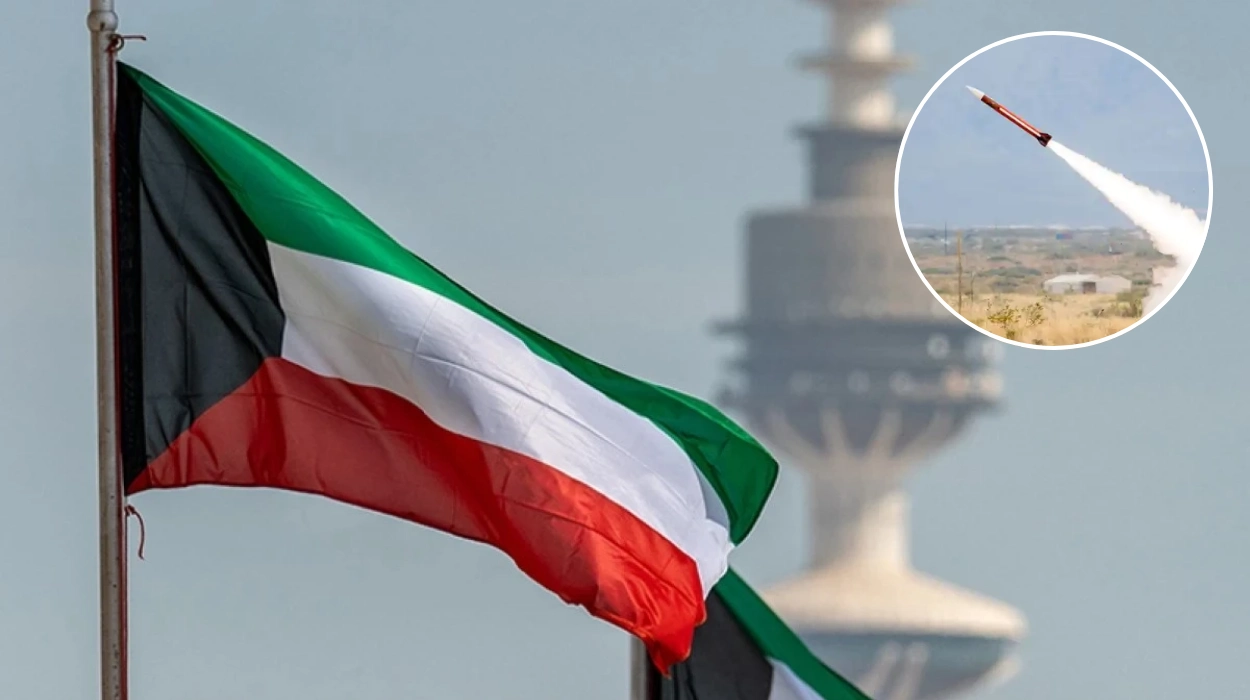
- The Kuwaiti Ministry of Defence detected and successfully downed seven hostile Iranian ballistic missiles within its domestic sovereign airspace.
- Defensive interceptions occurred directly over several densely populated residential areas, causing mid-air explosions heard across major metropolitan areas.
- Official military statements confirm that the defensive actions resulted in no civilian or military casualties, though scattered falling debris caused significant material damage across multiple locations.
- The Iranian missile barrage followed a high-stakes encounter hours prior, where the United States Central Command shot down four Iranian one-way attack drones over the Strait of Hormuz.
- Beyond Kuwait, neighboring Bahrain was simultaneously targeted by Iranian aerial assets, leading to the activation of nationwide air raid sirens in Manama.
- Intelligence indicators point to the targeted nature of the strikes, which were directed toward regional military hubs, specifically civilian-adjacent areas housing foreign military footprints like the Ali Al Salem Air Base.
- The Kuwaiti Ministry of Foreign Affairs strongly condemned the unprovoked cross-border military strikes, labeling the operation a dangerous escalation and an egregious breach of state sovereignty.
Kuwait (Britain Today News) June 6, 2026 — In a major escalation of hostilities rippling across the Gulf region, the Kuwaiti Ministry of Defence announced on Saturday that its domestic air defence grids successfully engaged and downed seven hostile ballistic missiles launched directly from Iran. The defensive multi-battery engagements took place over several densely populated residential sectors within the sovereign territory of Kuwait. Falling missile fragments and shrapnel from the high-altitude defensive interceptions scattered across distinct geographical sectors, yielding visible material destruction but miraculously causing zero civilian or military casualties.
- Key Points
- What Caused the Sudden Activation of Kuwaiti Air Defence Systems?
- How Did Official Military Spokespersons Describe the Impact of the Attacks?
- What Strategic Role Did United States Central Command Play in the Interceptions?
- Where Exactly Did the Falling Interception Debris Land Within Kuwait?
- Why Was Neighboring Bahrain Simultaneously Targeted During the Strike?
- What Technical Details Have Emerged Regarding the Intercepted Missiles?
- How Has the Kuwaiti Ministry of Foreign Affairs Responded Diplomatically?
- What Events Prior to the Missile Strike Triggered the Escalation?
- How Are Local Communities Coping with the Structural and Material Damage?
- What Are the Long-Term Implications for Gulf Airspace and Trade Corridors?
- How Do Regional Security Experts View the Threat of Future Attacks?
The military escalation emerged just hours after the United States Central Command launched targeted strikes against Iranian maritime radar facilities. This development further complicates the precarious security environment of the world shipping corridors running through the Strait of Hormuz. It has triggered immediate, synchronised emergency protocols across adjacent Gulf Cooperation Council states.
Military command structures activated active interception measures the moment the tracking systems identified the incoming ballistic vectors. Colonel Saud Atwan, the official spokesperson for the Kuwaiti Ministry of Defence, provided the preliminary administrative assessment regarding the morning’s kinetic events. He confirmed that while the local populace experienced immense panic due to the structural shockwaves of the interceptions, structural damage remained confined to public assets and civilian property.
As the situation developed rapidly throughout the day, domestic security detachments and emergency response teams were deployed to three separate impact zones where substantial pieces of metal debris from the defensive systems had breached the ground level. The synchronised missile barrages targeted both Kuwaiti sovereign boundaries and neighboring Bahraini defensive perimeters. This highlights a critical shifting point in the regional conflict, moving away from localized proxy clashes toward direct, state-on-state kinetic confrontations.
What Caused the Sudden Activation of Kuwaiti Air Defence Systems?
The sudden midnight mobilization of Kuwait’s defensive network came after advanced long-range early warning radars picked up multiple supersonic signatures originating from deep within Western Iran. These signatures crossed into regional international air channels before altering paths directly toward urban zones. The General Staff of the Kuwaiti Armed Forces moved to its highest defensive alert tier within minutes, instructing regional anti-missile installations to engage the incoming threats before they could descend into low-altitude civilian airspaces.
Local defense coordinates worked alongside regional tracking networks maintained by international coalition forces stationed in the sector to guarantee continuous tracking data. The rapid progression from detection to kinetic engagement underscored the high level of readiness maintained by regional forces, who have spent months bracing for potential cross-border horizontal escalations.
Regional military monitors logged the launch sequence as a direct state-ordered action, bypassing traditional regional non-state networks. The technical profile of the intercepted assets indicates they belonged to advanced classes of short-to-medium-range solid-fuel ballistic missiles. These models are capable of achieving high terminal velocities designed to overwhelm standardized point-defense installations.
Residents across various administrative governorates in Kuwait described hearing a series of thunderous booms that rattled window structures and shook structural foundations. This prompted immediate public anxiety before the Ministry of Defence released explanatory safety updates through public broadcast mediums.
How Did Official Military Spokespersons Describe the Impact of the Attacks?
The official explanation of the morning’s defensive actions was delivered directly through state channels to prevent the spread of unsourced misinformation and public alarm across the internet. Military leaders sought to assure both domestic citizens and international observers that the country’s protective layers remained fully intact despite the scale of the incoming threat.
The spokesperson for the Kuwaiti Ministry of Defence, the structural performance of the active defense systems worked as designed to protect civilian lives. Colonel Saud Atwan stated that:
“The Iranian aggression resulted in material damage but no casualties. Earlier today, Kuwaiti authorities responded to three unusual reports of debris falling from defensive interceptions.”
The official statement aimed to clarify that the structural damage seen in residential areas was caused by falling structural fragments rather than direct, unhindered missile impacts. Emergency teams were deployed to secure the drop zones, retrieve the metallic debris for metallurgical evaluation, and ensure no unexploded kinetic subcomponents posed lingering threats to nearby communities.
What Strategic Role Did United States Central Command Play in the Interceptions?
The cross-border missile engagement cannot be evaluated in isolation from the broader maritime and aerial security maneuvers carried out by international coalition forces operating throughout the Persian Gulf. United States Central Command, headquartered regionally in Bahrain, was heavily involved in the wider defensive matrix that neutralized the multi-vector offensive operations launched by Iran’s military branches.
Military analysts confirmed that American defense networks worked in close coordination with regional partners during the engagement. The United States military command noted that:
“Iran fired seven ballistic missiles toward Kuwait and Bahrain hours after U.S. Central Command shot down four Iranian one-way attack drones that were launched toward the Strait of Hormuz.”
The coordination between local ground batteries and the United States Navy’s Aegis-equipped vessels stationed in the Gulf provided a layered defensive shield. This network tracked the incoming missiles from their initial ascent phases through to terminal destruction.
Central Command officials emphasized that their rapid intervention was necessary to protect international shipping lanes and alliance forces operating throughout the theater.
Where Exactly Did the Falling Interception Debris Land Within Kuwait?
The physical aftermath of the high-altitude air battles became visible shortly after sunrise, as local security forces cordoned off several sites within urban sectors where large metallic fragments had breached civilian spaces. Initial recovery operations focused on three distinct locations within residential districts, where debris had sliced through building roofs, crushed parked vehicles, and cratered neighborhood streets.
Military engineers and civil defense personnel moved quickly to isolate the impact zones to prevent civilian access. The technical data provided by field recovery units showed that the debris consisted of structural fragments from the outer casings of the Iranian missiles, mixed with the kinetic components of the localized air defense missiles.
Local police services set up security perimeters extending several blocks around the main impact sites. This allowed specialized forensic units to log structural serial numbers and confirm the specific weapon profiles used in the offensive action.
Why Was Neighboring Bahrain Simultaneously Targeted During the Strike?
The scope of the Iranian missile strike extended past Kuwait’s borders, forming a multi-pronged assault that also targeted the island kingdom of Bahrain. This coordinated approach indicates a broader strategic objective aimed at striking key locations linked to international maritime operations and regional foreign defense support.
The dual-nation targeting strategy prompted immediate activation of national defense networks across the lower Gulf region. The publication noted that:
“Bahrain activated air raid sirens and instructed residents to move to the nearest safe location and follow official guidance. In a strongly worded statement, Bahrain’s foreign ministry condemned the attacks and accused Iran of violating the sovereignty of both Gulf nations.”
The simultaneous targeting of Manama and Kuwait City shows a calculated effort by Iranian military planners to pressure states that host western military logistics bases.
By pushing Bahrain to activate its national warning sirens and order citizens into underground shelters, the strike disrupted normal civic operations and elevated regional anxieties to levels not seen in decades.
What Technical Details Have Emerged Regarding the Intercepted Missiles?
Military aviation specialists and weapons analysts have started breaking down the technical parameters of the engagement to assess the operational readiness of the defense systems deployed throughout the region. The high interception success rate highlights the significant upgrades made to regional air defense networks over the past several years.
Central Command’s tracking systems gathered extensive telemetry data during the flight paths of the incoming targets. The military agency stated that:
“Initial assessments indicate six of the missiles launched by Iran were intercepted and a seventh did not reach its intended target. There are currently no reports of harm to U.S. personnel, and Iranian claims of damaging U.S. 5th Fleet headquarters in Bahrain are false.”
The technical breakdown reveals that the majority of the incoming threats were neutralized during their terminal descent phase.
The single missile that failed to reach its target area reportedly suffered an in-flight structural breakdown over unpopulated waters, reducing its potential impact on regional infrastructure.
How Has the Kuwaiti Ministry of Foreign Affairs Responded Diplomatically?
On the diplomatic front, the unprovoked missile strikes have sparked sharp responses from regional political leaders, who view the direct targeting of their home territories as an unacceptable shift in regional dynamics. The Kuwaiti government moved quickly to mobilize regional diplomatic channels, working to establish a unified front against further cross-border operations.
The Kuwaiti Ministry of Foreign Affairs issued a strong condemnation through its formal state media networks. The ministry’s diplomatic statement clarified that:
“The attacks constitute a dangerous escalation and a direct violation of the foundational tenets of international law and state sovereignty.”
Kuwaiti diplomats have initiated emergency talks with fellow member states of the Gulf Cooperation Council to coordinate a joint response at the United Nations.
The state’s diplomatic message emphasizes that while Kuwait maintains a neutral foreign policy posture, it will take all necessary measures to defend its home territory and population from external military operations.
Explore More about World:
European Leaders Macron, Starmer and Merz Set for London Talks with Zelenskiy
Paris Peace Forum Opens in Rabat, Urging the World to Turn Crises Into Opportunities
What Events Prior to the Missile Strike Triggered the Escalation?
The sudden outbreak of missile fire was the result of building friction between international naval forces and Iranian military branches over control of regional shipping corridors. The immediate trigger occurred a day earlier, when western naval forces intercepted an unauthorized deployment of aerial drones near global trade routes.
The direct missile strikes were launched after coalition forces destroyed four Iranian one-way attack drones over the Strait of Hormuz. The network explained that:
“The attack drones posed an immediate threat to regional maritime traffic. In response, U.S. forces also struck coastal radar sites in Goruk and on Qeshm Island.”
The destruction of these coastal surveillance installations disrupted Iran’s real-time monitoring of the naval channels.
This prompt response led the Islamic Revolutionary Guard Corps to bypass proxy networks and launch direct ballistic missile strikes against locations hosting international logistics support infrastructure.
How Are Local Communities Coping with the Structural and Material Damage?
While the lack of casualties brought immediate relief to the area, the reality of managing widespread material damage across urban sectors has presented logistical challenges for local municipal authorities. Structural repair crews and utility teams worked through the night to restore power grids and clear damaged roadways blocked by fallen debris.
Neighborhood groups in the affected sectors have focused on assessing structural impacts on private residential properties. Municipal evaluation teams noted that several apartment complexes suffered structural damage from the force of the falling debris.
Local civil defense teams have established temporary support centers to assist families whose homes require safety inspections before they can be re-occupied.
What Are the Long-Term Implications for Gulf Airspace and Trade Corridors?
The expansion of kinetic military activity into the airspace of non-combatant Gulf states has raised serious concerns within the international aviation and maritime commerce industries. Commercial airlines operating routes across Europe, Asia, and Africa have initiated sweeping adjustments to their flight patterns to avoid the upper airspace sectors of the northern Persian Gulf.
Regional civil aviation authorites ordered temporary ground stops and route diversions while active defense measures were underway. The economic monitoring group noted that:
“Defensive grids getting activated knocked out domestic flight operations. The money being spent on physical defense right now is money that was supposed to go toward city services.”
The long-term economic consequences extend past the immediate costs of rebuilding damaged infrastructure.
Insurance premiums for commercial maritime vessels navigating the adjacent shipping lanes are projected to rise significantly. This change could alter trade dynamics and increase shipping costs for international energy supplies moving out of the region.
How Do Regional Security Experts View the Threat of Future Attacks?
As military forces across the region maintain a high state of alert, geopolitical analysts are assessing whether the defensive actions of the weekend will deter future strikes or lead to a wider regional conflict. The direct involvement of state military forces marks a shift from past patterns of indirect engagement.
Strategic analysts suggest that the high interception rate demonstrated by Kuwaiti and coalition forces may alter future military calculus. Experts note that the successful defense of these areas shows that regional protective networks are capable of handling coordinated, multi-vector ballistic threats.
However, the continued deployment of advanced missile platforms underscores the persistent risks facing civilian populations and critical infrastructure across the region, keeping local defense commands on high alert for the foreseeable future.