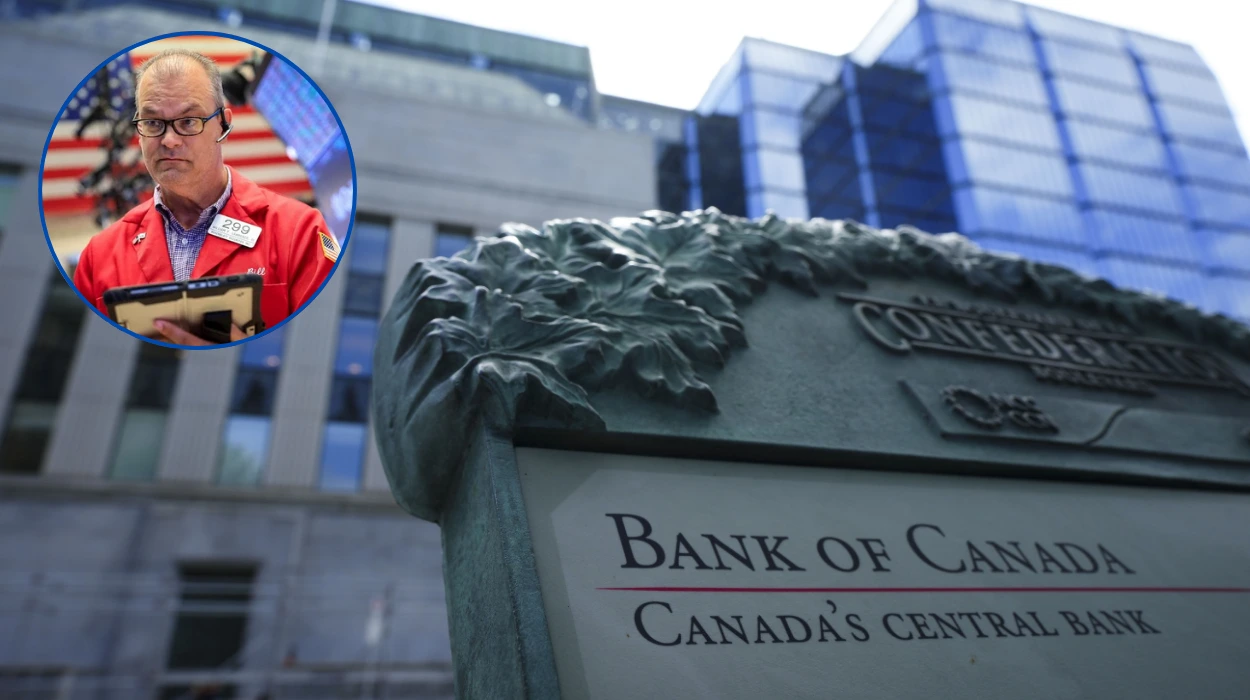
Key Points
- The Bank of Canada’s governing council agreed to keep monetary policy nimble in response to new US trade restrictions and energy price pressures, according to minutes released on Wednesday.
- The central bank held its key interest rate unchanged at 2.25% on 10 June.
- Governor Tiff Macklem said there was limited evidence that higher energy prices were fuelling broad-based inflation.
- The policy rate has remained at the lower end of the bank’s neutral range since October, reflecting economic slack.
- Conflict in the Middle East pushed petrol prices higher into early June, lifting May inflation to 3.2%.
- This marked the first time in 29 months that headline inflation moved outside the Bank of Canada’s 1% to 3% target range.
- The six-member rate-setting council described the situation as a “dilemma” requiring a careful balance between weak growth and rising prices.
- Council members agreed not to over-react to the inflation data but also said they would not be too slow to respond if price pressures became persistent.
- Money markets have pared back earlier bets on a December rate hike and now expect rates to stay unchanged through year-end.
- The economy technically entered recession at the end of the first quarter, but the council does not believe it is “clearly in recession.”
- The upcoming review of the United States-Mexico-Canada Agreement (USMCA) was flagged as a significant source of uncertainty that could trigger policy action.
Ottawa (Britain Today News) June 24, 2026 – The Bank of Canada’s governing council agreed to keep its monetary policy approach flexible in order to respond to new United States trade restrictions and the impact of energy prices, whether those pressures emerge separately or at the same time, according to the minutes of its latest meeting, released on Wednesday. The minutes offer the clearest insight yet into how policymakers are weighing a delicate trade-off between sluggish economic growth and an unexpected jump in inflation, at a time when external trade risks continue to cloud the outlook for the Canadian economy.
- Key Points
- What Did the Bank of Canada Decide on Interest Rates?
- Why Has the Bank of Canada Kept Its Policy Rate at the Lower End of Neutral?
- What Did Governing Council Members Say About the Policy Dilemma?
- Will the Bank of Canada Raise Interest Rates if Inflation Persists?
- How Have Money Markets Reacted to the Inflation Data?
- Does the Bank of Canada Expect the Economy to Return to Growth?
- Why Is the USMCA Review a Risk Factor for Canadian Monetary Policy?
- What Happens Next for Bank of Canada Interest Rates?
What Did the Bank of Canada Decide on Interest Rates?
The Bank of Canada left its key interest rate unchanged at 2.25% on 10 June, a decision that was widely expected by economists and financial markets ahead of the announcement. Governor Tiff Macklem said at the time that the central bank was seeing limited evidence that higher energy prices were fuelling broad-based inflation across the economy, suggesting that policymakers were not yet convinced that a single source of price pressure justified a shift in the bank’s stance.
The decision to hold rates steady continues a pattern that has now persisted for several months, with the governing council treating the current rate as appropriately balanced given the conflicting signals coming from different parts of the economy.
Why Has the Bank of Canada Kept Its Policy Rate at the Lower End of Neutral?
According to the minutes, the central bank has kept its policy rate at the lower end of its neutral level, a setting that is neither stimulative nor restrictive, since October. This positioning has primarily been driven by economic slack, meaning that output and employment have been running below the economy’s full potential, reducing the urgency for either further rate cuts or hikes.
The neutral rate is the theoretical level at which monetary policy neither speeds up nor slows down economic activity. By sitting at the lower end of that range, the Bank of Canada has signalled that it sees more downside risk to growth than upside risk to inflation, at least until recent developments in energy markets began to complicate that picture.
How Has the Middle East Conflict Affected Canadian Inflation?
The minutes state that the war in the Middle East led to higher petrol prices up until the beginning of June, a development that pushed Canada’s headline inflation rate to 3.2% in May. This was a significant moment for the central bank, as it marked the first time in 29 months that the headline inflation figure had moved past the top end of the Bank of Canada’s 1% to 3% target range.
For a central bank that operates under a formal inflation-targeting mandate, a breach of the target range, even a modest one, carries weight. It raises the question of whether the move is temporary, driven by a one-off geopolitical shock to energy prices, or whether it signals the beginning of a more persistent inflationary trend that would require a policy response.
What Did Governing Council Members Say About the Policy Dilemma?
The minutes were explicit about the difficulty of the decision facing policymakers.
“Governing Council members agreed the economic situation presented a dilemma for monetary policy,”
the summary of deliberations said. This single line captures the central tension at the heart of the bank’s current position: an economy that is too weak to comfortably absorb higher interest rates, but an inflation rate that is too high to ignore.
The six-member rate-setting council weighed the factors confronting the Canadian economy directly, balancing weak growth, which would normally call for lower rates, against high inflationary pressures, which would normally call for rate hikes. The minutes make clear that no single, straightforward answer was available to the council, and that members had to exercise judgement about which risk posed the greater threat to the economy in the near term.
Will the Bank of Canada Raise Interest Rates if Inflation Persists?
The minutes provide a clear signal about the conditions under which the central bank would consider tightening policy.
“In responding to the rise in inflation, the Governing Council did not want to over-react, but nor did it want to be too slow to respond,”
the deliberations said. The council added that if consumer price index (CPI) data began to show evidence that inflation was becoming more persistent, it would be a signal to hike rates.
This framing suggests that the Bank of Canada is currently treating the inflation spike as provisional rather than structural, but is prepared to act if forthcoming data suggests otherwise. It places considerable weight on upcoming inflation readings, which will be closely watched by economists, investors, and households alike for signs of whether the May spike was a temporary blip or the start of a longer-term trend.
Is Inflation Outside the Energy Sector Still Under Control?
Despite the rise in headline inflation, the minutes clarified that outside of energy prices, inflationary pressures were generally contained. This is a notable distinction, as it suggests that the broader basket of goods and services that make up the Canadian economy has not seen the kind of widespread price acceleration that would typically alarm policymakers.
This detail is central to understanding the bank’s cautious approach. If inflation were broad-based, spreading across food, housing, services, and other categories, the case for an imminent rate hike would be considerably stronger. Instead, the narrower, energy-driven nature of the inflation spike has allowed the governing council to treat the figure with a degree of patience, while still flagging the risk of persistence if conditions evolve.
How Have Money Markets Reacted to the Inflation Data?
Money markets responded to the May inflation reading by initially pricing in a possible interest rate hike in December. However, according to the report, those bets have since been pared back, and traders now expect the Bank of Canada to keep interest rates unchanged through the remainder of the year.
This shift in market expectations reflects a broader reassessment of the inflation story, with investors apparently placing more weight on the central bank’s own cautious language and on the contained nature of non-energy inflation than on the headline figure alone. Market positioning of this kind can shift quickly, however, and further inflation or energy price data released between now and December could prompt renewed volatility in rate expectations.
Is the Canadian Economy in Recession?
The minutes addressed a politically and economically sensitive question directly: whether Canada is currently in a recession. The economy slipped into a technical recession at the end of the first quarter, but the Bank of Canada has cautioned against putting too much weight on that data point.
The governing council shared the view that a recession is properly characterised by a “deep, widespread and persistent decline” in aggregate economic activity, a bar that members did not believe the current data had cleared.
“Members agreed that the economy was weak; it was still operating in excess supply and there was slack in the labour market. But the economy was not clearly in recession,”
the summary statements showed.
This careful, almost technical distinction matters because it shapes how the central bank frames the appropriate policy response. A central bank confronting a deep recession would typically be expected to cut rates aggressively to support demand. A central bank confronting weak but not collapsing growth, alongside an inflation overshoot, faces a far more nuanced calculation, which is reflected in the bank’s continued decision to hold rates steady rather than move in either direction.
Explore More about World:
Zizians Member Michelle Zajko Charged With Murdering Her Parents in Pennsylvania
Dettol Apologises in China After ‘Toxic Men’ Advertisement Sparks Public Backlash
Does the Bank of Canada Expect the Economy to Return to Growth?
Despite the technical recession and the weakness in the labour market, the governing council struck a measured note of optimism about the path ahead. Overall, members agreed that the economy appeared to be returning to growth, the statement said.
This assessment suggests that policymakers view the recent contraction as a temporary phase rather than the beginning of a deeper downturn. It also helps explain why the bank has not felt compelled to cut rates further despite the technical recession, as members appear to believe that the underlying trajectory of the economy is already improving, even if that improvement has not yet been fully reflected in the headline growth figures.
Why Is the USMCA Review a Risk Factor for Canadian Monetary Policy?
One of the more forward-looking elements of the minutes concerned international trade policy rather than domestic economic data. The members were united in their view that the upcoming review of the United States-Mexico-Canada free trade agreement was an important source of uncertainty, and that it could lead to policy action in case the review turns out to be negative.
This is a significant acknowledgement from the central bank, as it places a trade policy process, rather than a purely economic indicator, at the centre of its forward guidance. Canada’s economy remains heavily exposed to trade with the United States, and any disruption arising from the USMCA review, whether through tariffs, restrictions, or broader uncertainty, has the potential to affect growth, employment, and prices simultaneously. The governing council’s explicit reference to this risk indicates that trade policy developments will be a key input into future interest rate decisions, alongside more traditional measures such as inflation and output data.
What Happens Next for Bank of Canada Interest Rates?
Taken together, the minutes paint a picture of a central bank trying to balance several moving parts at once: a weak but recovering economy, an inflation reading that has technically breached its target range due to energy prices, contained underlying price pressures elsewhere in the economy, and a significant trade policy risk on the horizon in the form of the USMCA review.
For now, the governing council’s stated preference is to remain nimble rather than committing to a fixed path in either direction. The minutes indicate that future CPI data will be closely scrutinised for signs of persistent inflation, which would be treated as a signal to raise rates. Equally, any negative outcome from the USMCA review could prompt a different kind of policy response. With money markets currently expecting rates to hold steady through the end of the year, the Bank of Canada’s next moves will likely depend heavily on how these parallel risks evolve over the coming months.