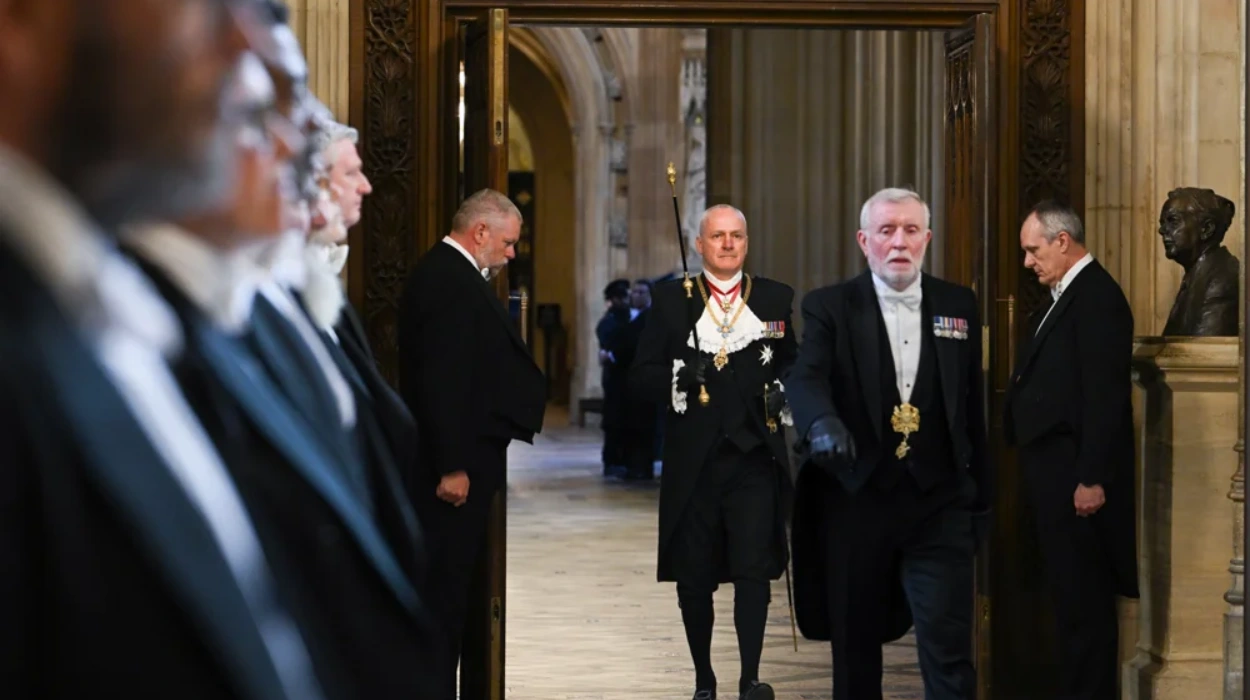
What is the office of Black Rod and what does the title mean?
Black Rod is the senior usher and sergeant-at-arms of the House of Lords, named for an ebony staff topped with a gold lion that signifies the office.
- What is the office of Black Rod and what does the title mean?
- When and how did the office originate?
- What are the primary ceremonial duties of Black Rod today?
- What administrative and managerial roles does Black Rod perform?
- How does the Black Rod ceremony symbolise parliamentary independence?
- Who has held the office and what notable appointments occurred?
- What is the Black Rod’s role in the State Opening of Parliament?
- How does Black Rod interact with the House of Commons during exceptional events, such as prorogation or prorogued sessions?
- What legal or constitutional powers does Black Rod hold?
- In what other Commonwealth parliaments does Black Rod exist and how do those roles compare?
- What are concrete examples of Black Rod’s actions in modern parliamentary practice?
- What administrative resources and team support Black Rod commands?
- What data and remuneration information exist about the role?
- How has the role adapted to modern security and constitutional needs?
- What implications does the Black Rod role have for constitutional practice and public perception?
- What are current debates or reforms related to the role and its ceremonies?
- How should researchers and writers cite authoritative sources on Black Rod?
- What future relevance will Black Rod hold for the UK constitution and parliamentary life?
The office of Black Rod is a royal appointment that functions as a personal attendant of the sovereign within the House of Lords and as an officer responsible for ceremonial, security, and administrative duties. The title derives from the physical staff of office: an ebony (black) rod surmounted by a golden lion, symbolizing royal authority and the bearer’s role as the monarch’s representative in the upper chamber. The holder is appointed by royal letters patent and performs duties on behalf of the Crown within parliamentary ceremonies.
When and how did the office originate?
Black Rod originated in the 14th century as an officer of the Order of the Garter and was institutionalised for the House of Lords by the mid-1300s.
Earliest formal references connect the office to the royal household and the Order of the Garter, with institutional functions recorded from about 1350 and in letters patent from 1361, establishing the role within royal and parliamentary practice. Over centuries the office shifted from a purely royal household position to a defined parliamentary official who serves ceremonial, custodial, and security functions for the House of Lords. The office evolved alongside changes in parliamentary sovereignty, notably after 1642 when disputes between sovereign and Commons reshaped ceremonial protocol.
What are the primary ceremonial duties of Black Rod today?
Black Rod organises and conducts State Opening ceremonies, summons Members of the House of Commons to the Lords, and manages formal royal communications.
The most widely observed duty is summoning the House of Commons to hear the sovereign’s (King’s or Queen’s) Speech at State Opening by approaching the Commons, having the door traditionally slammed, then knocking three times with the rod to be admitted and to lead MPs to the Lords. Black Rod also coordinates other royal and parliamentary ceremonies: the reception of the sovereign in the Lords, the proclamation of a new monarch, and formal events such as addresses and coronation-related sittings. The office manages ceremonial staff, ensures protocol compliance, and liaises between the two Houses when official royal instructions require Commons attendance in the Lords.
What administrative and managerial roles does Black Rod perform?
Black Rod leads the House of Lords’ ceremonial staff, oversees access and security for ceremonial occasions, and manages administrative teams supporting chamber operations.
Beyond public spectacle, Black Rod manages a team (commonly several dozen staff) responsible for the day-to-day running of the House of Lords’ ceremonial and access functions. Responsibilities include planning and executing formal events, supervising doorkeepers and ushers, coordinating security clearances for visiting dignitaries, and advising on protocol and precedence. The role historically included custodial duties for the Palace of Westminster’s ceremonial objects and coordination with palace authorities and security services.
How does the Black Rod ceremony symbolise parliamentary independence?
The Commons’ refusal to admit Black Rod without formal knocking symbolises the independence of the elected House from royal or upper-house intrusion.
The ritual in which the Commons doors are shut in Black Rod’s face, followed by three knocks, stems from historical conflicts between the Commons and Crown/upper house, especially episodes in the 17th century (for example, tensions around Charles I and attempts to arrest MPs). The closing of the door represents the Commons’ right to control its own internal proceedings and to refuse unsummoned royal or external interference. The subsequent formal admittance after knocking codifies mutual respect between Houses and the Crown while preserving Commons’ procedural independence.
Who has held the office and what notable appointments occurred?
The role has existed for over six centuries with roughly 60 holders; Sarah Clarke became the first woman appointed in 2017.
Historical records and institutional sources indicate the office has been continuously occupied since medieval times, and the roster of holders reflects centuries of royal and parliamentary continuity. In November 2017 Sarah Clarke was appointed Lady Usher of the Black Rod, formally taking up the post in February 2018, marking the first female appointment to the role in over 650 years. Holders historically have been senior, trusted figures often drawn from military, policing, or public service backgrounds appropriate to ceremonial leadership and security oversight.
What is the Black Rod’s role in the State Opening of Parliament?
During State Opening, Black Rod summons the Commons, coordinates the procession, and ensures the sovereign’s access to the Lords chamber for the King’s Speech.
State Opening is the fixed ceremonial event marking the parliamentary session in which the sovereign delivers the King’s Speech outlining government policy. Black Rod is dispatched from the Lords to the Commons to summon MPs; after the formal knocking protocol, Black Rod leads MPs to the Lords so they can attend the speech. Black Rod also oversees procession order, seating, and ceremonial etiquette, liaising with clerks and the sovereign’s household to ensure the event follows constitutional form and royal precedence.
How does Black Rod interact with the House of Commons during exceptional events, such as prorogation or prorogued sessions?
Black Rod delivers formal messages and proclamations between the sovereign/House of Lords and the Commons during prorogation and other exceptional constitutional events.
In prorogation, dissolution, or other exceptional events, Black Rod conveys formal communications on behalf of the Crown or Lords to the Commons, ensuring that constitutional and procedural instructions are delivered with formal ceremony and recorded protocol. The office’s involvement gives legal and constitutional weight to the Crown’s instructions, and the ritual delivery underlines the separation of roles among sovereign, Lords, and Commons. Media coverage and official guides often describe these duties when prorogation or special sessions occur.
What legal or constitutional powers does Black Rod hold?
Black Rod has no independent legislative power; the office exercises procedural and ceremonial authority delegated by the Crown and the House of Lords.
The office acts under royal appointment and House of Lords authority, executing ceremonial and administrative functions rather than making legal decisions or directing legislative outcomes. Black Rod’s authority is procedural—enforcing order at ceremonial events, directing ushers, and delivering formal summons—but not judicial or legislative. The office’s powers derive from convention, royal letters patent, and internal House of Lords rules rather than from statute granting independent coercive powers.
In what other Commonwealth parliaments does Black Rod exist and how do those roles compare?
Analogues of Black Rod exist in Commonwealth parliaments such as Canada, Australia, and New Zealand, performing similar ceremonial and procedural functions.
Commonwealth jurisdictions with upper chambers exported the role or a close equivalent; these officers carry similar staffs, run ceremonial events, and summon lower-house members for royal or viceregal speeches. Local adaptations reflect constitutional differences: in some countries duties focus more on chamber security and administration, while in others ceremonial protocol mirrors the UK practice closely. Examples include the Usher of the Black Rod in the Canadian Senate and comparable officers in Australian and New Zealand legislatures.
What are concrete examples of Black Rod’s actions in modern parliamentary practice?
Examples include the three knocks at State Opening, organising the Lords’ procession, and supervising access for visiting heads of state and ceremonial guests.
Contemporary, well-documented instances include the annual State Opening where Black Rod summons MPs with three knocks; the reception and guidance of the sovereign into the Lords chamber; and co-ordinating ceremonial seating and security for visiting dignitaries. Media reports and parliamentary records describe the physical act of knocking, the procession routes inside the Palace of Westminster, and the administrative briefings Black Rod provides to clerks and security. These actions illustrate the role’s blend of public symbolism and practical event management.
What administrative resources and team support Black Rod commands?
Black Rod typically leads a team of roughly 20–30 ceremonial and access staff who manage logistics, protocol, and day-to-day ceremonial operations.
Contemporary reporting lists the Black Rod office as supervising several dozen staff—ushers, door-keepers, and event coordinators—responsible for formal events and everyday chamber access. The office’s budgetary and staffing responsibilities include planning high-profile events, arranging security clearances, maintaining ceremonial regalia, and coordinating with the House of Commons and palace services. Administrative authority enables Black Rod to implement arrangements that carry formal parliamentary and royal legitimacy.
What data and remuneration information exist about the role?
Public sources report that the Black Rod’s salary is a six-figure figure in local currency ranges historically under £100,000, and staff numbers and budgets are disclosed in parliamentary administrative records.
Official remuneration and staffing details are published in parliamentary or government records and referenced in reputable reporting; for example, past reporting indicated a salary figure in the tens of thousands of pounds annually for the post (reporting cited figures near £90,000). Parliamentary administrative reports and transparency disclosures list staff numbers and budget allocations for chamber support and ceremonial functions, which provide quantifiable details about the office’s resourcing. For precise current figures, consult the Houses of Parliament or formal payroll disclosures.
How has the role adapted to modern security and constitutional needs?
Black Rod combined traditional ceremonial duties with modern security coordination and event management consistent with 21st-century parliamentary operations.
The office now coordinates with parliamentary security services, police, and official household staff to secure ceremonial routes, protect visiting dignitaries, and ensure safe public access during high-profile events. Black Rod’s modern remit includes risk assessment, timing and crowd management, and working within statutory security frameworks while preserving ceremonial protocol. This adaptation balances centuries-old symbolism with contemporary operational demands.
What implications does the Black Rod role have for constitutional practice and public perception?
Black Rod symbolises constitutional continuity, the Crown’s ceremonial link to Parliament, and the Commons’ autonomy, shaping public understanding of Britain’s uncodified constitution.
The office embodies ceremonial continuity linking the monarchy, the House of Lords, and the elected Commons, which reinforces public recognition of constitutional roles and traditions. The ritual—especially the shutting of the Commons door and the three knocks—visibly demonstrates the balance between symbolic royal authority and democratic self-governance, affecting civic literacy about parliamentary process. For scholars and civic educators, Black Rod offers an accessible case study in how ceremony communicates constitutional principles.
What are current debates or reforms related to the role and its ceremonies?
Debates focus on modernising ceremonial practice, inclusivity in appointments, and transparency over costs, while preserving constitutional symbolism.
Discussion in media and parliamentary circles includes calls for diverse appointments (as reflected in the first female appointment in 2017), review of ceremonial costs, and ensuring that pageantry remains understandable to contemporary citizens. Reform proposals tend to weigh historical preservation against accessibility, cost, and representational fairness; legislative change is rarely proposed because the role is grounded in convention and royal appointment rather than statute. Public debate often occurs around high-profile events when visibility of the ceremony spikes.
How should researchers and writers cite authoritative sources on Black Rod?
Use parliamentary records, official House of Lords guidance, academic histories, and institutional encyclopaedias for authoritative, citable information.
Primary-source documentation includes royal letters patent, House of Lords official guides, parliamentary archives, and government transparency pages; secondary authoritative sources include encyclopaedia entries and constitutional histories. For academic work, cite peer-reviewed history journals or university-press books on parliamentary evolution; for current procedural detail cite the House of Lords or official parliamentary communications. These sources ensure factual accuracy and traceability for scholarly or journalistic use.
What future relevance will Black Rod hold for the UK constitution and parliamentary life?
Black Rod will remain a constitutional and ceremonial fixture reflecting continuity, adapted to modern security and representational standards.
Given the role’s deep roots in constitutional convention and its practical function in ceremonial coordination, Black Rod will retain importance in State Openings and royal communications while adapting staffing and protocols for modern inclusivity and security standards. Its continued visibility ensures the public encounters a living demonstration of the UK’s uncodified constitutional norms, preserving the office’s educational and symbolic functions.