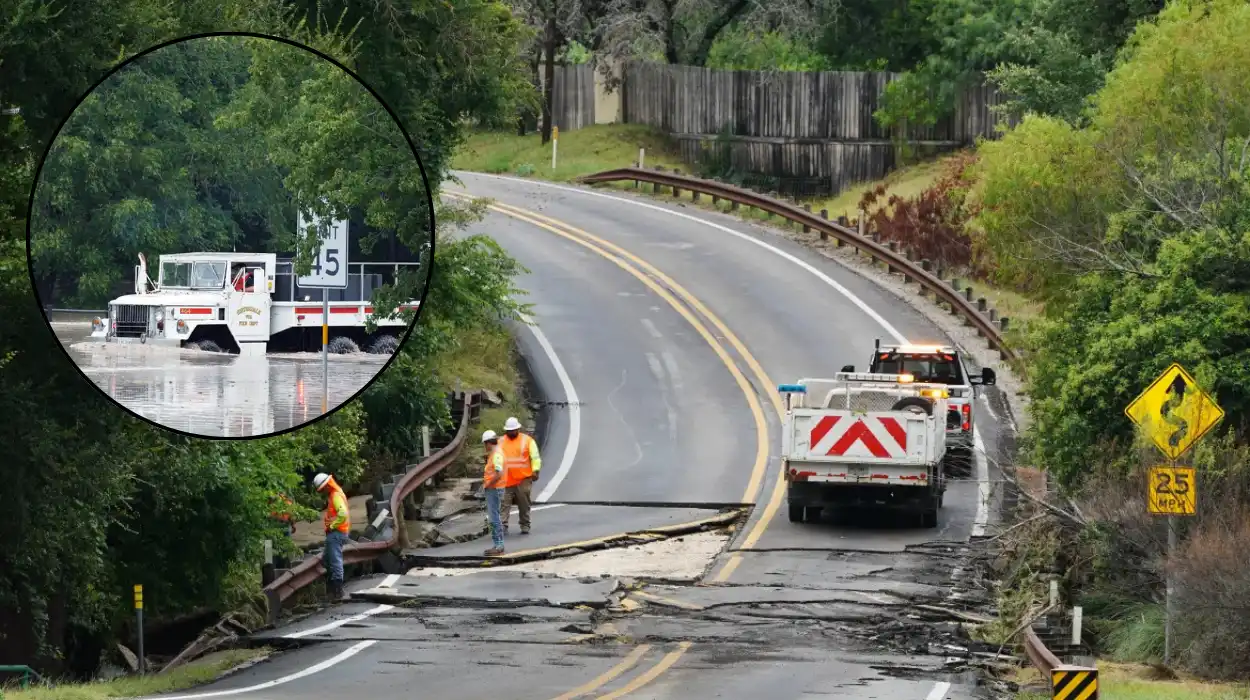
Key Points:
- At least two people have died as torrential rains and flash floods ravage central Texas for the second consecutive year
- Over 230 rescues have been conducted by emergency responders across the state
- Texas Governor Greg Abbott issued a disaster declaration for 59 counties
- The National Weather Service reported 25 to 50cm (10 to 20 inches) of rain, with some areas receiving up to 60cm (two feet)
- Nearly 6 million people were placed under flood watches across south and central Texas
- New flood warning sirens, installed after last year’s deadly Camp Mystic tragedy, were activated during this week’s storms
- Federal legislation called the Mystic Alerts Act has been introduced to improve emergency alert systems
- The Nueces River near Uvalde exceeded its 1996 record crest
- More than 2,350 emergency responders, 800 vehicles, 75 boats, and 20 aircraft have been deployed
- The flooding has affected the same region where at least 139 people died in floods just over a year ago
Texas (Britain Today News) July 17, 2026 – Catastrophic flooding has once again swept across central Texas, claiming at least two lives and prompting hundreds of rescues as communities still reeling from last year’s devastating floods face yet another natural disaster. The heavy rainfall, which began on Tuesday, has unleashed record-shattering downpours across the region, with some areas receiving more rainfall in a matter of days than they typically see in an entire year.
- Key Points:
- What Caused the Catastrophic Flooding in Central Texas?
- Who Are the Victims of the Texas Floods?
- How Have Emergency Responders Managed the Crisis?
- What Makes This Flooding Different from Last Year’s Disaster?
- How Did the New Warning Systems Perform?
- What Federal Legislation Has Been Proposed?
- What Is the Current Situation and What Lies Ahead?
- What Is the Psychological Impact on Communities?
- How Are Communities Coping with Repeated Disasters?
- What Lessons Can Be Learned from This Disaster?
The latest round of extreme weather has tested new emergency warning systems installed after last year’s tragedy, as Governor Greg Abbott issued a disaster declaration for 59 counties and called for round-the-clock emergency operations. With nearly 6 million residents under flood watches, the state has mobilised what officials describe as one of the largest emergency responses in Texas history.
What Caused the Catastrophic Flooding in Central Texas?
The flooding stems from a slow-moving weather pattern that has parked over the region, dropping relentless rainfall since Tuesday. The National Weather Service reported 25 to 50cm (10 to 20 inches) of rain across parts of the Hill Country, with some areas receiving as much as 60cm (two feet) of precipitation this week alone. As reported by Daniel Trotta of Reuters, the National Weather Service confirmed that some towns have seen more than 20 inches of rain since the start of the week .
Chief Nim Kidd with the Texas Division of Emergency Management explained the challenges faced by meteorologists in predicting the storm’s path. As reported by Chelsey Zhu of KUT Austin, Kidd stated:
“The way that this weather pattern is setting up is difficult for the models that the meteorologists use to tell us exactly where it’s going to fall and exactly how much is going to fall” .
The rainfall has caused rivers throughout the region to surge to near or over record levels. The Nueces River near Uvalde reached a record crest of 28.01 feet on July 16, according to preliminary data, breaking a record of 24.88 feet set in 1996. Governor Abbott warned that the Nueces was expected to reach two times the flow of Niagara Falls .
Who Are the Victims of the Texas Floods?
Governor Abbott confirmed at least two fatalities resulting from the flooding . One victim, a male near the city of Comfort, died after being swept away in a recreational vehicle. The other, a female in Uvalde, was swept away by floodwaters while driving on a road. The governor did not initially release the victims’ identities or ages .
However, Jennie Steward told the Associated Press that one of the victims was her husband, 65-year-old John Mark Steward of Kerrville. She recounted that she was away visiting her parents when she received word from a neighbour that their mobile home had been carried off by floodwaters spilling over from nearby Goat Creek.
“It’s really hard that I wasn’t there with him,”
she told the AP, adding that they had just celebrated their third anniversary .
The other victim, who has not been named, was swept away near Uvalde, a city roughly 138 kilometres southwest of San Antonio. The Uvalde area was among those of greatest concern as the Nueces River threatened to exceed its historic crest .
How Have Emergency Responders Managed the Crisis?
Texas has deployed an extensive emergency response operation to rescue stranded residents and mitigate the disaster’s impact. Governor Abbott reported that 2,350 emergency responders have been deployed to the region, equipped with helicopters and boats to rescue people from submerged vehicles and homes .
The governor outlined the scale of the operation:
“More than 800 vehicles, more than 75 boats, and 20 aircraft have been deployed” . These resources include Black Hawk helicopters and swiftwater rescue boats, as officials seek to avoid a repeat of the human toll from one year ago .
One dramatic rescue involved California man Gabriel Pablo, who was plucked from an 18-wheeler that was overtaken by raging floodwaters while driving in the region. Pablo told San Antonio’s Fox affiliate KABB that the rain swept his truck away “like [it was] nothing” .
Texas Game Wardens have been particularly active in the rescue efforts, having rescued close to 150 people by Thursday afternoon, according to a Texas Parks and Wildlife Department spokesperson. Video shared by Texas Game Wardens showed submerged vehicles being swept away in water, with responders rescuing people from homes and cars swept off roads .
What Makes This Flooding Different from Last Year’s Disaster?
This year’s flooding has struck the same region that experienced devastating floods just over a year ago, when at least 139 people died, including 28 campers, staff and counsellors at Camp Mystic, an all-girls summer camp on the Guadalupe River .
However, there are notable differences between the two events. While last year’s flooding occurred suddenly over the Fourth of July weekend, this year’s event has developed over several days, allowing residents more time to prepare. As reported by Chelsey Zhu of KUT Austin:
“It’s been a full week of rain for some of these places that has built up to this severe flooding. So people have been able to see this develop over days” .
Governor Abbott emphasised that lessons learned from last year’s tragedy have helped prevent more catastrophe this time, though the behaviour of the water along riverfront campgrounds is different than it was then. Abbott noted that early on, over 80 people were cleared from campgrounds .
Texas resident Claudio Castillo captured the emotional impact of seeing the region flood again. As reported by KUT Austin, Castillo stated:
“It’s sad. It’s just like a desert. It hits you. You know, it hits you pretty hard. Especially when you go right by Camp Mystic. You know, something happened pretty bad there” .
How Did the New Warning Systems Perform?
In response to last year’s devastating floods, Texas lawmakers prioritised flood safety measures. Last September, Governor Abbott signed a law requiring warning sirens in flood-prone areas across the state, including Kerr County. The law also allocated $50m in funding to help buy and install warning systems .
Just last month, Kerr County announced that the system was operational. KXAN, Austin’s NBC affiliate, reported that sirens went off as floods approached the region before this week’s storms . The warning systems were activated during this year’s flooding event, providing critical alerts to residents .
Zhu of KUT Austin noted that public awareness has also improved:
“People across the state are more aware of the risks after the deadly floods last year. People might be paying more attention to severe weather alerts when they’re sent out and things like shelter-in-place or evacuation orders” .
What Federal Legislation Has Been Proposed?
In response to the ongoing flooding crisis, federal lawmakers have introduced legislation to improve emergency alert systems. This week, Senators John Cornyn, a Republican from Texas, and Jon Ossoff, a Democrat from Georgia, introduced legislation that would allow emergency alerts to be delivered by satellite networks to phones when cellular service failed .
The bill is called the Mystic Alerts Act, in honour of the floods at Camp Mystic last year. The legislation aims to ensure that residents in flood-prone areas receive critical warnings even when traditional communication infrastructure is compromised .
What Is the Current Situation and What Lies Ahead?
As of Thursday, the National Weather Service forecasts that the heavy rain will start to move out of these flooded areas, potentially transitioning the response from search and rescue to recovery over the next couple of days . However, Governor Abbott warned that the hardest-hit areas are expecting more rain into Friday and are not out of danger yet, with some rivers expected to reach historic levels .
The impact of the flooding has been widespread. Some 125 roadway sections across the state have been affected, and 87 of those were closed including a bridge that was struck by a barge . The governor urged people to stay off the roads until the storms subside, expected late on Friday .
Uvalde and Johnson City remain among the areas of greatest concern. After days of pounding rain, the National Weather Service said a large wave on Thursday barrelled down the same river wrecked by flash floods last summer. Some spots of the Guadalupe River rose by more than nine metres .
As much as 74 centimetres of rain fell in Uvalde County, which was spared from the worst flooding a year ago, the weather service said on Thursday. Other areas saw roughly 30 cm of rain . The Frio and Pedernales rivers are expected to reach among their highest levels on record .
What Is the Psychological Impact on Communities?
The psychological toll on communities that have experienced back-to-back catastrophic floods cannot be overstated. Residents who survived last year’s flooding are now facing similar trauma, with memories of the disaster still fresh in their minds.
Claudio Castillo’s remarks to KUT Austin reflect this collective trauma: “It’s sad. It’s just like a desert. It hits you. You know, it hits you pretty hard. Especially when you go right by Camp Mystic. You know, something happened pretty bad there” .
Zhu noted that when her colleagues went out to speak with people during the flooding,
“it was inevitable that last year’s flooding was front and center in people’s minds” .
This suggests that the psychological impact of repeated disasters may have long-lasting effects on community resilience and mental health.
Explore More about World:
Death Toll Nears 5,000 After Venezuela Twin Earthquakes 2026
Iran Threatens to Halt Mideast Energy Exports Amid US Blockade
How Are Communities Coping with Repeated Disasters?
Despite the trauma, communities in the Texas Hill Country are showing resilience. The improved warning systems and increased public awareness have likely contributed to preventing a higher death toll this year. Zhu noted:
“People across the state are more aware of the risks after the deadly floods last year. People might be paying more attention to severe weather alerts when they’re sent out and things like shelter-in-place or evacuation orders” .
However, the closure of Camp Mystic, which did not open for business this summer and filed for Chapter 11 bankruptcy earlier this year, reflects the long-term economic and social consequences of these repeated disasters. The camp faces wrongful death lawsuits over its response to last year’s flooding .
The federal Mystic Alerts Act, if passed, could provide another layer of protection for communities prone to natural disasters, ensuring that emergency alerts reach residents even when cellular service fails .
What Lessons Can Be Learned from This Disaster?
This week’s flooding in Texas offers several important lessons for disaster preparedness and response. First, the importance of early warning systems cannot be overstated. The new sirens installed after last year’s flooding provided critical alerts to residents, potentially saving lives .
Second, building public awareness about flood risks is essential. As Zhu noted, people in the region are now more aware of the dangers and more likely to heed warnings . Third, the unpredictability of weather patterns necessitates robust emergency response systems. As Chief Nim Kidd observed, the models used by meteorologists struggle to predict exactly where rainfall will occur .
Finally, the psychological and economic impacts of repeated disasters require long-term support for affected communities. The closure of Camp Mystic and the ongoing lawsuits highlight the need for comprehensive recovery efforts that address not only immediate physical needs but also long-term economic and mental health consequences .