Key Points
- Volunteers in eastern Congo are warning communities about a rare Ebola outbreak as suspected cases rise near 1,000.
- The outbreak involves the rare Bundibugyo type of Ebola, for which there is no vaccine or treatment.
- Red Cross volunteer Vanny Birungi says awareness work in Bunia is being met with anger, suspicion, stones and verbal abuse.
- Health workers and volunteers are facing a “double threat”: the virus itself and hostility from residents.
- Birungi and colleagues are continuing door-to-door and group awareness campaigns in a working-class neighbourhood under intense heat.
- The situation reflects both a public health emergency and a trust crisis in the affected community.
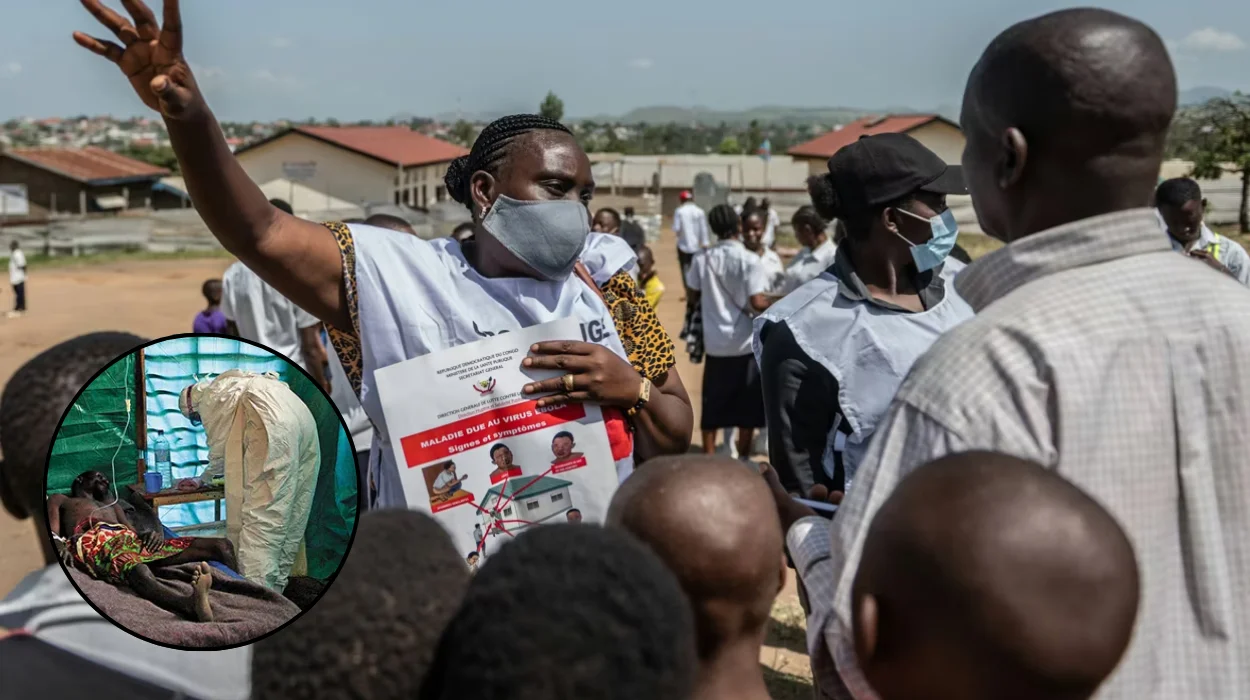
Bunia (Britain Today News) May 25, 2026 — A rare Ebola outbreak in eastern Congo is putting communities under pressure as suspected cases near 1,000, while volunteers and health workers trying to warn residents are also facing violence, suspicion and resistance. As reported by Vanny Birungi of the Red Cross, the effort to contain the outbreak in Bunia has become a dangerous mission for world, with outreach workers confronting not only the disease but also hostility from people they are trying to protect.
Why is this Ebola outbreak different?
The outbreak at the centre of concern is the Bundibugyo type of Ebola, which is described as rare and particularly alarming because there is no vaccine or treatment for it. That makes early detection, isolation, contact tracing and community awareness especially important, since prevention remains the main defence. The scale of the situation has intensified because suspected cases are nearing 1,000, a number that signals both active spread and the urgency of intervention.
Public health officials and volunteers are therefore relying heavily on education and communication in the field. In practice, that means repeatedly explaining how Ebola spreads, why symptoms matter, and why people should report suspected cases rather than hide them. The challenge is that in areas where fear is high and trust is low, those messages do not always land.
What are volunteers facing on the ground?
As reported by Vanny Birungi of the Red Cross, volunteers in Bunia are dealing with more than just the virus. Birungi said,
“We continue to tell them that the disease is out there. Some accept, and others don’t,”
capturing the split response from residents as awareness work continues under difficult conditions. That quote reflects the central tension of the outbreak response: the need for urgent public cooperation versus the reality of doubt and resistance.
Birungi’s account also shows the personal risk facing frontline workers. She said she and colleagues have been pelted with stones and subjected to verbal abuse while speaking to groups in a working-class neighbourhood. In a public health emergency, that kind of hostility can slow awareness, reduce reporting and undermine the very trust needed to stop transmission.
Why are residents reacting with suspicion?
Outbreaks like this often spread fear as quickly as they spread disease, especially when communities feel overwhelmed by outside warnings or uncertain about what health teams are saying. In such circumstances, rumours, mistrust and previous negative experiences can shape how people respond to health messages. The result is that volunteers may be seen not as helpers but as threats, even when they are trying to save lives.
The reaction in Bunia suggests that the outbreak is also a social crisis. Residents may fear quarantine, stigma, economic disruption or the idea that being identified as a contact could bring trouble to their families. When a disease is rare and dangerous, the absence of familiar understanding can make people cling to denial, which in turn makes containment harder.
What does the outbreak mean for Congo?
Eastern Congo has long faced complex health and security pressures, and an Ebola outbreak adds another layer of strain. A rise in suspected cases demands rapid intervention, but that response depends on community cooperation, protective equipment, trained staff and reliable communication. When volunteers are attacked, the public health chain weakens at the very point it is needed most.
The fact that the outbreak involves a rare strain with no vaccine or treatment makes the situation more serious. Public health teams cannot rely on a quick pharmaceutical solution, so they must work through surveillance, isolation and behavioural change. That is a slower, harder path, particularly in neighbourhoods where people are already wary of authority or external messaging.
How are frontline workers responding?
Despite the hostility, Birungi and her colleagues have continued speaking to residents in Bunia, moving through communities to explain the risk and encourage caution. Their work, carried out under the scorching sun, is a reminder that outbreak control often depends on patient, repetitive and unglamorous fieldwork. It is not only medical treatment that matters, but the human effort to persuade people to listen.
As reported by Birungi, some residents accept the warnings, while others refuse to believe the disease is present. That mixed response leaves health workers trying to bridge a widening gap between scientific urgency and public doubt. In practical terms, every conversation matters, because each household reached may help reduce exposure and identify suspected cases sooner.
Explore More about World:
Pakistan’s Munir Advances Iran Deal Through Tehran Mediation 2026
Gaza: 22 hospitals attacked since the beginning of 2026
What makes trust so important?
Trust is one of the strongest tools in an outbreak response because disease control depends on people believing the advice they are given. If residents distrust volunteers, they may hide symptoms, avoid screening or resist contact tracing, which can allow the virus to spread further. That makes community engagement as important as masks, gloves or clinical protocols.
The Bunia experience shows how quickly distrust can become dangerous. A volunteer who is met with stones and abuse cannot work as effectively, and fear may spread through the wider population as people hear conflicting stories about the outbreak. In this environment, clear and respectful messaging is essential, but it is also fragile.
What is the bigger public health lesson?
The outbreak underlines a familiar lesson from past epidemics: a virus is never only a medical problem. It is also a communication problem, a trust problem and, often, a political and social problem. When people are frightened, information must travel faster than rumours, but that is difficult when the messengers are being chased away.
The situation in Bunia therefore stands as a warning about the human side of outbreak control. Health workers cannot stop Ebola alone; they need communities willing to cooperate, report symptoms and accept prevention measures. Without that cooperation, even basic awareness campaigns become risky work.
The story also shows the importance of frontline volunteers, who often work in direct contact with residents before major responses are visible. Their role is vital, because they are usually the first to hear concerns, answer questions and challenge misinformation. But their safety matters too, and attacks on them can become a public health threat in their own right.
What happens next?
The immediate focus will remain on reducing suspected cases, improving awareness and calming fear in affected neighbourhoods. That will require consistent outreach, stronger local engagement and practical support for people who may feel threatened by the outbreak response. It also means protecting the volunteers and health workers who are carrying out this work on the ground.
For now, the message from Bunia is stark: the Ebola outbreak is dangerous, but so is the hostility facing the people trying to stop it. As Birungi’s account shows, the road to containment runs through both medicine and trust, and the latter may prove just as difficult to secure as the former.