Key Points
- Tens of thousands gathered in central London for two major demonstrations on Saturday
- Events included Tommy Robinson’s Unite the Kingdom march and a pro-Palestine Nakba Day rally
- Around 4,000 Metropolitan Police officers were deployed across the capital
- Police confirmed 31 arrests by approximately 4:30pm
- Arrests included suspects linked to a Birmingham GBH case and protest-related incidents
- Unite the Kingdom march featured anti-government chants and political speeches
- Speakers included Stephen Yaxley-Lennon, Katie Hopkins, Ant Middleton, Laurence Fox and Andrew Bridgen
- Pro-Palestine rally drew large crowds, with organisers estimating up to 250,000 attendees
- Labour MPs Apsana Begum and Diane Abbott addressed demonstrators
- Jeremy Corbyn and Zarah Sultana also spoke at the pro-Palestine event
- Police enforced rules on face coverings, leading to at least one arrest
- Government blocked 11 foreign nationals ahead of the protests
- New CPS guidance highlights scrutiny of protest chants and online content
- Live facial recognition and drone surveillance were used for policing
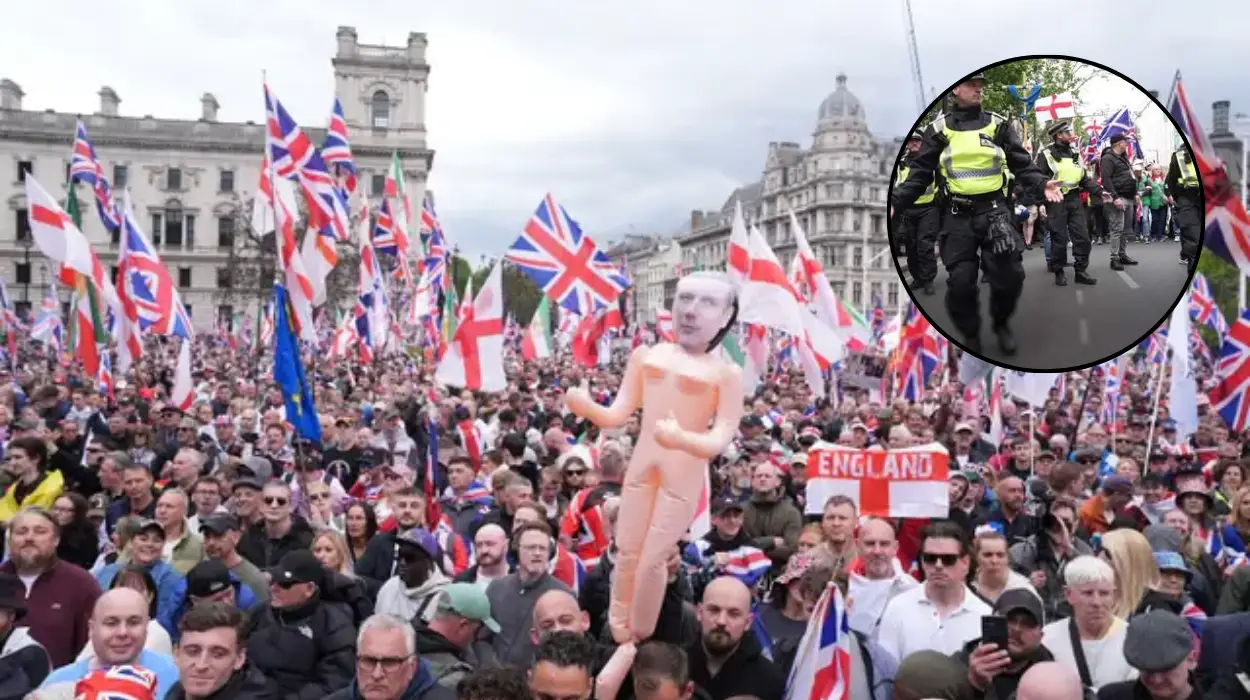
London (Britain Today News) May 16, 2026 – Tens of thousands of demonstrators gathered across central London on Saturday for two rival protests that prompted a significant policing operation, resulting in 31 arrests by late afternoon, according to the Metropolitan Police.
- Key Points
- What happened during the two London protests?
- Why were arrests made during the demonstrations?
- What messages were expressed at the Unite the Kingdom march?
- What took place at the pro-Palestine Nakba Day rally?
- How did police monitor and control the protests?
- What new legal guidance affects protest behaviour?
- What role did the government play ahead of the protests?
What happened during the two London protests?
Two major demonstrations unfolded simultaneously in central London, drawing large crowds with sharply contrasting political messages. The Unite the Kingdom march, led by Stephen Yaxley-Lennon, widely known as Tommy Robinson, took place alongside a pro-Palestine Nakba Day rally.
The Metropolitan Police confirmed that both events were largely peaceful despite the scale. In a statement shared on X, the force said:
“While this may seem high, to this point both protests have proceeded largely without significant incident.”
Approximately 4,000 officers were deployed to manage crowds, monitor tensions and enforce protest conditions, reflecting heightened concerns around public order and political sensitivities.
Why were arrests made during the demonstrations?
Police confirmed that 31 arrests had been made by around 4:30pm, covering a range of offences. Among the most notable incidents, officers arrested two men near Euston station who had travelled to London for the Unite the Kingdom protest.
According to the Metropolitan Police, the individuals were wanted in connection with separate offences. One suspect was linked to a serious assault case in Birmingham involving a man being run over, while the second was wanted for allegedly encouraging attacks on a police officer.
In another incident, a woman was arrested at the pro-Palestine protest after reportedly refusing to remove a fabric face covering when instructed by officers. Police had requested several demonstrators to remove masks, citing legal restrictions.
Explore More about London:
London museum to return sacred Jain texts over unethical acquisition 2026
Mouse Poo and Gnawed Food Packets Found in London School Kitchen 2026
What messages were expressed at the Unite the Kingdom march?
The Unite the Kingdom demonstration featured strong anti-government rhetoric, with chants such as “Keir Starmer’s a wanker” and “we want Starmer out” echoing through parts of central London. Many participants wore red hats bearing the slogan “Make England Great Again”.
Stephen Yaxley-Lennon addressed supporters both through social media and on stage. In a video posted online, he said:
“Keir Starmer, the country’s awake, your days are numbered.”
During his speech, he encouraged political mobilisation, stating:
“Are you ready for the battle of Britain? 2029 we have an election… If we don’t send a message in our next election… we are going to lose our country forever.”
Other speakers included media personality Katie Hopkins, television figure Ant Middleton, actor-turned-politician Laurence Fox, and former Conservative MP Andrew Bridgen, each contributing to the rally’s political tone.
Siobhan Whyte, mother of murder victim Rhiannon Whyte, delivered an emotional address. She said:
“Keir Starmer… has failed us. He has failed my daughter, Rhiannon. I believe she will still be alive today if this disgusting excuse of a man had not been in control.”
Meanwhile, Polish politician Dominik Tarczynski appeared via video link, claiming he had been barred from entering the UK ahead of the rally.
What took place at the pro-Palestine Nakba Day rally?
The pro-Palestine demonstration drew a significantly large turnout, with organisers estimating attendance at around 250,000 people, although police figures suggested a lower estimate of approximately 30,000.
Crowds gathered with banners reading “Bristol stands with Palestine”, “Stop Trump, Stop Farage”, and “Free Palestinian Hostages”. Many demonstrators wore keffiyehs, symbolising solidarity with Palestinians.
Labour MP Apsana Begum addressed the crowd, urging unity and resilience. She stated that the movement would not be divided by the “far right”.
Diane Abbott also spoke, warning of shared threats. She said:
“They are viciously right-wing, viciously racist… We have to come together… to fight the racists, to fight the fascists, to fight the antisemites.”
Zarah Sultana criticised political leadership, stating that Andy Burnham was “not an alternative” and describing him as
“another establishment politician cut from the same Zionist cloth”.
Former Labour leader Jeremy Corbyn emphasised the need for systemic change, telling supporters that Westminster requires a shift in “policy” rather than “personalities”.
How did police monitor and control the protests?
The Metropolitan Police implemented extensive surveillance and crowd-control measures. Drones were deployed to monitor protest routes, while CCTV systems were actively used across the city.
Commander Clair Haynes had previously confirmed that officers in Wembley would track movements from the FA Cup final to identify individuals heading towards demonstrations.
In a significant development, live facial recognition technology was used during the operation, marking one of the first instances of its deployment in protest policing. Cameras were also positioned in Camden, an area expected to see heavy foot traffic from attendees.
Police also enforced rules around face coverings, particularly where identity concealment could hinder law enforcement efforts.
What new legal guidance affects protest behaviour?
The Crown Prosecution Service (CPS) recently issued updated guidance concerning protest-related offences, particularly around hate speech and public incitement.
The new framework urges prosecutors to consider whether chants, banners or symbols — especially those shared online — could amount to criminal offences such as stirring up hatred.
The CPS stated that the revised approach reflects “the changing international context” and aligns with broader efforts to fast-track hate crime prosecutions.
Authorities are now required to assess not only the immediate impact of protest expressions but also their potential influence when circulated on digital platforms.
Recent cases have seen individuals charged for chants including “death to the IDF” and “globalise the intifada”, highlighting the growing legal scrutiny surrounding protest language.
What role did the government play ahead of the protests?
Ahead of the demonstrations, the Government took preventative measures by blocking 11 foreign nationals from entering the UK. Prime Minister Sir Keir Starmer described them as “far-right agitators”.
Additionally, new protest restrictions mean organisers and speakers could face prosecution if events are used to promote extremism or unlawful speech.
Weyman Bennett, co-convenor of Stand Up To Racism, criticised the Unite the Kingdom protest. He said:
“Tommy Robinson tried to use his protest to silence solidarity with Palestine and divide communities through racism and Islamophobia. He failed.”
He added:
“Today, thousands of people stood together to defend the right to protest and to say clearly that the far right do not speak for the majority.”