Key Points
- Iran’s rial fell to a record low of 2.02 million rials per US dollar on the informal market on Monday, 24 August 2026, while the Central Bank’s official rate remains near 1.5 million rials.
- The currency’s decline comes as the Trump administration prepares to expand secondary sanctions on entities and countries doing business with Tehran, a move officials have described as an “economic D-Day”.
- Double-digit inflation, negative growth and nearly six months of war since US and Israeli strikes on 28 February have driven food prices higher, with rice rising by around 60% and beef by more than 150%.
- The International Monetary Fund expects Iran’s economy to contract by more than 5% in 2026, adding pressure on households and businesses.
- The UAE suspended all trade with Iran last week after accusing Tehran of missile fire, cutting off a key import route and trading partner.
- Iranian Foreign Ministry spokesperson Esmail Baghaei warned that further escalation would have consequences and said Tehran’s response options remain open.
- Iran retains strategic leverage through the Strait of Hormuz, where attacks and security threats have nearly halted maritime traffic. Iran and Oman are reportedly finalising a joint management strategy, with Oman’s Foreign Minister Badr Albusaidi due in Tehran on Tuesday.
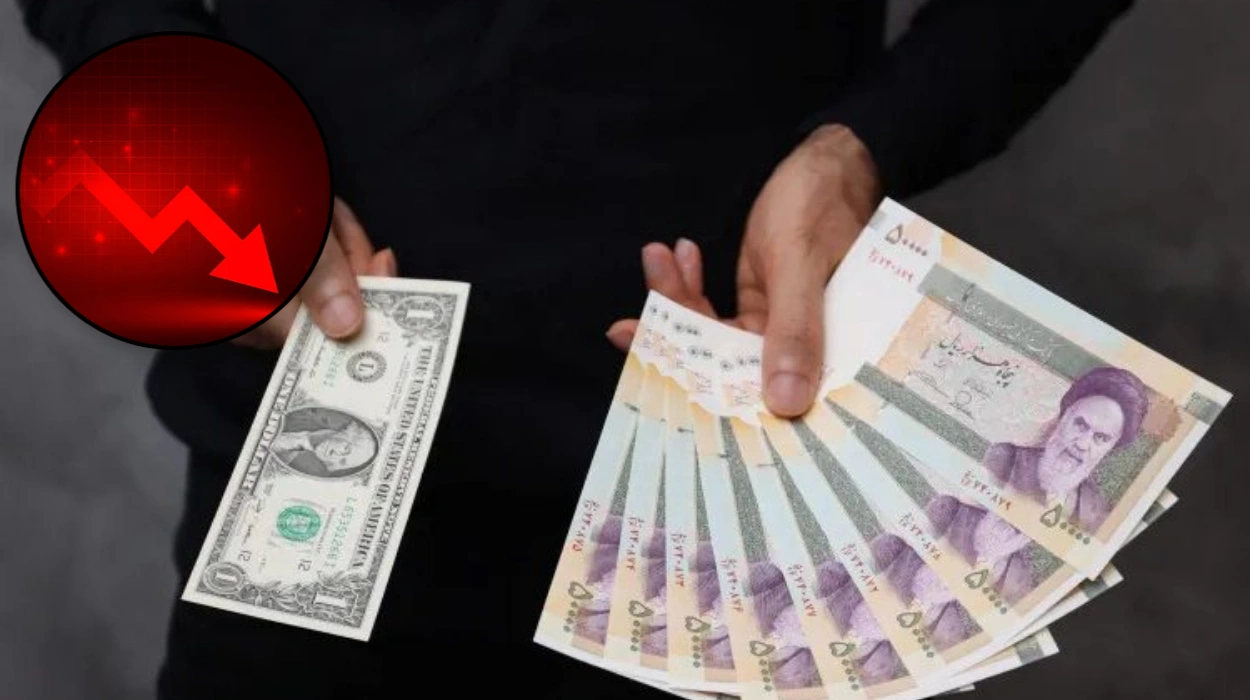
Tehran (Britain Today News) August 24, 2026 – Iran’s currency hit a record low on Monday as Washington prepared to announce fresh sanctions it said would add further pressure on an economy already battered by previous measures and a US naval blockade. The rial dropped to 2.02 million to the US dollar as trading opened on informal currency markets, even as Iran’s Central Bank maintains an official rate of around 1.5 million rials per dollar, a gap that underscores the depth of the crisis for ordinary Iranians who rely on the market rate.
- Key Points
- What triggered the rial’s record fall to 2.02 million per dollar?
- How severe is inflation and food price pressure for Iranian households?
- What do IMF projections say about Iran’s 2026 economic outlook?
- What new US sanctions are being prepared and why do they matter?
- How has the UAE’s trade suspension affected Iran’s import channels?
- What has Iran’s Foreign Ministry said about escalation and response options?
- Why does the Strait of Hormuz remain a strategic lever for Iran?
- What is the reported Iran–Oman plan to manage the Strait of Hormuz?
- How are ordinary Iranians reacting to the currency collapse?
- What are the implications for regional trade and diplomacy?
What triggered the rial’s record fall to 2.02 million per dollar?
The latest plunge follows months of compounding shocks. Even before US and Israeli attacks on Iran on 28 February, the rial faced heavy pressure from double‑digit inflation and negative economic growth; nearly six months of war have since driven the currency to repeated lows, culminating in Monday’s breach of the psychologically significant 2 million threshold. As reported by the Associated Press, the informal market rate of 2.02 million rials per dollar is the price most Iranians encounter when buying foreign currency, making the drop acutely felt across households and small businesses.
How severe is inflation and food price pressure for Iranian households?
Rising prices are deepening economic strain, with essential food costs surging since the war began. Rice prices have jumped by around 60% and beef prices by more than 150%, according to reporting that aggregates on‑the‑ground observations and market data. In downtown Tehran, residents lined up to buy US dollars on Monday, with one man telling the Associated Press he was using his remaining savings to protect against further declines in the rial, a scene that illustrates the rush into hard currency as a hedge against erosion of purchasing power.
What do IMF projections say about Iran’s 2026 economic outlook?
Compounding concerns over inflation, sanctions and months of war, the International Monetary Fund projects Iran’s economy will shrink by more than 5% this year, placing further strain on households and businesses. A contraction of this magnitude would rank among the steepest declines in the region for 2026 and signals that the combined effects of conflict, trade disruption and financial isolation are feeding through to real output, employment and incomes.
What new US sanctions are being prepared and why do they matter?
Aiming to intensify economic pressure on Tehran, the Trump administration has pledged tougher sanctions against Iran, including secondary measures targeting entities and countries that maintain business ties with Tehran. As reported by Reuters, the US Treasury is expected to broaden the scope of secondary sanctions it can impose on entities and countries that maintain business ties with Iran, with a source familiar with the plans saying the action is likely to reveal additional categories of Iran‑related conduct subject to secondary sanctions in the future. The source added that for certain Iranian sectors, any activity, even in a third country, could be subject to secondary sanctions, raising the stakes for banks, traders and logistics firms that facilitate transactions on behalf of the Iranian government.
How has the UAE’s trade suspension affected Iran’s import channels?
The growing pressure also follows the United Arab Emirates’ decision last week to suspend all trade with Iran, a major blow given that the UAE has long served as one of Tehran’s largest trading partners and its primary source of imports. The suspension, enacted after Abu Dhabi accused Tehran of missile fire, removes a critical conduit for goods and re‑exports, tightening supply chains and contributing to higher domestic prices for consumers and manufacturers reliant on imported inputs.
What has Iran’s Foreign Ministry said about escalation and response options?
Warning against further escalation, Iranian Foreign Ministry spokesperson Esmail Baghaei stated on Monday that any heightened friction would carry consequences, adding that Tehran’s options to respond remain open. His remarks come amid hostile rhetoric from both sides, with Iran denouncing US plans to announce new sanctions that could put further strain on the Islamic Republic’s economy and impact its most important trading partners, including China. Baghaei has previously argued that such secondary sanctions “find no foundation in international law”, a position Tehran has reiterated on social media and in diplomatic channels.
Why does the Strait of Hormuz remain a strategic lever for Iran?
Despite mounting economic pressure, Iran continues to hold strategic leverage through the Strait of Hormuz, where persistent attacks and security threats have brought maritime traffic nearly to a standstill. The chokepoint’s vulnerability amplifies the global stakes of the crisis, as disruptions there ripple through oil markets, insurance costs and shipping schedules, reinforcing Tehran’s ability to extract political and economic concessions even as its currency weakens.
Explore More about the World:
Indonesia, China Hold Key Defence and Energy Talks in Jakarta
Spain’s Hotel Prices Jump 5.9% in July as Valencia Leads Surge
What is the reported Iran–Oman plan to manage the Strait of Hormuz?
Meanwhile, Iran and Oman are reportedly finalising an agreement on a joint strategy to manage the Strait of Hormuz, with Oman’s Foreign Minister Badr Albusaidi scheduled to visit Tehran on Tuesday for talks. The initiative reflects regional efforts to stabilise a critical maritime corridor and reduce the risk of miscalculation, even as Washington hopes for a deal to reopen the strait within days, according to earlier reporting.
How are ordinary Iranians reacting to the currency collapse?
On the ground, the currency collapse is reshaping daily financial behaviour. In downtown Tehran, queues formed at exchange offices as residents sought dollars, with one man telling the Associated Press he was deploying his remaining savings to shield against further rial declines. Such scenes underscore a broader shift towards dollarisation of savings and a loss of confidence in the local currency, trends that can entrench inflationary expectations and complicate policy responses.
What are the implications for regional trade and diplomacy?
The convergence of record currency weakness, expanded US secondary sanctions and the UAE’s trade suspension creates a tight feedback loop that constrains Iran’s access to hard currency, imports and financing. At the same time, diplomatic overtures such as the Iran–Oman talks on the Strait of Hormuz indicate that regional actors are seeking off‑ramps to prevent further escalation, even as Washington signals an “economic D‑Day” approach designed to maximise pressure on Tehran.