Key Points
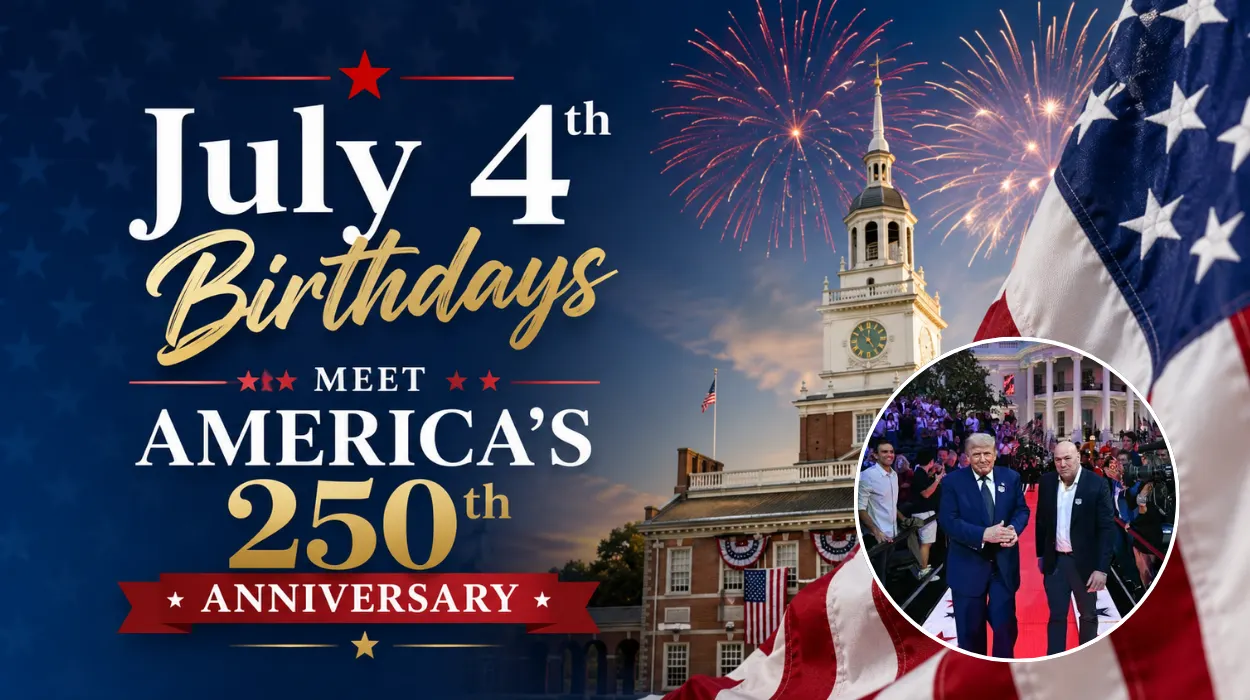
- The United States marks the 250th anniversary of its independence from Britain on 4 July 2026, with events organised across the National Mall under the Donald Trump administration.
- The milestone coincides with ongoing civil rights rollbacks, immigration crackdowns and strained international relations.
- Several Americans who share their birthday with Independence Day described mixed and often difficult emotions about this year’s celebrations.
- Interviewees include a writer based in Brussels and Barcelona, a goldsmith from Portland, a retired research scientist from Connecticut, a retired professor from Virginia, a graduate student from Arizona, a retired journalist from New Jersey, and a retired university employee from Arlington.
- Many respondents drew comparisons with the bicentennial celebrations of 1976, which several described as more meaningful than the 250th anniversary.
- Concerns raised by respondents centred on the perceived politicisation of the anniversary and its association with the current administration.
- One respondent linked the anniversary to broader unresolved questions about race and class in American history.
- Despite the criticism, several respondents said they still planned modest personal celebrations, such as baking pies or gathering with friends.
Washington DC (Britain Today News) July 04, 2026 – The United States on Saturday marks 250 years since declaring independence from Britain, a milestone the Donald Trump administration is marking with a series of events and celebrations across the National Mall. For a number of Americans, however, the date carries a second layer of significance, as it is also the day they were born, and this year several told the Guardian the anniversary has left them with complicated feelings about celebrating a personal milestone alongside a national one.
- Key Points
- What Makes This Year’s Anniversary Different From Past Celebrations?
- What Did Jo Haemer Say About Celebrating This Year?
- Why Does Craig Allen Compare 2026 to the Bicentennial?
- How Does Bill Combs Feel About Sharing His Birthday With Independence Day?
- What Did Bertram P Dowd Say About Reconciling Patriotism With His Birthday?
- How Has Brian O’Reilly’s Sense of National Pride Changed Over Time?
- What Did the Arlington Respondent Say About America’s Political Divisions?
- What Happens Next as the National Mall Marks 250 Years?
The commemorations arrive at a moment of considerable political tension in the United States. The anniversary follows a period marked by rollbacks to civil rights protections, stepped-up immigration enforcement, and friction in the country’s relationships abroad. Against that backdrop, several people who share their birthday with the Fourth of July said they were struggling to reconcile personal celebration with the national mood, even as they acknowledged decades of enjoying the coincidence.
What Makes This Year’s Anniversary Different From Past Celebrations?
For most of their lives, several respondents said, sharing a birthday with Independence Day had been a source of pride and novelty rather than discomfort. Barbecues, fireworks and the general goodwill of a national holiday made growing up on 4 July feel special, they said. This year, however, the scale of the semiquincentennial commemorations, paired with the political climate surrounding them, has changed that calculus for some.
Several interviewees pointed specifically to the involvement of the Trump administration in shaping the tone of the anniversary, arguing that the celebrations felt less like a shared national moment and more like a platform for the current government. Others said the anniversary had prompted them to reflect more critically on the ideals the day is meant to represent, and how far the country has moved from them.
How Does Maria Ashot View the 250th Anniversary?
Maria Ashot, a 69-year-old writer and Harvard University graduate who divides her time between Brussels and Barcelona, said the Fourth of July had always held deep personal resonance for her, rooted in the principles of the Declaration of Independence. Speaking to the Guardian, Ashot said she believed being American meant living up to those founding ideals.
She was sharply critical of this year’s commemorations, telling the Guardian that Donald Trump had appropriated the occasion. Referring to a recent altercation reported at the White House, Ashot said the president’s “utter lack of class & sophistication” had culminated in disorder at a building she said he had “half-demolished”. She added plainly that she would not be joining in the official festivities this year.
What Did Jo Haemer Say About Celebrating This Year?
Jo Haemer, a 73-year-old high-end gold and platinum smith based in Portland, Oregon, was born in Germany to American parents during the Cold War. She told the Guardian that her upbringing as a military child had shaped how she and her siblings see the world, describing themselves as unusually adventurous and flexible as a result.
Haemer, who typically marks the day by baking pies and hosting friends for drinks and desserts, said she often finds herself celebrating quietly because many people she knows leave town for the holiday. Reflecting on the scale of this year’s anniversary, she told the Guardian that the country’s bicentennial in 1976 had felt more meaningful to her than the 250th, attributing the shift in part to the current administration.
Why Does Craig Allen Compare 2026 to the Bicentennial?
Craig Allen, a 71-year-old retired research scientist based in Connecticut, also drew a direct comparison between this year’s commemorations and the bicentennial celebrations of 1976. He recalled watching the tall ships gather in Philadelphia as a young man and feeling genuine pride in the nation’s achievements at the time.
By contrast, Allen told the Guardian that this year’s milestone had proven difficult for him personally. He said the current mood felt markedly different, telling the Guardian that “the country has lost its way”, and that the scale of official celebrations made him want to retreat from public life altogether rather than take part.
How Does Bill Combs Feel About Sharing His Birthday With Independence Day?
Bill Combs, a 74-year-old retired professor living near Bryce Mountain in Virginia, said that for decades he had understood the Fourth of July was not really about him personally, even as he enjoyed the cake, fireworks and picnics that came with it. He described it to the Guardian as simply a “neat day” to have been born on.
This year, however, Combs said his enthusiasm had waned considerably. He told the Guardian he was not looking forward to observing the day at all, describing it as a self-serving occasion that had cheapened the meaning of the word “America”. He went further, characterising the 250th anniversary as a spectacle signifying nothing of substance.
What Did Bertram P Dowd Say About Reconciling Patriotism With His Birthday?
Bertram P Dowd, a graduate student based in Arizona whose own father was also born on 4 July in the late 1950s, told the Guardian that this particular birthday had left him conflicted. He said he wanted to be able to enjoy the cultural commemorations surrounding the 250th anniversary, but felt that the broader symbols of patriotism had become too closely associated with the Trump administration and its supporters for him to take part comfortably.
Dowd told the Guardian he hoped that, in decades to come, once the current political moment had passed, he might feel able to celebrate the day fully again. For this year, though, he said his plans were considerably more modest, preferring to stay home rather than join in the wider celebrations.
How Has Brian O’Reilly’s Sense of National Pride Changed Over Time?
Brian O’Reilly, a 77-year-old retired journalist based on the New Jersey shore, shares his birthday not only with the nation but with his identical twin brother. He told the Guardian that growing up as a twin born on Independence Day had once given him a strong sense of personal and national pride, with all three elements, being a twin, sharing the date, and being American, reinforcing one another.
O’Reilly said that pride had eroded over time, first during the Vietnam War and more recently under the current administration. He told the Guardian it had been more enjoyable to share a birthday with the country decades ago, when the United States was more widely regarded as an admired global example, adding that the tone of this year’s celebrations had taken some of the joy out of the occasion for him.
What Did the Arlington Respondent Say About America’s Political Divisions?
A retired university employee based in Arlington, Virginia, who also shares the 4 July birthday, described this year’s anniversary to the Guardian as “complicated”. She said the current political climate had placed considerable strain on the country and exposed deep structural faults within American democracy.
She went further in linking the country’s present divisions to older, unresolved patterns, telling the Guardian that white elites had long persuaded poorer white Americans to align against their own economic interests rather than identify with fellow working people across racial lines. Her comments reflected a broader theme among respondents: a sense that this year’s milestone had prompted deeper reflection on the nation’s unfinished business.
Explore More about World:
World Bank Approves $70m Loan for Connected Punjab Digital Drive
Devastating Earthquakes Hit Venezuela: UNICEF Rushes Aid to Children
Are All July 4 Birthdays Being Marked With the Same Sense of Unease?
Not every respondent framed the day in identical terms, though a common thread ran through nearly all the accounts shared with the Guardian: long-standing personal affection for the coincidence of their birth date, tempered this year by discomfort with the political tone of the official commemorations. Several noted they still intended to mark the day quietly with family or friends, even while declining to take part in larger public events.
The pattern suggests that for at least some Americans born on Independence Day, the 250th anniversary has become less a straightforward celebration and more an occasion for reflection on the state of the country relative to the ideals the day is meant to honour. For many of those who spoke to the Guardian, the discomfort was not with the idea of the anniversary itself, but with the way it has been staged and by whom, a distinction several respondents were careful to draw.
That distinction, between the country’s founding ideals and the manner of this year’s official commemorations, recurred throughout the interviews. Several respondents framed their reluctance to take part in public events not as a rejection of patriotism, but as an expression of it, arguing that genuine national pride requires holding the country to the standards set out in its founding documents rather than simply marking the calendar.
What Happens Next as the National Mall Marks 250 Years?
Official events are continuing across the National Mall over the Independence Day period, forming part of the administration’s programme to mark the semiquincentennial. Coverage of both the public commemorations and the personal reflections of those born on the date is expected to continue as the anniversary unfolds, with the accounts shared by Ashot, Haemer, Allen, Combs, Dowd, O’Reilly and the Arlington respondent offering a snapshot of how differently individuals are experiencing a shared milestone in American history.
Whether the mixed sentiment expressed by these respondents is broadly representative of Americans born on the Fourth of July remains difficult to say from a small sample of accounts. What is clear from those who spoke to the Guardian is that, for them, this particular birthday has arrived freighted with more meaning, and more ambivalence, than in years past.