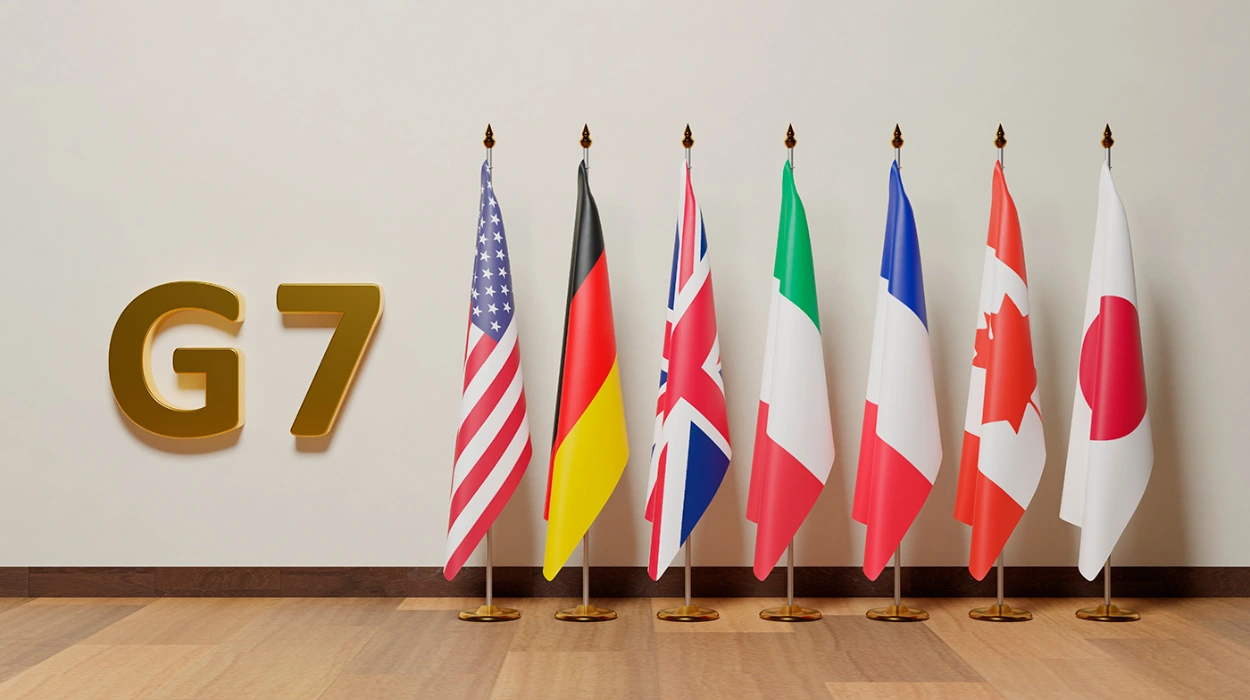
The G7 (Group of Seven) is an intergovernmental forum of seven advanced democracies—Canada, France, Germany, Italy, Japan, the United Kingdom, and the United States—plus the European Union—that collectively generate more than $57 trillion in nominal GDP (about 29% of the global economy in 2024) and hold roughly 50% of worldwide nominal net wealth. These nations coordinate global economic policy, address transnational security threats, and lead on climate, health, and technology governance through annual summits and ministerial tracks.
- What are the G7 countries and how did the group form?
- Which seven nations belong to the G7 and who leads them today?
- How much economic power do G7 countries hold today?
- What is the G7’s structure and how does it operate without a formal charter?
- How does the G7 influence global economics and finance?
- What security and geopolitical roles does the G7 play now?
- How does the G7 lead on climate change and energy policy?
- What is the G7’s stance on technology and artificial intelligence governance?
- How has the G7’s global influence changed relative to the G20 and BRICS?
- What internal divisions and external challenges weaken the G7 today?
- What is the future relevance of the G7 in a shifting global order?
- How does the G7 compare economically to China and emerging powers?
- What real-world examples show the G7’s impact on global issues?
- What are the key takeaways on the G7’s economic strength and global role now?
What are the G7 countries and how did the group form?
The G7 consists of Canada, France, Germany, Italy, Japan, the UK, and the US, formed from the 1975 G6 summit at Rambouillet after the 1973 oil crisis; Russia joined in 1998 as the G8 and was suspended in 2014 over Crimea, reverting the bloc to G7. The group has no treaty or secretariat; it operates via a rotating annual presidency that sets agendas and hosts summits, with ministers (“sherpas”) negotiating policy before leaders meet.
The G7 originated from an informal 1973 meeting of finance ministers in the White House library—known as the “Library Group”—between the US, UK, West Germany, France, and Japan, which expanded to include Italy at France’s 1975 Rambouillet summit. Canada joined in 1976, creating the G7. The European Union became a “non-enumerated member” in 1981, attending via the European Council and Commission presidents.
The bloc’s core purpose was macroeconomic coordination after the Nixon shock, the 1970s energy crisis, and the collapse of Bretton Woods. By the 1980s, the G7 broadened to security issues (e.g., the Iran–Iraq War, Soviet occupation of Afghanistan) and later launched debt-relief programs for heavily indebted poor countries, Chernobyl shelter funding, and the Financial Stability Forum.
Russia’s 1998 membership created the G8, but its 2014 annexation of Crimea led to indefinite suspension, and Russia formally left in 2018. The 2022 full-scale invasion of Ukraine deepened G7 cohesion, prompting coordinated sanctions, energy embargoes on Russian oil/gas, and hundreds of billions in aid to Ukraine—including a 2024 framework to loan $50 billion using profits from frozen Russian assets.
Which seven nations belong to the G7 and who leads them today?
The seven members are Canada (PM Mark Carney), France (President Emmanuel Macron), Germany (Chancellor Friedrich Merz), Italy (PM Giorgia Meloni), Japan (PM Sanae Takaichi), the UK (PM Keir Starmer), and the US (President Donald Trump), with the EU represented by António Costa and Ursula von der Leyen. France holds the 2026 presidency and hosts the June 15–17, 2026 summit in Évian-les-Bains.
Every member is a wealthy democracy classified as an “advanced economy” by the IMF. The group represents about 780 million people (nearly 10% of the world population) and uses five official languages: English, French, German, Italian, and Japanese.
| Member | Head of Government | Finance Minister | Central Bank Leader | Currency | NATO | OECD |
|---|---|---|---|---|---|---|
| Canada | Mark Carney (PM) | François-Philippe Champagne | Tiff Macklem (Governor) | CAD | Yes | Yes |
| France | Emmanuel Macron (President) | Roland Lescure | François Villeroy de Galhau | EUR | Yes | Yes |
| Germany | Friedrich Merz (Chancellor) | Lars Klingbeil | Joachim Nagel (President) | EUR | Yes | Yes |
| Italy | Giorgia Meloni (PM) | Giancarlo Giorgetti | Fabio Panetta (Governor) | EUR | Yes | Yes |
| Japan | Sanae Takaichi (PM) | Satsuki Katayama | Kazuo Ueda (Governor) | JPY | No | Yes |
| UK | Keir Starmer (PM) | Rachel Reeves (Chancellor) | Andrew Bailey (Governor) | GBP | Yes | Yes |
| US | Donald Trump (President) | Scott Bessent | Kevin Warsh (Chair) | USD | Yes | Yes |
Data sourced from Wikipedia’s current leaders table.
How much economic power do G7 countries hold today?
In 2024, the G7’s combined nominal GDP was nearly $57 trillion (29% of global economy); as of 2024, they hold over 44% of world nominal GDP, about 30% of GDP by PPP, and roughly 50% of global nominal net wealth. The US alone accounts for $32.4 trillion nominal GDP (2026), while Germany leads Europe at $5.45 trillion.
The economic share has declined over the past decade due to emerging economies’ growth—especially China. In 2024, the G7’s PPP-adjusted GDP share fell below 30%, and excluding the US, it was half that. However, the G7 still dominates in high-value sectors: technology, finance, aerospace, pharmaceuticals, and advanced manufacturing.
Per capita wealth remains highest in the G7. The US leads at $94,430 nominal GDP per capita (2026), followed by Germany ($65,303), Canada ($60,305), and the UK ($61,056). All members have Human Development Index (HDI) scores above 0.915, indicating “very high” development.
Trade volume totals $26.1 trillion (2025) for the G7 excluding the EU. The US leads with $9.076 trillion in trade, followed by Germany ($5.002 trillion) and the EU ($9.189 trillion).
What is the G7’s structure and how does it operate without a formal charter?
The G7 is an informal forum with no charter or secretariat; it operates via a rotating annual presidency that sets the agenda, hosts the summit, and coordinates ministerial meetings led by “sherpas” (envoys). The EU participates fully as a non-enumerated member since 1981.
The presidency rotates yearly among members. France presides in 2026, Germany in 2025, Canada in 2024, and Italy in 2023. Each presiding country defines priorities (e.g., climate, AI, Ukraine) and organizes logistics.
Ministers and sherpas negotiate policy initiatives throughout the year before leaders meet at the annual summit (typically June/July). Since 1987, G7 Finance Ministers meet at least semi-annually, up to four times yearly. Seven ministerial tracks exist: finance, environment, health, trade, interior, digital/technology, and development.
Nonmember countries are sometimes invited. The 2025 Canada summit included India, Australia, Brazil, Mexico, South Africa, South Korea, and Ukraine. The 2023 Hiroshima summit invited South Korea, Australia, India, Indonesia, Brazil, Vietnam, Comoros, Cook Islands, and Ukraine.
How does the G7 influence global economics and finance?
The G7 coordinates global economic policy, sets rules for international finance, and drives initiatives like the 15% global minimum corporate tax (agreed 2021), debt relief for poor countries, and the Financial Stability Forum. It shapes IMF and World Bank policies and leads on currency coordination (e.g., 1985 Plaza Accord).
The group launched the G20 in 1999 to include emerging markets, but the G7 remains the core decision-making cluster for advanced economies. G7 members contribute about 75% of global official development assistance (ODA) and are the biggest contributors to international organizations.
Key economic mechanisms:
- Plaza Accord (1985): US, Japan, UK, France, Germany coordinated to devalue the USD, correcting trade imbalances.
- Global minimum corporate tax: 2021 provisional agreement on 15% rate to curb tax avoidance.
- Debt relief: 2005 announcement of up to 100% cancellation for heavily indebted poor countries.
- Financial Stability Forum: Established to manage the international monetary system.
The G7 also imposes coordinated sanctions on economic adversaries. Post-2022, members barred Russian banks from dollar/euro transactions and phased out Russian oil/gas imports, crippling Moscow’s revenue.
What security and geopolitical roles does the G7 play now?
The G7 leads Western sanctions against Russia, supports Ukraine with hundreds of billions in aid, coordinates on China’s economic coercion, addresses nuclear proliferation (Putin, North Korea), and manages Middle East instability (Iran-Israel conflict). In June 2025, G7 leaders affirmed Israel’s right to self-defense and labeled Iran the “principal source of regional instability”.
The bloc imposed unprecedented sanctions after Russia’s 2022 Ukraine invasion: energy embargoes, financial restrictions, and military weapons transfers. In 2024, G7 agreed to loan Ukraine $50 billion using profits from frozen Russian assets.
On China, the G7 hardened its stance in March 2025, removing references to the “One China” policy regarding Taiwan—a shift Beijing opposes. The 2024 Italy summit communiqué referenced Beijing dozens of times, mostly as an adversary.
Nuclear threats from Putin and North Korea reinvigorated G7 security focus. The 2023 Hiroshima summit launched the “Hiroshima AI Process” to govern AI globally, fearing AI could raise nuclear conflict risk.
The 2025 Canada summit focused prominently on the Iran-Israel conflict (Twelve-Day War). Leaders signed a deescalation statement, but no joint Ukraine declaration emerged—marking a rift.
How does the G7 lead on climate change and energy policy?
The G7 committed to the 2015 Paris Agreement, launched the Global Apollo Programme, and in April 2024 agreed to close all coal power plants by 2030–2035 unless greenhouse gases are captured or emissions align with the 1.5°C pathway. The bloc also pledged $20 million in 2019 to fight Brazil’s Amazon fires.
Climate is a core track. The 2021 UK summit encouraged action against climate change and biodiversity loss. The 2022 Germany summit discussed climate, energy, and health under “Investing in a Better Future”.
Key initiatives:
- Paris Agreement (2015): G7 catalyzed the landmark climate deal.
- Coal phase-out: 2024 agreement on 2030–2035 closure with carbon capture exceptions.
- Global Apollo Programme: Launched at the 2015 Bavaria summit to promote low-carbon investment.
- Amazon pledge: $20 million for Brazil wildfire response (2019), though criticized as small.
The G7 also promotes clean energy and ocean protection. Canada’s 2018 presidency emphasized “working together on climate change, oceans, and clean energy”.
What is the G7’s stance on technology and artificial intelligence governance?
The G7 launched the 2023 “Hiroshima AI Process” to develop a common global AI governance framework, addressing risks like AI accelerating nuclear conflict. The 2025 summit also issued statements on AI, quantum computing, and critical minerals.
Technology is a growing track. The 2021 UK summit included a digital/technology ministerial meeting (April 28–29). The group focuses on AI safety, quantum encryption, and supply chains for critical minerals.
The Hiroshima AI Process aims to establish international standards for AI development, usage, and oversight. It emerged amid fears that rapidly advancing AI could destabilize nuclear deterrence.
How has the G7’s global influence changed relative to the G20 and BRICS?
The G7’s GDP share has declined from over 40% to 29% (2024) due to emerging economies; many analysts now view the G20 as more relevant, representing 85% of global GDP and two-thirds of the world population, including China, India, Brazil, and Russia. The BRICS group (now including Egypt, Ethiopia, Iran, UAE, Indonesia) also challenges G7 dominance.
The G20 surpassed the G7 in prestige after the 2007–08 financial crisis, when leaders first met in Washington post-Lehman Brothers. The G20 adopted a 2.1% collective growth goal in 2014 and enabled the US-China Paris Agreement announcement in 2016.
Experts argue the G7 “risks failure” without China and emerging powers. G7 summits now regularly invite outsiders to broaden expertise—the 2025 summit included India despite strained Canada-India relations.
Proposed expansions include:
- D10: G7 plus Australia, India, South Korea (Atlantic Council proposal)
- G9: G7 plus South Korea and Australia (to reduce Eurocentrism)
- T-12: “Techno Democracies” including more digital-power nations
Trump floated a “Group of Eleven” adding Russia to D10 in 2020, but all other members rejected it.
What internal divisions and external challenges weaken the G7 today?
Internal divisions include US trade/climate tensions under Trump (2017–2021, 2025–present), disagreements on China policy, and the 2025 summit’s failure to produce a joint communiqué. External challenges are China’s rise, nuclear proliferation, AI risks, and Middle East instability.
Trump challenged unity on trade (imposing steel/aluminum tariffs on allies) and climate (refusing Paris Agreement commitment in 2017). Merkel called it a “depressing withdrawal”; Macron urged him “to be serious”. Trump also pushed for Russia’s readmission in 2018 and 2020, rejected by all others.
In 2025, Trump criticized Russia’s expulsion as causing the Ukraine war, then left the summit a day early to address the Twelve-Day War. No joint Ukraine declaration emerged—a departure from 2024’s $50 billion asset-profits loan agreement.
European leaders face UK-EU navigation, rising nationalism, and cohesion challenges. The 2016 G7 warned a UK-EU exit would reverse global trade/trends.
What is the future relevance of the G7 in a shifting global order?
Experts say the G7 is “fast becoming a ritualized gathering of states struggling to define what they still share,” yet it remains influential on sanctions, climate, AI, and Ukraine aid. The 2026 France summit will test whether middle powers can revive relevance.
Thomas Liu (Institute for Peace & Diplomacy) wrote:
“The G7 is no longer what it once claimed to be: a steering committee of the free world”.
Yet the bloc still catalyzes major initiatives: Paris Agreement, Ukraine $50 billion loan, Hiroshima AI Process, coal phase-out.
France’s 2026 presidency focuses on “middle power” engagement. The summit (June 15–17, Évian-les-Bains) will likely address Ukraine, Iran, China, AI, and climate.
The G7’s future depends on:
- Unity: Resolving US-EU rifts on trade, China, Russia
- Expansion: Including Australia, India, South Korea (D10)
- Complementarity: Working with G20, not competing
- Outreach: Engaging Global South on infrastructure, climate finance
Without these, the G7 risks irrelevance. With them, it can remain a core coordinator of advanced democracies.
How does the G7 compare economically to China and emerging powers?
China’s 2024 nominal GDP is ~$17.9 trillion (17.9% global share), rivaling the US but below the G7’s $57 trillion total; however, China leads in PPP-adjusted GDP and manufacturing output. The G7 dominates in net wealth per adult, HDI, and high-tech sectors.
| Metric | G7 (excl. EU) | China | US |
|---|---|---|---|
| Nominal GDP (2024) | $57 trillion | ~$17.9T | $32.4T |
| Global GDP share (nominal) | 29% | ~17.9% | ~26% |
| GDP share (PPP) | ~30% | ~40%+ | ~16% |
| Net wealth share | ~50% | ~17.9% | ~30%+ |
Data from CFR and Statista.
China exceeds the G7 in PPP GDP due to lower prices, but the G7 holds far more net wealth per adult and higher HDI. The G7 leads in aerospace (Boeing, Airbus), semiconductors (NVIDIA, Intel), pharmaceuticals (Pfizer, Roche), and finance (JPMorgan, HSBC).
Emerging powers (India, Brazil, Indonesia) are growing fast. India’s 2026 nominal GDP is projected at $4.15 trillion, becoming the G7’s “most significant insurance policy” at Évian.
Explore More about World:
UN approves first-ever labour treaty for gig economy platform workers
Iran Pact Signed, U.S. Officials Say: Strait of Hormuz Traffic Set to Surge
What real-world examples show the G7’s impact on global issues?
The G7 imposed coordinated Russia sanctions (2022–present), pledged $20 million for Amazon fires (2019), launched the Hiroshima AI Process (2023), and agreed to close coal plants by 2030–2035 (2024). It also funded Ukraine with $50 billion via frozen Russian asset profits (2024).
Examples:
- Russia sanctions: Energy embargoes, banking restrictions, $50B Ukraine loan
- Amazon fires: $20M pledge to Brazil (2019), Macron threatened Mercosur trade deal block
- Hiroshima AI Process: 2023 global AI governance framework
- Coal phase-out: 2024 agreement on 2030–2035 closure
- Global min. tax: 2021 15% corporate tax provisional agreement
- Paris Agreement: G7 catalyzed 2015 climate deal
- Ukraine aid: Hundreds of billions in financial/military support since 2022
These actions demonstrate the G7’s ability to mobilize rapid, coordinated responses to crises.
What are the key takeaways on the G7’s economic strength and global role now?
The G7 remains the world’s core advanced-democracy forum, controlling 29% of global GDP, 50% of net wealth, and leading on sanctions, climate, AI, and Ukraine. Its share has declined, but it still sets rules for finance, trade, and technology while coordinating Western responses to Russia and China.
Core facts:
- 7 members + EU: Canada, France, Germany, Italy, Japan, UK, US
- GDP: $57T nominal (2024), 29% global share
- Net wealth: ~50% worldwide
- Population: 780M (10% global)
- Presidency: France (2026), summit June 15–17, Évian-les-Bains
- Key initiatives: Paris Agreement, Hiroshima AI Process, coal phase-out, $50B Ukraine loan
The G7’s future depends on unity, outreach to emerging powers, and complementarity with the G20. Without these, it risks becoming ritualized. With them, it remains indispensable for advanced-democracy coordination.