Key Points
- The United States, United Kingdom and Australia have confirmed they are jointly developing unmanned undersea vehicles (UUVs) under the trilateral AUKUS defence pact.
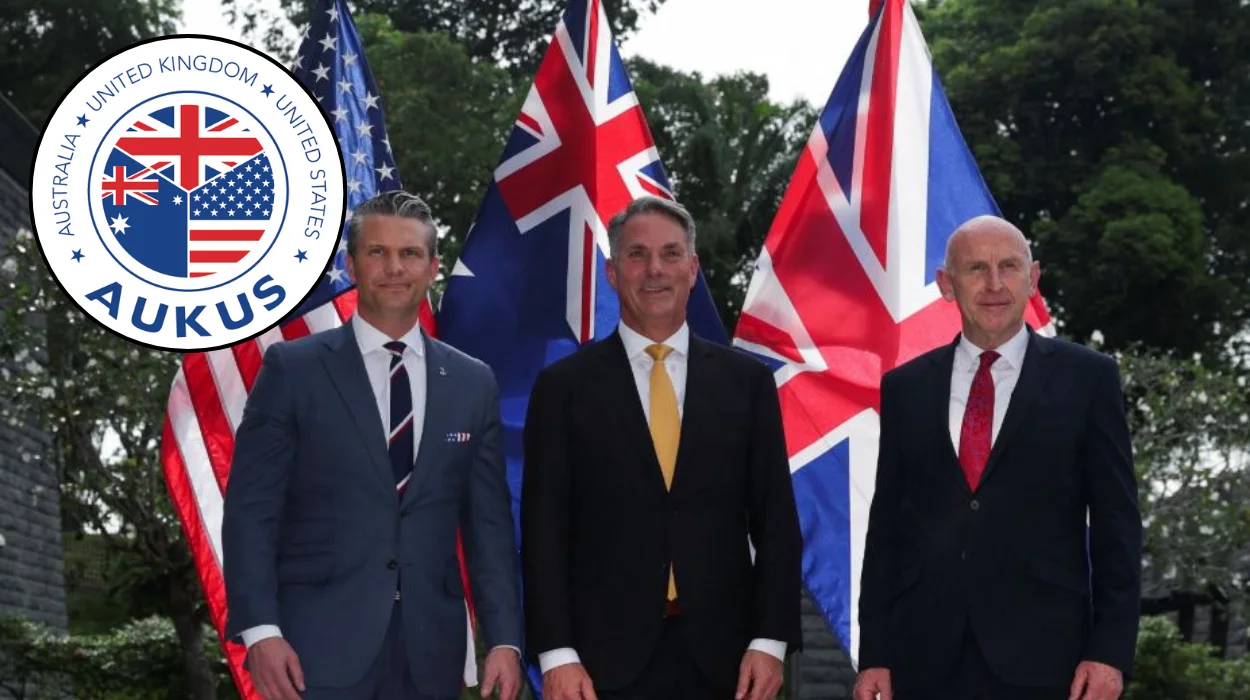
- U.S. Secretary of Defense Pete Hegseth announced the initiative to reporters on Saturday, calling it a “signature project” of AUKUS Pillar Two.
- AUKUS issued a joint statement confirming that delivery of the UUVs will begin in 2027.
- The programme aims to improve reconnaissance and strike capabilities and to bolster superiority in anti-submarine warfare, anti-surface warfare, mine countermeasures, electronic warfare and contested littoral manoeuvre.
- The UUV project sits under AUKUS “Pillar Two”, which focuses on advanced defence technologies including quantum computing, undersea systems, hypersonics, artificial intelligence and cyber technology.
- According to Hegseth, the signature project will deliver “a suite of highly adaptable multi-mission UUV payloads designed to support undersea operations and maintain our collective advantage in the maritime domain”.
- AUKUS was formed in 2021 by the US, UK and Australia as part of broader efforts to counter China’s growing power in the Indo-Pacific region.
- The announcement reinforces AUKUS’s shift from purely nuclear-submarine cooperation (Pillar One) to broader technology-sharing and joint capability development under Pillar Two.
United States (Britain Today News) May 30, 2026 – The United States, Britain and Australia have moved decisively into a new phase of undersea warfare cooperation, with the three nations now developing unmanned undersea vehicles for deployment from 2027 under the AUKUS security pact.
- Key Points
- What exactly is the AUKUS unmanned undersea vehicle programme?
- “a suite of highly adaptable multi-mission UUV payloads”,
- Why are the US, UK and Australia developing these systems now?
- How does this fit into the broader AUKUS structure?
- What capabilities will the unmanned undersea vehicles provide?
- What does the 2027 delivery timeline mean in practice?
- How does this affect regional security and the balance of power?
- What are the implications for defence industry and technology sharing?
- How will operators and navies use these systems?
- What questions remain unanswered?
- What does this mean for the future of AUKUS?
U.S. Secretary of Defense, in remarks to reporters on Saturday, the trilateral partnership is advancing a “signature project” to deliver a range of multi-mission unmanned undersea vehicle (UUV) payloads that will operate across the Indo-Pacific and beyond. In a joint statement released by AUKUS, the three countries confirmed that the first deliveries of these vehicles are scheduled to begin in 2027, marking a tangible milestone in the pact’s second pillar of advanced technology collaboration.
The programme is designed to enhance the three nations’ reconnaissance and strike capabilities while bolstering superiority in anti-submarine and anti-surface warfare, mine countermeasures, electronic warfare and contested littoral manoeuvre, according to the AUKUS joint statement. Hegseth described the initiative as central to maintaining collective advantage in the maritime domain, emphasising that the UUVs will be “highly adaptable” and capable of supporting a wide spectrum of undersea operations.
What exactly is the AUKUS unmanned undersea vehicle programme?
As explained in the joint AUKUS statement, the unmanned undersea vehicle programme is a core element of Pillar Two, the pact’s technology and innovation track that runs alongside the more publicly discussed nuclear-submarine cooperation under Pillar One. Pillar Two was established to accelerate development and sharing of advanced defence technologies, including quantum computing, undersea systems, hypersonic and counter-hypersonic capabilities, artificial intelligence and cyber technology.
The UUV project is described as a “signature project” within this framework, meaning it is intended to be a flagship capability that demonstrates the practical benefits of trilateral technology integration. Rather than a single device, the effort will deliver
“a suite of highly adaptable multi-mission UUV payloads”,
suggesting that the three nations are planning a family of systems that can be configured for different tasks such as surveillance, mine detection, intelligence gathering and potentially strike support.
According to Hegseth, these payloads are designed to support undersea operations and maintain collective advantage in the maritime domain, underscoring the strategic intent behind the programme. The emphasis on adaptability and multi-mission use indicates that the weapons and sensors carried by the UUVs, as well as the vehicles themselves, may be modular and upgradable as threat conditions evolve.
Why are the US, UK and Australia developing these systems now?
The timing of the announcement reflects both technological readiness and strategic urgency in the Indo-Pacific. As noted in the AUKUS statement, the programme is part of broader efforts by the three countries to push back against China’s growing power in the region. Since AUKUS was formed in 2021, the security environment in the Indo-Pacific has become increasingly contested, with Beijing expanding its naval capabilities, anti-access/area-denial systems and undersea domain awareness.
Undersea warfare is particularly critical in this context, because submarines and unmanned undersea systems can operate beneath the surface where traditional air and surface defences are less effective. By developing UUVs jointly, the United States, Britain and Australia aim to gain an edge in detecting, tracking and, if necessary, engaging adversary submarines and surface ships while simultaneously improving their own situational awareness.
Hegseth’s description of the UUVs as tools to bolster superiority in anti-submarine and anti-surface warfare, mine countermeasures, electronic warfare and contested littoral manoeuvre directly addresses these challenges. Littoral manoeuvre, in particular, refers to operations in shallow coastal waters where many of the region’s crucial sea lanes, ports and naval bases are located, and where traditional large submarines face greater risks.
How does this fit into the broader AUKUS structure?
AUKUS is structured around two main pillars. Pillar One focuses on helping Australia acquire conventionally armed, nuclear-powered submarines (SSNs) with technology and industrial support from the United States and the United Kingdom. Pillar Two, by contrast, is oriented toward joint development and sharing of advanced technologies across a wider range of domains, including undersea systems, hypersonics, quantum technologies, AI and cyber.
The UUV programme is a clear manifestation of Pillar Two’s ambition to move beyond planning and announcements into concrete, deliverable capabilities. Where Pillar One has been dominated by long timelines and complex industrial arrangements around SSNs, Pillar Two is intended to be more agile, with faster cycles of development, testing and fielding.
As reported by Hegseth, the UUV initiative is the “signature project” of this pillar, indicating that it is being used as a testbed for how the three nations can collaborate on complex defence technology without relying solely on existing national programmes. The joint statement’s emphasis on a
“suite of highly adaptable multi-mission UUV payloads”
suggests that the three countries are building a shared architecture that can integrate different sensors, weapons and mission modules from all three partners.
What capabilities will the unmanned undersea vehicles provide?
According to the AUKUS joint statement, the UUV programme will improve the three nations’ reconnaissance and strike capabilities and bolster superiority in several key areas: anti-submarine warfare, anti-surface warfare, mine countermeasures, electronic warfare and contested littoral manoeuvre. Each of these areas represents a distinct operational challenge that unmanned undersea systems are uniquely suited to address.
In anti-submarine warfare, UUVs can act as persistent, low-profile sensors that patrol choke points, sea lanes and adversary coastal waters, feeding acoustic and other data back to surface ships, submarines and aircraft. In anti-surface warfare, they can be equipped with sensors to detect and track surface vessels and, potentially, with weapons to engage them, thereby extending the reach of naval forces without putting manned platforms at direct risk.
Mine countermeasures represent another critical application, as UUVs can map the seafloor, detect and classify mines and, in some configurations, neutralise them, keeping manned minesweepers and other ships out of danger. Electronic warfare missions may involve UUVs that emit signals to deceive or jam adversary sonar and communications, or that monitor the electromagnetic spectrum to build a picture of enemy activity.
Finally, contested littoral manoeuvre refers to operations in shallow, crowded coastal waters where there is a high risk of detection and engagement. In such environments, small, quiet, unmanned systems can operate in coordination with manned submarines and surface ships to provide additional sensors, decoys or strike options, thereby complicating an adversary’s defensive calculations.
What does the 2027 delivery timeline mean in practice?
AUKUS’s joint statement confirms that delivery of the unmanned undersea vehicles will start in 2027. That timeline implies that significant development, testing and integration work is already underway or planned in the immediate future, with the aim of moving from prototype to operationalCapability within a relatively short window.
For naval programmes, a 2027 delivery date is ambitious but not unprecedented, particularly for unmanned systems that can be incrementally upgraded as they enter service. The phrasing “delivery will start in 2027” suggests an initial batch of vehicles or payloads will be handed over to the three navies for evaluation and early operational use, with further batches and capabilities following in subsequent years.
Hegseth’s description of the project as delivering a
“suite of highly adaptable multi-mission UUV payloads”
reinforces the idea that the 2027 milestone is the beginning of a broader rollout, rather than a one-off procurement. This approach allows the three nations to learn from early deployments, refine designs and adapt missions as the strategic environment and technological landscape evolve.
How does this affect regional security and the balance of power?
The AUKUS UUV programme is explicitly framed as part of efforts to
“push back against China’s growing power in the Indo-Pacific region”.
By enhancing undersea reconnaissance, strike and mine-countermeasure capabilities, the United States, Britain and Australia are seeking to complicate adversary planning and strengthen deterrence in a region where maritime disputes and strategic competition are intensifying.
Undersea systems are particularly sensitive from a strategic perspective, because they can operate below the surface and are difficult to detect and track. A network of allied UUVs operating across the Indo-Pacific could provide continuous monitoring of key sea lanes, straits and naval bases, thereby improving early warning and reducing the risk of surprise.
At the same time, the development of such capabilities is likely to be viewed by Beijing as a further hardening of the US-led alliance architecture in the region, potentially prompting countermeasures in its own undersea programmes and in diplomatic and economic levers. The announcement thus adds another layer to the ongoing strategic competition in the Indo-Pacific, where control of the undersea domain is increasingly seen as decisive.
What are the implications for defence industry and technology sharing?
The UUV programme sits squarely within Pillar Two’s broader aim of deepening technology sharing and joint industrial collaboration among the three nations. By defining the project as a “signature project”, AUKUS signals that it intends to use this programme as a model for how the partners can co-develop, co-produce and co-field advanced defence systems.
This approach has significant implications for defence industries in the United States, Britain and Australia, as it creates opportunities for shared contracts, joint research and development, and integrated supply chains. The emphasis on “multi-mission UUV payloads” suggests that different companies and research institutions across the three countries may contribute sensors, weapons, software and platform elements, all integrated under a common architecture.
From a legal and policy perspective, the programme also tests the partners’ ability to navigate export controls, classification regimes and national security restrictions while still achieving meaningful interoperability. Successfully doing so could set a precedent for future Pillar Two initiatives in hypersonics, quantum computing, AI and cyber technology.
Explore More about World:
Trump set to return to Walter Reed for third medical check‑up of his second term
US Forces Act Against Ship Defying Iran Port Restrictions
How will operators and navies use these systems?
Although specific operational concepts remain classified, the AUKUS statement and Hegseth’s remarks provide enough detail to sketch a plausible picture of how the UUVs might be employed. The navies of the United States, Britain and Australia are likely to integrate UUVs into existing undersea and surface fleets, using them as force multipliers rather than as standalone assets.
For example, submarines could deploy UUVs ahead of their position to scout ahead, map the seabed or detect enemy activity, thereby extending their situational awareness without exposing themselves. Surface ships could launch and recover UUVs to conduct persistent surveillance in contested areas, while aircraft could drop UUV payloads into key maritime zones for long-duration missions.
The “highly adaptable” nature of the payloads suggests that operators will be able to reconfigure UUVs for different missions as the operational picture changes, swapping sensors or weapons depending on whether the priority is intelligence gathering, mine countermeasures or strike support. This flexibility is particularly valuable in a dynamic environment where adversaries are constantly adapting their tactics and technologies.
What questions remain unanswered?
While the announcement provides a clear strategic direction and a delivery timeline, several important questions remain. The exact types, sizes and ranges of the UUVs have not been disclosed, nor have the specific sensors, weapons or communications systems that will be integrated into the payloads. Similarly, the division of labour among the three countries – which nation will lead platform development, which will provide certain payloads, and how costs will be shared – has not been detailed in the public statement.
The operational basing and deployment patterns for the UUVs are also unclear. Will the systems be homeported in Australia, with forward deployments to the Indian and Pacific Oceans, or will they be distributed across multiple bases in all three countries? How will the partners manage operational command and control for UUVs that may cross national boundaries and operate in contested waters?
Finally, the extent to which the UUV programme will be open to other allies and partners, or remain strictly a US–UK–Australia endeavour, is not specified. These are questions that will likely be addressed in coming months as the programme moves from announcement to implementation.
What does this mean for the future of AUKUS?
The confirmation of a concrete, time-bound UUV programme strengthens the case that AUKUS is evolving from a strategic declaration into a practical capability-building alliance. By delivering a
“suite of highly adaptable multi-mission UUV payloads”
starting in 2027, the three nations are demonstrating that Pillar Two can produce tangible results on a relatively fast timeline.
If the UUV project succeeds, it could pave the way for additional signature projects in other Pillar Two domains, such as hypersonic systems, quantum-enabled communications and AI-driven command and control. Conversely, any technical, industrial or political difficulties in delivering the UUVs could test the resilience of the trilateral partnership and force a reassessment of timelines and expectations.
For now, the AUKUS statement and Hegseth’s remarks make clear that the three countries view the undersea domain as central to their shared strategic outlook. By committing to jointly develop and field unmanned undersea vehicles, they are signalling that the future of maritime competition in the Indo-Pacific will be decided, in significant part, beneath the waves.