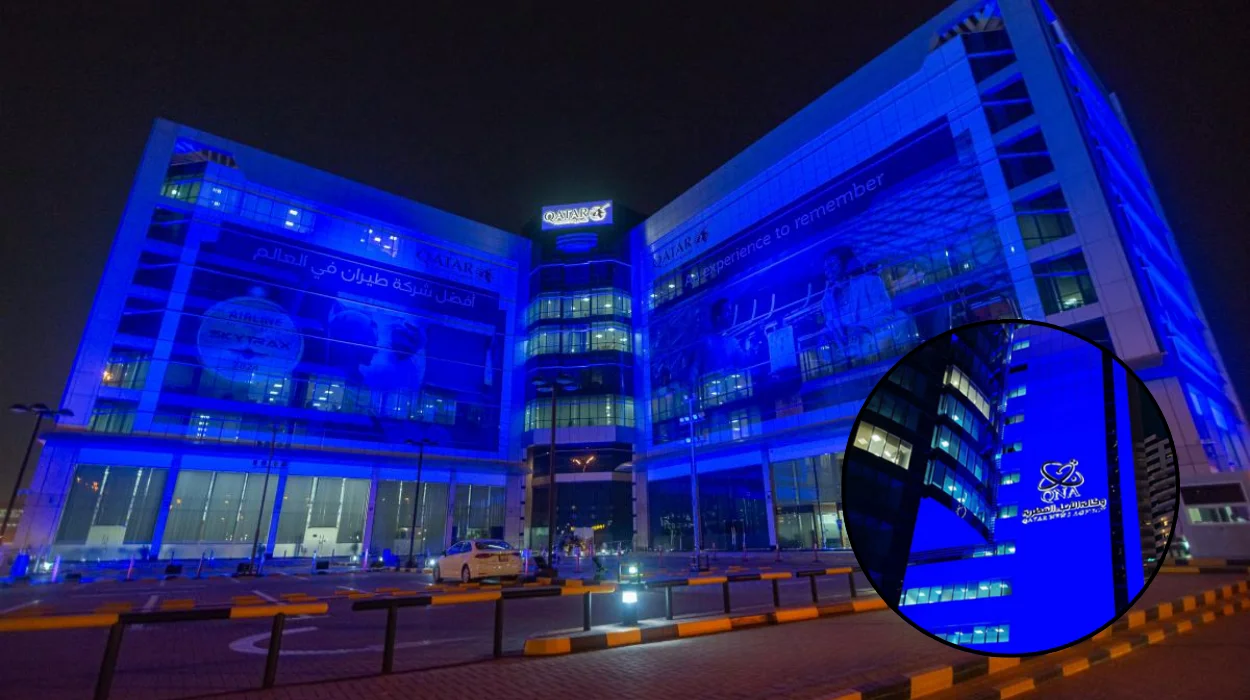
Key Points
- Qatar News Agency (QNA) illuminated its headquarters in blue to mark World Autism Awareness Day on April 2, 2026.
- The initiative joins other state institutions in raising global awareness about autism.
- The annual event, observed worldwide on April 2, promotes awareness, support, and inclusion for individuals with autism.
- QNA’s participation highlights the importance of awareness, encouraging access to care and resources for those affected.
- The effort aligns with Qatar’s comprehensive development process under the Qatar National Vision 2030.
- World Autism Awareness Day was established by the United Nations General Assembly in 2007, following a proposal by the State of Qatar.
Doha (Britain Today News) April 2, 2026 – The Qatar News Agency (QNA) has illuminated its headquarters in striking blue light to commemorate World Autism Awareness Day, actively participating alongside other state institutions in a nationwide push to heighten public consciousness about autism spectrum disorders. This symbolic gesture underscores Qatar’s ongoing commitment to fostering inclusion and support for individuals living with autism, emphasising the need for enhanced access to essential care and resources.
The blue illumination, a globally recognised emblem for autism awareness, draws attention to the challenges faced by millions worldwide. QNA’s initiative forms part of a broader observance held annually on April 2, a date designated to spotlight the unique needs of those on the autism spectrum and advocate for their integration into society.
What Is World Autism Awareness Day?
World Autism Awareness Day serves as a pivotal platform for global advocacy, encouraging governments, organisations, and communities to prioritise autism-related issues. Established through a landmark resolution by the United Nations General Assembly in 2007, the day emerged directly from a proactive proposal submitted by the State of Qatar. This Qatari-led effort highlighted the nation’s forward-thinking approach to neurodevelopmental disorders, positioning Doha as a key player in international health diplomacy.
The resolution, formally known as A/RES/62/139, called upon member states to raise awareness about autism at all levels. It urged actions such as improving early diagnosis, expanding research, and bolstering support services. Since its inception, the day has galvanised millions, with landmarks from the Eiffel Tower to the Burj Khalifa bathed in blue each April 2. In Qatar, the observance resonates deeply, reflecting the country’s holistic vision for societal advancement.
QNA’s statement emphasised that its blue lighting ceremony aims to
“highlight the importance of awareness and encourage broader support and inclusion for individuals with autism.”
This aligns seamlessly with national priorities, as the agency noted its participation dovetails with the State of Qatar’s comprehensive development process. At the core of this process lies the Qatar National Vision 2030, a blueprint that envisions a knowledge-based economy while addressing human development comprehensively, including health and social inclusion.
Why Did QNA Choose Blue Illumination?
The choice of blue holds profound symbolism, representing trust, peace, and reliability – qualities essential in the journey towards autism acceptance. QNA’s headquarters, a prominent fixture in Doha’s media landscape, stands illuminated as a beacon, visible to passersby and symbolising solidarity. This act mirrors global traditions where public buildings, bridges, and monuments don the colour to spark conversations.
As reported directly from QNA’s official dispatch, the initiative seeks to promote
“awareness and global support for those affected.”
It underscores the agency’s role not just as a news disseminator but as a participant in national awareness campaigns. By joining state institutions, QNA amplifies a collective message: autism awareness transcends individual efforts, requiring unified action.
Qatar’s involvement extends beyond symbolism. The nation has invested significantly in autism support infrastructures, including specialised centres and educational programmes. These efforts ensure that individuals with autism gain access to tailored therapies, vocational training, and community integration opportunities – all vital for empowering them to lead fulfilling lives.
How Does This Align with Qatar National Vision 2030?
The Qatar National Vision 2030 serves as the foundational framework for the country’s transformation into a diversified, sustainable economy by mid-century. Pillar four of this vision focuses on human development, stressing capabilities enhancement, social protection, and family cohesion. QNA explicitly linked its observance to this pillar, stating that participation
“comes in line with the State of Qatar’s comprehensive development process as outlined in the Qatar National Vision 2030.”
This alignment manifests in tangible policies. Qatar has expanded autism screening in schools, introduced inclusive education models, and funded research hubs. The Supreme Council of Health, now part of the Ministry of Public Health, coordinates these initiatives, ensuring evidence-based interventions. By illuminating its building, QNA reinforces how media can drive public discourse on these fronts, encouraging empathy and policy advocacy.
Experts note that such high-profile gestures normalise discussions around autism, reducing stigma prevalent in many societies. In Qatar, where family-centric values prevail, awareness campaigns empower parents and caregivers with knowledge about early intervention, which can dramatically improve outcomes.
Who Proposed World Autism Awareness Day to the UN?
Qatar’s diplomatic imprint on this day is indelible. In 2007, the State of Qatar proposed the resolution to the UN General Assembly, advocating for a dedicated global awareness platform. This move stemmed from Her Highness Sheikha Moza bint Nasser, Chairperson of the Qatar Foundation, whose longstanding advocacy for education and disability rights propelled the initiative.
The assembly adopted the resolution unanimously on December 18, 2007, designating April 2 as World Autism Awareness Day. Qatar’s proposal highlighted autism’s global prevalence – affecting approximately 1 in 100 children worldwide, according to WHO estimates – and the urgent need for coordinated responses. Subsequent years saw Qatar hosting UN forums on autism, cementing its leadership.
QNA’s coverage recalls this heritage, positioning the 2026 observance as a continuation of Qatar’s pioneering role. The agency’s statement proudly notes the UN establishment “following a proposal by Qatar,” reminding audiences of the nation’s contributions to international welfare.
What Impact Does Autism Awareness Have Globally?
Raising awareness translates into real-world change. On this front, World Autism Awareness Day has catalysed policy shifts worldwide. Countries have enacted anti-discrimination laws, boosted funding for therapies, and promoted employment quotas for autistic individuals. In the Gulf region, Qatar’s efforts have inspired neighbours like the UAE and Saudi Arabia to launch similar campaigns.
Challenges persist, however. Diagnosis rates vary, with underreporting in low-resource areas skewing data. QNA’s initiative addresses this by advocating for “access to care and resources,” a call echoed in UN reports urging equitable services. In Qatar, public-private partnerships have established facilities like the Sidra Medicine Autism Centre, offering multidisciplinary care.
Families benefit immensely from such visibility. Parents report greater community understanding post-awareness events, easing daily interactions. Schools incorporate sensory-friendly designs, workplaces offer neurodiversity training – all ripples from days like April 2.
Why Is Qatar Committed to Autism Inclusion?
Qatar’s commitment reflects its broader social contract. The Qatar National Vision 2030 integrates disability inclusion across sectors, from urban planning to labour markets. State institutions, including QNA, exemplify this by embedding awareness into operations. The blue illumination serves as a visual pledge, signalling that inclusion is non-negotiable.
Statistics underscore the stakes: Qatar’s population growth amplifies the need for scalable services. Government data shows rising autism diagnoses, prompting investments in genetic research and behavioural therapies. QNA’s role amplifies these narratives, ensuring they reach policymakers and the public.
Looking ahead, the 2026 observance invites broader participation. QNA encourages entities to adopt blue symbols, fostering a movement. This collective momentum promises sustained progress towards a fully inclusive Qatar.
In summary, QNA’s blue-lit headquarters on April 2, 2026, encapsulates Qatar’s dedication to autism awareness. Rooted in national vision and global leadership, it advances a future where every individual thrives.