
Key Points
- Joint US-Israeli Operation Epic Fury launched February 28, 2026, triggering immediate crypto market reactions.
- Iranian exchange outflows jumped 700% within minutes of airstrikes, totaling over $10.3 million in 72 hours.
- 60% of outflows moved to self-custody wallets by ordinary Iranians protecting savings from collapsing rial.
- 27% flowed to international exchanges for dollar liquidity.
- Bitcoin fell 23.8% to $65,000 on March 1 but rebounded above $70,000 by mid-March, up 8% from lows; gold dropped 11.6%.
- Brent crude surged from $60 to over $119 per barrel due to Strait of Hormuz tensions.
- Bitcoin global hashrate fell 8% in March from price slump crushing mining margins, especially Middle East operators.
- IRGC-linked networks moved over $3 billion yearly via USDT on Tron stablecoins.
- Iran’s Strait of Hormuz Management Plan, passed March 30, mandates $1-per-barrel Bitcoin toll for oil tankers; 2 million-barrel supertanker pays ~$2 million.
- Bitcoin enables wartime trade settlement for sanctions-hit Iran, bypassing SWIFT and dollar system.
- Total crypto market stabilized near $2.5 trillion by early April despite equity losses.
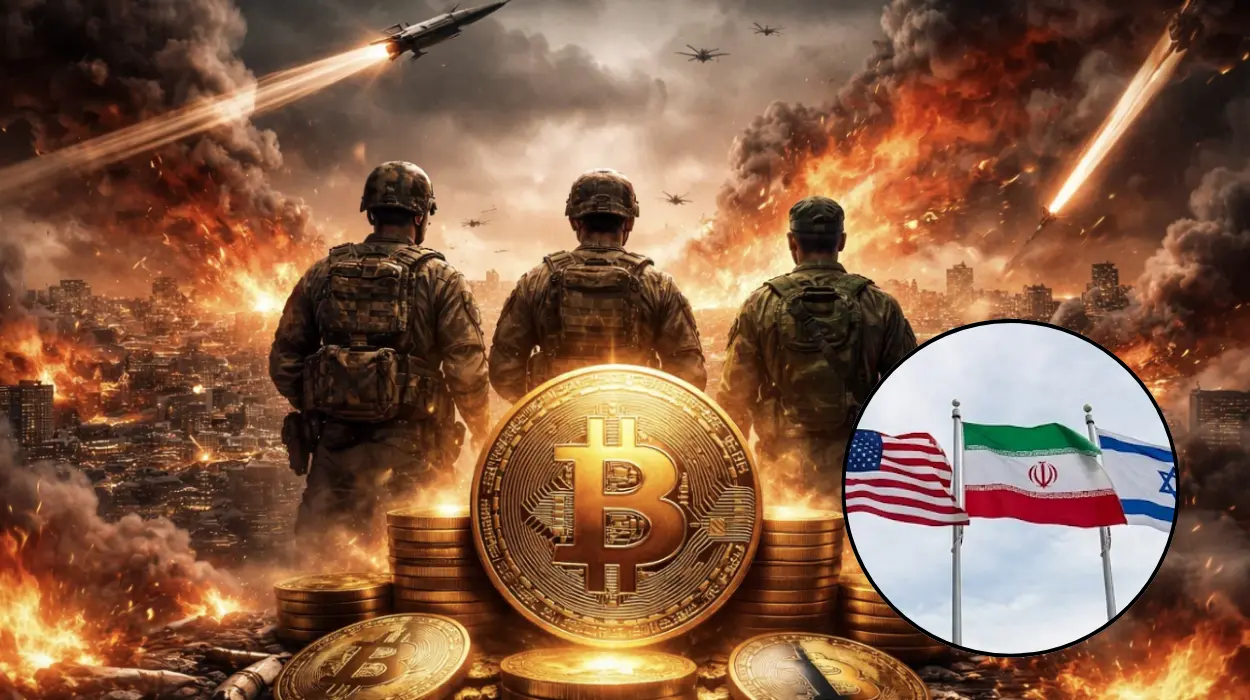
Tehran (Britain Today News) April 10, 2026 – The escalating Iran-US-Israel conflict has thrust cryptocurrency into the heart of global crisis management, transforming digital assets into vital tools for wartime payments, sanctions evasion, and civilian financial survival.
- Key Points
- How Did Bitcoin Weather the Initial Market Shock?
- What Impact Did the War Have on Oil Prices and Crypto Mining?
- Why Have Stablecoins Emerged as a Key Battleground?
- How Is Iran Using Bitcoin for Strait of Hormuz Tolls?
- What Does This Mean for Crypto’s Role in Global Crises?
- How Have Iranian Civilians Relied on Crypto Amid Chaos?
- What Lessons Emerge for Bitcoin’s Sovereign Adoption?
- Why Did Traditional Hedges Like Gold Falter?
- What Regulatory Ripples Follow Stablecoin Exposures?
Markets reacted with lightning speed when the joint US-Israeli offensive, codenamed Operation Epic Fury, commenced on February 28. Iranian cryptocurrency exchange outflows surged 700% within minutes of the initial airstrikes. Over the following 72 hours, more than $10.3 million exited major local platforms.
Ordinary Iranians drove much of this movement, with around 60% of funds shifting to self-custody wallets to shield savings from the rapidly depreciating rial and mounting geopolitical uncertainty. Another 27% directed towards international exchanges, as citizens sought dollar-pegged liquidity amid frozen banking channels.
How Did Bitcoin Weather the Initial Market Shock?
The first waves of panic hammered Bitcoin, sending its price down 23.8% to a low of about $65,000 by March 1, as missile exchanges lit up the Gulf region. Traditional financial markets ground to a halt over the weekend, with cross-border banking routes tightening under the strain of heightened sanctions and logistical disruptions.
Yet Bitcoin’s downturn proved short-lived. The cryptocurrency clawed back strongly, surpassing $70,000 by mid-March and gaining roughly 8% from its post-crash trough. In stark contrast, gold – long hailed as the quintessential war-time safe haven – plummeted 11.6% over the same interval, underscoring Bitcoin’s emerging resilience in conflict zones.
This rebound highlighted cryptocurrency’s decoupling from conventional assets during acute crises. As equities wavered and physical commodities faced supply chokepoints, Bitcoin’s borderless nature allowed it to serve as a rapid store of value for those under duress.
What Impact Did the War Have on Oil Prices and Crypto Mining?
Tensions encircling the Strait of Hormuz propelled Brent crude prices from $60 to above $119 per barrel, amplifying global energy market volatility. This surge rippled into Bitcoin’s infrastructure, where the network’s global hashrate dipped 8% throughout March.
Miners, particularly smaller operators in the Middle East, grappled with insolvency as Bitcoin’s price slump eroded profit margins. The pressure stemmed not primarily from spiking electricity costs but from diminished revenues that squeezed operational viability. Remarkably, the Bitcoin network weathered this disruption without systemic collapse, demonstrating its decentralised robustness.
Why Have Stablecoins Emerged as a Key Battleground?
Stablecoins have crystallised as a focal point in the conflict’s financial skirmishes. Investigators uncovered that networks affiliated with Iran’s Islamic Revolutionary Guard Corps (IRGC) had been channeling more than $3 billion annually, predominantly through USDT on the Tron blockchain.
This activity underscores how dollar-pegged stablecoins facilitate sanctions circumvention, offering liquidity and transfer speed unavailable through traditional rails. Tron’s low fees and high throughput have made it a preferred conduit for such high-volume, covert flows.
How Is Iran Using Bitcoin for Strait of Hormuz Tolls?
Iran has pioneered a starkly innovative application of Bitcoin in statecraft. Under the Strait of Hormuz Management Plan, enacted on March 30, oil tankers transiting the vital chokepoint must remit a toll of $1 per barrel in Bitcoin to secure clearance and naval escort.
A fully laden supertanker carrying 2 million barrels would thus incur approximately $2 million in cryptocurrency payments. This policy marks the first instance of a sovereign entity leveraging Bitcoin at scale for global trade settlement in one of the world’s most critical shipping arteries.
For Iran, severed from the SWIFT system and dollar-dominated finance, Bitcoin provides a wartime bulwark that stablecoins alone cannot match. Its proven scarcity and network security offer predictability amid volatility, turning a pariah asset into a pragmatic lifeline.
What Does This Mean for Crypto’s Role in Global Crises?
By early April, the broader cryptocurrency market had steadied near $2.5 trillion in total valuation, defying regional instability and equity market routs. Ceasefire murmurs and short squeezes further bolstered Bitcoin’s climb back to $69,000 levels.
This episode cements cryptocurrency’s transition from financial periphery to crisis epicentre. Digital assets now synchronise with warfare dynamics, enabling rapid capital flight, sovereign toll collection, and survival hedging. Iran’s Bitcoin toll exemplifies how sanctioned states can repurpose crypto for economic leverage, potentially inspiring similar tactics elsewhere.
The conflict exposes vulnerabilities too. Mining disruptions reveal infrastructure frailties, while stablecoin flows invite intensified regulatory scrutiny from Western powers. Yet Bitcoin’s rebound over gold signals shifting investor paradigms, where programmable money outpaces inert metals in fluid battlegrounds.
How Have Iranian Civilians Relied on Crypto Amid Chaos?
For everyday Iranians, cryptocurrency became a bulwark against fiat erosion. As the rial crumbled under airstrike fallout and capital controls, self-custody wallets absorbed the lion’s share of outflows. This grassroots shift reflects a broader awakening: in hyperinflationary war zones, holding keys trumps trusting banks.
International exchange inflows chased stable dollar exposure, bypassing jammed SWIFT lanes. Such movements, while modest in global terms, represented life savings for thousands, highlighting crypto’s democratising potential in authoritarian distress.
What Lessons Emerge for Bitcoin’s Sovereign Adoption?
Iran’s gambit elevates Bitcoin beyond speculation into geopolitical utility. By mandating crypto tolls, Tehran not only monetises its chokepoint but tests Bitcoin’s scalability for macro trade. A $2 million payment per supertanker scales effortlessly on Lightning Network layers, minimising on-chain congestion.
This real-world baptism challenges narratives of crypto as mere volatility plaything. Sovereign adoption, once theoretical, now contends with practicalities like wallet security and price oracles for barrel valuations. Success here could cascade, with other resource-rich actors eyeing similar models.
Why Did Traditional Hedges Like Gold Falter?
Gold’s 11.6% dive amid Bitcoin’s resurgence flips historical scripts. Physical delivery hurdles in contested seas hampered bullion logistics, while Bitcoin’s instant transferality shone. War’s acceleration of digital finance favours assets that ignore borders and embargoes.
Equity markets, meanwhile, bled from supply chain fears, yet crypto’s decentralisation insulated it. This divergence prompts analysts to rethink hedge portfolios, weighting Bitcoin higher in tail-risk scenarios.
What Regulatory Ripples Follow Stablecoin Exposures?
IRGC’s $3 billion USDT odyssey via Tron spotlights enforcement gaps. Tron’s opacity shields illicit vectors, prompting calls for enhanced blockchain forensics. Yet wartime exigencies complicate crackdowns, as civilian flows commingle with sanctioned ones.
Western regulators eye tighter stablecoin pegs and KYC mandates, potentially fragmenting dollar proxies. Iran’s pivot to Bitcoin sidesteps these, betting on native asset purity over tethered illusions.
The 2026 Iran-US-Israel clash endures as cryptocurrency’s defining crucible, recasting digital money as indispensable in strife. From tanker tolls to tellerless banking, crypto proves indispensable where legacy systems seize. As talks of truce flicker, markets hold breath, but Bitcoin’s wartime provenance is indelibly etched.