Key Points
- British Defence Secretary John Healey says UK jets are flying more missions across the Middle East than at any point in the past 15 years.
- Over 1,200 flying hours and 80 interception operations have been conducted since conflict with Iran escalated in February.
- UK has deployed 1,000 troops in the region and an additional 500 personnel in Cyprus.
- Healey announces deployment of Sky Sabre to Saudi Arabia, and other air-defence systems to Kuwait, Bahrain, and Qatar.
- The visit to Saudi Arabia aims to deepen UK-Gulf defence ties in response to growing Iranian aggression.
- British intelligence suspects continued coordination between Russia and Iran on drone warfare and electronic systems.
- Iran’s missile capabilities now include longer-range systems, though no direct threat to Europe has been assessed.
- UK reaffirms its readiness and defensive capacity to protect bases and allies against regional attacks.
London (Britain Today News) April 1, 2026 — British Defence Secretary John Healey has confirmed that the United Kingdom currently has more jets flying in the Middle East than at any other time in the past 15 years, marking a major reinforcement of UK air operations amid intensifying Iranian aggression in the Gulf region.
- Key Points
- Why has the UK ramped up its air operations in the Middle East?
- How many UK personnel and assets are currently deployed?
- What additional reinforcements has the UK announced?
- What did John Healey’s Saudi Arabia visit achieve?
- How is Russia involved in supporting Iran?
- Does Iran pose a direct threat to the UK or Europe?
- What does this signal for future UK-Gulf defence cooperation?
Healey revealed that British pilots have logged more than 1,200 flying hours since February, when the latest wave of conflict began, and have carried out over 80 interception operations in coordination with Royal Air Force Regiment units. The Defence Secretary also confirmed an expanded presence of UK troops and equipment across Saudi Arabia, Bahrain, Qatar, Kuwait, and Cyprus, reflecting what he described as a “modern partnership” with Gulf allies built on shared security interests.
Why has the UK ramped up its air operations in the Middle East?
During a detailed interview with Asharq Al-Awsat, Healey explained that the decision to increase air operations was driven by the surge in Iranian aerial and drone attacks targeting Gulf states since February 28.
“UK pilots and aircrew have flown over 1,200 hours on defensive missions across the region,”
he said.
“Together with our RAF Regiment gunners, they have now had over 80 engagements since the conflict began.”
Healey commended UK Armed Forces for
“flying alongside Gulf partners to help protect lives”
and stressed that British personnel were playing
“a vital role in safeguarding the region’s stability and preventing further escalation.”
The Ministry of Defence has also confirmed that these missions include defensive counter-air operations spanning Bahrain, Jordan, Qatar, the UAE, and Cyprus, all coordinated from regional command centres.
How many UK personnel and assets are currently deployed?
Healey confirmed that the UK has around 1,000 military personnel stationed across the Middle East, not including those in Cyprus.
“Force protection is at the highest levels for UK bases in the region,”
he stated, adding that Cyprus alone now hosts an additional 500 UK air defence personnel.
He detailed that Britain currently has Typhoon and F-35 jets in the region, Wildcat helicopters armed with counter-drone Martlet missiles, and a Merlin Crowsnest helicopter providing radar and airborne surveillance. HMS Dragon, one of Britain’s most advanced Type 45 destroyers, is deployed in the Eastern Mediterranean and integrated into the allied air-defence system.
“This is the largest British air presence in the region in 15 years,”
Healey emphasised.
“We are determined to keep our forces, our partners, and our shared interests safe.”
What additional reinforcements has the UK announced?
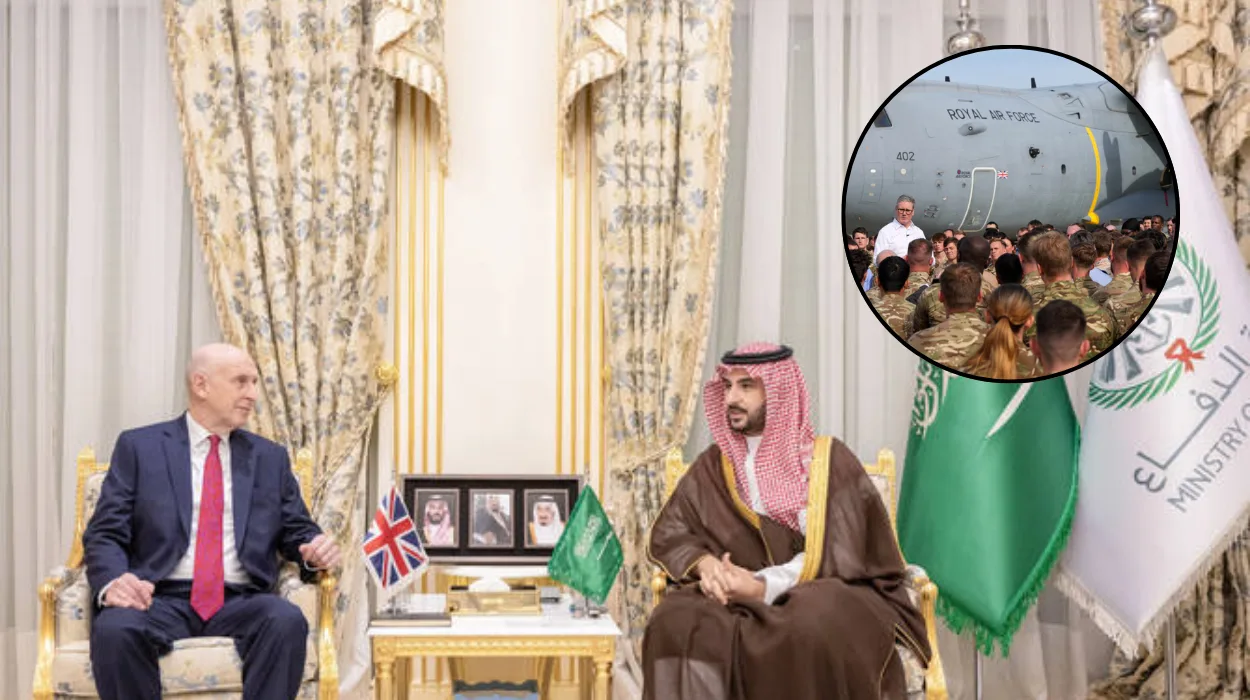
The Defence Secretary confirmed that more military assets are on the way to Gulf allies. During his recent visit to Saudi Arabia, Healey informed Saudi Defence Minister Prince Khalid bin Salman that Britain will deploy the Sky Sabre air-defence system to Saudi territory. The system, designed to detect and neutralise incoming missiles, will integrate with Saudi Arabia’s national defence grid.
In addition, Healey revealed that Rapid Sentry, a radar and missile launcher network, has been stationed in Kuwait, while Lightweight Multiple Launchers are now operating in Bahrain. He also said British aircraft continue nightly defensive missions over Qatar.
He noted that Taskforce Sabre, an industry-government collaboration, has been established to ensure British defence manufacturers can rapidly supply Gulf partners with advanced anti-drone systems.
“Taskforce Sabre brings together our industry and our allies under one objective — to protect lives and repel Iranian attacks,”
Healey said.
What did John Healey’s Saudi Arabia visit achieve?
According to Healey, his visit to Saudi Arabia aimed to demonstrate the UK’s solidarity with its long-standing ally in the face of sustained Iranian attacks.
“The purpose of my visit this week was to show our Saudi friends and partners that the United Kingdom stands with Saudi Arabia during this period of sustained and indiscriminate Iranian attacks,”
he said.
He described the bilateral relationship as
“a modern partnership responding to contemporary challenges,”
and praised the “trust and shared understanding” developed over decades of cooperation.
“Because of that deep foundation, we have been able to respond decisively, deploying new systems like Sky Sabre and other assets in record time,”
he added.
British and Saudi defence industries have enjoyed a history of collaboration, particularly in arms development, pilot training, and counterterrorism, but Healey characterised the current partnership as
“one forged through operational necessity in an era of regional volatility.”
How is Russia involved in supporting Iran?
When questioned on foreign backing for Iran’s operations, Healey was explicit in attributing continued drone and intelligence support to Moscow. He said British intelligence “highly likely” confirms that Russia provided Iran with extensive training and technological support before the latest outbreak.
“Our assessment is that Russia has shared intelligence and provided training to Iran, including on drone technology and electronic warfare,”
Healey explained, adding that these activities are
“ongoing despite international pressure.”
He further described the growing cooperation between the two nations as “an axis of aggression,” asserting that both
“menace their neighbours and pose a threat more widely to us all.”
This statement aligns with assessments by other Western intelligence agencies, which have linked Tehran’s increased drone precision and range to advanced Russian engineering support.
Does Iran pose a direct threat to the UK or Europe?
Healey sought to reassure the public that Britain does not currently assess any direct missile threat to Europe or its territories.
“There is no assessment that Iran is trying to target Europe with missiles,”
he stated, before reaffirming Britain’s readiness:
“Even if they did, we have the resources and alliances needed to defend the UK and our allies against any form of attack.”
He emphasised that UK bases in the Middle East, including RAF Akrotiri in Cyprus, remain under heightened protection. Defensive counter-air missions operate continuously, and additional radar and missile-defence upgrades are being implemented across key installations.
What does this signal for future UK-Gulf defence cooperation?
Healey’s comments highlight a broader recalibration of Britain’s military footprint in the region — one that underscores both deterrence and long-term alliance management. The UK’s expanded involvement reflects its strategic interest in maintaining open trade routes, energy infrastructure stability, and regional partnerships essential to British global security.
Analysts note that these moves also reinforce London’s post-Brexit foreign policy emphasis on “Global Britain,” asserting Britain’s influence through alliances beyond NATO frameworks.
In practical terms, the deployment of Sky Sabre and Rapid Sentry systems signals a new level of integration between British and Gulf defence networks, positioning the UK as a principal deterrent force alongside regional partners.
“We will continue to stand shoulder to shoulder with our Gulf friends as they defend their nations from aggression,”
Healey said, closing his remarks.
“Our Armed Forces remain vigilant, capable, and committed.”