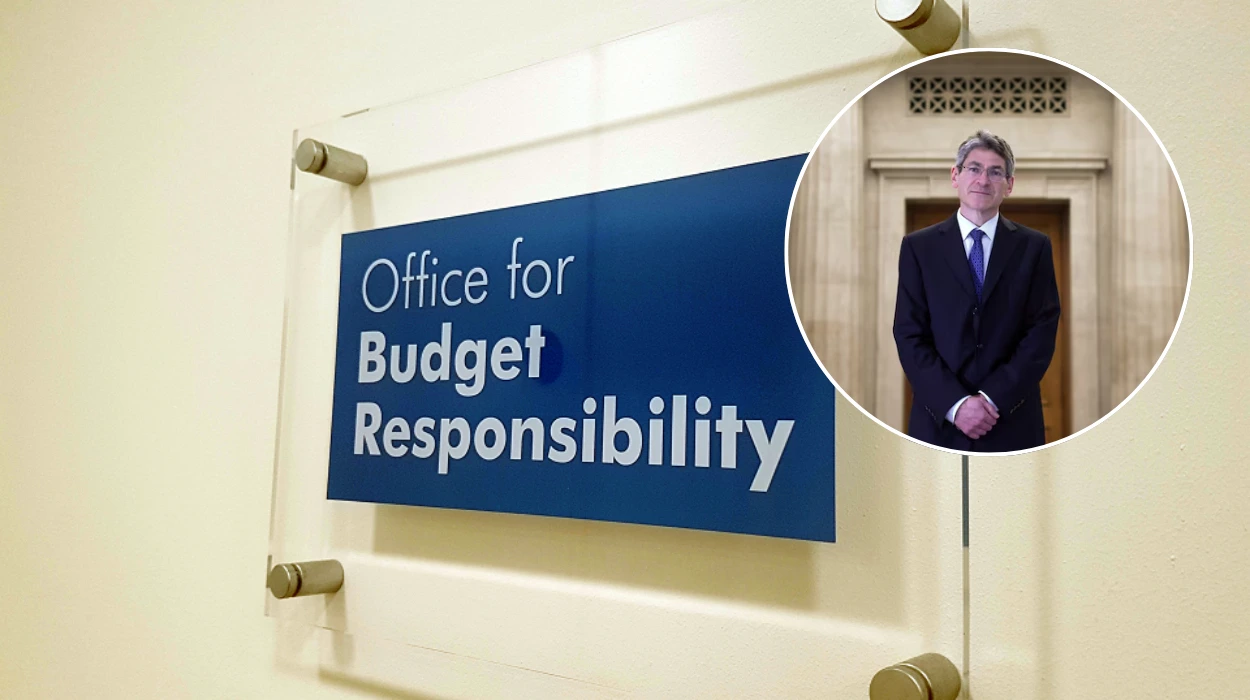
Key Points
- Parliament’s Treasury Committee has confirmed its backing for Jonathan Haskel to become the next chair of the Office for Budget Responsibility (OBR).
- The committee said Haskel possesses the “appropriate professional competence and personal independence” required for the post.
- Haskel, a former Bank of England interest rate-setter and economics professor, was put forward by the Treasury to replace Richard Hughes.
- Hughes resigned as OBR chair after the watchdog prematurely published details of Chancellor Rachel Reeves’ November budget.
- Appearing before the Treasury Committee, Haskel said he was less optimistic than most other analysts about Britain’s economic outlook.
- He told MPs that Britain was “not in a very good fiscal position”.
- Haskel warned that exposure to the jump in energy prices caused by the Iran war could embed high inflation into the economy for several years.
- He said his own forecast pointed to “somewhat higher interest rates and weaker GDP growth than most are expecting”.
- Despite the warnings, Haskel expressed optimism that growth in artificial intelligence could help lift Britain’s weak productivity record.
- Haskel defended the OBR against criticism that it has been too slow to revise down overly optimistic productivity forecasts.
London (Britain Today News) July 16, 2026 — Jonathan Haskel, a former Bank of England interest rate-setter and economics professor, has won the backing of MPs to become the new head of Britain’s budget forecasting agency, Parliament’s Treasury Committee confirmed on Thursday. In a statement, the committee said its members had concluded that Haskel
- Key Points
- Who Is Jonathan Haskel and Why Has He Been Nominated?
- What Did the Treasury Committee Say About Haskel’s Appointment?
- Why Did Richard Hughes Step Down as OBR Chair?
- What Has Haskel Said About Britain’s Fiscal Position?
- Why Is Haskel Less Optimistic Than Other Analysts?
- How Might the Iran War Affect UK Inflation, According to Haskel?
- Does Haskel See Any Positives for the UK Economy?
- What Has Been Said About the OBR’s Productivity Forecasting Record?
- When Will Haskel Formally Take Up the Role?
- What Has the Chancellor and OBR Said About the Appointment?
“has the appropriate professional competence and personal independence for the role”,
clearing the way for him to take charge of the Office for Budget Responsibility (OBR) at a critical moment for the UK’s public finances.
Who Is Jonathan Haskel and Why Has He Been Nominated?
Jonathan Haskel is a Professor of Economics at Imperial College Business School, a position he has held since 2008, with research interests centred on productivity and economic growth. He was put forward for the OBR role by HM Treasury following the departure of Richard Hughes, and his candidacy has now cleared its most significant parliamentary hurdle with the Treasury Committee’s public endorsement.
Before his nomination to the OBR, Haskel built a substantial track record in UK economic policymaking. He served as an External Member of the Bank of England’s Monetary Policy Committee (MPC), where he was known for taking a relatively hawkish stance on interest rates during his tenure. He has also held a non-executive director role at the UK Statistics Authority and sat as an External Member of the Reporting Panel of the Competition and Markets Authority. That breadth of experience across monetary policy, statistics oversight and competition regulation was cited as central to his suitability for a role that requires both technical rigour and demonstrable independence from government.
What Did the Treasury Committee Say About Haskel’s Appointment?
The Treasury Committee, a cross-party body of MPs tasked with scrutinising HM Treasury, the Bank of England and related public institutions, holds the power to approve or reject all appointments to the OBR’s Budget Responsibility Committee, including its chair. In its Thursday statement, the committee said it had judged Haskel to possess the professional competence and personal independence the chairmanship demands — the two central tests set out under the Governance Code for Public Appointments for a role of this sensitivity.
The committee’s approval follows a formal pre-appointment hearing at which Haskel answered questions from MPs on his economic outlook, his understanding of the OBR’s remit, and how he would approach the role’s requirement for impartiality. With that scrutiny now complete, Haskel’s path to the chairmanship is effectively confirmed, subject to the completion of the standard appointment process.
Why Did Richard Hughes Step Down as OBR Chair?
The vacancy Haskel is set to fill was created after Richard Hughes resigned from the OBR chairmanship following a serious lapse in the organisation’s handling of confidential government information. The OBR had prematurely published details from its Economic and Fiscal Outlook — material that included specifics of Chancellor Rachel Reeves’ November budget — before the Chancellor herself had delivered it to Parliament. The episode was widely regarded as a significant embarrassment for the fiscal watchdog, given that safeguarding the confidentiality of budget material ahead of its formal announcement is considered fundamental to its credibility.
Since Hughes’ departure, the OBR has been operating without a permanent chair, with Budget Responsibility Committee members Professor David Miles and Tom Josephs continuing to lead the organisation on an interim basis. Both men welcomed the nomination of Haskel as his replacement, saying in a joint statement:
“We are pleased that the Chancellor has nominated Jonathan Haskel as the next Chair of the OBR, pending confirmation by the Treasury Committee.”
What Has Haskel Said About Britain’s Fiscal Position?
During his appearance before the Treasury Committee, Haskel offered a frank assessment of the state of the UK’s public finances. He told the committee in a public hearing that Britain was “not in a very good fiscal position”, pointing to a substantial rise in debt as a proportion of national economic output. He attributed that increase to a series of shocks the country has weathered in recent years, including the COVID-19 pandemic and the war in Ukraine, both of which required substantial government spending and borrowing.
Haskel also acknowledged that this deteriorating fiscal backdrop had heightened the political pressure bearing down on the OBR itself, as governments and opposition politicians increasingly scrutinise the watchdog’s forecasts and their implications for tax and spending decisions.
Why Is Haskel Less Optimistic Than Other Analysts?
Haskel’s evidence to MPs set him apart from the broader consensus among UK economic forecasters. He said his own outlook for the economy was notably more downbeat than that of most other analysts currently tracking Britain’s prospects. In a set of written answers submitted to the Treasury Committee, he explained:
“My forecast would be in the medium term of somewhat higher interest rates and weaker GDP growth than most are expecting.”
That combination — higher borrowing costs paired with a slower pace of expansion — would represent an unwelcome scenario for a government already grappling with tight fiscal constraints, and it underscores the scale of the challenge Haskel is set to inherit as he prepares to take responsibility for producing the UK’s official economic and fiscal forecasts.
How Might the Iran War Affect UK Inflation, According to Haskel?
Among the specific risks Haskel flagged to lawmakers was Britain’s exposure to volatility in global energy markets stemming from the conflict involving Iran. In his written responses to the Treasury Committee, he warned that the resulting jump in energy prices could cause inflationary pressure to become entrenched in the UK economy for an extended period, rather than proving a temporary spike.
He went further in a separate written statement, noting that he expects interest rates to rise in response to these price pressures stemming from higher oil and gas costs.
“I regard this as a risk of embedding inflation somewhat into the UK economy, necessitating more of a rise in interest rates than had been expected,”
Haskel wrote. The assessment suggests that, should his prediction prove accurate, the Bank of England could face renewed pressure to tighten monetary policy at a time when economic growth is already under strain.
Does Haskel See Any Positives for the UK Economy?
Despite the largely cautious tone of his evidence, Haskel did not present an entirely pessimistic picture. He told the committee that he remained hopeful that growth in artificial intelligence could help address one of the UK economy’s most persistent weaknesses: its sluggish productivity performance. Improved productivity is widely regarded by economists as a precondition for the UK to achieve stronger growth without generating additional inflationary pressure, since it allows output to rise without a corresponding increase in costs.
Haskel’s comments suggest he views technological change, and AI in particular, as a potential counterweight to some of the more difficult fiscal and monetary pressures he has otherwise highlighted, even as he cautioned that the full benefits of such a shift are likely to take time to materialise.
What Has Been Said About the OBR’s Productivity Forecasting Record?
The OBR’s own record on productivity forecasting formed part of the discussion during Haskel’s hearing. The organisation has faced criticism in recent years for producing productivity growth forecasts that were viewed as overly optimistic, and for being slow to revise those projections downward as the underlying economic evidence weakened. This has been a recurring point of contention among economists and parliamentarians who argue that overly rosy productivity assumptions can distort the wider fiscal picture, including estimates of future tax revenues and the sustainability of government borrowing.
Rather than distancing himself from the OBR’s past approach, Haskel came to the organisation’s defence on this point during his evidence session, signalling a degree of continuity in how he intends to approach the role even as he takes on responsibility for addressing the concerns that have been raised.
Explore More about Politics:
Hillsborough Law: Lord Alton Welcomes Commons Return
MP Ellie Chowns Raises Workplace Heat Fears Amid UK Heatwave
When Will Haskel Formally Take Up the Role?
With the Treasury Committee’s backing now secured, attention turns to the timing of Haskel’s formal appointment. It is anticipated that he will take up his post in good time to oversee the OBR’s production of its next forecast alongside the government’s forthcoming budget later this year, a timeline that underscores the urgency behind resolving the chairmanship vacancy. In the interim period before he formally assumes the role, Professor David Miles and Tom Josephs are continuing to lead the OBR’s day-to-day operations.
The OBR holds executive responsibility for producing the UK’s official economic and fiscal forecasts, assessing the government’s performance against its self-imposed fiscal rules, and reporting on risks to the sustainability of the public finances — functions that will fall to Haskel once his appointment is finalised.
What Has the Chancellor and OBR Said About the Appointment?
Chancellor Rachel Reeves, who put Haskel forward as her preferred candidate for the role, described him as “an outstanding nominee for Chair,” adding:
“His depth of expertise in economics and his track record of independent, rigorous analysis make him exactly the right person to lead the OBR – supporting the credibility of our fiscal framework and ensuring our economy is underpinned by sound public finances.”
Haskel himself struck a note of gratitude on his nomination, stating:
“I am honoured to be nominated as the next Chair of the OBR. The OBR plays an indispensable role in maintaining the transparency and integrity of the UK’s public finances, and I am committed to upholding that.”
He also thanked colleagues at Imperial College, as well as Professor David Miles and Tom Josephs, for what he described as their “outstanding leadership of the OBR” during the period the organisation has operated without a permanent chair.
With the Treasury Committee’s endorsement now formally recorded, Haskel is poised to become one of the most consequential economic figures in Westminster, tasked with steering an institution whose forecasts will shape the government’s tax and spending choices at a time when, by his own account, the UK’s fiscal footing remains far from secure.