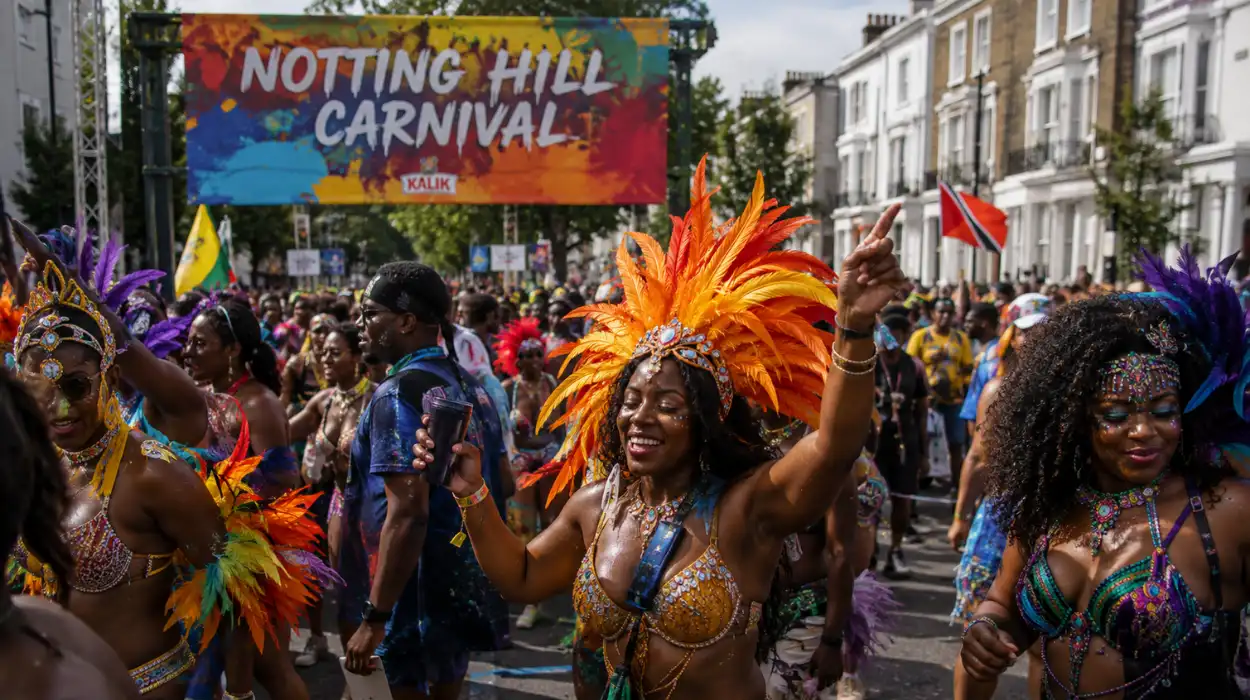
Notting Hill Carnival is Europe’s largest street festival. It takes place annually in west London over the August Bank Holiday weekend. Notting Hill Carnival 2026 runs across three days, from Saturday 29 August to Monday 31 August 2026, in the Royal Borough of Kensington and Chelsea. The event draws around two million attendees, features more than 40,000 volunteers, and involves roughly 9,000 police officers on duty. This guide covers the full 2026 schedule, parade route, travel options, road closures, and safety information for anyone planning to attend.
- What Is Notting Hill Carnival?
- When Does Notting Hill Carnival 2026 Take Place?
- What Is the History of Notting Hill Carnival?
- What Is the Official Schedule for Notting Hill Carnival 2026?
- What Are the Main Events at Notting Hill Carnival?
- J’Ouvert
- UK National Panorama Steel Band Competition
- Children’s Day Parade
- Adults’ Day Parade
- Sound Systems
- What Is the Notting Hill Carnival Parade Route?
- How Do You Get to Notting Hill Carnival?
- What Roads Are Closed During Notting Hill Carnival?
- Where Can You Watch the Parade for Free?
- What Should You Bring to Notting Hill Carnival?
- Is Notting Hill Carnival Free to Attend?
- How Big Is Notting Hill Carnival?
- What Is the Economic and Cultural Impact of Notting Hill Carnival?
- What Safety Measures Are in Place at Notting Hill Carnival?
What Is Notting Hill Carnival?
Notting Hill Carnival is an annual Caribbean-style street festival held in Notting Hill, west London, celebrating British African-Caribbean and British Indo-Caribbean culture through music, costume, and parades. It began in 1966 and has grown into one of the largest street festivals on Earth. The event centres on steel bands, sound systems, mas (masquerade) costume groups, and a formal judged parade.
Notting Hill Carnival takes place on the streets surrounding Ladbroke Grove, in the Notting Hill district of the Royal Borough of Kensington and Chelsea. The festival is organised by Notting Hill Carnival Ltd, working with local authorities including Kensington and Chelsea Council, the Metropolitan Police, Transport for London, and the London Fire Brigade. Carnival is free to attend for the general public along the parade route and surrounding streets. Paid tickets apply only to specific events, such as the Panorama steel band competition.
The festival is built around three core elements. Mas bands are costumed performance groups that parade in themed formations, often featuring feathers, sequins, and elaborate headpieces. Sound systems are large static music rigs positioned along side streets, each playing a specific genre such as reggae, soca, dancehall, or drum and bass. Steel bands, also called pan bands, perform on steelpan instruments originating in Trinidad and Tobago, and compete in the Panorama competition.
When Does Notting Hill Carnival 2026 Take Place?
Notting Hill Carnival 2026 runs from Saturday 29 August to Monday 31 August 2026. The main parade days are Sunday 30 August, designated Family and Children’s Day, and Monday 31 August, designated Adults’ Day, which falls on the UK August Bank Holiday. Saturday is reserved for the Panorama steel band competition.
The event follows a fixed annual pattern. Carnival always takes place on the Sunday and Monday of the August Bank Holiday weekend in England, a tradition that has held since the festival’s founding in 1966. In 2026, this places the main carnival days on 30 and 31 August, with Panorama held the preceding Saturday, 29 August. The 2026 edition marks the 60th anniversary of the festival’s founding.
What Is the History of Notting Hill Carnival?
Notting Hill Carnival originated in 1966, founded by members of the Caribbean community in London, including Claudia Jones, Rhaune Laslett, Leslie Palmer, Sam King, and Duke Vin, in response to racial tensions and the 1958 Notting Hill race riots. The event evolved from an indoor Caribbean carnival event into an outdoor street parade during the 1960s.
Claudia Jones, a Trinidad-born journalist and political activist, organised an indoor Caribbean Carnival in 1959 as a response to the Notting Hill race riots of 1958, which saw violent attacks on Black residents by white mobs. This indoor event is widely cited as a precursor to the modern outdoor carnival. Rhaune Laslett, a community organiser, is credited with launching the first outdoor street festival in Notting Hill in 1966, originally conceived as a broader community event. Leslie Palmer, who led the carnival from 1973 to 1975, introduced sound systems and expanded the event’s scale and structure, shaping the format still used today. In 2006, the UK public voted Notting Hill Carnival onto an official list of Icons of England, recognising it as a defining feature of national cultural heritage.
What Is the Official Schedule for Notting Hill Carnival 2026?
The official 2026 schedule spans three days: Saturday features the Panorama steel band competition, Sunday features J’Ouvert and the Children’s Parade, and Monday features the main Adults’ Day Parade, with sound systems and judging zones active on both Sunday and Monday. Each day has fixed start and end times set by the organisers.
The table below sets out the confirmed daily schedule for Notting Hill Carnival 2026.
| Day | Time | Event |
|---|---|---|
| Saturday 29 August | 6:00 PM – 11:00 PM | UK National Panorama Steel Band Competition |
| Sunday 30 August | 6:00 AM – 9:00 AM | J’Ouvert traditional celebration |
| Sunday 30 August | 10:00 AM – 10:30 AM | Opening Ceremony |
| Sunday 30 August | 10:30 AM – 5:00 PM | Children’s Day Parade and Carnival |
| Sunday 30 August | 10:30 AM – 8:30 PM | Adults’ ‘Dutty Mas’ |
| Sunday 30 August | 12:00 PM – 7:00 PM | Sound Systems |
| Sunday 30 August | 8:30 PM – close | Judging Zone |
| Monday 31 August | 10:30 AM – 8:30 PM | Adults’ Day Parade and Carnival |
| Monday 31 August | 12:00 PM – 7:00 PM | Sound Systems |
| Monday 31 August | 8:30 PM – close | Judging Zone |
Panorama takes place at Emslie Horniman’s Pleasance Park and requires a paid ticket. J’Ouvert, the Children’s Parade, and the Adults’ Day Parade are free and open to the public along the designated route.
What Are the Main Events at Notting Hill Carnival?
Notting Hill Carnival includes five core events: J’Ouvert, the Panorama steel band competition, the Children’s Day Parade, the Adults’ Day Parade, and static sound systems positioned along side streets throughout the carnival area. Each event has a distinct format, location, and audience.
J’Ouvert
J’Ouvert is a pre-dawn street celebration held early on Carnival Sunday, from 6:00 AM to 9:00 AM. The term derives from the French phrase “jour ouvert,” meaning “daybreak.” Participants cover themselves in paint, powder, or mud and move through the streets to live drumming and music, marking the traditional opening of Carnival. J’Ouvert originates in Trinidadian emancipation celebrations marking the end of slavery in 1838.
UK National Panorama Steel Band Competition
Panorama is a competitive steel band event held on the Saturday preceding the main carnival, from 6:00 PM to 11:00 PM, at Emslie Horniman’s Pleasure Park. Steel bands, also called pan orchestras, perform arranged pieces and are judged on musicality, arrangement, and performance. This event requires a purchased ticket, unlike the free parade days.
Children’s Day Parade
The Children’s Day Parade takes place on Carnival Sunday, from 10:30 AM to 5:00 PM. It follows a shortened version of the main parade route and features youth mas bands, school groups, and family-oriented performances. This day is designated as free to all attendees.
Adults’ Day Parade
The Adults’ Day Parade is the largest single event of Carnival, held on Monday 31 August from 10:30 AM to 8:30 PM. It features the full mas band procession along the complete parade route, with costumed performers, trucks carrying sound equipment, and formal judging at designated judging points.
Sound Systems
Sound systems are static music installations set up on side streets across the carnival footprint, operating from 12:00 PM to 7:00 PM on both Sunday and Monday. Each sound system plays a specific music genre, such as reggae, soca, garage, or drum and bass, drawing crowds who remain at fixed locations rather than following the parade route.
What Is the Notting Hill Carnival Parade Route?
The Notting Hill Carnival parade route runs through the Notting Hill and Ladbroke Grove area of west London, passing along Great Western Road, Chepstow Road, Westbourne Grove, Ladbroke Grove, and Kensington Park Road, with judging points positioned at key locations along the circuit. The Adults’ Day route on Monday covers the full circuit, while the Children’s Day route on Sunday is shortened.
The parade moves in a continuous loop rather than a single point-to-point path, allowing mass bands, floats, and performers to circulate through the core carnival area over several hours. Official, up-to-date maps showing the exact 2026 route and street closures are published by Notting Hill Carnival Ltd and Kensington and Chelsea Council ahead of each year’s event, since minor route adjustments occur based on construction, safety assessments, or crowd management needs. Attendees should confirm the current year’s exact route and judging point locations through these official sources close to the event date.
How Do You Get to Notting Hill Carnival?
Public transport is the recommended method of travel to Notting Hill Carnival, using London Underground stations including Notting Hill Gate, Ladbroke Grove, Westbourne Park, and Royal Oak, since road closures prevent most private vehicle access to the carnival area. Transport for London operates enhanced service levels during the event.
The nearest Underground stations are Notting Hill Gate on the Central, District, and Circle lines, Ladbroke Grove and Westbourne Park on the Hammersmith & City and Circle lines, and Royal Oak on the Hammersmith & City line. During peak crowd periods, Transport for London and station staff may implement one-way pedestrian systems or temporary station closures to manage capacity. Some stations operate exit-only restrictions during the busiest hours of Sunday and Monday afternoons. Attendees should check Transport for London’s live travel updates on the day of attendance, since specific station restrictions vary by year and by real-time crowd density. Cycling is possible via designated cycle parking points outside the road closure zone. Private car access into the carnival area is not available due to road closures.
What Roads Are Closed During Notting Hill Carnival?
Kensington and Chelsea Council closes a wide network of residential and main roads across the Notting Hill and North Kensington area for the full carnival weekend, including Ladbroke Grove, Westbourne Park Road, and Portobello Road, with closures typically beginning the Saturday morning before Carnival and lifting after clean-up on the Tuesday following. Parking suspensions apply across the closure zone.
Road closures are managed jointly by Kensington and Chelsea Council, the Metropolitan Police, and Transport for London. Residents within the closure zone require identification or pre-arranged access passes to reach their properties by vehicle during restricted hours. Businesses operating within the area receive separate guidance on deliveries, waste collection, and licensing during the event. The council publishes a full, address-specific list of closed roads and parking suspensions ahead of each year’s carnival, since the closure zone can shift slightly year to year based on the confirmed route and safety planning. Emergency vehicle access is maintained throughout the closure period via coordination with the London Fire Brigade and London Ambulance Service.
Where Can You Watch the Parade for Free?
The entire Notting Hill Carnival parade route is free to view from public streets and pavements along the circuit, with no ticketed viewing areas required for the general public. Positioning matters more than payment, since crowd density varies significantly by location and time of day.
Areas near Ladbroke Grove and Kensington Park Road tend to attract the highest crowd density, particularly during peak afternoon hours on both Sunday and Monday. Side streets slightly off the main route, and locations near the start of the parade circuit in the morning, generally offer more open viewing space. Arriving before 11:00 AM on either parade day allows earlier positioning before crowd volume peaks in early afternoon. Some private venues, balconies, and rooftop spaces along the route offer paid premium viewing packages, operated independently of the free public route.
What Should You Bring to Notting Hill Carnival?
Recommended items for Notting Hill Carnival include comfortable closed-toe footwear, a small bag for essentials, sun protection, a portable phone charger, and identification, while prohibited items include glass bottles, weapons, and unauthorised sound equipment. Bag searches are conducted at various points by police and event stewards.
Weather in London on the August Bank Holiday weekend is variable, so layered clothing suited to both sun and rain is advisable. Cash and contactless payment are both commonly accepted at food and drink vendors along the route, though vendor-specific payment methods vary. Mobile network congestion is common in the densest crowd areas due to high attendee volume, so downloading offline maps or agreeing meeting points with companions in advance is a practical precaution. The Metropolitan Police and event organisers publish a specific list of prohibited items each year, which typically includes glass containers, knives, fireworks, and drones.
Is Notting Hill Carnival Free to Attend?
General attendance at Notting Hill Carnival, including J’Ouvert, the Children’s Day Parade, and the Adults’ Day Parade, is free of charge, while the Saturday Panorama steel band competition requires a purchased ticket. Food, drink, and merchandise purchased from vendors along the route are paid separately.
This free-access structure has remained consistent since the event’s founding, distinguishing it from many comparable ticketed festivals of similar scale. Revenue for the event’s organisation comes from a combination of vendor fees, sponsorship, grants, and ticketed events such as Panorama, rather than general admission charges.
How Big Is Notting Hill Carnival?
Notting Hill Carnival attracts approximately two million attendees annually, making it the largest street festival in Europe and one of the largest in the world, behind only events such as Rio de Janeiro’s Carnival in overall global scale. The event mobilises over 40,000 volunteers and approximately 9,000 police officers.
The scale of Notting Hill Carnival places significant demand on London’s transport infrastructure, emergency services, and local council resources across the event weekend. Comparable major UK outdoor events, such as Glastonbury Festival, draw substantially fewer attendees per day despite running over a similar multi-day format, underscoring Carnival’s position as the largest annual free public gathering in the country.
What Is the Economic and Cultural Impact of Notting Hill Carnival?
Notting Hill Carnival generates significant economic activity for London through tourism spending, vendor trading, and hospitality demand, while serving as a primary cultural institution for British African-Caribbean and British Indo-Caribbean communities. The event is formally recognised as a national cultural icon.
Local vendors, food traders, and hospitality businesses across West London experience substantial demand increases during the carnival weekend, with street food, drinks, and merchandise trading forming a core part of the event’s informal economy. Beyond its economic footprint, Carnival functions as an intergenerational cultural transmission point, with mas bands, steel orchestras, and sound system crews often passing skills and traditions between generations of participants. The event’s recognition on the UK’s list of Icons of England in 2006 reflects its embedded position within broader British cultural heritage, extending beyond its origins as a community response to racial tension in the 1950s and 1960s.
Explore More about the UK:
King Charles Senior Aide Exit Raises Royal Staff Concerns
Falkland Islands: History, Dispute & Strategic Role
What Safety Measures Are in Place at Notting Hill Carnival?
Safety at Notting Hill Carnival is managed through a coordinated deployment of Metropolitan Police officers, London Fire Brigade personnel, London Ambulance Service crews, and trained event stewards, supported by CCTV coverage, bag searches, and a published list of prohibited items. Approximately 9,000 police officers are deployed across the event weekend.
The Metropolitan Police coordinate crowd management, bag searches at key entry points, and rapid response to incidents throughout the carnival footprint. The London Fire Brigade provides fire safety guidance specific to the event, given the density of static sound systems, generators, and food vendor equipment across the route. First aid points and London Ambulance Service crews are positioned at intervals along the parade route and in high-density areas. Kensington and Chelsea Council additionally coordinates a post-carnival clean-up operation, including support for residents and businesses requiring property clean-up following the event.
Notting Hill Carnival 2026 takes place from Saturday 29 August to Monday 31 August in the Notting Hill and Ladbroke Grove area of west London, marking the 60th year of the event since its founding in 1966. The three-day structure combines the ticketed Panorama steel band competition on Saturday with free public access to J’Ouvert, the Children’s Day Parade, and the Adults’ Day Parade across Sunday and Monday. Attendees relying on public transport, checking current road closures, and confirming the official parade route through Notting Hill Carnival Ltd and Kensington and Chelsea Council ahead of the event will have the most accurate, up-to-date information for planning their visit.