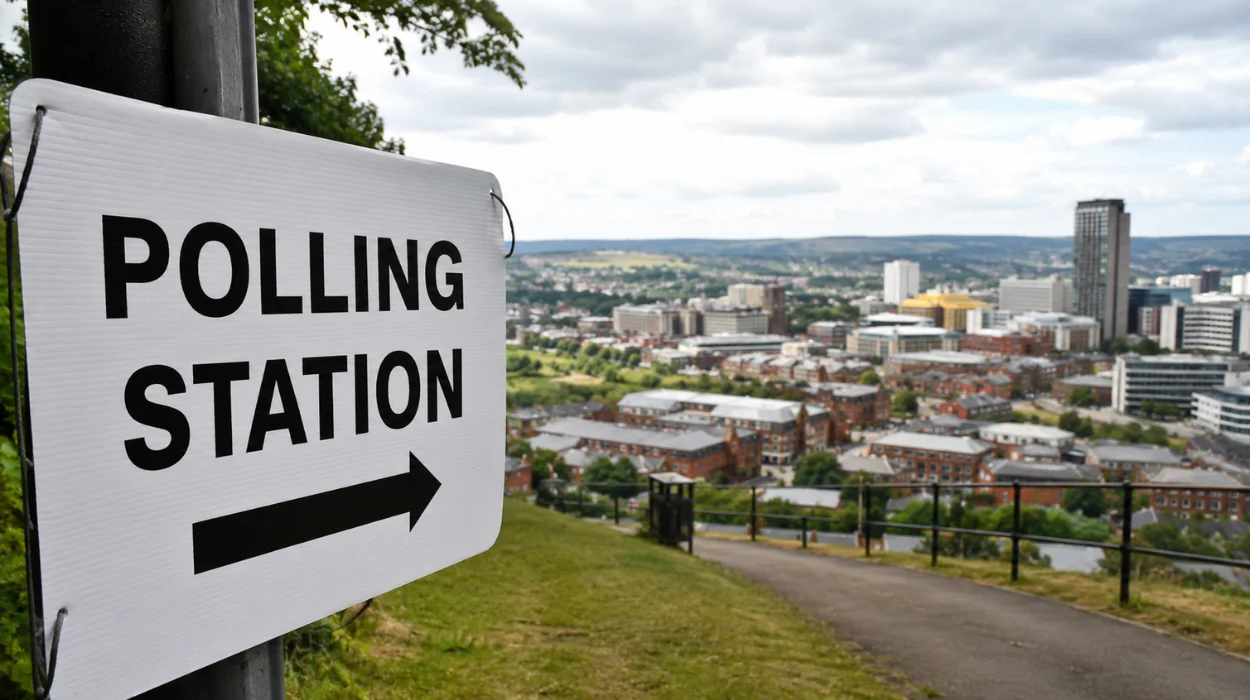
The Southey by-election, held in Sheffield on 27 August 2026, resulted in a win for Reform UK candidate Paul Jakeman. The result extended Reform UK’s presence in the ward and continued a pattern of gains for the party across Sheffield City Council during 2026.
- What Was the Result of the Southey By-Election?
- Why Was the Southey By-Election Called?
- Who Is Paul Jakeman, the New Reform UK Councillor?
- What Was the Vote Breakdown in the Southey By-Election?
- How Does This Result Compare to the May 2026 Local Elections?
- What Does This Mean for Sheffield City Council?
- What Is the Southey Ward and Where Is It Located?
- What Is Reform UK and What Are Its Policies?
- Why Is Voter Turnout Low in By-Elections?
- What Are the Wider Implications of This By-Election for UK Politics?
- What Happens Next in Southey Ward?
What Was the Result of the Southey By-Election?
Reform UK’s Paul Jakeman won the Southey by-election with 1,113 votes, defeating Labour candidate Jayne Dunn by a margin of 297 votes. The result gave Reform UK a second councillor in the Southey ward, alongside sitting Reform councillor Yvonne Sykes.
Paul Jakeman won with 1,113 votes, 297 ahead of Labour candidate Jayne Dunn. Following Jakeman’s victory, Reform now holds two seats in the Southey ward. According to Sheffield City Council’s official results, the by-election was held on Thursday 27 August 2026, and Paul Jakeman of Reform UK was elected. Total ballot papers issued numbered 2,243, with 3 rejected ballots, out of an electorate of 14,348, producing a turnout of 15.63 per cent. Five candidates contested the seat. Reform UK finished first, Labour finished second, and the remaining three candidates trailed with smaller vote shares.
Why Was the Southey By-Election Called?
The by-election followed the resignation of Gareth Slater, who was elected as a Labour councillor for Southey ward in 2024 before becoming an independent councillor earlier in 2026. His departure from the council seat left a vacancy that required a by-election under UK local government rules.
The election was called in July 2026 after the resignation of Gareth Slater, who was elected for Labour in 2024 but became an independent earlier in the year. A by-election is a special election held to fill a public office that has become vacant between scheduled general elections. In English local government, a council seat vacancy triggers a by-election when a councillor resigns, dies, or is disqualified during their term. Southey ward had already held one election in 2026, on 7 May, as part of the scheduled local elections across Sheffield. Slater’s resignation as an independent, only months after that vote, meant Southey electors returned to the polls a second time within the same year.
Who Is Paul Jakeman, the New Reform UK Councillor?
Paul Jakeman is a Sheffield-based businessman who runs an outdoor pursuits company and has supported grassroots football in the city. He previously stood as the Reform UK candidate in Dore and Totley ward during the May 2026 local elections, finishing second.
Jakeman is a local man with years of experience running an outdoor pursuits company in Sheffield and supporting grassroots football, according to Reform UK’s Sheffield group leader, Councillor John Hesketh. Jakeman stood for Dore and Totley ward in May 2026, coming second out of six candidates, as Liberal Democrat group leader Councillor Martin Smith retained his seat. After his Southey win, Jakeman framed the result in policy terms. He described the outcome as “a victory for Reform’s common sense policies on housing, public transport, the state of Sheffield’s roads and how the council is managed.” Hesketh welcomed Jakeman to the Reform group, stating that his background made him “a welcome addition” who would support the party’s aim of holding the Labour and Green Party town hall leadership to account.
What Was the Vote Breakdown in the Southey By-Election?
Reform UK secured 50.6 per cent of the vote, Labour secured 37 per cent, the Green Party secured 6.5 per cent, the Conservative Party secured 3.1 per cent, and the Liberal Democrats secured 2.5 per cent. Reform UK retained the seat with a vote-share increase over the May 2026 result.
Vote-share data compiled by election analysts shows the following distribution of votes across the five candidates:
| Party | Vote Share | Change from May 2026 |
|---|---|---|
| Reform UK | 50.6% | +0.6 points |
| Labour | 37.3% | +12.8 points |
| Green Party | 6.5% | −6.4 points |
| Conservative | 3.1% | −1.7 points |
| Liberal Democrats | 2.5% | −2.2 points |
The Southey by-election result showed Reform UK on 50.per cent, up 0.6 points; Labour on 37.3 per cent, up 12.8 points; the Green Party on 6.5 per cent, down 6.4 points; the Conservatives on 3.1 per cent, down 1.7 points; and the Liberal Democrats on 2.per cent, down 2.2 points. No Independent or Trade Unionist and Socialist Coalition candidate contested this by-election, both of which had stood in May 2026. The overall classification of the result was a Reform UK hold, since the party already controlled the seat following the May election.
Which Parties Contested the Seat?
Five parties fielded candidates in the Southey by-election: Reform UK, Labour, the Green Party, the Conservative Party, and the Liberal Democrats. Reform UK and Labour accounted for the overwhelming majority of votes cast, together taking close to 88 per cent of the total ballot. The Green Party, Conservatives, and Liberal Democrats each lost vote share compared with the May 2026 contest, indicating a consolidation of votes around the two leading parties in this specific by-election.
How Does This Result Compare to the May 2026 Local Elections?
Reform UK’s majority in Southey narrowed sharply, from over 1,000 votes in May 2026 to 297 votes in August 2026, even though Reform’s vote share rose slightly. Labour’s vote share increased by nearly 13 percentage points between the two contests.
Reform’s Yvonne Sykes had unseated former Lord Mayor Jayne Dunn at the May 7 2026 council elections, winning by 2,157 votes to 1,059, a majority of 1,098 votes. In the August by-election, that majority fell to 297 votes. Sheffield Council and Labour leader Councillor Fran Belbin addressed this shift directly. She said Reform had a majority of 1,000 votes in May, and that Labour had slashed that majority to less than 300 votes in the by-election. Belbin described the outcome as evidence of Labour’s improving performance in the ward, stating she had “good hopes for the future” based on the narrowing gap, despite Labour not winning the seat outright. The rise in Labour’s vote share, combined with turnout that was substantially lower than the May election, suggests that the by-election electorate differed in composition from the electorate that voted in the full local elections four months earlier. Lower turnout by-elections frequently show more concentrated voting patterns, since only the most motivated electors participate.
What Does This Mean for Sheffield City Council?
Reform UK now holds 11 seats on Sheffield City Council following the Southey by-election, with Labour holding 25 seats, the Liberal Democrats holding 22 seats, the Green Party holding 20 seats, and Sheffield Community Councillors and Independents holding a combined six seats.
Labour now has 25 members on the council, the Liberal Democrats have 22, the Green Party has 20, Reform UK has 11, Sheffield Community Councillors have two, and Independents have four. Reform UK won 12 seats in the May 2026 elections, bringing its group total to 13, but that number subsequently dropped by three to 10 due to resignations or suspensions before this by-election restored it to 11. Sheffield City Council operates under no overall control, meaning no single party holds a majority of seats. Labour and the Green Party currently form a shared administration to govern the council. No overall control is a common outcome in English local government when the electorate splits its support across four or more parties, requiring coalition or minority arrangements to pass budgets and policy decisions.
What Is the Current Composition of Sheffield City Council?
Sheffield City Council has 84 elected councillors representing 28 wards, with three councillors per ward under a system of elections by thirds, meaning roughly one-third of seats are contested in most years rather than the full council at once. Following the Southey by-election, the seat allocation stands at Labour with 25 seats, the Liberal Democrats with 22 seats, the Green Party with 20 seats, Reform UK with 11 seats, Sheffield Community Councillors with two seats, and Independents with four seats. This distribution places Labour as the largest single party, though well short of the 43 seats required for an outright majority.
What Is the Southey Ward and Where Is It Located?
Southey ward is a residential electoral division in the north of Sheffield, England, represented by three councillors on Sheffield City Council. It forms part of the Sheffield South East parliamentary constituency area used for UK local government elections.
Southey ward sits within the city of Sheffield, South Yorkshire, and elects three councillors to Sheffield City Council under the city’s system of elections by thirds. The ward has an electorate of 14,348 registered voters, based on figures published for the August 2026 by-election. Wards in England are the basic building blocks of local government representation, each electing councillors who sit on the relevant council and represent constituents on local issues including housing, waste collection, planning, and social care. Southey’s political representation shifted substantially during 2026, moving from Labour control to Reform UK control across two elections held within four months of each other.
What Is Reform UK and What Are Its Policies?
Reform UK is a British political party founded in 2018, originally as the Brexit Party, and rebranded under its current name in 2021. The party campaigns on reducing immigration, cutting taxes, and reforming public services, and has expanded its local government presence significantly during 2026.
Reform UK positions itself as a challenger to the established Conservative and Labour parties, drawing support particularly in areas with historically strong working-class Labour voting patterns. In Sheffield, Reform UK’s gains in wards such as Southey reflect a broader national trend of the party winning council seats previously held by Labour and the Conservatives. Jakeman’s own comments after his Southey victory identified housing, public transport, road conditions, and council management as the specific policy areas driving support for the party in the ward. Reform UK’s rise in local government has been accompanied by scrutiny of candidate vetting and councillor conduct, illustrated in Sheffield by the loss of three Reform seats between May and August 2026 due to resignations or suspensions.
Why Is Voter Turnout Low in By-Elections?
Voter turnout in the Southey by-election reached 15.63per centt, substantially below typical turnout for scheduled local elections. Low turnout in by-elections is a consistent pattern across UK local government, driven by reduced media coverage, single-issue timing, and voter fatigue after recent elections.
By-elections held outside the normal electoral calendar typically attract lower turnout than scheduled elections, because they lack the coordinated national campaigning, media coverage, and voter mobilisation that accompanies elections held on the same day across many wards or constituencies. Southey electors had already voted in a full council election in May 2026, and the additional summer by-election, called after an unexpected resignation, occurred without the same level of public attention. A turnout of 15.63per centt means fewer than one in six eligible voters in the ward cast a ballot, a figure consistent with historical by-election turnout patterns in English local government, which frequently fall between 15 and 30 per cent depending on local circumstances and the perceived competitiveness of the contest.
What Are the Wider Implications of This By-Election for UK Politics?
The Southey result demonstrates Reform UK’s continued ability to hold council seats gained in 2026, while showing Labour making measurable gains in vote share within a single ward over four months. Both parties have cited the result as evidence supporting their respective political narratives.
Reform UK’s retention of the Southey seat, despite a narrowing margin, supports the party’s broader claim of establishing durable electoral footholds in former Labour strongholds rather than achieving one-off protest votes. The swing toward Labour, from a 1,098-vote deficit in May to a 297-vote deficit in August, gives Labour evidence that its support in the ward is recovering, even without translating into a seat win. Political analysts commonly treat sequential by-election results within the same ward as more informative than single elections, because they isolate changes in voter sentiment over a defined period rather than comparing different wards with different demographic profiles. The instability in Reform UK’s Sheffield council group, which lost three of its twelve May seats to resignations or suspensions before this by-election, also illustrates a recurring challenge for newer parties expanding rapidly into local government: maintaining councillor discipline and retention alongside electoral growth.
Explore More about Politics:
Penny Mordaunt: Political Career, News and Latest Updates
Anna Turley: Biography, Career, Politics & Latest News
What Happens Next in Southey Ward?
Paul Jakeman has taken his seat as one of three Southey ward councillors, joining fellow Reform UK councillor Yvonne Sykes. The next scheduled elections affecting Southey ward will occur as part of Sheffield’s ongoing elections by-thirds cycle, unless a further vacancy triggers another by-election beforehand.
With Jakeman’s election, Southey ward is now represented by two Reform UK councillors and one Labour or other-party councillor, depending on the outcome of the ward’s remaining seats from prior elections. Sheffield City Council’s elections-by-thirds system means the ward will next return to the ballot in line with the council’s regular electoral schedule, barring any further resignation, disqualification, or death among sitting councillors that would necessitate another by-election. The council’s overall political balance, currently under no overall control with a Labour-Green administration, remains dependent on cross-party cooperation to pass budgets and set policy until the next full round of elections redistributes seats across all 28 wards.