Key Points
- A Ryanair flight from Athens International Airport to London Luton left without 20 to 50 passengers on Sunday, June 14, 2026, as passengers were stranded in passport control queues
- Passengers reported a “mega queue” of several hundred people at both security and passport control amid stifling 30C temperatures at Athens airport
- Daily Mirror travel writer Milo Boyd, who boarded the flight, said at least 20 others arrived too late, with one passenger crying and another “about to explode”
- The incident marks the latest disruption since the EU’s Entry Exit System (EES) was launched on April 10, 2026, to track non-EU citizens entering or leaving the Schengen area
- Ryanair blamed border control delays at Athens airport, stating all passengers at the boarding gate when boarding closed travelled without incident
- Athens airport cited congestion linked to “high passenger volumes and additional processing requirements associated with travel to non-Schengen destinations”
- The flight missed its air traffic control slot and departed an hour late after missing passengers’ bags were unloaded
- Greek tourism minister Olga Kefalogianni promised in April 2026 British passengers would not face biometric checks, but the Greek Foreign Ministry later disputed any exemption existed
- Ian Collins tweeted Ryanair calling it “utterly disgraceful you left my daughter (and half your passengers) at the gate in Athens today”
- California passenger Karen Alarcon Cabada reported being stuck in an hour-long queue on Monday when it took “forever to check one’s passport”
- In April 2026, about 100 Easyjet passengers were stranded in Milan after queues of up to three hours at passport control
- In May 2026, Wizz Air’s UK boss told the BBC British holidaymakers should arrive at European airports three hours in advance
- Ryanair has called for the EES implementation to be suspended until September, describing the system as “half-baked”
- Travel expert Simon Calder described EES as “passport roulette” with numerous reports of travelers missing flights
Athens (Britain Today News) June 17, 2026 – Ryanair passengers were stranded in Greece after their UK-bound flight departed without them, as airports across Europe continue grappling with severe passport control delays linked to new border verification procedures. The flight from Athens International Airport to London Luton on Sunday, June 14, reportedly left without 20 to 50 passengers, some of whom became visibly angry, prompting airport authorities to step in to maintain orderly operations, the BBC has been told.
- Key Points
- What Caused the Ryanair Flight to Leave Without Passengers in Athens?
- How Long Were Passengers Stuck in the Athens Passport Queue?
- What Did Passengers Say About Being Left at Athens Gate?
- Is the EU Entry Exit System Responsible for Athens Airport Delays?
- What Did Greek Officials Promise About British Passenger Border Checks?
- How Have Other Airlines Responded to EES Passport Control Delays?
- What Warning Has Ryanair Issued to Passengers About EES?
- What Advice Should Passengers Follow for European Travel in 2026?
What Caused the Ryanair Flight to Leave Without Passengers in Athens?
The incident represent the latest disruption since the EU’s Entry Exit System (EES) was brought in on April 10, 2026, to track when non-EU citizens enter or leave the Schengen free movement area. Ryanair blamed border delays in a statement, while Athens airport said it had been experiencing congestion linked to “additional processing requirements,” though neither directly said EES was responsible.
The flight is understood to have missed its air traffic control slot and departed an hour late after the missing passengers’ bags were unloaded, creating a chaotic situation for those left behind at the gate. As frustration grew among stranded passengers, airport authorities stepped in “to maintain orderly operations” after “a number of passengers expressed their dissatisfaction,” the airport told the BBC.
A spokesperson for Athens airport said there had been
“periods of congestion at passport control in the departures area due to high passenger volumes and the additional processing requirements associated with travel to non-Schengen destinations”.
They added:
“As is currently the case at many European airports, passenger flows on certain routes may experience increased processing times as new border-control procedures continue to be implemented and refined”.
How Long Were Passengers Stuck in the Athens Passport Queue?
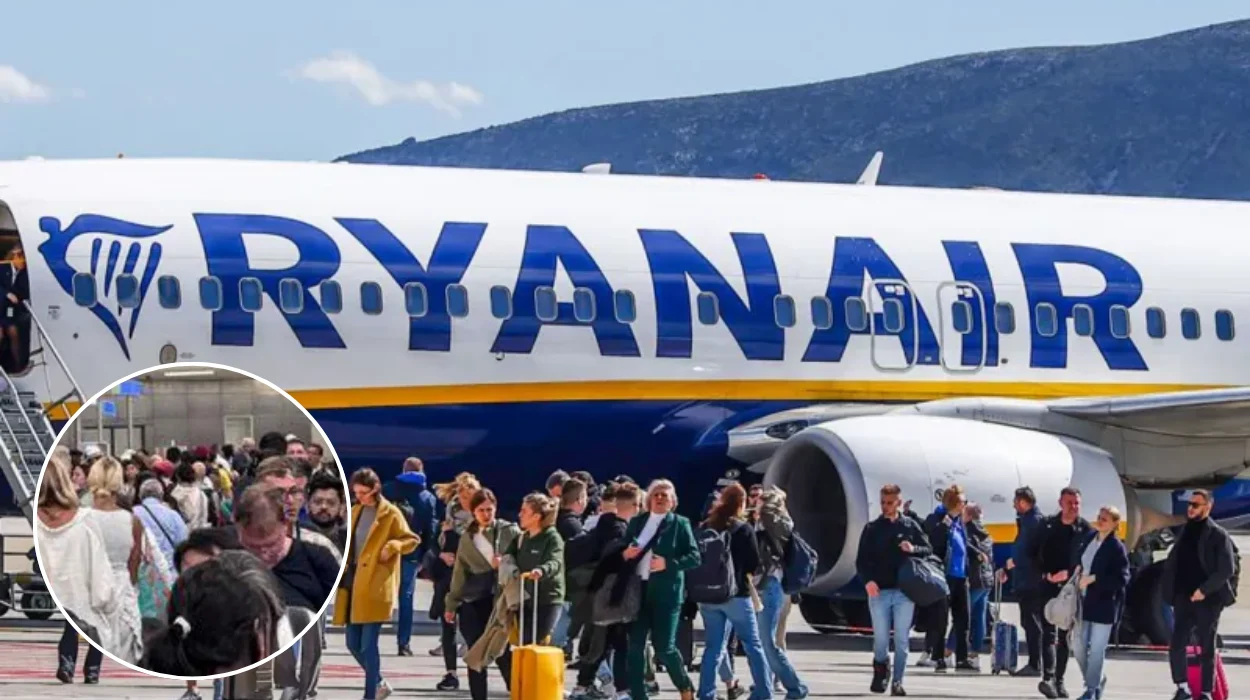
Milo Boyd, a Daily Mirror travel writer who managed to board Sunday’s Ryanair flight to Luton, described witnessing a “mega queue” of several hundred people at both security and passport control amid stifling temperatures of 30C. He told the BBC there had been this overwhelming congestion as passengers struggled to reach the boarding gate.
Boyd and his wife made it through 10 minutes before the gate closed, but he said at least 20 others had arrived too late for the flight.
“These poor people were pleading with the Ryanair staff to let them through – one guy was crying, another guy looked like he was about to explode,”
Boyd said, describing the emotional distress witnessed among stranded passengers.
Boyd said people stuck on the other side of the gate were shouting “you can’t do this” and
“this is your stupid airport’s fault, how can you not let us on?”
as frustration mounted among those left behind. The travel writer noted he had not had his fingerprints scanned or his photo taken on entry or exit at Athens, suggesting the biometric requirements may not have been fully implemented for all passengers.
What Did Passengers Say About Being Left at Athens Gate?
Ian Collins tweeted Ryanair to say it was
“utterly disgraceful you left my daughter (and half your passengers) at the gate in Athens today – awful experience,”
expressing his fury over the airline’s handling of the situation. His tweet captured the anger of many passengers who felt abandoned by both the airline and airport authorities.
Other passengers have reported similar delays at Athens airport, including Karen Alarcon Cabada from California, who told the BBC she had been stuck in an hour-long queue on Monday when it had taken “forever to check one’s passport”. Her experience confirms that the passport control delays were not isolated to Sunday’s incident but represented a broader systemic problem at the airport.
Ryanair said in a statement that “a number of passengers” did not board in time “due to delays caused by border control at Athens airport,” putting the blame squarely on border control rather than airline operations. It added:
“All passengers that were at the boarding gate when this flight from Athens to London Luton boarded, travelled without incident,”
suggesting the airline maintained it had followed proper procedures.
Is the EU Entry Exit System Responsible for Athens Airport Delays?
The EES was officially launched on April 10, 2026, and has since caused numerous reports regarding travelers missing flights and experiencing long waits at airports as systems struggle to handle the high volume of individuals trying to register. Several nations have paused EES at various times, with Greece delaying the system for UK travelers during the summer to improve the travel experience.
As reported by travel expert Simon Calder of The Independent, he described the EU’s Entry Exit System (EES) as ‘passport roulette’ following the numerous incidents. Significant issues arose in April 2026 when passengers flying with Ryanair and easyJet missed their flights from different Milan airports due to EES-related complications.
Video footage from one incident at Milan Bergamo showed a crowd of frustrated travelers informing staff that they had been held at the gate for more than an hour, seeking guidance on what to do next. Reports indicate that around 30 passengers were left behind on that Ryanair flight from Milan to Manchester on April 16.
Recently, Ryanair issued a scathing statement via social media, calling for the EES implementation to be delayed until September. Describing the system as ‘half-baked,’ Ryanair’s statement emphasized:
“Despite being aware over three [years] that EES would become operational from April 10, 2026, France, Poland, Italy, Spain, and Germany have not ensured that sufficient staffing, system preparedness, or kiosks are available”.
What Did Greek Officials Promise About British Passenger Border Checks?
In April 2026, Greek tourism minister Olga Kefalogianni promised British passengers would not face biometric checks or be “burdened” by bureaucracy when travelling to Greece this summer, according to an interview with the BBC. She assured that British tourists would not encounter biometric screenings at the border throughout the summer season.
However, the situation is unclear after the Greek Foreign Ministry later disputed that any exemption existed, telling Associated Press that
“we have not received any further update or clarification as to whether, for example, specific nationalities are temporarily exempt from the relevant procedure”.
The Greek Foreign Ministry confirmed the reversal, saying that it had no information that
“specific nationalities are temporarily exempt from the relevant procedure”.
Greece has claimed that it has “successfully commenced the full operation of the Entry-Exit System,” but it paused biometric checks for UK visitors in early April after long lines formed at Corfu airport. The European Commission recently confirmed that neither Portugal nor Italy intends to exempt British nationals from the new checks, despite unverified reports suggesting they might follow Greece’s lead.
Kefalogianni maintained that Greece is not violating EU regulations, which permit temporary suspensions of EES checks during peak congestion at airports but prohibit blanket exemptions for citizens of specific nations.
“What we’re doing [is] not actually [an] exemption,”
she clarified, suggesting the pause was a practical adjustment rather than a formal exemption.
How Have Other Airlines Responded to EES Passport Control Delays?
In April 2026, about 100 Manchester-bound Easyjet passengers were left stranded in Milan after queues of up to three hours at passport control, marking one of the earliest major EES-related disruptions. Around 100 individuals found themselves stranded in Milan after an Easyjet flight to Manchester departed without them, scheduled to leave on Sunday.
EasyJet held the aircraft at the gate for 52 minutes before aviation safety rules on crew operating hours forced it to depart, leaving just 34 of the 156 booked passengers on board the flight. One traveler recounted being kept waiting until the plane had already departed, only to be told to arrange their own return flights.
In May 2026, the UK boss of budget airline Wizz Air told the BBC that British holidaymakers should now arrive at European airports three hours in advance, significantly increasing the traditional two-hour recommendation. Wizz Air CEO Yvonne Moynihan also advises passengers to carry portable chargers and water due to lengthy queues.
“Traditionally, passengers are advised to reach the airport two hours before their flight; however, given the current situation, she recommends allowing three hours,”
Moynihan said, emphasizing the severity of the delays. Wizz Air told The Independent:
“We encourage our UK customers travelling home from Europe to arrive at the airport three hours ahead of their departure time, and to ensure they are prepared for border control procedures before travelling, as this can help reduce the risk of missing their flights”.
What Warning Has Ryanair Issued to Passengers About EES?
Ryanair has issued an ‘important’ alert to passengers stating:
“Beginning on April 10, 2026 the EU Entry/Exit System (EES) will be operational at all external borders of the Schengen Area. Consequently, passport checks may require additional time for certain travellers”.
The communication clarifies that those who possess a non-EU/non-EEA/non-Swiss passport and are entering or exiting the Schengen Area will be affected.
The messages further elaborate:
“Frequently impacted routes involve flights between the Schengen Area and nations such as the UK, Ireland, Cyprus, Montenegro, Serbia, Türkiye, Egypt, Israel, among others”.
Vacationers and other passengers might need to scan their passports, provide fingerprints, and have their facial images captured during passport verification.
Due to the more thorough inspections, longer wait times may occur, particularly at busy airports, with delays also likely before security checkpoints. For those impacted, Ryanair suggests arriving at the airport well in advance to account for potential delays, ensuring all travel documentation is readily available, and following the signs indicating ‘EES / Passport Control’.
Holders of EU, EEA, and Swiss passports will not be affected, nor will those travelling within the Schengen Area, such as from Spain to Italy or from Germany to France. Ryanair concluded:
“If entry is refused, it will be a result of EU regulations, not Ryanair’s policies. Learn more about how EES may influence your travel arrangements”.
Additionally, Ryanair to close check-in 20 minutes earlier amid concern over Europe border queues, with the change taking effect from November 2026, giving passengers more time to get through airports. The low-cost airline, which serves around 200 million travelers each year, will now require all passengers checking in at the airport or dropping off luggage to do so at least one hour before their scheduled departure, rather than the previous 40-minute cutoff.
Explore More about London:
Two Children Die as Measles Outbreak Spreads Across London with Hundreds of Cases Reported
Morning Traffic Crash at Highway 9 and 23 Intersection Leaves Injuries
What Advice Should Passengers Follow for European Travel in 2026?
Travel expert Simon Calder predicts EES ‘passport roulette’ could be put on hold ‘for rest of the summer,’ describing the ongoing chaos at European airports. The new system has been causing anxiety among many travelers preparing for their summer holidays, with significant headlines emerging in April 2026.
At busy airports, the EES translates to queues stretching two to three hours during peak travel periods, according to airport industry reports. The EU digital border scheme is causing three-hour waits at passport control as officials struggle with a 70 per cent increase in the time taken to carry out border checks, says the group representing Europe’s airports.
However, the European Union’s border agency has disputed these claims, stating:
“To date, no significant queues at the external borders of the Schengen area have been linked to the EES, apart from in limited specific cases where the processing time for passengers slightly increased at certain airports”.
To this day, no member state has reported or confirmed the claim that border-control processing times at airports increased by up to 70 per cent, with waiting times up to three hours during peak traffic periods, due to the introduction of the EES.
Despite the disputed statistics, the practical reality for passengers remains challenging, with multiple incidents of flights departing without passengers across Europe since the EES implementation. Early-summer holiday bookings are down amid ‘apprehension,’ with the UK travel industry warning of fears that EES checks requiring personal information and biometrics will cause summer of travel chaos in Europe.
The Greek tourism minister, Olga Kefalogianni, told the BBC that Greece would suspend biometric checks for British travellers until September to prevent summer disruption, though this position has since been contested by the Foreign Ministry. Passengers must remain vigilant about the evolving situation and follow airline guidance regarding advance arrival times at European airports.
For British travelers planning holidays in Greece, the bottom line is uncertainty, with the latest official position from the Greek Foreign Ministry being that no nationality is exempt from EES biometric checks. The situation remains fluid as European airports continue to implement and refine new border-control procedures throughout the summer 2026 travel season.