Key Points
- Daniel Day, 30, has received a 14-month prison sentence suspended for two years after climbing the Elizabeth Tower, home to Big Ben, in a pro-Palestine protest.
- Southwark Crown Court heard that the protest lasted around 17 hours and caused major disruption in Westminster, including road closures, bus diversions and the cancellation of more than 2,500 Parliament tours.
- The court said the stunt cost taxpayers at least £92,000 and involved a significant emergency response.
- Judge Tony Baumgartner described the incident as “well-planned offending” and said Day had shown little insight or remorse.
- Day was ordered to complete up to 20 rehabilitation days and wear an electronic monitor for four months.
- The protester livestreamed parts of the climb on Instagram, waved a Palestinian flag and chanted “Free Palestine.”
- Day was convicted of causing a public nuisance and trespassing on a protected site.
- The judge said Day and others “do not get to decide which laws you will follow and which laws you will break.”
Westminster (Britain Today News) July 27, 2026. A pro-Palestine protester who climbed the Elizabeth Tower and remained there for nearly 17 hours has avoided immediate custody after Southwark Crown Court handed him a suspended prison sentence, ending a case that drew a major police response, blocked traffic in central London and triggered a sharp rebuke from the judge.
- Key Points
- What happened at Big Ben?
- Why did the protest cause so much disruption?
- What did the judge say?
- What sentence was imposed?
- What offences did Day face?
- How long was he on the tower?
- What role did social media play?
- How did police and emergency services respond?
- What was said about Day’s background?
- Why does the case matter?
- What happens next?
What happened at Big Ben?
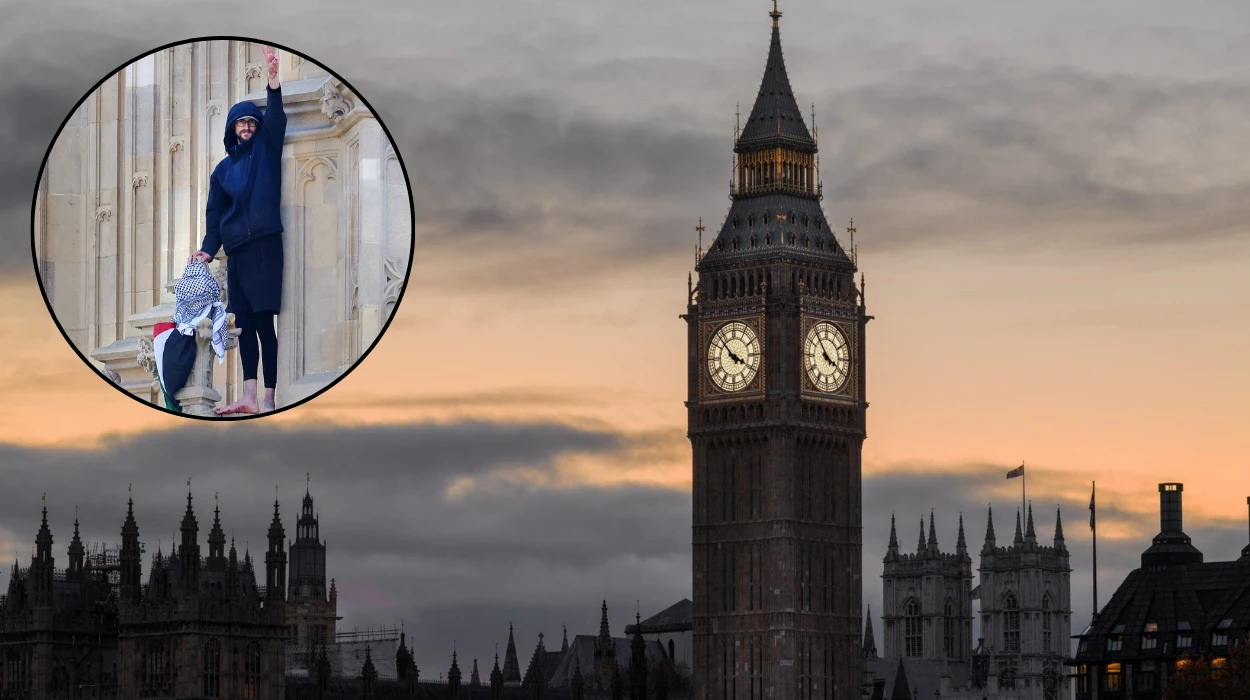
Daniel Day, 30, climbed the Elizabeth Tower on 8 March last year and stayed on the landmark for hours while displaying a Palestinian flag and broadcasting his protest on Instagram. The stunt unfolded in one of the most heavily protected and watched parts of central London, with emergency services and police responding as the incident continued through the day and into the night. By the time he came down, the protest had already become a major public order incident.
According to court reporting, Day’s actions were not spontaneous but the result of prior planning, with equipment taken up the structure to support the livestream. The court heard that the demonstrator had staged the protest barefoot, remained on a ledge high above the ground and used social media to project the message of the demonstration. The case has been followed closely because of both the symbolism of the site and the scale of disruption caused by the climb.
Why did the protest cause so much disruption?
The climb triggered a large-scale emergency operation in Westminster, where roads were closed, bus services were diverted and public access was restricted for much of the day. Court reporting said the disruption extended to Parliament Square and the surrounding road network, which is a key route through central London. More than 2,500 Parliament tours were cancelled as the situation developed, adding to the financial and logistical impact of the incident.
The court also heard that the incident cost taxpayers at least £92,000. Earlier reporting had placed the cost lower, but the sentencing coverage stated the later figure as the amount presented to the court. The financial impact, together with the police and emergency response, became part of the prosecution’s argument that the protest was not just symbolic but materially disruptive to the public.
What did the judge say?
Judge Tony Baumgartner, sitting at Southwark Crown Court, said Day’s conduct amounted to “well-planned offending” and made clear that political conviction did not excuse unlawful conduct. In his remarks, the judge said:
“You and others like you do not get to decide which laws you will follow and which laws you will break.”
He added that the defendant had shown “little insight into your offending or any real remorse.”
The judge nonetheless took into account mitigating factors, including Day’s failing eyesight and the fact that he had not committed further offences since the incident. That balance appears to have influenced the final outcome, with the court deciding on suspension rather than immediate imprisonment. The decision reflects a sentencing approach that recognised the seriousness of the protest while stopping short of sending Day to prison immediately.
What sentence was imposed?
Day received a 14-month prison sentence, suspended for two years. The court also ordered him to attend up to 20 rehabilitation days and placed him under electronic monitoring for four months. Those conditions mean the sentence remains hanging over him and could be activated if he breaches the terms of the order.
Suspended sentences are often used where a court considers that custody is justified in principle but that the defendant can be managed in the community under strict conditions. In this case, the court’s decision suggests it regarded the protest as serious and deliberate, but still saw enough mitigation to avoid immediate jail. The order leaves Day under continuing supervision while marking the offence as one that crossed the line from protest into criminal nuisance.
What offences did Day face?
Day was found guilty of causing a public nuisance and trespassing on a protected site. The nuisance conviction related to the scale of the disruption, the obstruction of public access and the effect on emergency services and transport in the area. The trespass count reflected the fact that the Elizabeth Tower is a protected site and not an open public climbing surface.
At earlier stages of the case, Day denied intentionally or recklessly causing a public nuisance. Reporting from the trial said he argued that his actions were intended to draw attention to Gaza and the UK’s response to the conflict. The court ultimately rejected that argument, with the prosecution saying there was no reasonable excuse for what he had done.
How long was he on the tower?
Court reports describe the incident as lasting around 16-and-a-half to 17 hours. One account said he climbed the structure at about 07:20 and came down after midnight, while other reports said he spent nearly 17 hours on the ledge. The exact figure varied slightly across coverage, but every account made clear that it was an exceptionally prolonged protest.
That length of time mattered because it prolonged the emergency response, heightened public attention and deepened the operational strain on police and transport. The court also heard that Day had suggested in an Instagram clip that he planned to remain there for several days, underlining the seriousness of the standoff. The eventual descent ended the immediate danger, but it did not remove the legal consequences that followed.
What role did social media play?
Day livestreamed the protest on Instagram, turning the climb into a public spectacle as well as a physical occupation of the landmark. He was reported to have unfurled a Palestinian flag and chanted “Free Palestine” while remaining on the tower. That social media element was important because it showed the protest was not only about occupying the site but also about maximising visibility.
The court heard that the livestreaming equipment had been taken up the tower in advance, which supported the prosecution’s case that the action had been planned. The digital broadcasting also amplified the reach of the protest beyond Westminster, allowing supporters and critics to follow events in real time. In practical terms, it transformed a local obstruction into a national news event.
How did police and emergency services respond?
The climb drew a substantial emergency response, with officers, negotiators and support services mobilised as the incident continued. Westminster Bridge was closed and central London traffic was affected, while public transport services were diverted around the cordon. Authorities treated the incident as a serious operational matter because of both the height of the structure and the risk to the protester and others nearby.
Reporting from the time of arrest said Day was eventually brought down using a cherry picker. That detail illustrates how difficult and resource-intensive the response was once the protest became a prolonged standoff. The wider impact on the area, rather than just the climb itself, was a major part of the case against him.
What was said about Day’s background?
The court heard that Day had failing eyesight, which the judge treated as a mitigating factor at sentencing. Reports also noted that he had not committed further offences since the protest, another point the court took into account. Those matters did not erase the seriousness of the offence, but they may have helped persuade the judge that a suspended sentence was appropriate.
Earlier coverage of the case described Day as unemployed and living in Westcliff-on-Sea, Essex. Reporting also said he had previous encounters with the law in protest-related matters, including a conditional discharge and fines. That history likely formed part of the wider sentencing context, even if it did not dominate the final decision.
Explore More about London:
Kylie Jenner Meta Glasses Poster Sparks Privacy Row
Chris Brown Pleads Guilty to Affray in London Court Case
Why does the case matter?
The case matters because it sits at the intersection of protest rights, public order and the use of iconic national landmarks as stages for political action. Courts have to balance the right to protest against the rights of the public to move freely and safely, especially in heavily trafficked parts of London. This sentencing shows that judges may recognise the political motive behind a protest while still imposing a serious penalty when the action creates major disruption.
It also sends a wider message to would-be protesters that visibility does not protect them from criminal liability. The judge’s comments made clear that causes do not grant permission to break the law, even when the protest is framed as moral or humanitarian. In that sense, the case is likely to be cited in future discussions about how far direct action can go before it becomes punishable conduct.
What happens next?
Day now faces two years under the suspended sentence, with the possibility of prison if he breaches the order. He must also complete the rehabilitation days set by the court and comply with electronic monitoring for four months. Those requirements mean the case is not simply over at the point of sentencing; it continues under supervision.
For Westminster and the wider criminal justice system, the case closes one chapter in a widely watched protest trial that began with a dramatic climb and ended with a judge’s warning about the rule of law. The sentencing outcome will likely fuel debate over where legitimate demonstration ends and criminal disruption begins. For now, the court has answered that question in Day’s case with a suspended prison term rather than an immediate jail sentence.