Key Points
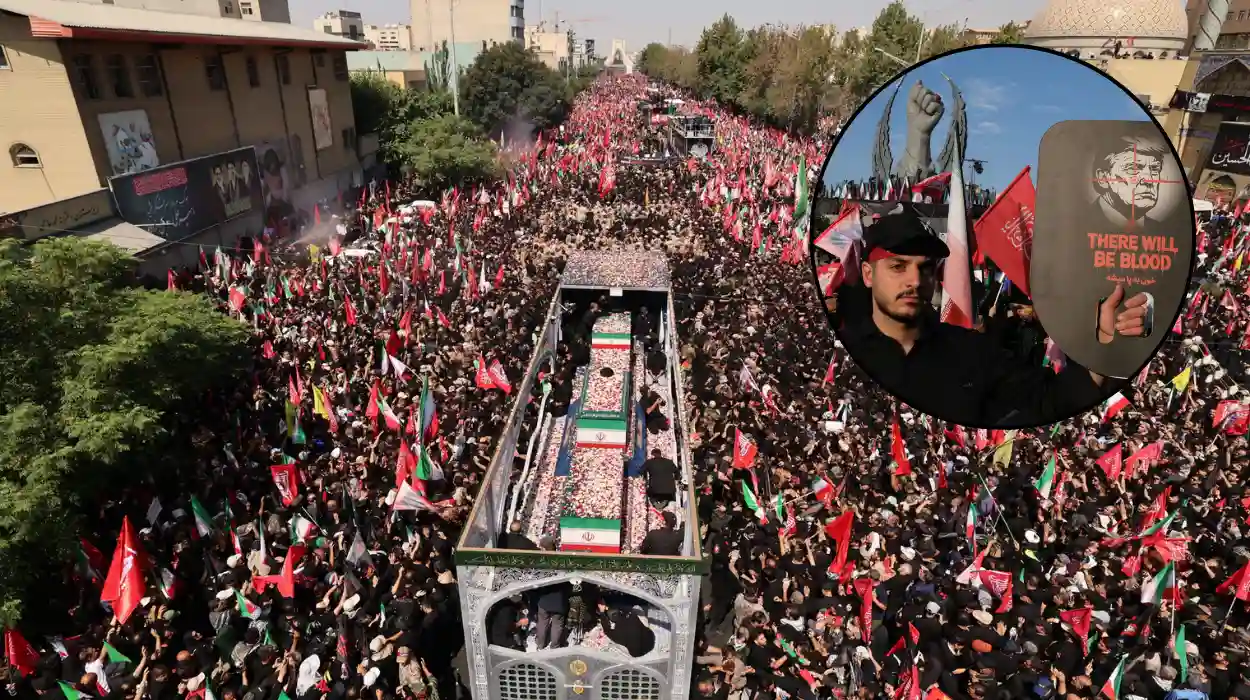
- Multi-day state funeral ceremonies for former Iranian Supreme Leader Ayatollah Ali Khamenei, killed in a US-Israeli air strike on 28 February 2026, have drawn crowds estimated in the millions across Tehran, Qom and Najaf.
- Estimates of Monday’s Tehran procession range as high as 12 to 15 million, with officials suggesting the turnout has surpassed the roughly 10 million who attended the 1989 funeral of Ayatollah Ruhollah Khomeini.
- Mourners have repeatedly chanted “Death to America” and “Death to Israel”, with placards and an on-stage eulogist calling for the killing of President Donald Trump and Israeli Prime Minister Benjamin Netanyahu.
- Iran’s new Supreme Leader, Mojtaba Khamenei, has stayed away from the ceremonies amid reported fears of an Israeli assassination attempt.
- Foreign Minister Abbas Araghchi says Tehran will not resume final-deal negotiations with Washington “if threats continue”, citing an interim memorandum of understanding.
- Reports of missile fire and an attack on a tanker in the Strait of Hormuz have added to tension even as an interim ceasefire holds.
- Analysts are divided on what the turnout means: some see proof of a resilient social base behind the clerical establishment, others argue it is stage-managed political theatre masking deep fractures.
- The funeral programme runs across seven days and several cities before Khamenei’s burial at the Imam Reza shrine in Mashhad, his birthplace.
Tehran (Britain Today News) July 07, 2026 — Iran has spent the past week staging what its state media has called “the funeral of the century” for former Supreme Leader Ayatollah Ali Khamenei, drawing crowds numbering in the millions through the streets of Tehran, Qom and Najaf in a show of mourning that has doubled as a display of political defiance towards the United States and Israel. As the procession moved on Tuesday to the holy city of Qom, where funeral prayers were led by Ayatollah Javadi Amoli at the Jamkaran Mosque, Iran’s leadership was still weighing the political mandate handed to it by a population that has, over recent days, filled boulevards, mosques and squares to bid farewell to the man who led the Islamic Republic for 36 years.
- Key Points
- How Did the Funeral Ceremonies Unfold?
- How Many People Actually Turned Out?
- Why Does the Size of the Crowd Matter Politically?
- What Have Mourners and Officials Said About Revenge?
- Why Has Mojtaba Khamenei Stayed Away From the Funeral?
- What Is Happening in the Strait of Hormuz?
- Why Won’t Iran Resume Nuclear Talks With Washington?
- What Has Donald Trump Said About the Funeral?
- How Are Analysts Interpreting the Funeral’s Meaning?
- What Preparations Did Iran Make for the Funeral?
- Which Foreign Delegations Attended the Ceremonies?
- How Has the Funeral Been Used to Convey Religious and Political Messaging?
- What Happens Next?
How Did the Funeral Ceremonies Unfold?
Khamenei was killed, aged 86, in a joint US-Israeli air strike on his compound on 28 February 2026, the first day of a war between Iran and the US-Israeli alliance. Burial had originally been planned for March but was delayed as the conflict continued. According to Al Jazeera’s coverage of the funeral programme, the ceremonies opened in Tehran and were scheduled to run across seven days, moving from Tehran to Qom, then to Najaf and Karbala in Iraq, before Khamenei’s body is finally returned to Iran for burial at the Imam Reza shrine in Mashhad. Streets, airspace and much of daily life in the capital were shut down for the duration of the mourning period, which PBS reported began on Saturday and is due to conclude with the burial on Thursday.
How Many People Actually Turned Out?
Crowd estimates, as ever with mass gatherings of this kind, vary sharply depending on the source. Iran International reported that officials had expected between 15 and 20 million participants across the week of ceremonies, while Wikipedia’s running account of the funeral noted that estimates for Monday’s Tehran procession alone ranged from roughly 12 to 15 million, figures attributed to the Financial Times. By comparison, Al Jazeera noted that Khomeini’s 1989 funeral, long regarded as the benchmark for mass mourning in the Islamic Republic, drew about 10 million people. Whatever the precise figure, the scale was large enough that the NCRI, an opposition group critical of the Iranian government, conceded in its own commentary that officials were “already claiming between twelve and twenty million mourners.”
Why Does the Size of the Crowd Matter Politically?
For Iran’s leadership, the turnout is being read as a rebuttal to Western assumptions that the war and the killing of Khamenei had left the regime isolated and weakened. A Reuters analysis of the funeral argued that the mourners in Tehran sent a message that the attempt by the United States and Israel to break the Islamic Republic had failed, and that the government’s ability to survive the conflict is now feeding directly into its negotiating posture with Washington. The Middle East Observer, offering an academic reading of the event, described the funeral as amounting to a form of “referendum by tears” for a population that had just endured a devastating war and the loss of its top leadership.
What Have Mourners and Officials Said About Revenge?
Calls for retaliation against the US and Israel have run through the ceremonies almost as prominently as grief itself. As reported by Euronews, an on-stage eulogist, Mohammad Rasouli, addressed the crowd before prayers over Khamenei’s body and asked mourners:
“Why shouldn’t we kill the one who killed my Imam and my Leader?”
He went on to tell attendees that killing Trump was their duty. Iran International separately reported that some participants in the procession carried placards bearing crosshairs over the faces of Trump, Republican Senator Lindsey Graham, commentator Ben Shapiro, and several other US and pro-Israel figures, with slogans warning that “your heads will roll.” According to the Associated Press, via PBS, funeral prayers on Sunday were accompanied by chants of “Death to America” and “Death to Israel”, and one procession featured an effigy of Trump being hanged.
Why Has Mojtaba Khamenei Stayed Away From the Funeral?
Perhaps the most conspicuous absence from the week’s ceremonies has been that of Mojtaba Khamenei, the late leader’s son who assumed the role of Supreme Leader in March. Officials speaking to the New York Times, as cited in reporting on the funeral, said he had been barred from attending over fears that he could be tracked down or assassinated by Israel, a concern sharpened by remarks from Israeli Defence Minister Israel Katz reportedly describing the younger Khamenei as “marked for death.” His absence has fed speculation, noted by the opposition-aligned NCRI, over whether he will even appear for his father’s eventual burial in Mashhad.
Is Iran’s Government Presenting a United Front?
Publicly, yes — but the picture beneath the surface is more complicated. Iran International reported that the funeral has exposed a deeper struggle inside Tehran over ownership of the decision to negotiate with Washington, noting that even Hossein Shariatmadari, editor of the hardline Kayhan newspaper, is now warning against rhetoric that threatens national cohesion. The same reporting described how some of the most uncompromising factions linked to the Revolutionary Guard now argue that Iran’s priority should be preserving its missile programme as a strategic asset, even as pragmatists push to secure the country’s frozen financial interests through a settlement with the US.
What Is Happening in the Strait of Hormuz?
Tension has not been confined to rhetoric. Axios reported, in coverage relayed by Iran International, that Iran’s Revolutionary Guard fired at least two missiles at commercial vessels transiting the Strait of Hormuz, one of the world‘s most important energy corridors. Iranian state broadcaster IRIB said separately that a liquefied natural gas tanker had come under attack after allegedly ignoring warnings while attempting to use a route near Oman, though no Iranian official has confirmed responsibility. Alaeddin Boroujerdi, a member of parliament’s national security and foreign policy committee, said that a decision to change the governing regime of the strait had been made “at the highest levels” of the Islamic Republic, and that legislation on the matter would be brought before parliament imminently.
Why Won’t Iran Resume Nuclear Talks With Washington?
Foreign Minister Abbas Araghchi has made clear that further negotiations hinge on the tone coming out of Washington. In a post on X reported by both Iran International and the Times of Israel, Araghchi wrote that “negotiations on final deal will not commence if threats continue,” invoking paragraph 13 of an interim memorandum of understanding signed between Tehran and Washington the previous month, and calling on the US to “honour your signature.” He added that millions of Iranians had rallied to honour Khamenei’s legacy and that neither the public nor the armed forces were “moved by any threats.”
What Has Donald Trump Said About the Funeral?
Trump has commented publicly on the ceremonies more than once. Newsweek reported that, speaking at an America 250 event at Mount Rushmore, the president told the crowd:
“We gave them a week off for a funeral because we’re nice.”
Trump said of Iran’s surviving leadership gathered for the funeral:
“One shot [and we can take them all out], but we are not going to do that.”
He has also warned that he would “finish the job” if Tehran does not agree to a final deal, prompting Iran’s embassy in Armenia to respond, according to the same report, that Washington would never understand the grief surrounding Khamenei’s death.
How Are Analysts Interpreting the Funeral’s Meaning?
Interpretations diverge sharply along political lines. The Middle East Observer’s analysis argued that the turnout reveals a “highly resilient social core” that believes in the state’s ideology, even if that core is not uncritical of government policy. By contrast, the NCRI’s commentary dismissed the spectacle as choreographed political theatre, arguing that state media and insiders reveal a system that “possesses no real internal strength” left to draw on. Reuters’ analysis took a middle position, framing the funeral as the moment Tehran sought to convert its survival of the war into diplomatic leverage in future talks over the Strait of Hormuz, Iran’s nuclear programme and the broader shape of any lasting settlement with Washington.
What Preparations Did Iran Make for the Funeral?
The scale of the logistical operation behind the ceremonies has been considerable. According to details reported around the funeral, Tehran province prepared 5,000 mosques and 700 schools to host pilgrims, while authorities arranged some 50 million loaves of bread to feed the crowds. Free fibre-optic internet access points were set up at ten locations, grocery stores were ordered to operate around the clock, and the Iranian Red Crescent pitched a thousand tents inside Mellat Park for visitors. Some mourners reportedly travelled at least 750 kilometres to reach Tehran for the ceremonies, with volunteers distributing food and water to help people cope with the summer heat.
Explore More about World:
Gold Prices Near Two-Week High as Downside Risks Persist
Germany Boosts New Rail Infrastructure Funding for 2027
Which Foreign Delegations Attended the Ceremonies?
The funeral has also become a diplomatic occasion in its own right. Al Jazeera reported that representatives from more than 100 countries were expected to attend, according to Iran’s state-linked broadcaster IRIB, with delegations from Hamas and Hezbollah present at earlier events. Pakistani Prime Minister Shehbaz Sharif and Bangladesh’s Parliament Speaker Hafiz Uddin Ahmed were among the foreign officials confirmed to attend, while religious delegations from Turkey, Iraq, Afghanistan and elsewhere joined the ceremonies in Qom. The absence of senior Western leaders was seized upon by some critics as evidence of Iran’s isolation, though Iranian officials and sympathetic commentators have rejected that framing, arguing instead that the presence of so many governments from the wider region undercuts the idea that the Islamic Republic stands alone.
How Has the Funeral Been Used to Convey Religious and Political Messaging?
Al Jazeera’s reporting on the symbolism of the event noted that Iranian authorities have leaned heavily on the language of martyrdom, presenting Khamenei’s death as a sacrifice and casting public mourning as something close to a national duty. The funeral’s official slogan, “must rise”, has appeared on banners throughout the procession, alongside imagery invoking Shia religious tradition and the legacy of the 1979 revolution. Officials have used the week of ceremonies to fold Khamenei’s death into a broader narrative of resistance, linking his killing directly to the events of the war and to Iran’s continuing standoff with Washington and Tel Aviv.
What Happens Next?
With the procession now in Qom and further stops planned in Najaf and Karbala before the final burial in Mashhad, both the funeral and the political manoeuvring around it are expected to continue for several more days. IRGC Quds Force commander Esmail Ghaani said the Iraqi leg of the procession would deepen calls for revenge and strengthen unity between Iran and Iraq against the United States. Meanwhile, talks between Washington and Tehran on a permanent end to the war, covering the Strait of Hormuz, Iran’s nuclear programme and the Lebanon front involving Hezbollah, appear to be on hold until the mourning period concludes. Whether the scale of public mourning translates into a freer hand for Iran’s negotiators, or hardens the position of hardliners pushing for confrontation, is likely to become clearer once formal negotiations resume.