Key Points
- Millions of UK homes face climate-related subsidence risk according to new analysis by the British Geological Survey (BGS)
- London, Essex, Kent, and land from Oxford to the Wash on England’s east coast are identified as the most vulnerable areas
- Hotter, drier summers driven by global heating cause ground beneath houses to shrink and drag property foundations down
- Anna Harrison, BGS scientist, combined geotechnical volume change data with projected rainfall and temperature scenarios for the coming century
- By 2070, approximately 500,000 properties could be affected under a low emissions scenario aligned to the Paris climate agreement
- Under medium emissions scenario, more than 1.8 million properties could be affected, closest to current global emissions trajectories
- London boroughs Camden, Islington and Barnet are most susceptible, with over 26% of capital properties likely affected by 2070 under medium scenario
- UK experienced warmest spring on record in 2025 and driest in more than 50 years, triggering £153m in subsidence insurance claims
- Almost 9,000 households received insurer support in first six months of 2025, with average payout of £17,264 per claim
- Subsidence substantially reduces property value and lenders often refuse mortgages until resolved, requiring engineering work to stabilise land
North London (Britain Today News) June 11, 2026 – Millions of homes across London, Essex and Kent face growing risk of sinking as the climate crisis intensifies, according to groundbreaking analysis from the British Geological Survey (BGS) that pinpoints areas most vulnerable to hotter, drier weather causing ground to shrink and drag foundations down.
- Key Points
- Which Areas Are Most Vulnerable to Subsidence Risk?
- What Do Climate Projections Show for 2070?
- Why Are Dry Weather and High Temperatures Major Factors?
- How Much Have Subsidence Insurance Claims Cost in 2025?
- What Signs Indicate a Property Has Subsidence Damage?
- What Damage Can Subsidence Cause to Properties?
- What Mitigation Measures Can Homeowners Take?
- How Serious Is the London-Specific Risk?
- What Should Homeowners Do If They Suspect Subsidence?
As hotter, drier summers driven by global heating become more frequent, the ground under houses can shrink and drag down a property’s foundations, creating what scientists call “shrink-swell subsidence”. The most vulnerable areas include London, Essex, Kent and a tranche of land from Oxford up to the Wash on England’s east coast, according to scientists who say mitigation measures will be needed.
Anna Harrison, a scientist at the BGS, explained the methodology:
“By combining geotechnical information about volume change potential with data about projected rainfall and temperature scenarios for the coming century, we have been able to identify the areas of Great Britain most likely to become susceptible to shrink-swell subsidence”.
Which Areas Are Most Vulnerable to Subsidence Risk?
Most vulnerable areas are in the London area, and that’s also where bigger changes in rainfall and temperature are expected, Harrison said.
“It’s a double whammy,”
London also has a higher density of buildings, compounding the risk. Harrison added:
“These properties might have foundations that currently can withstand the changes in moisture, but you might find in future there’s going to be more movement. It’s probably going to get worse”.
Highly populated parts of London including Camden, Islington and Barnet are most susceptible, as well as Kent in the south-east of England. Specific neighborhoods in London, such as Camden, Islington, and Barnet, are particularly prone to subsidence, alongside regions in Kent located in the southeast of England.
The BGS report highlights that the areas most at risk include London, Essex, and Kent. Areas such as Camden, Islington, Brent, and Barnet are some of the most affected.
What Do Climate Projections Show for 2070?
The GeoClimate dataset forecasts that, by 2070, about 500,000 properties could be affected under a low emissions scenario aligned to the Paris climate agreement. This rises to more than 1.8 million properties under a medium scenario, closest to current global emissions trajectories.
Under the medium emissions scenario, the number of properties likely to be affected in the capital will exceed 26% by 2070. More than 26 per cent of properties in London could be affected by subsidence by 2070, forecasts show.
Under the medium emissions scenario, the proportion of properties in London likely to experience shrink-swell effects could surpass 26 percent by 2070, potentially reaching as high as 54 percent under a high emissions scenario, affecting 2.5 million in the capital.
In a high emissions scenario, more than 4.2 million properties could face these risks, the report states. Under the high emissions emission scenario, with over 2.5 million properties in the capital highly likely or extremely likely to be affected.
Why Are Dry Weather and High Temperatures Major Factors?
Harrison said:
“Dry weather and high temperatures are a major factor in the emergence of shrink-swell subsidence. Looking ahead, these increases in hotter, drier summers and warmer, wetter winters are projected to continue”.
Anna Harrison, an applied Quaternary scientist at the BGS, stated that the report pinpoints the regions most susceptible to subsidence and warned that
“By integrating geotechnical data regarding potential volume changes with forecasts of rainfall and temperature for the coming century, we have identified the regions of Great Britain most likely to be prone to shrink-swell subsidence in the future,”
Ms. Harrison explained.
“Dry conditions and elevated temperatures significantly contribute to the onset of shrink-swell subsidence. Looking forward, we anticipate that these hotter, drier summers and warmer, wetter winters will continue”.
How Much Have Subsidence Insurance Claims Cost in 2025?
In 2025, the UK experienced the warmest spring on record and the driest in more than 50 years. The Met Office confirmed the UK experienced its warmest spring on record this year – with above-average temperatures across all four nations.
There were £153m of subsidence-related insurance claims in the first six months of 2025. According to the Association of British Insurers (ABI), subsidence-related insurance claims in the UK totalled £153 million (US$205 million) in the first half of 2025.
Over the first six months of the year, insurers supported almost 9,000 households in recovering from subsidence damage, with the average payout per claim standing at £17,264. In the first half of the previous year, insurers reported assisting nearly 9,000 households in addressing subsidence-related damage, with the average claim payout reaching £17,264.
What Signs Indicate a Property Has Subsidence Damage?
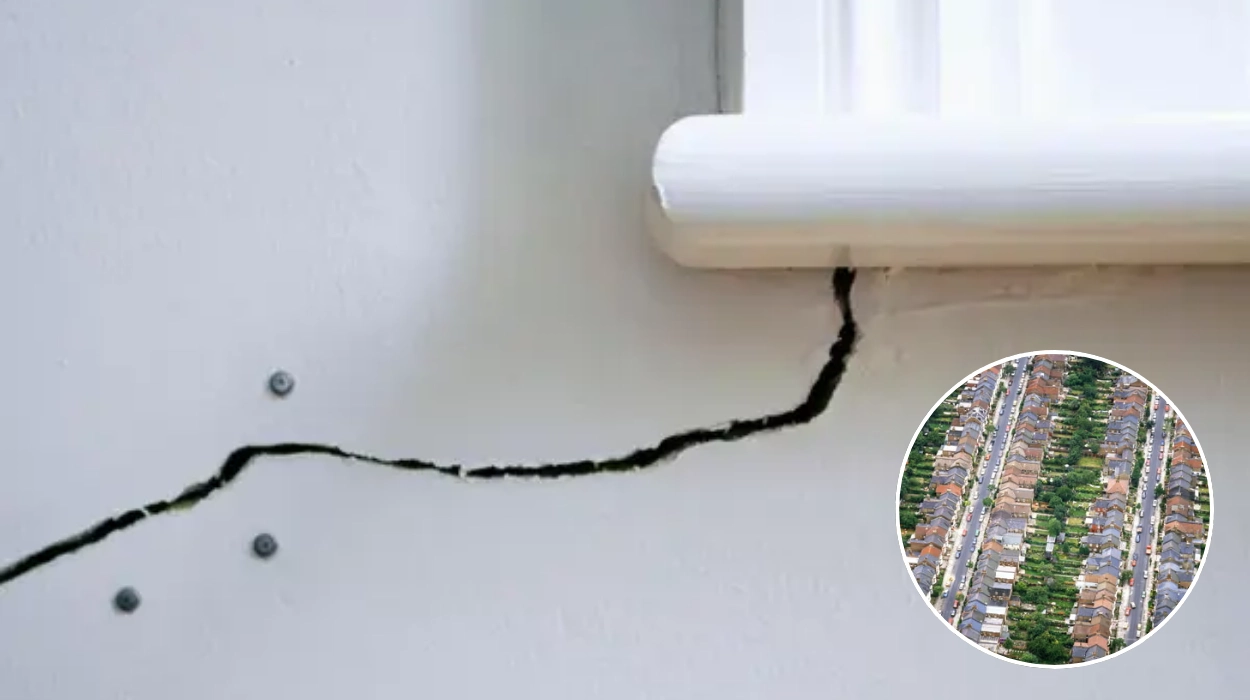
Signs include diagonal cracks around window and door frames, as well as sloping floors. Homeowners concerned about subsidence should look out for a few tell-tale signs.
While not every crack signals a serious issue, those that are more than 3 millimetres wide – roughly the depth of a £1 coin – diagonal and wider at the top than the bottom, and visible both inside and outside the property may warrant further investigation.
Indicators of subsidence include diagonal fissures in walls that are wider at top, and windows that become difficult to open, and wallpaper that wrinkles at the seams where walls meet the ceiling.
Other indicators include doors and windows sticking without an obvious cause, or wallpaper that begins to rip or crinkle in areas not affected by damp. Subsidence cracks usually appear very suddenly, rather than gradually.
What Damage Can Subsidence Cause to Properties?
Subsidence can substantially reduce a property’s value and lenders will often refuse to offer mortgages until it has been resolved. The ramifications of subsidence can greatly diminish a property’s market value, often burdening homeowners with substantial expenses to stabilize their residences before mortgage lenders are willing to proceed.
It can require engineering work to stabilise land or underpin a property. Furthermore, local authorities and utility companies may need to undertake engineering projects to replace damaged pipes and unstable transport systems.
In some cases, utility pipes need to be replaced and trees and vegetation removed. Subsidence occurs when the ground beneath a building sinks, pulling the property’s foundations down with it.
Explore More about London:
Daniel Krikler to Star in The Pianist Stage Production in London
Shoplifting Gang Attacks Staff at North London Supermarket in Shocking Incident
What Mitigation Measures Can Homeowners Take?
“While not all cases can be prevented, homeowners can reduce the risk by managing nearby trees and shrubs that they own, and by ensuring that gutters, pipes and plumbing are well maintained to avoid leaks,”
Louise Clark, Manager of General Insurance Policy at the ABI, said.
Climate change is significantly increasing the risk of subsidence in the UK, particularly in areas with clay-rich soils that sink and swell in response to changing moisture levels caused by hot temperatures, Clark added.
Clay soils – notably London Clay, Oxford Clay and Lias Clay – expand when wet and contract when dry, cracking walls, distorting frames, and in severe cases requiring underpinning. Subsidence risk is highest where clay soils are most common: south-east England, London, the Thames Valley, and parts of the Midlands.
An estimated 4.5 million UK homes sit in shrink-swell areas, concentrated in southern and eastern England. Watch for early warning signs: new or widening diagonal cracks around windows and doors, sticking doors, or gaps where walls meet ceilings.
How Serious Is the London-Specific Risk?
London also has a higher density of buildings, which compounds the subsidence risk.
“These properties might have foundations that currently can withstand the changes in moisture, but you might find in future there’s going to be more movement. It’s probably going to get worse,”
The London Government has noted that in May 2021, the British Geological Survey (BGS) launched maps that assessed the risk of climate related subsidence to homes and properties in the next 50 years. This research found that as many as 57 per cent of properties in London will be affected by 2070.
More than 40% of London’s homes could be affected by subsidence by the end of the decade, a report commissioned by London’s mayor, Sadiq Khan, found. Projections indicate that the number of properties in London likely to be affected by subsidence will rise from 20% in 1990 to 43% by 2030 and more than 50% by 2070.
With climate crisis projections indicating that hotter, drier conditions are likely to become increasingly frequent over the coming century, the number of properties susceptible to subsidence-related shrink-swell is on the rise.
What Should Homeowners Do If They Suspect Subsidence?
“If you suspect your property has suffered from subsidence damage, contact your insurer as soon as possible. It’s exactly what your home insurance is there to cover,”
Louise Clark at the ABI advised.
If in doubt, seek professional advice and speak to your insurer. Subsidence typically happens when soil loses moisture and contracts – often due to prolonged dry spells or the presence of trees and shrubs that draw water from the ground.
Properties in some densely-populated parts of London, particularly in northern and central London boroughs, are most at risk, as are areas of the south east of England with clay-rich soils.
The new BGS GeoClimate data product provides information on the potential for clay shrink-swell subsidence under multiple climate scenarios, helping mitigate the economic risk from shrink-swell subsidence.
By 2070, more than four million properties (10% of the national total) risk being highly or extremely likely to face subsidence under worst scenarios. New analysis finds that the number of buildings across Britain highly or extremely likely to suffer “shrink-swell” is set to double from 3% in 1990 to 6.5% by 2030.