Key Points
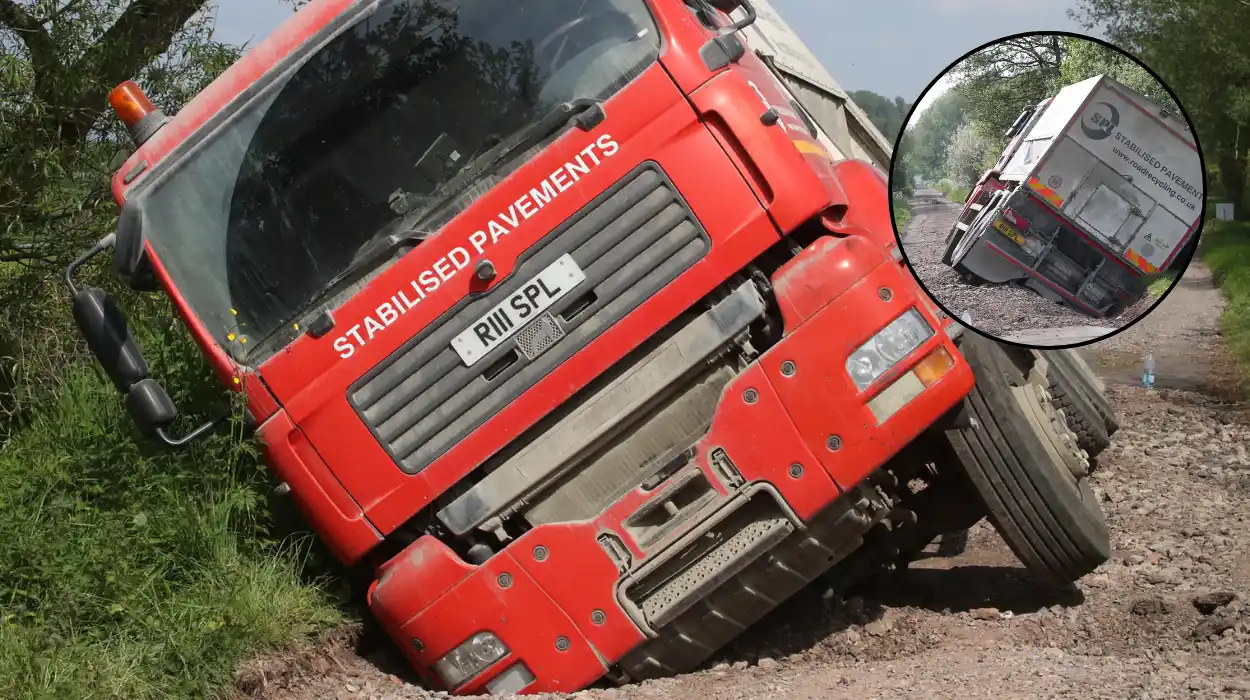
- A lorry became stuck in a sinkhole on Butleigh Moor Drove, near Walton in Somerset, after being sent to repair road damage.
- Contractors from Stabilised Pavements were carrying out planned highway works when the ground gave way beneath the vehicle.
- The lorry was left at a near 45-degree angle and the workers had to abandon it.
- Somerset Council said the road is built on peat and has suffered significant movement and rutting.
- The council added that the site would be assessed after the lorry is recovered to decide the best way to complete repairs.
- Local councillor Lucy Trimnell criticised the council’s approach to road maintenance, describing it as like “trying to darn a pair of fishnet tights”.
- Councillor Richard Wilkins said wet and freezing weather, including damage caused by Storm Chandra in January, had contributed to a sudden deterioration in many roads.
- Stabilised Pavements has been approached for comment.
What happened on the road near Walton?
Somerset (Britain Today News) May 12, 2026— A lorry sent to repair damaged roads became stuck in a sinkhole on a rural route near Walton, leaving the vehicle tilted at a steep angle and forcing workers to abandon the scene. The incident happened on Butleigh Moor Drove, also known as Butleigh Drove, during planned highway works carried out for Somerset Council.
- Key Points
- What happened on the road near Walton?
- Why was the lorry there in the first place?
- What did Somerset Council say?
- Why are local roads getting worse?
- What criticism has been made?
- What happens next at the site?
- How serious is this incident?
- Who is involved in the story?
- Why does this matter locally?
As reported in the material provided, contractors from a company called Stabilised Pavements were working on holes in the road when the ground suddenly gave way beneath the lorry. The vehicle was left at a near 45-degree angle, turning a repair job into an emergency recovery operation.
Why was the lorry there in the first place?
The lorry had been sent to the site to help fix road damage, but the road surface itself proved unstable. Somerset Council said the road is constructed on peat and has experienced significant movement and rutting, conditions that can make repair work difficult and unpredictable.
A council spokesperson said planned highway works were under way on Butleigh Moor Drove near Walton and that the works were being delivered by contractors. The spokesperson added that problems of this kind can arise when work is carried out in such ground conditions.
What did Somerset Council say?
Somerset Council said the lorry involved in the works would be recovered before the site is assessed to determine the most appropriate way to complete the repairs. That statement suggests the immediate priority is to remove the stranded vehicle and then decide how to stabilise the damaged section of road.
Richard Wilkins, the portfolio holder for transport and waste services, said council contractors had been working to fix the damage caused by Storm Chandra in January, as well as other weather events. He told the Local Democracy Reporting Service that recent wet and freezing conditions had led to
Why are local roads getting worse?
The council’s explanation points to a combination of weather damage and difficult ground conditions. Wet and freezing conditions can weaken road surfaces, create rutting and make previously passable routes more vulnerable to collapse once heavy machinery begins work.
The road near Walton appears especially sensitive because it is built on peat, which can shift and move more easily than firmer ground. In practical terms, that means repairs may trigger unexpected failures even when crews are acting on known damage rather than starting from scratch.
What criticism has been made?
Lucy Trimnell, an opposition councillor in Somerset, told The Times that the council’s approach to road repairs was like
“trying to darn a pair of fishnet tights”
and said the road network was “rapidly deteriorating”. Her comments reflect growing frustration among some local figures over the condition of rural roads and the scale of repair work required.
The criticism also highlights a wider political issue: whether local authorities are doing enough to maintain roads before they reach a more serious state of collapse. In this case, the stranded lorry has become a highly visible symbol of the difficulties councils and contractors face when trying to repair weather-hit infrastructure.
What happens next at the site?
According to Somerset Council, the lorry is due to be recovered and the site will then be assessed before the next stage of repair is decided. That means the focus now shifts from emergency removal to engineering judgement, with the council needing to decide how best to restore the road safely.
The recovery process may also help reveal more about the underlying condition of the road and how extensive the damage really is. If the peat base has shifted significantly, the final repair may require more than a straightforward patch job.
How serious is this incident?
No injuries were mentioned in the provided material, but the incident is still significant because it shows how vulnerable some rural roads can be when heavy repair work meets unstable ground. A repair vehicle getting stuck in the very hole it was sent to fix is also likely to attract public attention because of the irony and the scale of disruption.
The event may also raise questions about planning, risk assessment and the methods used to repair roads in peat-heavy areas. While the council says such issues can occasionally arise under these conditions, the visible failure of a lorry in the work zone underscores just how challenging the environment can be.
Who is involved in the story?
The main parties named in the material are Somerset Council, its transport and waste portfolio holder Richard Wilkins, opposition councillor Lucy Trimnell, and the contractor Stabilised Pavements. Each has a distinct role: the council is responsible for the road network, the councillor is voicing criticism, and the contractor was carrying out the repair works when the ground failed.
The road itself, Butleigh Moor Drove near Walton, is the central location in the story. Its peat base and the damage caused by recent weather form the backdrop to the incident and help explain why a routine repair became an unexpected collapse.
Why does this matter locally?
For residents and road users, the story is not just about one stranded lorry but about the wider state of local infrastructure. Rural routes are often essential links for farming, commuting and emergency access, so repeated damage can have practical consequences beyond inconvenience.
The case also illustrates the pressure on councils after severe weather events. When roads deteriorate quickly, authorities may need to prioritise limited resources, meaning some repairs are delayed, complicated or made more expensive by the very conditions they are meant to address.