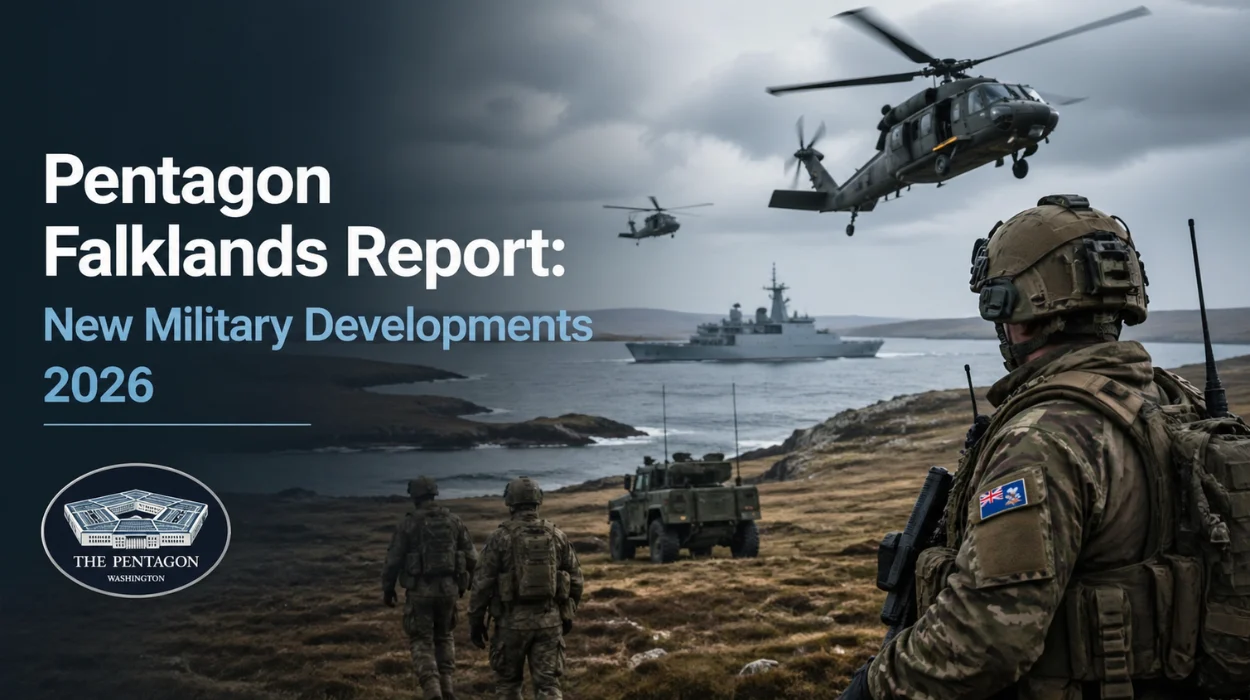
The 2026 Pentagon Falklands report refers to a leaked internal Pentagon email reported in April 2026 that discussed reviewing U.S. support for Britain’s Falklands position during tensions over the Iran war. It did not change Falklands sovereignty, but it renewed focus on the islands’ defence posture, the UK garrison, and Argentina’s modernising armed forces.
- What is the Pentagon Falklands report?
- Why did the report matter in 2026?
- What is the Falklands defence structure?
- What military assets are based there?
- How has Argentina’s military changed?
- What is the sovereignty dispute?
- How strong is the British deterrent?
- What changed after the 2026 leak?
- Why does the Falklands issue still matter?
- What should readers watch next?
What is the Pentagon Falklands report?
The Pentagon Falklands report is a media label for a leaked Pentagon email reported in April 2026, not a formal public policy paper. The email allegedly floated reconsidering U.S. backing for Britain’s Falklands claim as part of pressure on allies over the Iran conflict.
The report became significant because it linked a long-running sovereignty dispute to a live geopolitical crisis. Britain responded by restating that sovereignty rests with the UK and that the islanders’ right to self-determination remains central. Reuters and the BBC both reported that the email had not been independently verified by their outlets.
The Falkland Islands, also called Islas Malvinas in Spanish, are a British Overseas Territory in the South Atlantic Ocean. The dispute over them has shaped diplomacy between the United Kingdom and Argentina for decades. The 2026 report matters because it showed how quickly the issue can re-enter major-power politics.
Why did the report matter in 2026?
The report mattered because it suggested the U.S. could use the Falklands dispute as diplomatic leverage, which touched sovereignty, alliance politics, and military deterrence at the same time. Britain rejected any change in its position immediately, turning the story into a test of strategic support.
The timing intensified its impact. The leak surfaced during a period of friction linked to the Iran war and NATO politics, so the Falklands became part of a broader transatlantic dispute. That widened the story beyond the islands themselves and into the stability of Western diplomatic coordination.
For Britain, the core issue was not only territory but also continuity of defence policy. For Argentina, any shift in international support would feed a familiar argument that the sovereignty question remains open. For the islands’ residents, the main concern is the protection of self-government and security.
What is the Falklands defence structure?
The Falklands defence structure is a permanent British military system built around RAF Mount Pleasant, Mare Harbour, and rotating joint-service personnel. It includes air defence, air mobility, maritime support, and local infrastructure designed to deter aggression and sustain rapid reinforcement.
RAF Mount Pleasant, officially part of the Mount Pleasant Complex, opened in 1985 and became fully operational in 1986. It was built after the Falklands War to replace the vulnerability of earlier arrangements and to give Britain a permanent military foothold on the islands.
The base functions as both a military station and a civilian gateway. The Falkland Islands government says scheduled flights operate through Mount Pleasant, including service links to Chile and Ministry of Defence flights from RAF Brize Norton. That makes the base central to both defence and daily logistics.
British Forces South Atlantic Islands, commonly abbreviated BFSAI, provides the military umbrella. Public descriptions of the installation list roughly 1,000 permanently deployed joint-service personnel and supporting units across the archipelago. The exact force mix changes over time, but the base remains the anchor of the system.
What military assets are based there?
The main military assets include Typhoon fighter aircraft, air-defence missiles, naval patrol support, radar sites, and a roulement infantry company. These assets create layered surveillance, response, and protection across air, sea, and land domains around the islands.
The air element is built around Quick Reaction Alert duty. Typhoon fighters have carried out that role in the Falklands since 2009, when they replaced Tornado F3 aircraft. In January 2026, reporting indicated that RAF Typhoons were receiving upgraded radar systems, a sign that the platform continues to receive modernisation.
The land defence layer includes a rotating infantry presence and an air-defence missile detachment described as Sky Sabre. The presence of air-defence missiles matters because the islands sit far from mainland reinforcement and depend on local denial capability until additional forces arrive.
The maritime layer includes support from Mare Harbour and Royal Navy presence in the South Atlantic. The islands also rely on radar and communications infrastructure, including early-warning and airspace-control sites. Together these elements reduce warning time for any hostile approach.
How has Argentina’s military changed?
Argentina has accelerated military modernisation, especially in airpower, with 24 refurbished F-16s acquired from Denmark and early deliveries reported in late 2025. The program aims to restore credible air-defence and training capacity after years of aircraft decline.
The F-16 program is the most important recent change because it addresses Argentina’s lost supersonic fighter capability. Reporting in April 2026 said the first six aircraft had already arrived in December 2025 and that the air force was working toward initial operational capability by the end of 2026.
This matters to Falklands security because aircraft remain one of the clearest indicators of regional military capability. A modern fighter fleet does not alter sovereignty, but it changes the balance of signalling, patrol options, and contingency planning.
Other reporting has also described Argentina’s acquisition of transport aircraft, helicopters, drones, and tanks. Those systems broaden its military toolkit even if they do not directly create an immediate threat to the islands. The main strategic significance is that Buenos Aires has re-entered a serious rearmament phase after years of decline.
What is the sovereignty dispute?
The sovereignty dispute is the long-running disagreement between the United Kingdom and Argentina over who owns the Falkland Islands. Britain says sovereignty rests with the UK, while Argentina claims the islands as part of its national territory.
Britain’s official position is stable and unchanged. In April 2026, Downing Street said sovereignty of the Falkland Islands rests with the UK and that the islanders’ right to self-determination is paramount. That statement echoed the same line repeated after the leaked Pentagon email emerged.
The United Nations continues to treat the issue as a decolonization dispute. In June 2025, the UN Special Committee on Decolonization adopted a resolution asking Argentina and the UK to resume negotiations aimed at a peaceful solution. That shows the issue remains active in international diplomacy even without immediate battlefield risk.
Self-determination is the key legal and political principle on the British side. It means the people living on the islands have the right to decide their political future. Argentina, by contrast, frames the question as a territorial integrity issue.
How strong is the British deterrent?
The British deterrent is strong in a defensive sense because it combines permanent forces, air policing, radar coverage, and rapid reinforcement options. The system is designed to prevent surprise rather than to support large-scale expeditionary war.
The permanent nature of Mount Pleasant gives Britain a forward military presence that did not exist before the 1982 war in the same form. That presence changes the cost of any challenge because a potential adversary faces local air defence, air patrols, and an established command structure.
Deterrence also depends on logistics. The islands are remote, so reinforcement takes planning, fuel, lift, and sea access. The British system uses air and sea routes through Mount Pleasant and Mare Harbour, which makes supply and personnel rotation more reliable than in the pre-1982 era.
The base’s public open day in March 2026 also reflects a broader reality: Mount Pleasant is not just a fortress but part of island life and civil support. That dual role strengthens resilience because the infrastructure serves defence and civilian mobility together.
What changed after the 2026 leak?
The immediate change after the leak was diplomatic, not military. Britain reaffirmed its stance, international media elevated the issue, and the Falklands returned to headlines as a test case for alliance politics and regional security.
No verified public evidence showed an actual U.S. policy reversal on the islands. The available reporting described a leaked email and a possible review, but not a formal decision. That distinction matters because leaked deliberations and enacted policy are not the same thing.
The story nevertheless revived scrutiny of defence planning. When a distant territory becomes part of great-power bargaining, analysts revisit air defence, patrol sustainability, missile coverage, and reinforcement timelines. Those factors define the practical security of the islands more than headline rhetoric does.
For the Falklands themselves, the episode reinforced the importance of clear political backing from London and stable military presence on the ground. It also reminded observers that sovereignty disputes can reappear suddenly when they intersect with wider wars.
Why does the Falklands issue still matter?
The Falklands issue still matters because it combines territory, self-determination, military geography, and alliance credibility. It remains one of the clearest examples of how a small island territory can shape regional defence planning and international diplomacy.
The islands sit in a strategically sensitive South Atlantic location. That location gives them value for air and maritime monitoring, fisheries protection, and sovereignty signalling. The British military posture therefore serves not only local defence but also a broader political message about control and endurance.
The dispute also remains symbolic. For Britain, it is tied to the principle that residents decide their own future. For Argentina, it is tied to a claim that has survived changes of government and military posture. For the UN system, it is still a decolonization question requiring peaceful dialogue.
Military developments in 2026 show that the issue is not frozen. Britain continues to sustain a permanent force, and Argentina continues to rebuild its capabilities. That combination keeps the Falklands relevant in any discussion of South Atlantic security.
What should readers watch next?
Readers should watch three things: Britain’s defence modernisation in the South Atlantic, Argentina’s F-16 rollout, and any new U.S. statements on Falklands policy. These are the main indicators of whether the 2026 controversy stays rhetorical or becomes strategically meaningful.
The first indicator is the condition of British air defence and logistics. Typhoon upgrades, radar reliability, and ship support all affect how quickly the UK can respond to a challenge.
The second indicator is Argentina’s progress toward operational fighter capability. If the F-16 program reaches sustained readiness, it changes the regional air picture even without altering the legal dispute.
The third indicator is diplomatic consistency. If the United States reaffirms its historic position, the April 2026 leak remains a political episode. If Washington shifts language, even modestly, the Falklands question gains a new layer of international pressure.
The 2026 Pentagon Falklands report is therefore best understood as a warning sign, not a policy outcome. It exposed how quickly the islands can return to the centre of strategic debate when military alliances, sovereignty claims, and regional rearmament intersect.