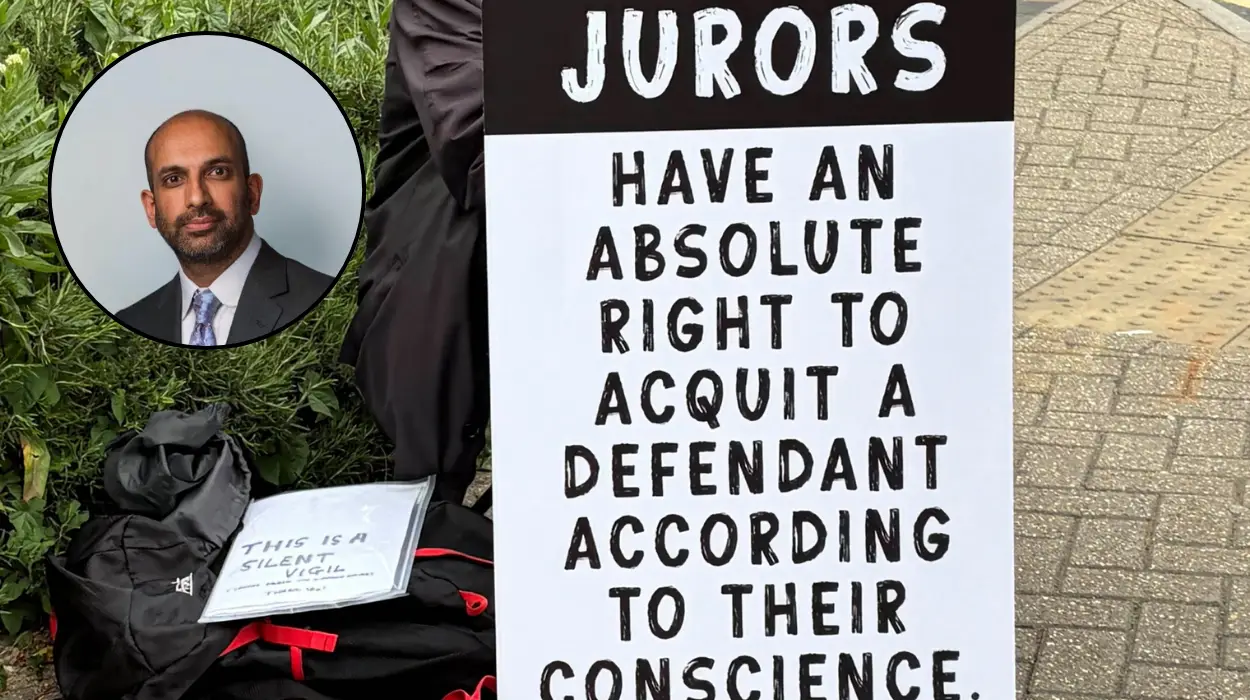
Key Points
- Human rights barrister Rajiv Menon KC is facing contempt of court proceedings over his closing speech in the trial of Palestine Action activists.
- The case concerns six defendants linked to a 2024 direct action protest at an Elbit Systems UK arms factory in Filton, near Bristol.
- Menon represented Charlotte Head in both trials and is accused of defying the judge’s directions to jurors.
- The first trial ended in January 2026 with no convictions, but the defendants were retried.
- After the second jury’s verdicts on Tuesday, the proceedings against Menon could be reported.
- Menon has previously worked on the Stephen Lawrence inquiry, Hillsborough inquests and the Grenfell Tower inquiry.
- The contempt proceedings are believed to be the first ever brought against a barrister over a jury speech, or at least the first in living memory.
- A Court of Appeal decision on whether the case should go ahead is still pending after Menon’s legal team challenged it.
What is Rajiv Menon KC accused of?
Bristol (Britain Today News) May 05, 2026 — A leading human rights barrister has been drawn into an unusual legal battle after being accused of contempt of court following remarks made during the Palestine Action trial. Rajiv Menon KC is said to have gone against judicial directions while making his closing speech in the case involving six activists connected to a protest at an Israeli subsidiary’s arms facility in Filton, near Bristol.
The allegation places the focus not only on the conduct of the trial, but also on the wider question of what limits apply to advocacy when a case involves political protest, conscience-based arguments and highly charged international events. The hearing against Menon is significant because it reaches into the relationship between judge, jury and defence counsel, a relationship that is central to the English criminal justice system.
According to the reporting, the judge had made clear that the defendants could not rely on a “lawful excuse” argument tied to the actions of the Israeli military in Gaza. The court also restricted lawyers from asking jurors to ignore legal directions, invoke jury equity, or be told of a supposed right to acquit according to conscience.
Why is this case considered unusual?
The case is considered highly unusual because it is believed to be the first contempt proceedings brought against a barrister in respect of a jury speech in living memory, and possibly ever. That makes it notable not just as a disciplinary issue, but as a legal moment that could influence future courtroom advocacy.
Menon’s position is also notable because he is a barrister with a long record of involvement in major public-interest cases. He previously worked on the Stephen Lawrence inquiry, the Hillsborough disaster inquests and the Grenfell Tower inquiry, which underlines the prominence of the lawyer now facing scrutiny.
The reported dispute centres on whether his closing speech crossed the line from robust defence advocacy into defiance of the trial judge’s instructions. That question matters because lawyers are expected to argue forcefully for their clients, but they must also remain within the boundaries set by law and judicial rulings.
What did the judge say Menon did?
Mr Justice Johnson said Menon’s closing speech invited jurors to disregard directions on the law and to let wider political views influence their verdict. In the judge’s account, Menon pointed the jury towards Bushell’s case of 1670 and read from a plaque at the Old Bailey describing the historic independence of the jury.
The judge said Menon also told the jury on six occasions that the trial judge could not direct them to convict the defendants. According to the reporting, Johnson argued that this amounted to encouraging the jury to set aside his rulings and to think about the Middle East conflict and the war in Gaza rather than the evidence alone.
This is central to the contempt allegation because it suggests the barrister did more than merely argue the defence case; it suggests he challenged the framework in which the jury had been told to decide the case. In legal terms, that is a serious issue because jury directions are meant to ensure verdicts are based on the law as explained by the court.
What happened in the original trial?
The first trial, which concluded in January, ended without any of the defendants being convicted of an offence. However, they were retried, and the case has since continued to attract attention because of the political context surrounding Palestine Action and the protest at the Elbit Systems UK site.
The defendants had been charged with violent disorder, aggravated burglary and criminal damage in relation to the 2024 direct action protest. Before that first trial, the judge ruled that they could not argue that their conduct was justified by the actions of the Israeli military in Gaza.
At the retrial, the courtroom dynamics changed notably. Charlotte Head and four co-defendants chose to represent themselves during closing speeches after dispensing with their barristers shortly before that stage, and Head later said this was because court decisions made her feel her legal team could no longer represent them in a way that “does us all justice”.
How does the retrial affect the case?
The retrial did not end the controversy; instead, it deepened it. After Head and three others were convicted of criminal damage, Menon was re-engaged to help with a failed bail application ahead of sentencing.
That sequence matters because it shows Menon remained involved in the case even after the most contentious part of his advocacy had already triggered criticism. It also shows that the legal dispute is not confined to one speech, but to the broader handling of a politically sensitive prosecution.
The reported Court of Appeal challenge means the contempt process is not yet settled. If the appeal court decides the case should proceed, the matter could become an important test of the boundaries of courtroom argument in politically charged trials.
Why does this matter for jury speech?
This case matters because it touches on the independence of the jury, one of the oldest principles in the common law tradition. Menon’s speech reportedly referred to Bushell’s case, which is widely recognised as a landmark in establishing jurors’ independence from judicial pressure.
But the issue here is not simply whether jurors are independent in principle; it is whether a barrister can lawfully remind them of conscience-based ideas when a judge has expressly barred such arguments. That tension sits at the centre of the contempt allegation and may determine how future defence counsel frame similar cases.
There is also a wider public interest angle because the case involves protest, Gaza-related arguments and the limits of political expression in a courtroom. For legal observers, the proceedings are important because they may clarify how far defence advocacy can go when moral, political and legal arguments overlap.
What happens next?
The next step depends on the Court of Appeal’s decision on whether the contempt proceedings should continue. Until that ruling is made, the legal position remains unresolved and Menon’s challenge to the case is still active.
If the proceedings go ahead, they are likely to attract close scrutiny from lawyers, judges and campaigners alike. The case is already being discussed as potentially unprecedented, both because of the barrister’s reputation and because of the rare nature of contempt action linked to a jury speech.