Key Points
- The Nova Festival exhibition opens in London on 20 May and will run until 5 July 2026.
- The exhibition recreates the 7 October 2023 Nova Festival massacre, using soundscapes, survivor testimony, reconstructed sites and artefacts including burnt vehicles and pairs of shoes.
- Organisers aim to convey the immediate terror of the attacks, with audiovisual elements that include an initial peaceful festival scene abruptly interrupted by “Red Alert” warnings and chaotic screams.
- Survivor testimony featured includes accounts from Aner Shapira and Adir Ben Zikri, graphic descriptions of mutilated bodies and mass casualties, and first-hand accounts of sheltering, flight and loss.
- As reported by Jewish News (reporter name cited in the body where relevant), Elkana Bohbot — an organiser and hostage survivor — described his reasons for presenting the painful recreation and his view that survivors must tell the story.
- The exhibition includes testimony from Zaka volunteers; one, Shneor Gol, describes daily emotional cost despite public expectation of stoicism.
- The installation presents explicitly graphic material, including references to mutilation and decapitation described by volunteers; organisers warn viewers of the exhibition’s emotional intensity.
- The show contains symbolic elements that draw parallels to Holocaust memorials, notably hundreds of abandoned shoes displayed against memorial candles, and panels referencing the March 2026 UN report on sexual violence by Hamas.
- The display has previously toured sites in the United States, Buenos Aires and Berlin; London marks a major UK showing.
- Visitors and some journalists observed strong emotional responses at the press preview, including tears among hardened reporters and visitors.
- The exhibition’s organisers and survivors urge broad attendance and testimony to counter denial and preserve survivors’ accounts.
- The exhibition’s run and public messaging include the slogan “We Will Dance Again” and a call “We will not be silent.”
London (Britain Today News) May 18, 2026 — An immersive and harrowing reconstruction of the 7 October 2023. Nova Festival massacre that uses sound, testimony and physical artefacts to place visitors inside the moment when a day of music and sun turned into slaughter.
- Key Points
- Why is the Nova Festival exhibition generating such intense emotional reaction?
- Who is the exhibition aimed at and what have visitors said?
- How does the exhibition treat comparisons to the Holocaust, and why is that significant?
- What are the ethical challenges in staging such an exhibition?
- Where else has the exhibition been shown and what is its schedule?
- What do organisers hope visitors will take away?
Why is the Nova Festival exhibition generating such intense emotional reaction?
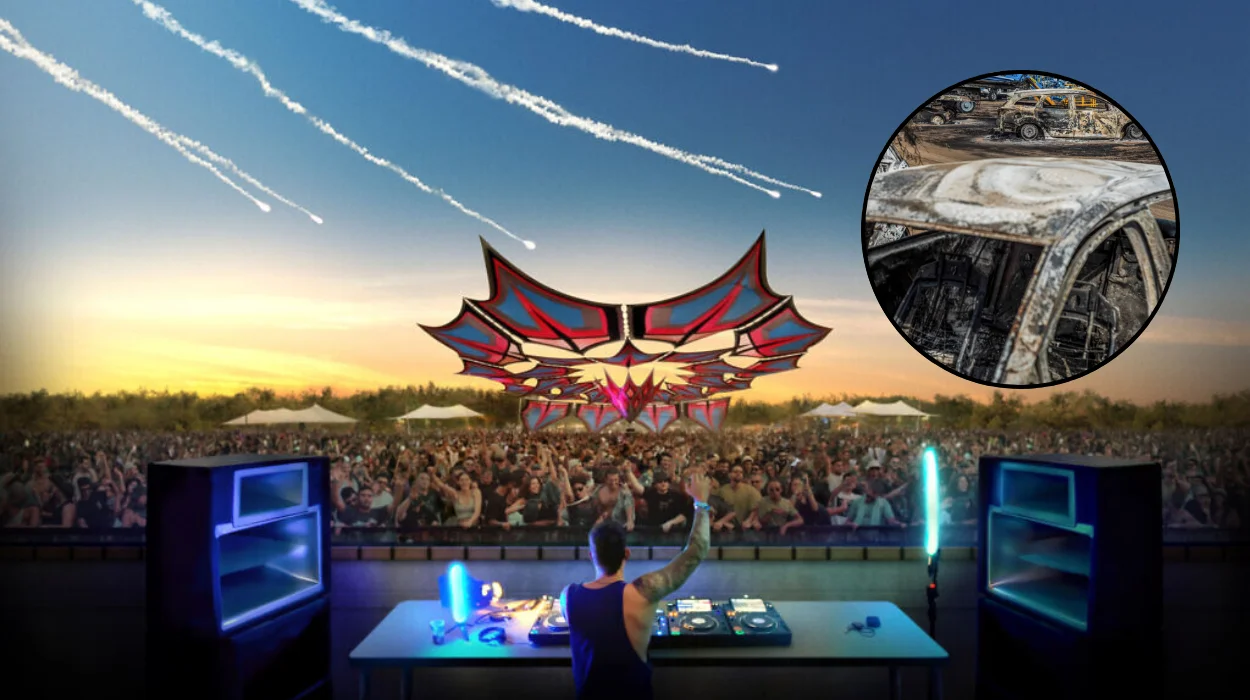
The Nova Festival exhibition is designed to confront visitors with the chaos and horror experienced by festival-goers on 7 October 2023. From the moment you enter, a programmed soundscape stages the abrupt change from elation to panic: bright, trance music and the warm sound of a morning festival dissolve into shouted warnings of “Red Alert!” and anguished cries. Screens around the space rotate survivor testimony and footage while the gallery floor is sanded and scattered with rescued, shot-up vehicles that once stood at the festival site. The curation intentionally removes comfort; it asks the audience to feel the disorientation, fear and aftermath of one of the deadliest attacks on civilians in recent memory.
As reported by Jewish News, Elkana Bohbot — who is credited as one of the organisers and who was himself held hostage after Nova — told the publication that although the recreation is “very painful” for him to witness, he considers it his mission to tell what happened. Bohbot stressed that survivors must speak before memory fades or is denied, saying,
“Please come to see it. Even if you only come for a minute.”
His remarks underline the exhibition’s explicit goal: to move visitors from curiosity to witness.
What kinds of testimony and artefacts are on display, and how do they shape the narrative?
The exhibition layers testimonies from survivors, rescuers and volunteers with material artefacts from the site. Testimonies include detailed, graphic recollections. Adir Ben Zikri describes running
“between burnt bodies, body parts strewn all over the road and rivers of blood,”
and recounts the emptiness of burial options:
“I have nothing to bury… nothing to bury.”
In a screening room devoted to the concrete shelters on Route 232, visitors hear accounts of dozens of people cramming into small rooms as attackers lobbied grenades and gunfire; one survivor, Aner Shapira, is noted for having tried to repel attackers before being killed. A wall poster in the shelter installation quotes a survivor:
“There were 40 of us in there and only seven came out alive. We couldn’t move. We were all covered by corpses.”
The exhibition also includes testimony from members of Zaka, the emergency response and recovery organisation. As reported by Jewish News, volunteer Shneor Gol spoke on camera of the “unspeakable” scenes he encountered — mutilated bodies and bags containing body parts — and admitted that despite the public perception of Zaka volunteers as emotionally hardened,
“I cry every day.”
His statement, placed within the exhibition, emphasises the long-term trauma for first responders as well as survivors.
Material items recovered or reconstructed from the site — shot-up cars, burned possessions and hundreds of abandoned pairs of shoes — provide visceral anchors for the testimonies. The shoe installation deliberately echoes Holocaust memorial motifs, inviting a comparison in the visitor’s mind between mass civilian loss and the enduring memory practices that follow mass atrocity. Organisers place these elements alongside panels summarising findings such as those in the March 2026 UN report on sexual violence by Hamas, with the headline
“We will not be silent.”
Who is the exhibition aimed at and what have visitors said?
The exhibition is pitched at a broad public: Israelis and Jews of the diaspora, non-Jewish visitors, students, journalists and anyone seeking to understand the immediate human cost of October 2023. At a press preview in London, dozens of journalists and hardened observers were reportedly moved to tears. As reported by Jewish News, Taryn Thomas, a Stanford student who visited the exhibition in Los Angeles in October 2024, said the show transformed her understanding of the Israeli–Palestinian conflict. Initially sceptical —
“I decided to go mainly to look for Zionist propaganda”
— she said the experience “broke my mind,” highlighting how the exhibition can shift perspectives by making the human element unavoidable.
Another effect of the exhibit is a public call to testimony: Elkana Bohbot — who spent 738 days in Hamas captivity and has written about his experience — urged attendance to maintain the record of events. He said the exhibition’s mission is to ensure survivors’ stories resist denial and forgetfulness, noting that
“now the survivors are dying and it’s too easy to deny what happened. But we, the survivors of 7 October, we are here and we must tell the story.”
How does the exhibition treat comparisons to the Holocaust, and why is that significant?
The curators do not shy away from drawing parallels to Holocaust memorialisation. The hundreds of shoes displayed with memorial candles are a clear visual device that compels visitors to place the Nova massacre within a broader history of civilian mass violence and remembrance. This framing has two aims: to communicate magnitude and to insist on the moral necessity of memory. Organisers couple this with explicit references to international reporting on sexual violence and other war crimes, including the March 2026 UN report, to position the Nova attacks within serious international scrutiny.
Some critics and visitors may see the comparison as provocative; the exhibition’s creators, however, argue that the parallels are not meant to equate different historical events simplistically, but to underline common questions about how societies remember mass atrocities and how survivors’ testimonies are preserved.
Explore More about London:
Tube strikes cancelled at ‘eleventh hour’ amid ongoing negotiations 2026
Tens of thousands attend rival London protests as 31 arrested 2026
What are the ethical challenges in staging such an exhibition?
Recreating scenes of recent violence inevitably raises ethical questions. The curators have chosen to include graphic descriptions and images — including references to mutilated bodies and decapitation accounts given by volunteers — which can be deeply traumatic for visitors and survivors alike. The exhibition team includes warnings about the material and offers contextual framing to avoid sensationalism. Survivor participation, where volunteers and former hostages consent to share their accounts, is part of the curatorial ethics; organisers contend that these first-person narratives are central to preventing denial and ensuring historical accuracy.
Where else has the exhibition been shown and what is its schedule?
The Nova Festival exhibition has toured multiple cities, including venues in the United States, Buenos Aires and Berlin, before its London run. The London showing runs from 20 May to 5 July 2026. Organisers invite the public with the rallying phrases
“We Will Dance Again”
and
“We will not be silent.”
What do organisers hope visitors will take away?
Organisers and survivors consistently urge visitors to witness, remember and tell others. Bohbot’s appeal —
“Please come to see it. Even if you only come for a minute”
— summarises the exhibition’s plea: attending is an act of bearing witness to a tragedy that organisers fear will otherwise be diminished over time. The show is unapologetically designed to provoke empathy, outrage, grief and a commitment to testifying about the victims and survivors.
At the press preview, many observers described leaving the exhibit deeply affected. The combination of intimate testimony, stark artefacts and confronting soundscapes aims not simply to inform but to keep alive the memory of those who died and those who remain haunted.
Information:
- Venue: London (specific venue and ticketing details available on organiser sites)
- Dates: 20 May–5 July 2026