Key Points
- Over 1,000 people gathered in Trafalgar Square, London, for a mass vigil on Saturday to oppose the UK government’s ban on Palestine Action.
- Metropolitan Police arrested 212 demonstrators for allegedly showing support for the proscribed organisation, with ages ranging from 27 to 82.
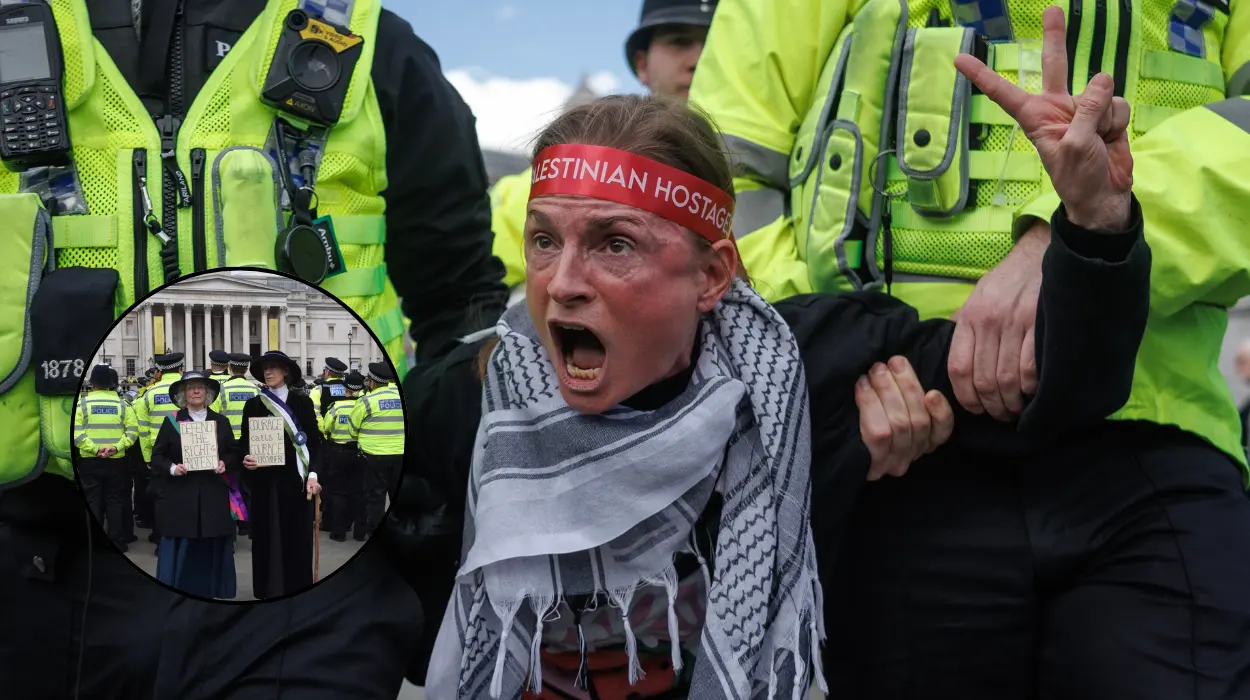
- Police physically carried many away, including an elderly woman with walking sticks who was escorted from the site.
- Demonstrators held signs reading “I oppose genocide. I support Palestine Action.”
- Defend Our Juries (DOJ), the organising group, demands the government lift the ban, drop Terrorism Act charges, and end police arrests for support.
- One demonstrator stated belief in democracy but claimed Britain has become non-democratic, endangering free speech.
- Palestine Action, a direct action group, seeks to end British complicity in Israel’s mistreatment of Palestinians; it claimed actions like painting RAF aeroplanes and attacking a London business linked to Israeli weapons manufacturers.
- UK government proscribed Palestine Action as a terrorist organisation in July 2025, alongside groups like al-Qaeda and Hezbollah; membership or support punishable by up to 14 years in prison.
- High Court ruled proscription unlawful on February 13, deeming it disproportionate and breaching freedom of expression.
- Metropolitan Police initially said unlikely to arrest post-ruling but U-turned on March 25, resuming arrests despite criticism.
- Eight linked activists staged hunger strikes in prison on remand to protest the proscription.
- Hunger striker Qesser Zuhrah criticised the Met Police for serving government interests over public protection.
- Organisers estimated 1,500 participants.
- Government appeal against High Court ruling set for Court of Appeal on April 28-29.
London (Britain Today News) April 11, 2026 – Hundreds of demonstrators faced arrest during a large vigil in Trafalgar Square protesting the government’s proscription of Palestine Action, as police enforced laws against support for the designated group. The Metropolitan Police reported detaining 212 individuals, highlighting tensions over free speech and counter-terrorism measures following a court challenge.
- Key Points
- What Sparked the Trafalgar Square Protest?
- Why Was Palestine Action Proscribed by the UK Government?
- What Did the High Court Rule on the Proscription?
- How Did Activists Respond to the Police U-Turn?
- What Are the Next Steps in the Legal Battle?
- Broader Context of Protests and Policing in London
- Implications for Free Speech and Counter-Terrorism?
What Sparked the Trafalgar Square Protest?
The gathering drew more than 1,000 participants, with organisers from Defend Our Juries (DOJ) estimating up to 1,500 attendees by Saturday afternoon. Many waved placards declaring
“I oppose genocide. I support Palestine Action,”
voicing solidarity amid legal battles over the group’s status.
Defend Our Juries, a UK-based activist network, spearheaded the event to challenge the ban imposed last year. The group explicitly called for the government to rescind the proscription, abandon all Terrorism Act investigations and charges against supporters, and halt what they described as a Metropolitan Police reversal on enforcement policy.
One unnamed demonstrator explained his presence stemmed from a commitment to democratic principles. He stated,
“I believed in the democracy.”
He further added,
“I think Britain has now descended into a non-democratic situation and I think that is very dangerous [for] free speech.”
Police response proved swift and physical. Officers carried numerous protesters away from the square, including a notable instance where an elderly woman clutching walking sticks was gently escorted by authorities. The Metropolitan Police confirmed these actions targeted alleged displays of support for a proscribed organisation, with arrests spanning ages 27 to 82.
Why Was Palestine Action Proscribed by the UK Government?
Palestine Action operates as a direct action campaign explicitly aiming to disrupt British involvement in what it terms Israel’s mistreatment of Palestinians. The group has publicly taken responsibility for high-profile incidents, such as breaking into an RAF base to paint aeroplanes and targeting a London business it linked to weapons manufacturing for Israel.
In July 2025, the UK government classified Palestine Action as a terrorist organisation, aligning it legally with entities like al-Qaeda and Hezbollah. This proscription renders membership or public expressions of support criminal offences, each carrying potential sentences of up to 14 years imprisonment.
The move drew immediate backlash, culminating in prison hunger strikes by eight activists connected to the network. These individuals, held on remand, fasted to contest the designation during their detention.
What Did the High Court Rule on the Proscription?
On February 13, the High Court declared the government’s proscription unlawful. Judges labelled the decision “disproportionate” and found it violated freedom of expression protections.
Following this judgment, the Metropolitan Police initially signalled restraint. Officials indicated they deemed arrests for mere support unlikely in light of the ruling.
However, on March 25, the force announced a policy shift, committing to resume detentions for such displays. Critics, including protest participants, accused this of undermining the court’s authority.
How Did Activists Respond to the Police U-Turn?
Qesser Zuhrah, one of the hunger-striking activists affiliated with Palestine Action, addressed the crowd directly at Trafalgar Square. She told on-site reporters,
“It just shows that the Met police, they don’t serve us, they don’t protect us, they work only to reinforce what the government wants.”
Defend Our Juries framed the vigil as a broader stand against perceived erosion of civil liberties. Their demands encompassed not only lifting the ban but also terminating ongoing probes under the Terrorism Act targeting those who backed the campaigners.
The group’s protest also spotlighted the police’s earlier about-face on post-ruling enforcement, positioning it as evidence of institutional bias.
What Are the Next Steps in the Legal Battle?
The UK government has lodged an appeal against the High Court’s February decision. Proceedings are slated for the Court of Appeal on April 28 and 29, promising further scrutiny of the proscription’s proportionality and its implications for expression rights.
Meanwhile, those arrested on Saturday face potential charges under terrorism legislation. The wide age range among detainees—from young adults to an 82-year-old—underscores the protest’s diverse makeup and the enforcement’s reach.
Broader Context of Protests and Policing in London
Saturday’s events echo ongoing friction between pro-Palestine activists and authorities since the ban’s inception. Palestine Action’s tactics, while non-violent in intent according to supporters, have involved property damage and disruptions, prompting the terrorist label.
The Metropolitan Police’s operations in Trafalgar Square involved substantial resources, with officers physically removing non-compliant individuals to maintain order. No injuries were reported among the elderly woman or others handled similarly, though footage captured the methodical clearances.
Defend Our Juries emphasised the vigil’s peaceful nature beforehand, focusing on speeches and signage rather than disruption. Yet, the 212 arrests indicate police interpreted banners and chants as illicit endorsements.
Implications for Free Speech and Counter-Terrorism?
Demonstrators like the one cited framed the crackdown as a slide towards authoritarianism. His remarks highlighted fears that robust anti-terror laws now stifle dissent on foreign policy, particularly regarding Israel-Palestine dynamics.
The High Court’s intervention marked a rare judicial check on executive proscription powers, typically reserved for overtly violent entities. Its finding of disproportionality questioned whether Palestine Action’s actions warranted equation with global jihadist networks.
As the appeal looms, outcomes could reshape how the UK polices advocacy groups. A upheld ban would solidify restrictions; a reversal might prompt policy recalibrations across law enforcement.
Organisers hailed the turnout as a success in amplifying their call, despite detentions. With over 1,000 voices united, the vigil signalled persistent opposition to the status quo.
This episode underscores deepening divides over security measures versus protest rights in Britain’s capital. As April’s court dates approach, public scrutiny intensifies on balancing these imperatives.