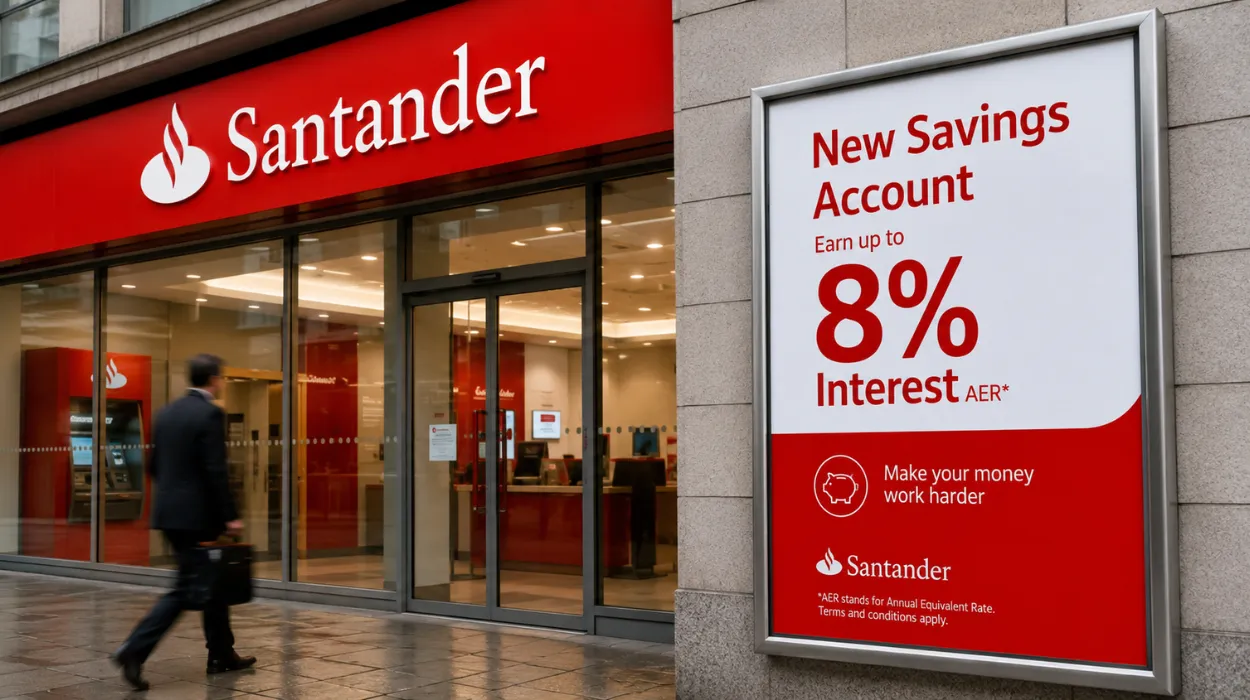
Santander’s new Regular Saver is a UK savings account that pays 8.00% AER/gross variable in the first year, with a 5.00% bonus rate included for 12 months and a lower 3.00% AER rate after that period. It is designed for existing Santander current account customers, including fee-free Everyday current account holders, and it lets savers deposit up to £200 each month.
- What is Santander’s new 8% savings account?
- Who can open the account?
- How does the account work?
- How much interest can you earn?
- Why do banks offer regular savers?
- How does it compare with standard savings?
- What are the main conditions?
- What does variable rate mean?
- What is the wider savings context?
- Why this matters for savers?
- How should a saver use it?
What is Santander’s new 8% savings account?
Santander’s new 8% savings account is a Regular Saver built for monthly saving, not lump-sum deposits, and it pays a headline 8.00% AER/gross variable in year one. The account is tied to a Santander current account, allows up to £200 per month, and starts with a minimum opening balance of £1.
A regular saver is a savings account that rewards consistent monthly deposits over a fixed period. Santander’s version follows that model by limiting deposits to a monthly cap and offering a high introductory rate for disciplined savers.
The “8%” figure is the annual equivalent rate, or AER, which shows the effect of interest compounding over a year. The account also includes a 5.00% bonus element for the first 12 months, after which the rate drops to 3.00% AER/gross variable.
Who can open the account?
The account is available to eligible Santander current account customers, including those with Santander’s fee-free Everyday current account, and some reports say new customers can qualify by opening or switching to a Santander current account first. Applicants must be 16 or over and live in the UK.
Santander’s published materials show the Regular Saver is linked to a Santander current account, which makes the bank relationship central to eligibility. That structure matters because the savings product is not a standalone account open to the general market.
Media coverage also reports that the account is open to new and existing customers with qualifying Santander current accounts, including Everyday, Edge, Edge Student, Edge Up, and Explorer. Those current accounts have different fee structures, so eligibility and cost depend on the current account selected.
How does the account work?
The account works by letting you save a fixed monthly amount, up to £200, for 12 months while earning a high variable rate. You can open it with £1, add money each month, and withdraw funds without penalty through a Santander current account.
Regular savers are built to encourage habit-based saving. Instead of holding a large balance from day one, they reward monthly discipline, which is why the rate is high but the deposit limit is low.
Santander’s account is limited to one per customer, and the rate is variable, which means Santander can change it in line with its terms. The withdrawal feature is notable because some regular savers charge penalties or restrict access more tightly.
How much interest can you earn?
If you pay in the full £200 every month for 12 months, the account can generate meaningful interest, but the final return depends on the variable rate and the timing of deposits. One industry estimate says a saver using the maximum monthly deposit could earn over £100 in interest over a year.
The account is not designed for large one-off balances. Its value comes from the combination of a high headline rate and steady monthly deposits, so the effective interest earned depends on how long each deposit stays in the account.
Because the rate is variable, the return is not fixed for the full year. That means savers should treat the 8.00% headline rate as a promotional structure rather than a guaranteed long-term yield.
Why do banks offer regular savers?
Banks offer regular savers to attract loyal current account customers, encourage monthly deposits, and deepen customer relationships. These accounts usually have short-term high rates, low deposit limits, and eligibility rules that connect them to a main banking relationship.
A regular saver helps a bank gather predictable monthly inflows. For customers, it creates a structured way to build an emergency fund, holiday fund, or short-term goal fund without needing a large starting balance.
This model has been used by high street banks for years. Santander’s previous regular saver products also relied on monthly contribution limits and a fixed promotional term, showing that this account fits a long-established savings pattern.
How does it compare with standard savings?
Compared with standard easy-access savings, a regular saver usually offers a higher headline rate but imposes monthly deposit limits and shorter terms. Santander’s 8% Regular Saver is aimed at disciplined monthly saving, while its Easy Access Saver is designed for instant access and broader flexibility.
Santander’s Easy Access Saver gives instant access to cash and links with Santander cash cards, which suits people who want liquidity rather than a promotional rate tied to monthly contributions. That contrast shows the core trade-off in savings design: access versus yield.
By contrast, the Regular Saver is built around a 12-month structure and a capped deposit pattern. This makes it most useful for savers who can commit to monthly payments and do not need to store a large cash balance in the account.
What are the main conditions?
The main conditions are simple: you need a qualifying Santander current account, can save up to £200 each month, can open the account with £1, and can hold only one Regular Saver account per customer. The rate is variable and drops after the first 12 months.
These conditions create a narrow but attractive product design. The deposit cap limits the total amount that can earn the high rate, while the current account requirement keeps the customer relationship inside Santander’s banking ecosystem.
A saver who uses the full monthly allowance will build a balanced, predictable savings habit. A saver who needs irregular withdrawals or large lump sums will usually find a standard easy-access account more suitable.
What does variable rate mean?
A variable rate means the bank can change the interest rate during the life of the account according to the product terms. In this case, the headline 8.00% AER includes a 5.00% bonus for the first 12 months, and after that the account currently pays 3.00% AER/gross variable.
This matters because the advertised return is not locked in forever. Variable pricing is common in savings products and reflects broader market conditions, including central bank rates and competition among deposit accounts.
For customers, the practical lesson is to review the account after the first year. The promotional rate expires, and the savings strategy then needs to be reassessed against other cash products available at the time.
What is the wider savings context?
The wider context is a competitive UK savings market where banks use rate-led offers to attract deposits and current account relationships. Santander’s launch fits the long-standing pattern of using introductory bonuses and monthly saver structures to appeal to retail customers.
Santander has used similar account structures before, including earlier regular saver products that also required a Santander current account and monthly standing-order style deposits. That history shows the new account is not isolated, but part of a recurring banking strategy.
The product also sits alongside Santander’s broader savings menu, which includes instant-access and ISA options. That range matters because savers often combine products: one account for access, another for higher promotional return, and another for tax-efficient saving where relevant.
Explore More about Business:
Accenture Share Price Insights: Growth, Risks & Outlook
Bank of England Forecast: Rates, Inflation & Economy
Why this matters for savers?
This account matters because it gives regular savers a high introductory rate on a modest monthly amount, which can improve returns without requiring a large starting balance. It is especially relevant for people building emergency funds, short-term goals, or monthly saving habits.
The strongest use case is for someone who already banks with Santander or is willing to switch. Since the account is linked to a Santander current account, the savings rate is only part of the value; the current account relationship is the gateway.
The product also highlights a broader principle in personal finance: rate alone does not determine usefulness. Access rules, monthly limits, and term length all shape how much real-world value an account delivers.
How should a saver use it?
A saver should use this account as a structured monthly pot rather than a primary cash reserve. The best approach is to pay in the maximum monthly amount if cash flow allows, keep track of the 12-month bonus window, and compare the post-bonus rate with other available savings products.
For example, a saver with a steady monthly surplus can direct that money into the Regular Saver each month until the cap is reached. That method captures the promotional rate while keeping the strategy simple and repeatable.
A saver needing instant access to a larger emergency fund should keep that reserve in an easy-access account instead. Santander’s own Easy Access Saver is built for that kind of use case.
Santander’s new 8% Regular Saver is a high-rate, monthly savings product for Santander current account customers, not a general-purpose savings account. Its value comes from disciplined deposits, a 12-month bonus structure, and a low entry threshold that makes it accessible to more savers.
The account is most attractive when someone can commit to monthly saving and already fits the Santander current account requirement. Its headline rate is strong, but its real usefulness depends on the saver’s habits, cash flow, and need for access.
In practical terms, this is a tactical savings product, not a permanent home for cash. Its role is to help customers build savings efficiently over a year, then reassess once the promotional period ends.