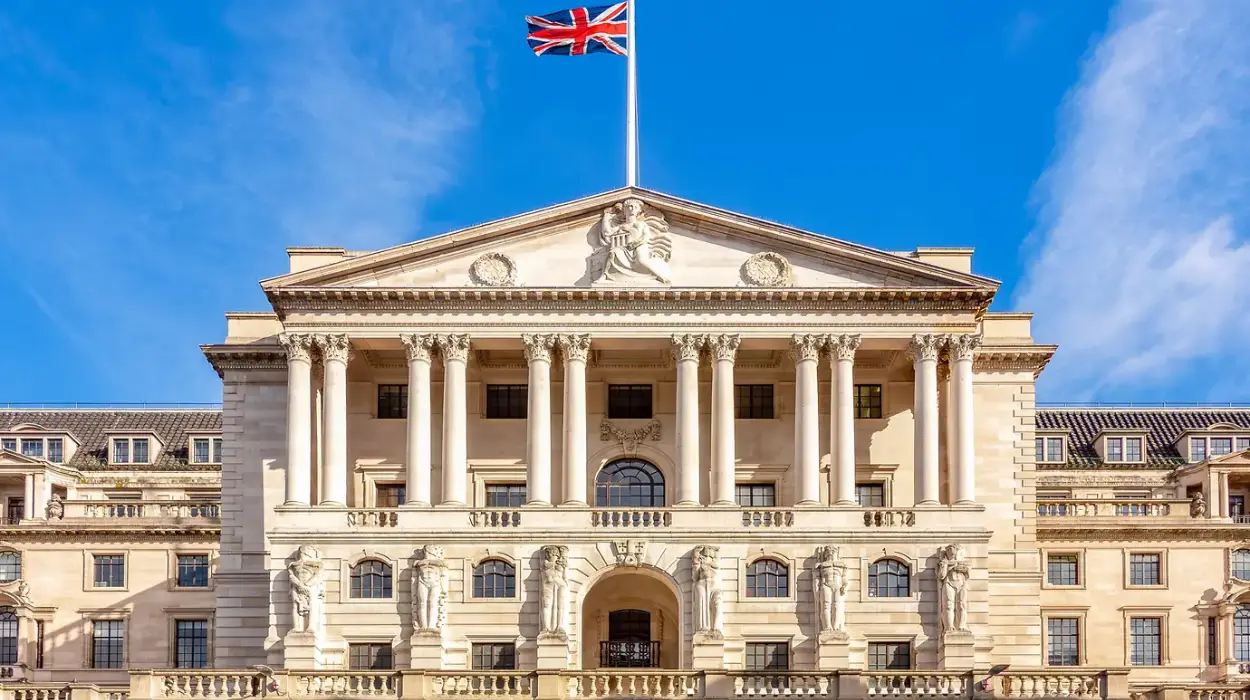
What is the Bank of England’s current forecast for interest rates, inflation, and economic growth?
The Bank of England maintains Bank Rate at 3.75% as of April 2026, with CPI inflation at 3.3% and expected to rise further before falling toward the 2% target. GDP growth is forecast at 0.8% for 2026, with economists predicting 1–2 rate cuts bringing Bank Rate to 3.00%–3.25% by late 2026, contingent on Middle East conflict energy price impacts.
- What is the Bank of England’s current forecast for interest rates, inflation, and economic growth?
- What is the Bank of England’s inflation forecast for 2026 and 2027?
- What is the Bank of England’s interest rate forecast and when will rates be cut?
- What is the Bank of England’s GDP growth forecast for the UK economy?
- What is the Bank of England’s Monetary Policy Committee and how does it set interest rates?
- What are the main risks to the Bank of England’s economic forecast?
The Bank of England serves as the United Kingdom’s central bank, responsible for monetary policy to maintain price stability and support economic growth. The Monetary Policy Committee (MPC) sets interest rates eight times annually to keep Consumer Prices Index (CPI) inflation at the government’s 2% target. Current economic conditions reflect significant uncertainty from the Middle East conflict, which has disrupted energy supplies and pushed global oil prices to $119 per barrel at peak in March 2026.
What is the Bank of England’s inflation forecast for 2026 and 2027?
CPI inflation reached 3.3% in March 2026, rising from the February forecast of 2.0% due to Middle East energy price shocks. Inflation is expected to peak above 3.5% by end-2026 in scenarios A and B, then fall below 2% in Scenario A or close to 2% in Scenario B by 2027. Scenario C projects inflation peaking over 6% in early 2027, ending around 2.5%.
The April 2026 Monetary Policy Report marks a dramatic shift from the February projection. Previously, inflation was expected to fall to 2.0% by Q3 2026. The new near-term projection is 1.4 percentage points higher at 3.3% for Q3 2026. The conflict in the Middle East has caused disruption to energy supplies, leading to sharp increases in global oil and gas prices. The Brent crude front-month oil price peaked at $119 per barrel on 31 March 2026, while UK wholesale gas futures rose approximately 37%.
Higher energy costs drive inflation through direct and indirect channels. Direct effects include higher motor fuel and utility prices faced by UK households. Indirect effects occur as companies pass increased energy costs through supply chains, with food prices experiencing the quickest pass-through. Consumer food price inflation is projected to rise to 4.6% by September 2026, with some industry contacts estimating food price inflation could reach 6%–7% by year-end.
The three scenarios in the April Report illustrate different inflation trajectories. In Scenarios A and B, assuming monetary policy follows the market interest rate path through 22 April, inflation rises to slightly over 3.5% at end-2026 before declining. Scenario A assumes oil and gas prices follow futures curves with households prioritizing saving, resulting in inflation ending below the 2% target. Scenario B assumes energy prices remain higher longer with modest second-round effects, ending close to 2%.
Scenario C presents a more severe outcome with sharply elevated energy prices remaining prolonged. This larger shock generates stronger second-round effects on wage and price-setting, causing inflation to peak over 6% at start-2027 and settle around 2.5%. Second-round effects refer to when higher inflation influences broader wage and price behavior, potentially embedding inflationary pressures into the economy.
Underlying consumer services inflation remains elevated at 4% to 5% in the three months to March 2026, above the 2.75% to 3% range consistent with 2% headline inflation. Consumer services inflation is expected to fall from 4.5% in March to 3.8% by September 2026, though disinflation will be weaker than previously expected due to higher non-labour input costs.
Inflation expectations have risen across households, businesses, and financial markets. The Citi/YouGov one-year ahead household inflation expectation measure rose to 5.4% in March from 3.3% in February. Firm one-year ahead CPI expectations increased to 3.5% in the three months to April, while household 5–10 year ahead expectations rose to 4.5%.
What is the Bank of England’s interest rate forecast and when will rates be cut?
Bank Rate was maintained at 3.75% at the April 29, 2026 MPC meeting, with an 8–1 vote. Economists forecast 1–2 rate cuts in 2026, bringing Bank Rate to 3.25%–3.00% by late 2026. ING and Oxford Economics predict the rate concluding 2026 at 3.25%, with cuts potentially occurring in March and June 2026.
The Monetary Policy Committee voted by majority 8–1 to maintain Bank Rate at 3.75% at the meeting ending 29 April 2026. One member voted to increase Bank Rate by 0.25 percentage points to 4%. The decision reflects the MPC’s judgment that current economic conditions will lessen second-round effects from higher energy prices, while financial conditions have tightened since the conflict began, already acting against inflationary pressures.
Bank Rate, also known as the Base Rate, determines the interest rate the Bank of England pays to commercial banks holding money with it. This influences the rates UK banks apply to borrowing and savings. Bank Rate affects other interest rates throughout the economy, serving as the primary tool to keep inflation stable.
The 2026 outlook shows significant debate among economists regarding timing and magnitude of cuts. Many economists expect 1–2 cuts in 2026, with Bank Rate potentially falling to 3.25%–3.00% by late 2026. ING forecasts two rate cuts in the second half of 2026, bringing Bank Rate to 3.25%. Oxford Economics’ Chief UK Economist Andrew Goodwin states, “We foresee the Bank Rate concluding 2026 at 3.25%”.
PwC projects the Bank of England base interest rate will edge down from 3.75% to 3.5% in 2026, responding to inflation moderating towards the 2% target. Goldman Sachs Research expects three more Bank Rate cuts to 3% in 2026, alongside materially lower inflation.
The timing of cuts depends critically on how the Middle East conflict evolves and how energy price shocks propagate through the economy. The MPC stands ready to act as necessary to ensure CPI inflation remains on track to meet the 2% target in the medium term. If second-round effects appear weaker than judged, monetary policy can lean against inflation by less. If second-round effects appear stronger, policy will need to lean more strongly.
Previous rate decisions show the downward trajectory from higher levels. On 19 March 2026, the MPC voted unanimously to keep Bank Rate unchanged at 3.75%. In June 2025, the Bank kept rates at 4.25% but hinted at cuts to come. The rate has been on a downward path, though timing remains difficult to predict in the highly unpredictable global environment.
What is the Bank of England’s GDP growth forecast for the UK economy?
UK GDP growth is forecast at 0.8% for 2026, down from 1.4% in 2025, according to KPMG’s May 2026 European Economic Outlook. PwC projects 1.2% growth in 2026, while the Office for Budget Responsibility (OBR) revised its forecast from 1.4% to 1.1% for 2026. Underlying GDP growth is expected to remain subdued at 0.1% in Q2 2026.
The energy supply shock from the Middle East conflict weighs on GDP growth through lower demand as real income growth slows and via higher uncertainty. Potential supply growth could also be reduced if business investment falls, firms exit, or supply chains become disrupted. The impact on near-term growth is expected to be moderate, though business confidence has eroded with many citing concerns about demand impact and higher input costs.
Underlying GDP, based on business survey indicators, is estimated to have grown by 0.2% in Q1 2026. This is below Bank staff estimates of potential supply growth of around 0.3%–0.4%, consistent with a growing margin of economic slack. Headline GDP growth was significantly stronger at 0.5% in Q1 2026 due to an unusually high monthly growth rate of 0.5% in February, though this substantially exceeds the signal from survey indicators.
Underlying GDP is expected to grow by only 0.1% in Q2 2026, slightly weaker than the February Report expectation, reflecting a small drag from higher uncertainty as firms reassess demand outlooks. The S&P Global UK PMI Survey output and new orders indices were below historical averages in April 2026, attributed to lower business confidence and postponement of new projects.
Household consumption growth remains subdued at 0.1% in Q4 2025, unchanged from the past two quarters. The elevated saving ratio rose to 9.9% in Q4 2025, driven by restrictive monetary policy. Consumption is expected to grow by only 0.1% in Q2 2026, exceeding expected real income growth such that the saving ratio falls to 9.1%.
Real post-tax household disposable income is projected to fall by 0.5% in the year to Q2 2026, lower than February expectations, as higher energy prices feed through to CPI inflation. The GfK consumer confidence index fell moderately over March and April 2026, consistent with lower expected real incomes weighing on sentiment.
Business investment growth was relatively robust at 4.3% over 2025, concentrated in non-residential buildings and utilities industries. However, business investment is expected to fall by 0.6% in H1 2026 relative to H2 2025, down from around 1% growth anticipated in February, consistent with higher uncertainty from the Middle East conflict.
Longer-term forecasts show divergence. PwC projects UK GDP will grow by 1.2% in 2026, picking up to 1.6% in 2027. KPMG expects growth to accelerate to 1.4% in 2027 after the 0.8% slowdown in 2026. The OBR increased projections for subsequent years after revising 2026 down to 1.1%.
What is the Bank of England’s Monetary Policy Committee and how does it set interest rates?
The Monetary Policy Committee (MPC) is a nine-member committee of the Bank of England formed in 1997, independent of political interference. The MPC meets eight times annually to decide the UK’s Base Rate, responsible for keeping CPI inflation close to the 2% target. Members include the Governor, Deputy Governors, Chief Economist, and four external members appointed by the Governor.
The MPC’s current composition as of April 2026 includes Andrew Bailey (Chair), Sarah Breeden, Swati Dhingra, Megan Greene, Clare Lombardelli, Catherine L Mann, Huw Pill, Dave Ramsden, and Alan Taylor. The Committee was designed to be independent of political interference, formulating monetary policy to meet the government’s inflation targets.
The Government has set the MPC a target for the 12-month increase in the Consumer Prices Index of 2%. This 2% inflation target is symmetric and applies at all times, meaning deviations above or below are equally undesirable. The MPC’s remit recognizes that actual inflation will depart from target due to shocks and disturbances, and attempts to keep inflation at target in these circumstances may cause undesirable volatility in output.
Subject to maintaining price stability (the 2% inflation target), the MPC is also required to support the Government’s economic policy, including growth and jobs. The MPC’s approach to setting interest rates balances the costs of leaning too little against second-round effects from supply shocks and the costs of responding too much, which could weaken the economy unnecessarily.
Monetary policy works through Bank Rate, which affects other interest rates in the economy. It is the rate of interest the Bank pays to commercial banks, building societies, and financial institutions holding money with it, and the rate charged on loans made to them. This influences banks’ own lending and savings rates throughout the economy.
The MPC cannot undo increases in global energy prices from supply disruptions like the Middle East conflict. Monetary policy takes time to work through the economy, so any action taken now would not prevent higher inflation in coming months. What the MPC does is set monetary policy to ensure shock effects do not become embedded into broad-based inflationary pressures, allowing inflation to fall back to the 2% target and stay there.
The MPC forms judgments about how much to lean against potential second-round effects. Leaning more strongly reduces the risk that broad-based inflationary pressures become embedded but comes at the cost of weakening the economy. The right balance changes depending on how events unfold.
Explore More about Business:
Elon Musk Net Worth Explained: Latest Wealth Breakdown & Growth
Martin Lewis Money Saving Hacks for Inflation and Daily Costs
What are the main risks to the Bank of England’s economic forecast?
The primary risk is the scale and duration of the Middle East conflict’s energy price shock, which creates highly uncertain global energy price prospects. Second-round effects on wage and price-setting pose material risk, with policy needing to lean against them if they strengthen. Financial conditions tightening, labour market loosening, and weakness in demand could contain inflationary pressures, but uncertainty remains around these judgments.
The conflict in the Middle East means prospects for global energy prices are highly uncertain. Monetary policy cannot influence energy prices but will be set to ensure economic adjustment occurs sustainably toward the 2% target. The policy stance required depends on the shock’s scale and duration, and how it propagates through the economy.
Second-round effects represent the key uncertainty. These occur when higher energy prices affect wage and price-setting behavior, feeding through into broad-based inflationary pressures. The MPC judges current economic conditions will lessen second-round effects, but uncertainty surrounds this judgment. Factors containing second-round effects include subdued labour demand, rising unemployment since 2024, and weakness in economic activity limiting companies’ ability to raise prices.
However, factors could strengthen second-round effects. Several years of above-target inflation could boost their strength, with agency intelligence suggesting companies may increase prices given compressed margins. Survey evidence indicates companies’ price-setting is more sensitive than previously to headline inflation increases. Household inflation expectations may also be more sensitive, particularly as inflation is driven by highly visible items like energy and food.
The larger and more persistent the rise in global energy prices, the stronger second-round effects are likely to be. This would further boost UK inflation, making it more likely inflation expectations rise and increasing chances of wage and price-setting behavior changes. If second-round effects appear weaker than judged, monetary policy can lean against inflation by less. If they appear stronger, policy must lean more strongly.
Financial conditions have tightened since the conflict began, already acting against second-round effects and reducing inflation over time. This tightening will help reduce inflation but also weighs on economic activity. The labour market continues to loosen, and a weakening economy could contain inflationary pressures, providing some offset to energy price impacts.
Other risks include business investment falling if uncertainty remains elevated, firms exiting markets, or supply chain disruptions. The share of firms reporting overall uncertainty as high or very high has risen recently, though remains lower than the 2022 peak. Agency intelligence suggests a protracted conflict is likely to dent investment intentions.
Household spending resilience poses uncertainty. Higher energy prices squeeze household income, potentially leading to marked demand falls. The Bank’s Agents report food price inflation could rise to 6%–7% by year-end, though timing and magnitude remain uncertain. The savings index rose by around one standard deviation between February and April 2026, indicating households think saving is currently a good time.
The Committee will continue monitoring the Middle East situation closely and how its impact propagates through the economy. The MPC stands ready to act as necessary to ensure CPI inflation remains on track to meet the 2% target in the medium term.