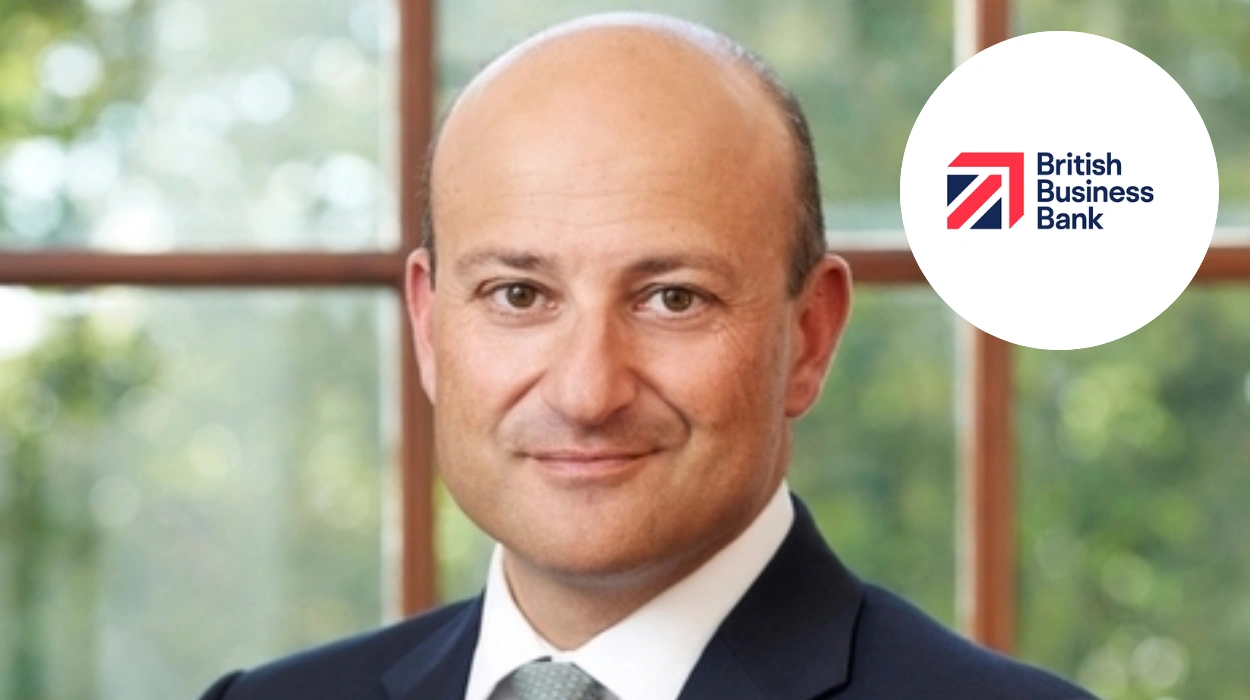
Key Points
- Louis Taylor, chief executive of the British Business Bank (BBB), will step down at the end of September after four years leading the UK’s state-backed economic development bank.
- Taylor will remain as chair of BBB Investment Services Limited, the Bank’s regulated third‑party investment arm, until the end of December to support continuity in its investment activities.
- Chief financial officer David Hourican will become interim chief executive from October while a formal recruitment process begins for a permanent successor.
- Taylor, who grew up in Gosforth, Newcastle, was tasked with steering the Bank beyond the pandemic period and widening access to finance for small and medium‑sized businesses across the UK.
- During his tenure, the British Business Bank secured a new Government mandate backed by £25.6 billion in additional financial capacity to support smaller firms.
- The Bank also adopted a five‑year strategy aimed at helping businesses to start, scale and remain in the UK, reflecting a stronger focus on domestic growth and innovation.
- A major restructuring under Taylor simplified more than 20 programmes into dedicated banking and investment divisions, with the aim of improving efficiency and clarity for business customers.
- Recent initiatives include the British Growth Partnership, which is attracting institutional capital into venture capital funds, alongside larger commitments to high‑growth technology and healthcare funds and direct investment in quantum computing firms.
- The Bank’s banking division has expanded its lending offer through the Growth Guarantee Scheme, additional support for community businesses and an enlarged Start Up Loans programme.
- Taylor has praised the British Business Bank’s “highly capable team” and said the organisation is now “a far more agile and effective organisation” with a clear long‑term strategy.
- British Business Bank chair Stephen Welton has hailed Taylor as an “outstanding leader” who has helped move the institution from a market participant after the pandemic to a “market leading position”.
- Business and Trade Secretary Peter Kyle has thanked Taylor for his “bold vision” over 11 years in public service and expressed confidence that the Bank’s next phase will give UK innovators the backing they need to turn ambition into success.
- The leadership transition comes at what senior figures describe as a “crucial moment” for the UK’s smaller and most innovative businesses, with the Bank expected to continue deploying significant capital across the regions and nations of the UK.
London (Britain Today News) – June 22, 2026 – The British Business Bank has announced that chief executive Louis Taylor will step down at the end of September, bringing to a close a four‑year tenure in which the Government‑owned lender has expanded its financial firepower, reshaped its structure and sharpened its focus on backing smaller businesses across the UK.
- Key Points
- Why is Louis Taylor stepping down as British Business Bank chief in 2026?
- How will leadership transition at the British Business Bank be managed in 2026?
- What has Louis Taylor achieved at the British Business Bank during his tenure?
- What has Louis Taylor said about his time leading the British Business Bank?
- How has the British Business Bank changed structurally and strategically under Taylor?
- What new programmes and investments has the Bank launched recently?
- How have UK leaders reacted to Louis Taylor’s departure in 2026?
- What role has Louis Taylor played in championing regional and North East businesses?
- What does this leadership change mean for UK smaller businesses and innovators?
Why is Louis Taylor stepping down as British Business Bank chief in 2026?
The British Business Bank said Louis Taylor will leave the role of chief executive at the end of September following a period marked by significant growth, investment and organisational reform at the UK’s economic development bank.
According to the Bank, his departure comes as the organisation moves into the next phase of its long‑term strategy and begins a fresh planning cycle, suggesting a natural transition point after the completion of major restructuring and mandate changes.
Taylor, who joined the British Business Bank in 2022 with a brief to guide the institution beyond the pandemic, has overseen the implementation of a new strategy and the securing of additional Government backing, positioning the Bank for its next stage of development.
While no specific personal reason has been publicly cited for his decision to stand down, the timing aligns with the embedding of that strategy and the creation of a leadership platform that his successor will now be expected to build on.
The Bank has emphasised that Taylor’s continued presence as chair of its regulated investment subsidiary until the end of December will help ensure continuity during the transition, particularly across its third‑party investment activities.
This staged handover reflects the scale of the institution’s portfolio and the importance of maintaining stable leadership at a point when many smaller and innovative businesses are seeking finance in a challenging economic climate.
How will leadership transition at the British Business Bank be managed in 2026?
The British Business Bank has confirmed that chief financial officer David Hourican will take over as interim chief executive from October, immediately after Louis Taylor steps down from the top job at the end of September.
Hourican’s appointment to the interim role is designed to provide stability while the Bank’s board and shareholder begin a formal recruitment process for a permanent successor.
Taylor will not sever ties with the organisation immediately, instead remaining as chair of BBB Investment Services Limited, the Bank’s regulated third‑party investment arm, until the end of December.
This structure will enable the Bank to keep continuity across key investment decisions and relationships, particularly in its dealings with fund managers and institutional investors.
As chair of the British Business Bank, Stephen Welton has framed the succession plan as part of a carefully managed process rather than a sudden change, stressing that the institution enters its new planning cycle with “increased financial capacity” and “ongoing momentum”.
The leadership handover will therefore take place against the backdrop of a five‑year strategic plan that is already in place, with the interim chief executive expected to focus on execution rather than redesign.
What has Louis Taylor achieved at the British Business Bank during his tenure?
When Louis Taylor joined the British Business Bank in 2022, his remit was to guide the organisation beyond the extraordinary interventions of the pandemic and to improve access to finance for smaller firms in all parts of the UK.
During his four years in charge, the Bank secured a new Government mandate backed by an additional £25.6 billion in financial capacity, significantly expanding its ability to support small and medium‑sized enterprises.
The Bank also adopted a five‑year strategy explicitly centred on helping businesses to start, scale and remain in the UK, reflecting a policy drive to anchor high‑growth and innovative firms domestically rather than seeing them relocate overseas.
This strategy has been underpinned by a concerted effort to simplify and clarify the Bank’s complex programme landscape, which previously encompassed more than 20 separate initiatives.
Under Taylor, the British Business Bank underwent a substantial restructuring that grouped these programmes into two core divisions: a banking division and an investment division.
This reform was designed to streamline operations, make it easier for businesses and finance providers to navigate the Bank’s offer and create clearer lines of responsibility within the organisation.
Recent activity overseen by Taylor includes the launch of the British Growth Partnership, which aims to draw in institutional capital to support UK venture capital funds.
The Bank has also made larger commitments to high‑growth technology and healthcare funds and has backed direct investments in quantum computing businesses, underscoring an emphasis on future‑facing and innovation‑led sectors.
On the lending side, the banking division has expanded its offer through initiatives such as the Growth Guarantee Scheme, additional support for community businesses and a larger Start Up Loans programme.
These programmes are intended to reach a broad spectrum of firms, from newly‑formed start‑ups to established community‑based enterprises and high‑growth scale‑ups seeking patient capital.
What has Louis Taylor said about his time leading the British Business Bank?
Louis Taylor has spoken warmly about his time at the helm of the British Business Bank, describing it as “a huge privilege” to have led the organisation over the past four years.
Reflecting on the changes made during his tenure, he said he had sought to set “a clear and ambitious vision” for the Bank as it evolved beyond its pandemic‑era role.
Taylor has highlighted that the Bank now has
“a comprehensive strategy to deliver that vision, increased flexible financial resources, a simplified operating model, a highly capable team and a customer focused culture”.
He argued that, as a result of these changes, the British Business Bank is now “a far more agile and effective organisation” than when he arrived.
Expressing personal pride in the institution’s staff, Taylor said he was “proud of the team of professionals” he has worked with and of “the capability we have built”.
He believes this enhanced capability gives his successor
“more firepower and the opportunity to execute the Bank’s five‑year strategic plan at a crucial moment for the UK’s smaller and most innovative businesses”.
In emphasising the importance of that “crucial moment”, Taylor has underlined the role the Bank can play in supporting smaller firms as they navigate economic uncertainty, adapt to technological change and pursue growth opportunities.
His remarks suggest he views the British Business Bank as being in a strong position to continue backing entrepreneurs and innovators across the country long after his departure.
How has the British Business Bank changed structurally and strategically under Taylor?
Under Louis Taylor’s leadership, the British Business Bank has transitioned from a complex organisation running more than 20 separate programmes to a streamlined institution with a clearer split between its lending and investment activities.
This has been achieved by consolidating those programmes into two core units: a banking division and an investment division.
The reorganisation was designed to simplify the Bank’s internal structure, reduce overlaps and make it easier for external partners and business customers to understand and access its support.
By bringing related schemes together under common management, the Bank aims to improve operational efficiency and deliver a more coherent customer experience.
Strategically, the adoption of a five‑year plan focused on helping businesses to start, scale and remain in the UK marks a move towards a more explicit emphasis on long‑term business development.
Rather than focusing solely on filling specific market gaps, the Bank is seeking to encourage sustained growth across the business life cycle, from early‑stage finance to later‑stage investment.
This strategy has been backed by a significantly enlarged Government mandate, with £25.6 billion in additional financial capacity committed to supporting smaller firms.
That increased firepower provides the Bank with more flexibility to respond to regional needs, emerging sectors and macro‑economic shifts, while still operating within its remit as a Government‑backed economic development institution.
What new programmes and investments has the Bank launched recently?
In recent years, the British Business Bank has made a series of high‑profile moves to deepen its role in the UK’s equity and debt markets for smaller businesses.
One of the flagship initiatives has been the creation of the British Growth Partnership, designed to attract institutional backing for venture capital investment in UK companies.
The Bank has also stepped up its commitments to funds focused on high‑growth technology and healthcare businesses, sectors that policymakers view as essential to the UK’s long‑term competitiveness.
Alongside these fund commitments, the Bank has supported direct investments in quantum computing businesses, signalling an appetite to back cutting‑edge technologies with the potential to reshape industries.
On the banking side, programmes have been expanded or refreshed to reach a wider range of borrowers.
The Growth Guarantee Scheme, for example, is intended to help viable smaller firms obtain finance they might otherwise struggle to secure from commercial lenders on reasonable terms.
Support for community businesses has been bolstered, reflecting a desire to ensure that local enterprises and social ventures can access finance to sustain and grow their operations.
In parallel, the Start Up Loans programme has been enlarged, offering more aspiring entrepreneurs access to finance and mentoring as they launch new ventures.
Collectively, these initiatives demonstrate the Bank’s attempt to cover the spectrum from micro‑businesses and local enterprises through to innovative, high‑growth firms in emerging technologies.
They also highlight the institution’s role as both a market participant and a catalyst for private‑sector investment into UK businesses.
Explore More about Business:
A Decade of Brexit: Challenges Still Facing UK Small Businesses
Chichester Tyre Recycling Plant Suspended by Environment Agency Over Fire Risks
How have UK leaders reacted to Louis Taylor’s departure in 2026?
British Business Bank chair Stephen Welton has paid public tribute to Louis Taylor, describing him as “an outstanding leader” of the organisation.
Welton said Taylor had taken the Bank
“from the role of market participant at the end of the pandemic to more of a market leading position today with a platform that can deliver at scale going forward”.
Looking ahead, Welton stressed that, as the Bank enters its new five‑year planning cycle, the
“increased financial capacity, greater financial freedoms and flexibilities that Louis has secured, and ongoing momentum leave a strong legacy”.
He argued that this legacy
“puts the Bank in a stronger position to continue to evolve and deliver on the ambitions we set out in our five‑year strategic plan and the government’s growth mission”.
Peter Kyle, Secretary of State for Business and Trade, has also praised Taylor, noting that he has been
“an outstanding chief executive of both the British Business Bank and UK Export Finance”.
Kyle said that
“his leadership has paved the way for countless businesses to hire more, boost wages and grow right across the UK”.
The Business and Trade Secretary added:
“I would like to thank him for his bold vision during his 11 years of public service, and his continued commitment to backing UK economic growth.
I am confident the next phase of the Bank will give UK innovators the bold backing they need to transform ambition into success.”
These comments underline the political importance attached to the British Business Bank’s work and the expectation that it will continue to play a central role in supporting economic growth, productivity and innovation beyond Taylor’s tenure.
They also reflect a view within Government that the Bank is now better equipped to operate at scale and with greater flexibility than in its early years.
What role has Louis Taylor played in championing regional and North East businesses?
Louis Taylor’s personal background has been a notable part of his story at the British Business Bank. Born in Newcastle and raised in Gosforth, he has been widely described as a longstanding champion of support for North East businesses.
During his time at the Bank, Taylor has spoken about the importance of ensuring that smaller firms in all parts of the UK – and not only in London and the South East – can access the finance they need to grow.
This regional focus has been reflected in the Bank’s work to deploy programmes and investment funds across the nations and regions, including the North East.
In public comments, Taylor has emphasised that his North East roots have helped shape his approach to backing British businesses, particularly those operating in areas that have historically struggled to attract sufficient private capital.
An interview with him has explored how his upbringing has influenced his commitment to levelling up access to finance, though the current announcement centres primarily on his departure and achievements at the Bank.
While the leadership change is national in scope, it carries particular resonance in the North East, where smaller firms often look to the British Business Bank as a key partner in accessing finance.
Taylor’s departure may therefore be watched closely by regional stakeholders keen to see continuity in the Bank’s focus on supporting businesses outside the capital.
What does this leadership change mean for UK smaller businesses and innovators?
For small and medium‑sized enterprises, the leadership change at the British Business Bank comes at a time of continued economic uncertainty, evolving interest‑rate conditions and rapid technological change.
However, the presence of a well‑defined five‑year strategy and a significantly expanded financial mandate suggests that the institution’s overall direction of travel will remain consistent.
With interim leadership in place and a recruitment process under way for a permanent chief executive, the Bank is expected to keep deploying capital through its existing programmes while exploring new opportunities aligned with Government priorities.
This should mean that businesses already engaged with the Bank – whether through loans, guarantees, equity funds or advisory programmes – experience continuity rather than disruption.
The emphasis on supporting high‑growth technology and healthcare businesses, as well as nascent sectors such as quantum computing, is likely to continue, given the substantial commitments already made.
At the same time, long‑standing initiatives like the Start Up Loans programme and support for community businesses are set to remain central tools for reaching entrepreneurs and local enterprises.
For innovators, the message from both the Bank’s leadership and Ministers is that the institution will continue to offer “bold backing” to help transform ideas and ambition into commercial success.
Taylor’s assertion that his successor will inherit an organisation with “more firepower” underscores the scale of resources now available to support the next generation of British businesses.