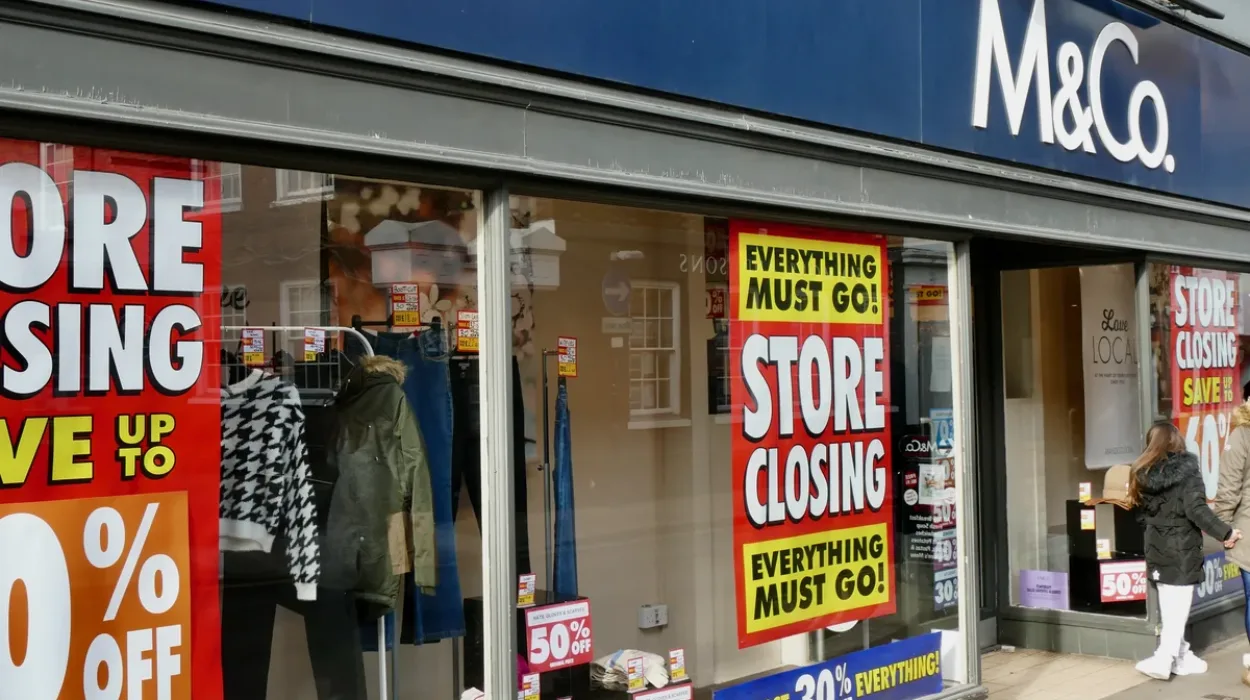
M&Co is a Scottish clothing and homeware retailer founded in 1834 in Inchinnan, Renfrewshire. The company entered administration in December 2022 under Teneo Financial Advisory, resulting in the closure of 168 stores and the loss of 1,800 jobs. Administration is a UK legal insolvency process in which an independent administrator takes control of an insolvent company to protect it from creditors while assessing options for survival or wind-down. M&Co’s case is one of the largest UK high street collapses of the post-pandemic period, and its financial records, now fully disclosed, provide a documented account of how a 188-year-old retailer failed.
- What Is M&Co and Why Did It Enter Administration?
- What Led to M&Co’s Financial Collapse?
- How Many Jobs Were Lost When M&Co Entered Administration?
- What Happened to M&Co’s Stores During Administration?
- Who Managed M&Co’s Administration Process?
- How Much Debt Did M&Co Owe When It Collapsed?
- What Did Creditors Receive From M&Co’s Administration?
- Who Bought M&Co After Administration?
- What Is the Difference Between Administration and Dissolution?
- What Does M&Co’s Collapse Reveal About the UK High Street?
What Is M&Co and Why Did It Enter Administration?
M&Co is a Scottish retail chain founded in 1834 that entered administration in December 2022 due to unsustainable debt, falling high street sales, and rising operating costs, resulting in the closure of all 168 stores and 1,800 job losses.
M&Co began as a pawnbroking business established by Neil McGeoch. It later developed into a clothing retailer under Len and Iain McGeoch, expanding into womenswear, menswear, childrenswear, and homeware. The company operated from its headquarters in Inchinnan, Renfrewshire, Scotland, and employed more than 3,900 people at its peak in 2019. Administration is the formal insolvency procedure that applies when a company cannot pay its debts as they fall due. An administrator, appointed by the company’s directors, creditors, or a court, takes legal control of the business. The administrator’s primary duties are to rescue the company as a going concern, achieve a better outcome for creditors than immediate liquidation, or realise assets to make a distribution to secured or preferential creditors. M&Co entered this process in December 2022, marking the second time in three years the company had required insolvency protection.
What Led to M&Co’s Financial Collapse?
M&Co collapsed due to declining footfall on the British high street, increased supply chain costs, inflationary pressure on consumer spending, and an inability to secure sufficient new investment to sustain 168 physical stores nationwide.
High street retailers across the United Kingdom faced compounding financial pressures between 2020 and 2022. Store-based clothing retailers recorded reduced footfall as online shopping expanded. M&Co’s cost base included rent, business rates, and staff wages across 168 locations, while revenue failed to keep pace with rising energy and freight costs. The company first sought new investment in 2020 during the COVID-19 pandemic in the United Kingdom, when professional services firm Deloitte was engaged to identify buyers or backers. That search did not resolve the company’s underlying debt position. By December 2022, M&Co’s liabilities exceeded its available assets, meeting the legal definition of insolvency under the Insolvency Act 1986. Teneo Financial Advisory was appointed as administrator to manage the company’s affairs from that point forward.
How Did the Pandemic Affect M&Co’s Finances?
M&Co first entered administration during the COVID-19 pandemic, before the 2022 collapse. That earlier episode resulted in the closure of 47 stores and the loss of 380 jobs. Pandemic-related restrictions closed non-essential retail across the United Kingdom for extended periods in 2020 and 2021, removing in-store revenue while fixed costs such as rent and rates continued. M&Co survived that first administration in reduced form, but the underlying debt burden it carried into 2022 proved unsustainable once trading conditions did not recover to pre-pandemic levels.
How Many Jobs Were Lost When M&Co Entered Administration?
M&Co’s 2022 administration resulted in 1,800 job losses across all 168 stores, following an earlier loss of 380 jobs from 47 store closures during the company’s 2020 pandemic-era administration.
The 1,800 job losses affected shop floor staff, store managers, and support functions tied directly to physical retail locations. On 6 February 2023, administrators announced that all 168 remaining M&Co stores would close during spring 2023, with the final closures completed by the end of April 2023. Employees were entitled to statutory redundancy payments and notice pay under UK employment law, processed through the administration estate and, where the estate had insufficient funds, through the National Insurance Fund via the Redundancy Payments Service. The combined job losses from both administration events, in 2020 and 2022, total 2,180 positions eliminated from a company that employed over 3,900 people in 2019.
What Happened to M&Co’s Stores During Administration?
All 168 M&Co stores closed permanently by the end of April 2023, following the administrators’ announcement on 6 February 2023 that no buyer had been found to continue the retail estate as a going concern.
Store closures followed a structured wind-down process rather than an immediate shutdown. Administrators continued limited trading through clearance sales to maximise the value recovered from remaining stock, a standard practice in UK retail administrations. This approach converts inventory into cash for the benefit of creditors before leases are formally surrendered. Landlords across the affected sites received notice as leases were disclaimed, a legal mechanism allowing administrators to end onerous property obligations. The closure of 168 stores removed M&Co’s entire physical retail footprint, leaving the brand without a high street presence for the first time since 1834.
Who Managed M&Co’s Administration Process?
Teneo Financial Advisory managed M&Co’s administration through three joint administrators, Adele Macleod, Gavin Park, and Robert Harding, who were legally responsible for assessing creditor claims and distributing recovered funds.
Joint administrators are insolvency practitioners licensed under the Insolvency Act 1986 and regulated by recognised professional bodies in the United Kingdom. Their statutory duties include taking control of company assets, notifying creditors, adjudicating submitted claims, and reporting outcomes to Companies House. In M&Co’s case, the administrators reviewed 608 individual creditor claims. They accepted these claims for a combined value of £34 million for dividend purposes, a figure lower than the £41 million initially stated in the directors’ own statement of affairs filed at the outset of the administration. This gap reflects the standard adjudication process, in which claims are tested against supporting evidence before being admitted for payment.
How Much Debt Did M&Co Owe When It Collapsed?
M&Co owed more than £46 million in total liabilities when it entered administration in December 2022, with 608 accepted creditor claims later valued at £34 million for formal dividend distribution purposes.
The £46 million figure represents the full scale of M&Co’s outstanding obligations at the point of insolvency, including amounts owed to suppliers, landlords, and other unsecured creditors. Unsecured creditors are parties owed money without a legal claim over specific company assets, placing them behind secured creditors and preferential creditors, such as certain employee claims, in the repayment order. The narrower £34 million figure reflects only the claims that survived the administrators’ formal adjudication process. Directors’ statements of affairs, required under UK insolvency law, provide an initial estimate of company liabilities at the start of proceedings, but these figures are routinely revised once each creditor’s claim is individually verified.
What Did Creditors Receive From M&Co’s Administration?
Unsecured creditors received a single payment of £800,000 through a prescribed part fund on 9 March 2026, equal to a dividend rate of 2.32 pence for every pound owed, with no further payments made.
The prescribed part is a statutory mechanism under UK insolvency law that ring-fences a portion of a company’s assets specifically for unsecured creditors, even when a floating charge holder would otherwise take priority over remaining funds. In M&Co’s case, this fund totalled £800,000, distributed on 9 March 2026 among the 608 admitted claims worth £34 million. A dividend rate of 2.32 pence in the pound means that for every £1 owed, creditors received approximately 2.3 pence. The administrators confirmed in their report that insufficient funds were realised to enable any further dividend beyond the prescribed part distribution. As a result, more than £33 million of the £34 million in admitted claims was permanently lost by M&Co’s creditors.
Who Bought M&Co After Administration?
AK Retail Holdings, part of the Yours Clothing Group, purchased the M&Co brand and its online retail operation for £2.5 million in February 2023, following the closure of all 168 physical stores.
The acquisition was structured as a brand and intellectual property purchase rather than a rescue of the existing store estate. Yours Clothing Group installed Andrew Killingsworth as Chief Executive Officer and Saeed Hatteea as Chairman to lead the relaunched business. This transaction allowed M&Co to continue trading exclusively online at mandco.com, without the physical retail footprint it had operated since the nineteenth century. By 2024, the relaunched online business reported revenue of £230.79 million, indicating that the M&Co brand retained commercial value despite the collapse of its store-based operations. The £2.5 million purchase price stands in sharp contrast to the £46 million in liabilities left behind in the administration estate, illustrating how UK insolvency law separates a company’s brand assets from its debts when a business is sold out of administration.
What Is the Difference Between Administration and Dissolution?
Administration is a temporary insolvency process aimed at rescuing a company or maximising asset recovery for creditors, while dissolution is the final legal act that permanently removes a company from the Companies House register.
M&Co’s administration formally concluded when the case transitioned to dissolution in June 2026. Dissolution occurs after an administrator or liquidator completes all statutory duties, including creditor distributions and final reporting. Once dissolved, a company ceases to exist as a legal entity and can no longer be sued, sign contracts, or hold assets. This transition, disclosed in documents lodged with Companies House, marked the formal end of the M&Co Trading Limited entity that entered administration in December 2022, more than three years after the initial insolvency filing. The extended timeline between administration and dissolution reflects the time required to adjudicate 608 creditor claims and process statutory distributions correctly under UK law.
Explore More about Business:
Harvey Nichols: Fashion, Beauty and Luxury Updates
Coughlans Bakery: Menu, Cakes, Bread and Customer Favourites
What Does M&Co’s Collapse Reveal About the UK High Street?
M&Co’s collapse reflects a wider pattern of UK high street retail failures since 2020, driven by rising operating costs, changing consumer shopping habits, and the financial strain of maintaining large physical store networks.
The scale of M&Co’s losses, £46 million in total debt against a £2.5 million brand sale price, demonstrates the financial gap that can exist between a retailer’s liabilities and the residual value of its brand once physical operations end. High streets across the United Kingdom experienced a documented wave of store closures during this period, as retailers reassessed the viability of large-format physical estates against digital-first business models. M&Co’s transition from a 168-store chain employing thousands of staff to an online-only retailer under new ownership illustrates a broader shift in UK retail structure. The company’s history, spanning from an 1834 pawnbroking business to a twenty-first-century online retailer, now serves as a documented case study in UK corporate insolvency, creditor recovery rates, and the legal separation between a failed company and the brand it leaves behind.