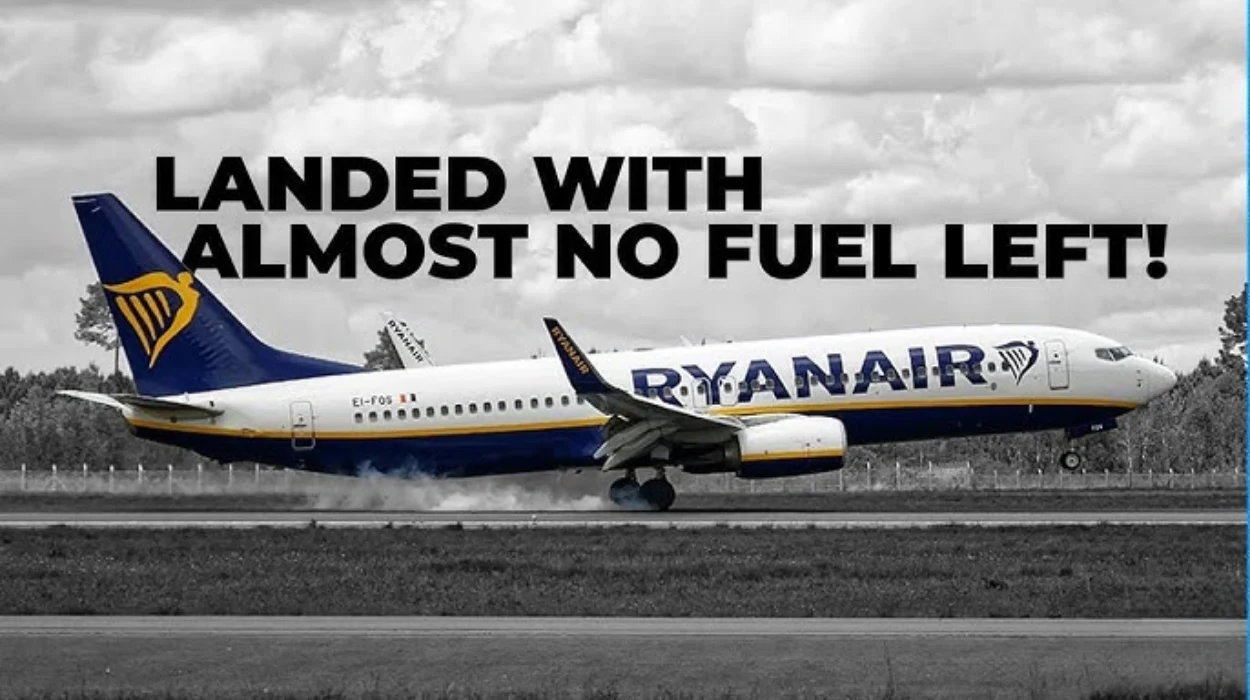
Ryanair Flight FR5448 is a scheduled passenger service operated by Ryanair, Europe’s largest low-cost carrier, headquartered in Swords, Ireland. On July 6, 2026, the flight declared a fuel emergency during its approach to Nantes Atlantique Airport in France and diverted to Brest Bretagne Airport. The aircraft landed safely with no injuries reported among passengers or crew. This incident highlights how ground-level runway disruptions can directly trigger in-flight fuel emergencies, even on short regional routes within Europe.
- What Happened to Ryanair Flight FR5448?
- Why Did the Flight Divert to Brest Instead of Landing at Nantes?
- What Is a Fuel Emergency in Aviation?
- How Common Are Fuel-Related Diversions in Commercial Aviation?
- What Aircraft Was Involved in the Ryanair FR5448 Incident?
- What Impact Did the Diversion Have on Other Flights at Nantes?
- What Happens After an Aircraft Declares a Fuel Emergency and Lands Safely?
- Why Do Single-Runway Regional Airports Pose Higher Diversion Risk?
- What Broader Lessons Does This Incident Illustrate for Air Travel Safety?
What Happened to Ryanair Flight FR5448?
Ryanair Flight FR5448, a Boeing 737-800 registered EI-EBK, departed Seville at 17:25 CEST on July 6, 2026, bound for Nantes. The crew declared a fuel emergency after a runway blockage forced a go-around, and the aircraft diverted to Brest Bretagne Airport.
The aircraft took off from Seville Airport (SVQ) in Spain on a routine scheduled service to Nantes Atlantique Airport (NTE) in western France. The flight proceeded normally for most of its journey. As the aircraft aligned for final approach to runway 21 at Nantes, air traffic controllers identified an obstruction on the runway surface. This obstruction forced the flight crew to abort the landing and execute a go-around, a standard aviation maneuver in which a landing aircraft climbs away instead of touching down.
Following the go-around, the crew climbed to 7,000 feet and later held at 4,000 feet while air traffic control worked to resolve the runway situation. The unplanned holding period consumed additional fuel that had not been accounted for in the original flight plan. As fuel reserves declined below required minimums, the captain declared a fuel emergency, a formal notification that obligates air traffic control to provide immediate priority handling.
Why Did the Flight Divert to Brest Instead of Landing at Nantes?
Nantes Atlantique Airport operates a single runway for commercial traffic. Debris from a separate emergency landing closed that runway, leaving Brest Bretagne Airport, located on the western tip of the Brittany peninsula, as the nearest viable alternative.
Nantes Atlantique Airport has one runway used for all commercial arrivals and departures. Because there is no backup runway, any obstruction on the single runway closes the airport entirely to inbound and outbound traffic. The obstruction that blocked Nantes runway 21 stemmed from a separate aviation event: an Air Nostrum-operated flight, IB1222, a Mitsubishi CRJ-1000 bound for Madrid and flying under an Iberia code, suffered an engine failure shortly after takeoff from Nantes. Investigators identified a burst tire as the likely origin of debris scattered across the runway. The CRJ-1000 returned and landed safely, but the debris field required the runway to close for inspection and cleanup.
With Nantes unavailable, air traffic control issued priority vectoring to Ryanair Flight FR5448 toward Brest Bretagne Airport. The crew climbed to 20,000 feet for the diversion and landed on runway 25L in Brest. Total airborne time from departure in Seville to landing in Brest was two hours and forty minutes. Brest was selected because of its proximity to Nantes and its runway length, both of which are necessary requirements for a Boeing 737-800 diversion under fuel-emergency conditions.
What Is a Fuel Emergency in Aviation?
A fuel emergency is a formal declaration made by a flight crew when remaining fuel falls below the minimum reserve required by aviation regulations. It requires air traffic control to provide immediate landing priority over other aircraft.
International aviation regulations, including those set by the European Union Aviation Safety Agency (EASA) and the International Civil Aviation Organization (ICAO), require commercial aircraft to carry reserve fuel beyond what is needed for the planned route. This reserve accounts for unexpected events such as diversions, holding patterns, or go-arounds. There are two primary declarations used by pilots depending on severity:
- Minimum Fuel: This alerts air traffic control that the aircraft is approaching its reserve fuel limit and cannot accept further delay without reaching a critical state. It does not guarantee immediate priority.
- Fuel Emergency (Mayday Fuel): This is a formal emergency declaration made when the aircraft’s fuel reserve is at or below the required minimum. It requires air traffic control to clear the aircraft for immediate, unimpeded routing to the nearest suitable airport.
In the case of Ryanair Flight FR5448, the crew progressed from a routine approach to a full fuel emergency after the unplanned go-around and holding pattern depleted reserves calculated for the original route to Nantes. Pilots also set the aircraft’s transponder to code 7700, the internationally recognized signal for a general emergency, which alerts every air traffic control facility monitoring the aircraft’s flight path.
How Common Are Fuel-Related Diversions in Commercial Aviation?
Fuel-related diversions are infrequent relative to total flight volume but occur regularly across global aviation due to weather delays, holding patterns, and airport closures. Regulatory fuel reserve requirements are designed specifically to prevent fuel exhaustion incidents.
Commercial aviation authorities mandate minimum fuel reserves precisely because unplanned delays are a routine part of flight operations. Common causes of fuel-related emergencies include:
- Airport closures: A blocked runway, as seen at Nantes, removes the primary landing option and forces aircraft into holding patterns or diversions.
- Weather disruptions: Storms, low visibility, or high winds can delay landings and force aircraft into extended holding.
- Air traffic congestion: High traffic volume at major hub airports can extend holding times beyond fuel-plan estimates.
- Mechanical issues: A separate fuel imbalance or leak, distinct from reserve depletion, can also trigger an emergency declaration, as documented in past Ryanair incidents involving fuel leaks on transatlantic and European routes.
Aviation safety data compiled by regulatory bodies such as EASA and the U.S. Federal Aviation Administration (FAA) indicate that fuel emergencies rarely result in fuel exhaustion, meaning the aircraft running completely out of usable fuel. The layered system of minimum fuel reserves, priority handling protocols, and pilot training is designed to intercept a developing fuel shortage well before it becomes a fuel exhaustion event. Ryanair Flight FR5448 is an example of this system functioning as intended: the crew identified the developing shortage, declared an emergency, and landed safely at an alternate airport within the aircraft’s remaining fuel capacity.
What Aircraft Was Involved in the Ryanair FR5448 Incident?
The aircraft was a Boeing 737-800, registration EI-EBK, delivered to Ryanair’s Irish air operator certificate in February 2009. It is approximately 17 years old and part of Ryanair’s core narrow-body fleet.
The Boeing 737-800 is a narrow-body, twin-engine aircraft widely used for short- and medium-haul routes across Europe. Ryanair operates one of the largest 737-800 fleets in the world under its Irish air operator certificate (AOC), which governs aircraft registered and operated under Irish aviation law. According to fleet tracking data, the Irish Ryanair AOC includes 197 Boeing 737-800 aircraft, nearly all of which remain in active service, alongside 143 Boeing 737 MAX 8 aircraft. This brings Ryanair’s total Irish-registered fleet to 344 aircraft, with an average fleet age of approximately 10.8 years.
The Boeing 737-800 has a typical fuel capacity of approximately 26,020 liters (6,875 U.S. gallons), giving it a maximum range of around 5,436 kilometers (2,935 nautical miles) depending on payload and configuration. On short regional routes such as Seville to Nantes, a distance of approximately 1,240 kilometers, aircraft typically carry additional reserve fuel beyond the minimum required, but extended holding patterns and unplanned diversions can still reduce that buffer to emergency levels, as occurred during this flight.
What Impact Did the Diversion Have on Other Flights at Nantes?
The runway closure at Nantes Atlantique Airport caused at least five inbound flights to divert and six scheduled departures to be canceled, with additional arrivals delayed for several hours.
Because Nantes Atlantique Airport operates only one commercial runway, its closure following the debris incident created immediate ripple effects across the regional flight network. Flights inbound to Nantes from London, Geneva, Nice, Toulouse, Lyon, and Porto were diverted to other airports. Six scheduled departures from Nantes were canceled outright. Additional flights arriving from Berlin, Montpellier, Lyon, and Amsterdam experienced extended delays while ground crews cleared debris from the runway surface.
Airport authorities indicated the runway would remain closed for inspection and cleanup until approximately 21:00 local time, a closure window of nearly four hours from the time of the initial debris-scattering incident. This type of single-point-of-failure disruption is common at regional airports with only one runway, since there is no alternate landing surface to absorb traffic during a closure, unlike larger international hub airports that typically operate multiple parallel runways.
What Happens After an Aircraft Declares a Fuel Emergency and Lands Safely?
Following a safe landing after a fuel emergency, aviation authorities typically review the flight data, air traffic control communications, and fuel calculations to determine whether procedures were followed correctly and whether any regulatory changes are warranted.
A fuel emergency declaration, even one resolved without incident, is treated as a reportable safety event under most national aviation frameworks. In France, this would fall under the jurisdiction of the Bureau d’Enquêtes et d’Analyses (BEA), the country’s civil aviation accident and incident investigation authority. Investigators typically review the following:
- Flight data recorder information: This documents fuel levels, altitude changes, and flight path throughout the incident.
- Air traffic control transcripts: These confirm the timeline of the go-around, holding pattern, and emergency declaration.
- Fuel planning documentation: This verifies whether the aircraft departed Seville with adequate reserves under applicable EASA regulations.
Because Ryanair Flight FR5448 landed safely with no injuries and no reported structural or mechanical damage, this incident is classified as a serious incident rather than an accident under ICAO definitions. Serious incidents still typically undergo a formal safety review, since regulators use these events to assess whether existing fuel reserve requirements, airport contingency planning, or air traffic control procedures require adjustment. The parallel investigation into the Air Nostrum CRJ-1000 engine failure and subsequent runway debris would proceed separately, focusing on the mechanical cause, believed to be linked to a tire failure during takeoff.
Why Do Single-Runway Regional Airports Pose Higher Diversion Risk?
Airports with only one commercial runway have no redundancy during a closure, meaning any single disruptive event, such as debris, disabled aircraft, or a medical emergency on the runway, halts all operations until fully resolved.
Major international hub airports typically operate two or more parallel or intersecting runways, allowing operations to continue on an unaffected runway if one is temporarily closed. Regional airports such as Nantes Atlantique, which primarily serve domestic and short-haul international routes, often operate a single runway due to lower overall traffic volume and space constraints. This design is cost-effective under normal conditions but creates a single point of failure during unplanned events.
When a single-runway airport closes, every inbound aircraft must either hold in the air, awaiting reopening, or divert to an alternate airport. The decision between holding and diverting depends on each aircraft’s remaining fuel reserves at the time of the closure. Aircraft with sufficient reserves, such as those from more distant origins with larger fuel loads, are more likely to hold. Aircraft on shorter routes with tighter fuel margins, such as Flight FR5448 on its Seville-to-Nantes route, are more likely to require diversion once reserves approach regulatory minimums.
Explore More about Business:
EasyJet–Castlelake Acquisition Deal Shakes Aviation Market
Glasgow Airport Travel Guide: Flights, Tips & Updates
What Broader Lessons Does This Incident Illustrate for Air Travel Safety?
This incident demonstrates that fuel reserve regulations and emergency declaration protocols function as designed, allowing crews to safely reroute aircraft before fuel levels become critical, even when disruptions originate from unrelated ground incidents.
The chain of events in this incident began with an unrelated mechanical failure on a different airline’s aircraft, which then cascaded into a fuel emergency for Ryanair Flight FR5448 due to the shared dependency on a single runway. This illustrates a broader principle in aviation safety: individual flight risk is often connected to the operational capacity of the airports and airspace an aircraft depends on, not solely the condition of the aircraft itself.
Regulatory fuel reserve requirements exist specifically to create a buffer against these kinds of interconnected disruptions. Ryanair Flight FR5448 carried sufficient reserve fuel to absorb a go-around, a holding pattern, and a diversion to an alternate airport more than 150 kilometers away from its original destination, without depleting fuel below safe operating limits. The successful outcome, a safe landing at Brest with no injuries, reflects the layered design of aviation safety systems: mandatory fuel reserves, formal emergency declaration protocols, priority air traffic control handling, and trained flight crews capable of executing diversions under time pressure.
For passengers, incidents like this typically result in delayed arrival at the final destination and require rebooking or ground transportation from the diversion airport to the originally scheduled destination. Airlines are generally responsible for arranging onward travel for passengers following a diversion caused by circumstances outside the passenger’s control, in accordance with EU passenger rights regulations governing flight disruptions within European airspace.