Alphabet Inc. is the parent company of Google, trading on the Nasdaq exchange under two primary tickers: GOOGL for Class A shares and GOOG for Class C shares. As of late July 2026, Alphabet ranks among the world’s most valuable public companies, with a market capitalization in the range of $4 trillion. This article explains Alphabet’s share structure, price history, business drivers, and the factors that determine where the stock moves next.
- What Is Alphabet Inc. and How Is It Connected to Google Stock?
- What Is Alphabet’s Current Share Price and Market Capitalization?
- How Did Alphabet Stock Originate and Evolve Historically?
- What Are the Different Share Classes of Alphabet Stock?
- What Business Segments Drive Alphabet’s Stock Performance?
- What Factors Influence Alphabet’s Share Price Movements?
- How Does Alphabet’s Stock Compare to Other Big Tech Companies?
- What Do Analysts Forecast for Alphabet’s Stock Price?
- What Are the Risks and Challenges Facing Alphabet Stock?
- What Is Alphabet’s Dividend and Shareholder Return Policy?
- Why Does Alphabet Stock Matter for the Broader Market?
What Is Alphabet Inc. and How Is It Connected to Google Stock?
Alphabet Inc. is the holding company created in 2015 to own Google and its other business units, including Google Services, Google Cloud, and Other Bets. Investors buy “Google stock” by purchasing Alphabet shares, since Google itself is not separately listed.
Alphabet Inc. was established on October 2, 2015, through a corporate restructuring designed to separate Google’s core internet business from other ventures such as life sciences, autonomous vehicles, and experimental technology. Larry Page and Sergey Brin, Google’s co-founders, created Alphabet as an umbrella entity. Google became a wholly owned subsidiary of Alphabet, alongside Other Bets units including Waymo, an autonomous vehicle company, and Verily, a life sciences research organization. Sundar Pichai has served as CEO of Alphabet since December 2019, when Page and Brin stepped down from their executive roles while remaining board members and controlling shareholders through their Class B share ownership. This structure means that when financial media refer to “Google stock,” they are describing Alphabet Inc. shares, since no independent Google security exists on any public exchange.
What Is Alphabet’s Current Share Price and Market Capitalization?
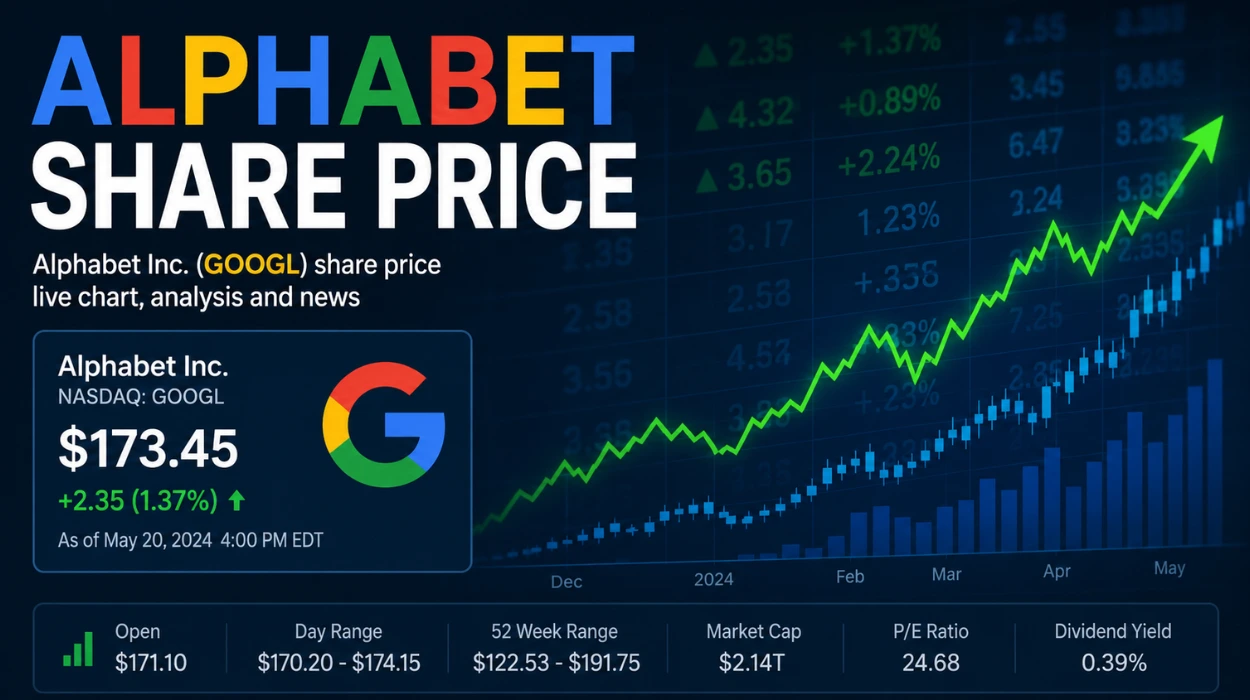
Alphabet shares traded in the range of $343 to $350 in late July 2026, with a market capitalization near $4 trillion. The 52-week trading range spans from a low of $188.70 to a high of $404.47.
Alphabet’s valuation places it among a small group of companies, alongside Apple, Microsoft, and Nvidia, that have reached multi-trillion-dollar market capitalizations. The stock carries a beta coefficient of approximately 1.76, indicating price swings larger than the broader market average. Daily trading volume regularly exceeds 19 million shares across the combined share classes. Alphabet reported second-quarter 2026 earnings on July 22, 2026, posting earnings per share of $9.11 against revenue of $119.8 billion. Google Cloud, the company’s enterprise infrastructure and artificial intelligence division, generated $24.8 billion in quarterly revenue. Following the earnings release, shares experienced volatility tied to an increased capital expenditure forecast, with the company signaling a full-year capex commitment near $205 billion for AI infrastructure and data center expansion.
Key Alphabet Stock Statistics (Mid-2026)
| Metric | Figure |
|---|---|
| Ticker symbols | GOOGL (Class A), GOOG (Class C) |
| Exchange | Nasdaq |
| Market capitalization | Approximately $4 trillion |
| 52-week high | $404.47 |
| 52-week low | $188.70 |
| Beta | 1.76 |
| Annual dividend | $0.88 per share |
| Dividend yield | Approximately 0.24% |
| Q2 2026 revenue | $119.8 billion |
| Q2 2026 EPS | $9.11 |
Figures fluctuate daily with market trading and should be verified against a live quote source before making financial decisions.
How Did Alphabet Stock Originate and Evolve Historically?
Google Inc. went public on August 19, 2004, priced at $85 per share through a Dutch auction, valuing the company near $23 billion. The company later reorganized into Alphabet Inc. in 2015, followed by two stock splits in 2014 and 2022.
Google’s 2004 initial public offering used a Dutch auction format, an unconventional method at the time intended to give retail investors broader access alongside institutional buyers. The IPO raised approximately $1.67 billion. From inception, Google used a dual-class share structure, with Class A shares carrying one vote each and Class B shares, held by founders and executives, carrying ten votes each. This structure allowed Page and Brin to retain control over strategic decisions despite owning a minority of total equity. In April 2014, Google executed its first stock split, distributing one new non-voting Class C share for every existing Class A or Class B share held. This event created the GOOG ticker for Class C shares, distinct from the voting GOOGL Class A shares. The restructuring doubled the total share count while proportionally halving the price per share.
The 2022 Stock Split
Alphabet’s board approved a second stock split on February 1, 2022, which shareholders ratified on June 1, 2022. The 20-for-1 split took effect on July 15, 2022, with adjusted trading beginning July 18, 2022. Each shareholder received 19 additional shares for every share previously held. Alphabet’s Class A share price fell from approximately $2,255.34 before the split to $112.64 when adjusted trading opened. A stock split does not change a company’s total market value or an individual investor’s total holding value. It increases the number of outstanding shares while decreasing the price per share proportionally, primarily to improve affordability and liquidity for retail investors. Amazon, Apple, Tesla, and Nvidia carried out similar splits around the same period, reflecting a broader trend among large technology companies to keep individual share prices accessible.
What Are the Different Share Classes of Alphabet Stock?
Alphabet maintains three share classes: Class A (GOOGL) with one vote per share, Class B with ten votes per share held only by founders and insiders, and Class C (GOOG) with no voting rights, traded publicly alongside Class A.
This three-tier structure serves a specific governance purpose. Class A shares (GOOGL) trade publicly on Nasdaq and grant holders standard voting rights at annual shareholder meetings. Class B shares are not publicly traded and are held almost exclusively by Alphabet’s founders, executives, and early insiders, carrying ten votes per share. Class C shares (GOOG) trade publicly but carry no voting rights at all. This class was introduced during the 2014 split specifically to let Alphabet raise capital and compensate employees with equity without diluting the voting control held by Page, Brin, and other insiders through Class B shares.
| Share Class | Ticker | Publicly Traded | Votes per Share |
|---|---|---|---|
| Class A | GOOGL | Yes | 1 |
| Class B | Not listed | No | 10 |
| Class C | GOOG | Yes | 0 |
Because GOOGL and GOOG represent the same underlying company and nearly identical economic value, their prices typically track each other closely, with only minor differences attributable to the value of voting rights.
What Business Segments Drive Alphabet’s Stock Performance?
Alphabet operates through three reportable segments: Google Services, Google Cloud, and Other Bets. Google Services generates the majority of revenue through advertising, while Google Cloud is the fastest-growing segment, expanding through AI infrastructure demand.
Google Services includes Search, YouTube, Android, Chrome, Google Play, Google Maps, and hardware devices such as Pixel phones. This segment also encompasses subscription products including YouTube Premium, YouTube TV, YouTube Music, NFL Sunday Ticket, and Google One cloud storage. Advertising revenue from Search and YouTube remains the company’s largest single revenue source, historically accounting for the majority of total company revenue. Google Cloud provides consumption-based infrastructure services and enterprise software, including the Vertex AI development platform, Gemini enterprise AI tools, cybersecurity products, and Google Workspace applications such as Gmail, Docs, Drive, and Meet. Google Cloud revenue reached $24.8 billion in the second quarter of 2026, reflecting continued enterprise adoption of generative AI tools. Other Bets encompasses experimental and early-stage ventures, most notably Waymo, an autonomous vehicle company, along with life sciences and technology research units. Other Bets typically operates at a financial loss and represents a small fraction of total revenue, functioning as a long-term investment segment rather than a near-term profit driver.
What Factors Influence Alphabet’s Share Price Movements?
Alphabet’s share price responds primarily to quarterly earnings results, advertising revenue trends, Google Cloud growth rates, capital expenditure announcements, regulatory rulings, and competitive developments in artificial intelligence.
Quarterly earnings reports are the single largest catalyst for short-term price movement, since they reveal actual advertising revenue, cloud growth rates, and profit margins against analyst expectations. Capital expenditure guidance has become an increasingly significant factor, since Alphabet has committed substantial spending, near $205 billion in recent full-year guidance, toward AI infrastructure and data center capacity. Investors weigh this spending against expected future returns from AI-driven products. Regulatory actions also move the stock. In July 2026, Google was fined approximately €1.0 billion by European Union regulators under the bloc’s Digital Markets Act, a law designed to limit the market power of large technology platforms. Competitive dynamics in artificial intelligence, including the performance of Google’s Gemini models relative to competing systems, influence investor sentiment about long-term growth prospects. Broader macroeconomic conditions, including interest rate policy, oil prices, and semiconductor sector performance, also affect Alphabet alongside other large technology stocks, since institutional investors often trade major technology holdings as a correlated group.
How Does Alphabet’s Stock Compare to Other Big Tech Companies?
Alphabet is one of a small group of companies, often called the “Magnificent Seven,” alongside Apple, Microsoft, Amazon, Meta, Nvidia, and Tesla, that dominate US stock market capitalization and heavily influence major indices.
Alphabet shares are components of the S&P 500 and Nasdaq-100 indices, meaning their price movements directly affect the performance of index funds and exchange-traded funds tracking these benchmarks. Because Alphabet holds a market capitalization near $4 trillion, it ranks among the largest weightings in both indices. Compared to peers, Alphabet has historically traded at a lower price-to-earnings multiple than some AI-focused competitors, reflecting a market view that balances Alphabet’s dominant advertising cash flow against slower perceived AI product momentum relative to rivals. Alphabet’s EV/EBITDA ratio, a valuation measure comparing enterprise value to earnings before interest, taxes, depreciation, and amortization, stood near 15.3x in mid-2026, a figure investors use to compare valuation across large technology companies with different capital structures.
What Do Analysts Forecast for Alphabet’s Stock Price?
Wall Street analysts maintain a consensus “Strong Buy” rating on Alphabet stock, with 12-month price targets ranging between approximately $399 and $434 per share as of mid-2026, based on coverage from dozens of research firms.
Analyst price targets represent individual forecasts published by equity research analysts at investment banks and brokerages, based on projected earnings, revenue growth, and valuation multiples. According to one aggregation of 64 analysts, the average rating for GOOGL was “Strong Buy,” with a 12-month price target of $433.55, representing an increase of roughly 24.79% from recent trading levels. A separate survey of 34 analysts placed the average target near $399.38. These targets are not guarantees of future performance. They reflect professional forecasts that change frequently as new earnings data, competitive information, and macroeconomic conditions emerge. Investors should treat analyst targets as one data point among many rather than a predictive certainty, since actual share price outcomes depend on future events that cannot be known in advance.
What Are the Risks and Challenges Facing Alphabet Stock?
Alphabet faces regulatory antitrust pressure, rising AI infrastructure costs, competitive threats from rival AI systems, and dependence on advertising revenue that remains sensitive to broader economic cycles.
Regulatory risk represents one of the most material ongoing challenges. Alphabet has faced multiple antitrust rulings and fines in the United States and European Union related to its dominance in search advertising, mobile operating systems, and digital advertising technology. The July 2026 EU fine under the Digital Markets Act illustrates continued regulatory scrutiny of Google’s market practices. Capital expenditure risk has grown alongside the AI infrastructure buildout. Alphabet’s approximately $205 billion capex commitment raises questions among investors about the timeline for generating adequate returns on that spending, and some analysts have described the scale of cash outflow as a strain on near-term free cash flow. Competitive risk stems from rival AI companies and products that could erode Google Search’s historical dominance if users shift toward alternative AI-powered search and assistant tools. Media organizations, including several major news outlets, have also raised concerns about Google’s AI-generated search summaries, known as AI Overviews, reducing referral traffic to publisher websites, a dynamic that could affect the broader internet advertising ecosystem Alphabet depends on. Cyclical advertising risk remains relevant as well, since a large share of Alphabet’s revenue derives from digital advertising spending, which tends to contract during periods of economic slowdown.
What Is Alphabet’s Dividend and Shareholder Return Policy?
Alphabet began paying a regular quarterly dividend in 2024 and has since paid an annualized dividend of $0.88 per share, alongside ongoing share buyback programs that return capital to shareholders.
Alphabet did not pay dividends for most of its history as a public company, instead reinvesting profits into business expansion and returning capital to shareholders primarily through share repurchases. The company initiated its first-ever dividend in April 2024, marking a shift toward a more traditional capital return policy common among mature large-capitalization companies. As of mid-2026, the annualized dividend stands at $0.88 per share, producing a dividend yield of approximately 0.24%, a relatively low figure that reflects Alphabet’s high share price and continued preference for growth reinvestment over large-scale income distribution. Alongside dividends, Alphabet’s board has authorized substantial share buyback programs, which reduce total shares outstanding, currently near 12.17 billion combined across share classes, and can support earnings per share growth over time.
Explore More about Business:
SuperBike Factory Administration Restructuring Sparks Debate
Volkswagen Group Future Plans: Innovation and EV Expansion
Why Does Alphabet Stock Matter for the Broader Market?
Alphabet’s size and index weighting mean its stock price directly influences the performance of the S&P 500, Nasdaq-100, and countless index funds and retirement portfolios that hold these benchmarks.
Because passive investment vehicles such as index funds and exchange-traded funds allocate capital proportionally to market capitalization, a company of Alphabet’s scale, near $4 trillion, carries outsized weight in determining whether these benchmarks rise or fall on a given trading day. Millions of retirement accounts, pension funds, and personal investment portfolios hold Alphabet shares indirectly through broad market index funds, even without direct stock ownership. Alphabet’s quarterly earnings reports are consequently treated as bellwether events for the technology sector and, at times, for the broader stock market, since the company’s results offer a window into digital advertising trends, enterprise cloud spending, and the pace of return on artificial intelligence investment across the economy. Analysts and financial media frequently cite Alphabet’s results alongside those of the other Magnificent Seven companies when assessing overall market direction, given the concentrated influence this small group of companies holds over total US equity market value.
This article provides factual, educational information about Alphabet Inc. and its publicly traded stock. It does not constitute financial or investment advice. Stock prices, market capitalization, analyst targets, and financial metrics change continuously, and readers should consult a licensed financial advisor and verify current figures through a live market data source before making investment decisions.