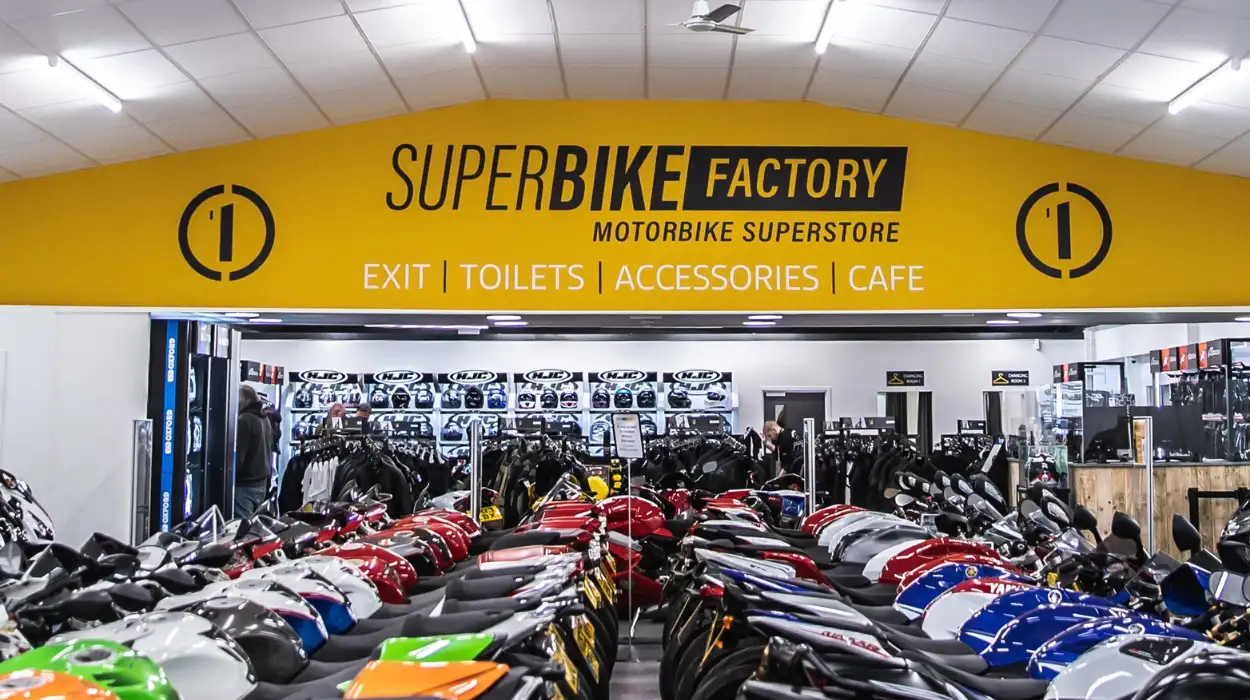
SuperBike Factory, a Macclesfield-based used motorbike retailer, entered administration on July 20, 2026, and ceased trading with immediate effect. The company operated as Europe’s largest used motorcycle dealer, selling approximately 15,000 bikes annually through six UK showrooms and an online platform. Its collapse followed years of rapid expansion, a private equity acquisition, and mounting financial pressure across the UK motorcycle retail sector.
- What Is SuperBike Factory and Why Did It Go Into Administration?
- What Is Administration and How Does a Notice of Intention Work?
- How Did SuperBike Factory Build Its Market Position?
- What Are SuperBike Factory’s Business Structure and Subsidiaries?
- What Financial Data Preceded the Administration Filing?
- Who Are the Appointed Administrators and What Is Their Role?
- What Happens to Customers, Staff, and Finance Agreements Now?
- How Does This Case Compare to Other UK Motorcycle Retailer Collapses?
- What Does the SuperBike Factory Case Reveal About the UK Used-Vehicle Finance Sector?
- What Is the Likely Future Impact on the UK Motorcycle Retail Market?
This article explains the causes, mechanics, and consequences of the SuperBike Factory administration process. It covers the company’s history, its corporate structure, the legal process of administration, the roles of the appointed administrators, and the wider implications for staff, customers, lenders, and the used-vehicle finance industry.
What Is SuperBike Factory and Why Did It Go Into Administration?
SuperBike Factory was a UK used motorbike retail group headquartered in Macclesfield, Cheshire, that ceased trading on July 20, 2026, after entering administration due to unsustainable debt, finance-sector uncertainty, and cash flow pressure despite reporting £83 million in annual turnover.
Administration is a formal UK insolvency procedure. A company enters administration when it can no longer pay its debts as they fall due, but a rescue or restructuring may still be possible. SuperBike Factory employed around 200 staff across its retail network. Founded in 2010 by Scott Behrens and James Watson, the company grew from a single Macclesfield showroom into a nationwide chain. Despite this growth and continued profitability on paper, the business filed a Notice of Intention to Appoint an Administrator on July 17, 2026, three days before administrators were formally appointed.
The immediate cause of collapse centered on liquidity, not lack of sales volume. SuperBike Factory continued to buy and resell thousands of motorcycles per year, but its finance brokerage arm faced legal and regulatory uncertainty following a Court of Appeal ruling affecting motor finance commission structures. This ruling created contingent liabilities tied to commission repayment obligations, which the company had already flagged as a monitored risk in its 2024 Annual Report.
What Is Administration and How Does a Notice of Intention Work?
Administration is a UK legal process that places an insolvent company under the control of licensed insolvency practitioners, giving it temporary protection from creditor legal action while options for rescue, sale, or wind-down are assessed.
A Notice of Intention to Appoint an Administrator (NOI) is a formal court filing. It does not mean a company has entered administration. Instead, it grants a short period of legal protection from creditor enforcement action, typically up to ten business days, during which directors, secured lenders, or the company itself can identify a path forward. This path may include refinancing, a pre-pack sale, or a full administration appointment.
SuperBike Factory filed its NOI on July 17, 2026, with UK courts. This filing was first reported by the business publication The Business Desk and confirmed through court insolvency records. For several days, the company operated in a transitional legal state: not yet in administration, but under formal creditor protection. On July 20, 2026, that protection period ended with the formal appointment of administrators, and the company’s trading operations stopped immediately.
The Legal Sequence of Events
The process followed three distinct stages. First, the company identified insolvency risk and filed the NOI on July 17, 2026. Second, during the protection window, the company and its stakeholders assessed rescue options, including engagement with its private equity backer. Third, on July 20, 2026, joint administrators were formally appointed, and the group ceased trading.
How Did SuperBike Factory Build Its Market Position?
SuperBike Factory expanded from one Macclesfield showroom in 2010 into a six-site national network by 2025, using a centralized buy-prepare-sell model built around its WeBuyAnyBike.com sourcing channel and large-format destination showrooms.
Scott Behrens and James Watson founded the company in 2010. Their business model relied on buying used motorcycles at scale through digital channels, preparing them centrally, and reselling them through large regional showrooms supplemented by online sales. This model allowed the company to compete on inventory volume and price transparency, distinguishing it from smaller independent dealers.
Expansion accelerated between 2021 and 2025. The company added a second site at Donington Park in 2021. In 2022, it acquired Bradford-based dealer Ritebike, rebranding the location as SuperBike Factory West Yorkshire. Bristol and Milton Keynes showrooms opened in 2023. The sixth and final site opened in Crawley in February 2025, occupying the former premises of P&H Motorcycles following a refurbishment.
| Year | Expansion Milestone |
|---|---|
| 2010 | Company founded in Macclesfield by Scott Behrens and James Watson |
| 2021 | Second showroom opens at Donington Park |
| 2022 | Acquisition of Ritebike, Bradford; rebranded SuperBike Factory West Yorkshire |
| 2023 | Showrooms open in Bristol and Milton Keynes |
| Dec 2023 | Private equity fund Enact (Endless LLP) acquires the group |
| Feb 2025 | Sixth showroom opens in Crawley on former P&H Motorcycles site |
| Jul 17, 2026 | Notice of Intention to Appoint an Administrator filed |
| Jul 20, 2026 | Administrators appointed; company ceases trading |
By 2025, the group sold approximately 15,000 motorcycles per year and described itself as Europe’s largest used motorbike retailer.
What Are SuperBike Factory’s Business Structure and Subsidiaries?
SuperBike Factory Group Limited operated through multiple linked entities covering retail sales, finance brokerage, insurance, and bike-buying services, with eight subsidiaries listed in its 2024 Annual Report reflecting a diversified but interconnected corporate structure.
The group extended beyond direct motorcycle sales into adjacent financial services. Its finance brokerage division became one of the largest motorcycle finance intermediaries in the United Kingdom, arranging credit agreements for customers purchasing bikes through its showrooms. This diversification increased revenue streams but also exposed the group to regulatory risk when finance commission rules changed.
Key Subsidiary Companies
The 2024 Annual Report listed eight subsidiaries under the parent group. These included Superbike Loans Limited, which handled motorcycle finance arrangements; Superbike Insure Limited, covering insurance products; Superbike Group Limited, the intermediate holding entity; We Want Your Motorbike Limited and We Want Your Motor Limited, both tied to bike-buying and sourcing operations; Factory Heads Motorbike Company Limited; Carbay Limited; and M A M Automotive Holdings Limited. Two entities, Superbike Factory Group Limited and Superbike Factory Limited, were the specific companies placed into administration.
In December 2023, private equity investor Endless LLP acquired the group through its SME-focused fund, Enact. Enact is classified as a restructuring and turnaround fund. The same fund had previously provided a loan to SuperBike Factory in 2024 to support business expansion, according to the company’s own financial disclosures.
What Financial Data Preceded the Administration Filing?
SuperBike Factory reported £83 million in turnover and £8.5 million in pre-tax profit in its most recent published accounts for 2024, filed in September 2025, figures that appeared healthy but masked underlying commission-related liabilities.
The scale of these figures made the administration filing unexpected to many industry observers. A company generating £83 million in annual revenue with a positive pre-tax profit margin of roughly 10 percent does not typically signal imminent insolvency. The disconnect stemmed from contingent liabilities outside standard trading profit, specifically commission clawback risk tied to motor finance agreements.
The Court of Appeal Ruling and Commission Risk
UK motor finance commission arrangements came under legal scrutiny following a Court of Appeal ruling that affected how dealers and brokers disclosed and earned commission on customer finance deals. SuperBike Factory’s own 2024 Annual Report acknowledged this risk directly, stating that finance provider terms could include repayment of commission if a finance agreement ended earlier than expected. The company stated it actively monitored this exposure and provided for it in its accounts. When the scale of potential repayment liabilities became clearer in 2026, the resulting financial strain outpaced the company’s available liquidity, despite continued retail profitability.
| Financial Metric | 2024 Reported Figure |
|---|---|
| Turnover | £83 million |
| Pre-tax profit | £8.5 million |
| Annual bikes sold | Approximately 15,000 |
| Staff employed | Approximately 200 |
| Retail locations | Six showrooms plus online platform |
Who Are the Appointed Administrators and What Is Their Role?
Michael Lennon, James Saunders, and Robert Halliday of Manchester-based KR8 Advisory Ltd were appointed joint administrators of Superbike Factory Group Limited and Superbike Factory Limited on July 20, 2026, taking legal control of the companies’ assets and creditor obligations.
Joint administrators are licensed insolvency practitioners appointed under the UK Insolvency Act 1986. Once appointed, they assume control of the company’s affairs, replacing the authority of the existing board of directors for matters relating to the insolvency process. Their statutory objectives, in order of priority, are to rescue the company as a going concern, achieve a better outcome for creditors than immediate liquidation, or realize property to distribute to secured or preferential creditors.
KR8 Advisory Ltd, based in Manchester, confirmed the appointment in a public statement, noting that both companies had ceased to trade with immediate effect. This immediate cessation, rather than a continued trading period under administrator control, indicates that a going-concern rescue of the retail operation was not the chosen path at the point of appointment. All enquiries relating to the companies or the administration process, including those from customers, were directed to a dedicated email address managed by KR8 Advisory.
What Happens to Customers, Staff, and Finance Agreements Now?
Customers with existing finance agreements, warranties, or pending vehicle transactions must contact the appointed administrators directly, while approximately 200 employees face redundancy risk as the group’s retail operations have ceased entirely.
When a company ceases trading upon entering administration, existing contracts do not automatically terminate, but day-to-day operational continuity ends. Customers who purchased motorcycles through finance agreements arranged by SuperBike Factory’s brokerage division typically continue owing payments to the underlying finance provider, since the credit agreement exists between the customer and the lender, not directly with the retailer in most structures. Warranty claims, deposits on undelivered vehicles, and part-exchange arrangements require direct engagement with the administrators to determine treatment as either secured, preferential, or unsecured claims.
Employees affected by the immediate cessation of trading are typically classified as redundant from the date administrators confirm the closure of operations, triggering statutory redundancy pay entitlements through the UK’s National Insurance Fund where the company itself cannot meet those obligations. Administrators are legally required to notify affected staff and relevant government bodies, including the Insolvency Service, when redundancies of this scale occur.
How Does This Case Compare to Other UK Motorcycle Retailer Collapses?
SuperBike Factory joins a pattern of UK motorcycle sector insolvencies since 2024, following the collapse of Completely Motorbikes in 2024 and the administrations of Mutt Motorcycles and CCM Motorcycles during 2025.
The used and new motorcycle retail sector in the United Kingdom experienced significant volatility following the post-pandemic demand surge. Between 2020 and 2022, constrained new-vehicle supply chains pushed buyers toward the used market, inflating prices and encouraging rapid dealer expansion. As new-vehicle supply normalized and interest rates rose, financing costs increased for both retailers and consumers, compressing margins across the sector.
Completely Motorbikes ceased operations in 2024. Mutt Motorcycles, a UK-based manufacturer, entered administration in 2025. CCM Motorcycles, a long-established British manufacturer, also entered administration during 2025. SuperBike Factory’s collapse in July 2026 extends this pattern from manufacturing into large-scale retail and finance brokerage, indicating that structural pressure in the sector affects multiple points in the supply chain, not only vehicle production.
What Does the SuperBike Factory Case Reveal About the UK Used-Vehicle Finance Sector?
The case demonstrates that motor finance commission liabilities, driven by regulatory and judicial rulings on disclosure practices, can create balance-sheet risk large enough to overwhelm an otherwise profitable retail business.
UK courts examined whether commission arrangements between dealers, brokers, and finance providers were adequately disclosed to consumers at the point of sale. Where commission structures were found to lack proper disclosure or consumer consent, courts and regulators established grounds for compensation claims and commission clawback. For businesses like SuperBike Factory that operated large in-house finance brokerage arms, this created a contingent liability that scaled with the volume of historical finance agreements written, independent of current retail performance.
This structural risk differs from typical retail insolvency causes such as declining sales or oversupply of stock. It represents a regulatory and legal risk category that can affect financially healthy companies with strong trading revenue. Other UK dealer groups with significant finance brokerage operations face comparable exposure, making this case relevant beyond the motorcycle sector alone, extending into car dealerships and other vehicle finance intermediaries.
Explore More about Business:
Volkswagen Group Future Plans: Innovation and EV Expansion
Ryanair Flight FR5448 Diverted After Mid-Air Fuel Alert
What Is the Likely Future Impact on the UK Motorcycle Retail Market?
The removal of Europe’s largest used motorbike retailer from the market creates a supply gap of roughly 15,000 annual bike transactions, likely benefiting competing dealer networks while increasing scrutiny of finance-linked retail models industry-wide.
Market consolidation typically follows the collapse of a dominant player. Remaining competitors, including independent regional dealers and other national chains, stand to absorb displaced customer demand and used-bike sourcing volume previously handled through WeBuyAnyBike.com and SuperBike Factory’s buying network. Manufacturers and finance providers previously reliant on SuperBike Factory as a distribution and brokerage partner must also redirect those relationships.
The case is likely to accelerate regulatory attention on commission disclosure practices across all vehicle finance sectors, not motorcycles alone. Dealers operating combined retail-and-finance-brokerage models may reassess their exposure to historical commission liabilities, potentially prompting proactive provisioning, restructuring of finance partnerships, or reduced reliance on in-house brokerage in favor of independent, arms-length finance intermediaries. For consumers, the immediate effect includes reduced marketplace competition and a need for existing SuperBike Factory finance customers to seek clarity on payment obligations directly from underlying lenders and the appointed administrators at KR8 Advisory Ltd.