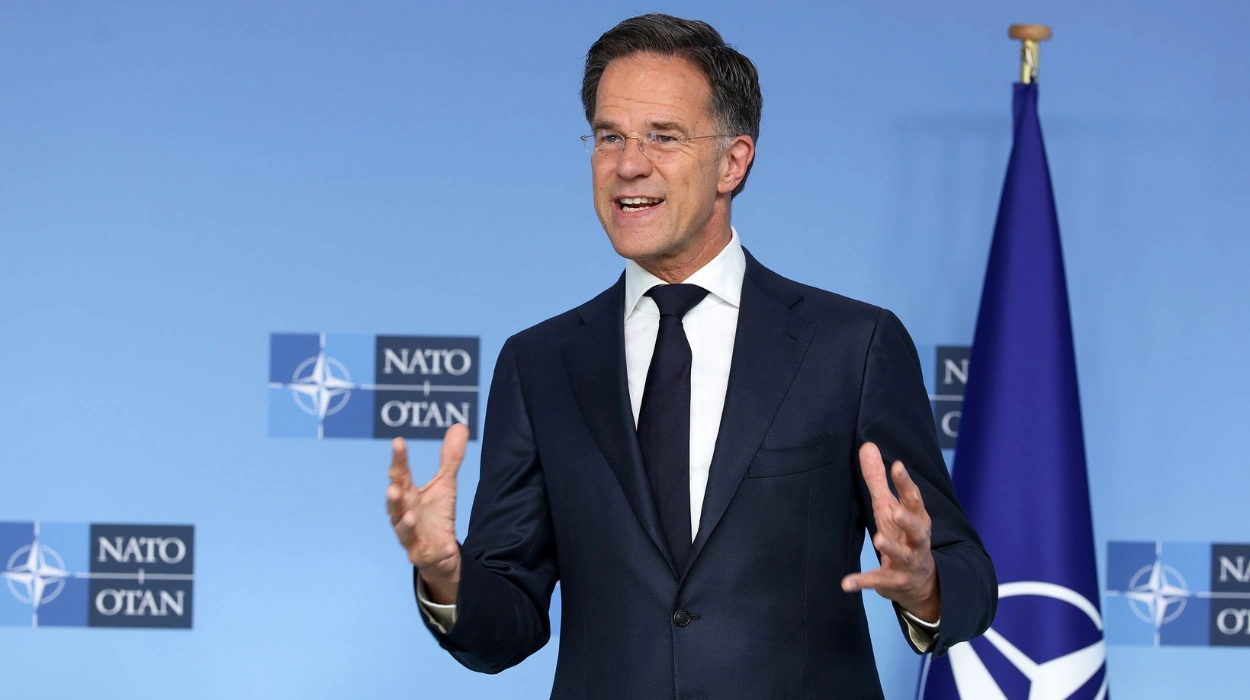
Mark Rutte serves as the 14th Secretary General of NATO, a position he assumed on October 1, 2024. He previously served as Prime Minister of the Netherlands from 2010 to 2024, making him the longest-serving prime minister in Dutch history. Rutte leads the 32-member North Atlantic Treaty Organization during a period of heightened European security concern tied to Russia’s war against Ukraine.
- Who Is Mark Rutte and What Is His Political Background?
- What Is Mark Rutte’s Role as NATO Secretary General?
- What Did NATO Agree to at the 2025 Hague Summit?
- How Is Mark Rutte Managing NATO’s Relationship With Ukraine?
- What Is Mark Rutte’s Position on Russia and European Security?
- How Does Mark Rutte Handle Relations With the Trump Administration?
- What Are the Wider Implications of Rutte’s Leadership for Europe?
Rutte was born on February 14, 1967, in The Hague, Netherlands. He began his professional career at Unilever, a British-Dutch consumer goods company, before entering Dutch politics in 2002. He joined the cabinet of Prime Minister Jan Peter Balkenende and won leadership of the People’s Party for Freedom and Democracy (VVD) in 2006. The VVD is a Dutch liberal-conservative political party. Rutte led the VVD to victory in the 2010 Dutch general election and formed a coalition government, becoming prime minister that year. He held the office for almost 14 years across four cabinets, a tenure that ended in 2024 when he transitioned to the NATO role.
NATO, formally the North Atlantic Treaty Organization, is a military and political alliance founded in 1949 under the Washington Treaty. It links 32 member states in North America and Europe under a mutual defense commitment known as Article 5, which states that an armed attack against one member is treated as an attack against all members. The Secretary General is NATO’s top civilian official, responsible for chairing key committees, coordinating alliance policy, and representing NATO in relations with governments and international bodies. Rutte succeeded Jens Stoltenberg, a former Norwegian prime minister, in this role.
Who Is Mark Rutte and What Is His Political Background?
Mark Rutte is a Dutch politician and NATO’s 14th Secretary General, previously serving nearly 14 years as Prime Minister of the Netherlands from 2010 to 2024, making him the longest-serving Dutch prime minister in the country’s history.
Rutte entered Dutch national politics in 2002 as a junior minister under Prime Minister Jan Peter Balkenende. He became leader of the VVD, the People’s Party for Freedom and Democracy, in 2006 after winning an internal leadership election. The VVD is one of the Netherlands’ major liberal-conservative parties, positioned in favor of free-market economics and limited government intervention. Rutte led the VVD into the 2010 general election, and after prolonged coalition talks, he became prime minister. He was the first prime minister since 1918 to hold self-described liberal political views, ending a 92-year gap since a liberal last led the country.
Rutte’s premiership spanned four separate cabinets: Rutte I (2010–2012), Rutte II (2012–2017), Rutte III (2017–2022), and Rutte IV (2022–2024). His first government collapsed early due to a budget negotiation impasse. Throughout his time in office, Rutte built a reputation as a pragmatic coalition-builder in a political system that regularly requires multi-party governments. Dutch politics operates under a proportional representation system, which typically produces fragmented parliaments and necessitates coalitions among three or more parties.
Rutte resigned as VVD leader in 2023 and stepped down as prime minister in 2024 following the collapse of his fourth cabinet over asylum policy disagreements. Later that year, NATO member states selected him as Secretary General, a role he took up on October 1, 2024. Colleagues and analysts describe Rutte as hard-working, pragmatic, and highly responsive, noting that he answers messages from fellow politicians within minutes and works continuously. He has remarked publicly on his skepticism of grand political vision, once stating that people seeking vision “should visit an optician.” Rutte has never married and has no children. He is a member of the Dutch Protestant Church and, during his time as prime minister, continued teaching social studies one morning per week at a secondary school in The Hague.
What Is Mark Rutte’s Role as NATO Secretary General?
As NATO Secretary General since October 2024, Rutte chairs the North Atlantic Council, coordinates alliance decision-making, represents NATO diplomatically, and manages relations between member governments, particularly the United States under President Donald Trump.
The North Atlantic Council is NATO’s principal political decision-making body, composed of permanent representatives or ministers from all 32 member states. The Secretary General chairs this council and works to build consensus, since NATO decisions require unanimous agreement among members. Rutte also oversees the International Staff at NATO headquarters in Brussels, Belgium, and acts as the alliance’s chief spokesperson on matters of collective defense and international security.
A defining feature of Rutte’s tenure has been his relationship management with U.S. President Donald Trump, who returned to office in January 2025. Rutte has been characterized in media coverage as NATO’s “Trump whisperer,” a term describing his approach of direct engagement and public praise aimed at keeping the United States committed to the alliance. This strategy included coordinated messaging ahead of and during NATO’s 2025 summit in The Hague, where Rutte worked with U.S. officials, including Permanent Representative Matthew Whitaker, to secure American backing for a new defense spending target.
Rutte’s role also includes crisis coordination. In 2026, he took a central position in managing alliance-level communications during the U.S. and Israeli military campaign against Iran, clarifying that NATO as an institution would not join the conflict, while individual member states retained the choice to act independently. He has also led diplomatic engagement on Arctic and Greenland security matters, holding discussions with President Trump in January 2026 regarding a security framework for the Arctic region, while stating that Greenlandic sovereignty remained outside the scope of those talks.
What Did NATO Agree to at the 2025 Hague Summit?
NATO members agreed at the June 24–25, 2025 summit in The Hague to raise defense spending to 5% of GDP annually by 2035, more than doubling the previous 2% target set in 2014, with Spain receiving a formal exemption.
The Hague Summit marked the first NATO leaders’ summit chaired by Rutte and the first attended by President Trump since his return to office. The agreement, known as the Hague Investment Plan, replaced the 2014 Wales Defence Investment Pledge, under which members had committed to work toward spending 2% of GDP on defense. NATO estimated that 23 of 32 members met that 2% benchmark by 2024, compared with only 3 members in 2014.
The new 5% target splits into two categories. Members agreed to allocate at least 3.5% of GDP to core defense requirements, covering areas such as troops, weapons, ammunition, and equipment needed to meet NATO Capability Targets. NATO Capability Targets are classified benchmarks defining the military capacity each member must maintain to support collective defense. The remaining 1.5% of GDP is designated for broader security-related spending, including critical infrastructure protection, cyberdefense, civil preparedness, and defense industrial base development. Member states must submit annual national roadmaps showing credible progress toward the target, with a formal review scheduled for 2029 and a final deadline of 2035.
Spain secured an exemption from the fixed 5% figure after Prime Minister Pedro Sánchez argued the target was disproportionate and incompatible with the country’s welfare spending commitments. Spain committed instead to reaching its NATO capability targets through an estimated 2.1% of GDP. Poland and the Baltic states, including Lithuania and Estonia, supported the accelerated target most strongly, citing direct exposure to potential Russian aggression. The summit’s final declaration totaled just five paragraphs and 427 words, a notably condensed format compared with the 38-paragraph communiqué from the 2024 Washington summit, reflecting a deliberate strategy to minimize points of disagreement among allies.
How Is Mark Rutte Managing NATO’s Relationship With Ukraine?
Rutte has maintained NATO’s military support pipeline for Ukraine through initiatives including the PURL mechanism, with Ukraine forecasting approximately $60 billion in military requirements from donor nations for 2026 alone.
PURL stands for the Prioritized Ukraine Requirements List, a mechanism through which NATO allies purchase American-made military equipment for transfer to Ukraine. Rutte has described this flow of equipment as essential to sustaining Ukraine’s defense against Russia’s ongoing invasion, which began in February 2022. Additional support channels include bilateral aid agreements between individual countries and Ukraine, multilateral initiatives such as the Czech ammunition initiative, and direct investment in Ukraine’s domestic defense industrial base.
At the 2024 Washington summit, prior to Rutte’s tenure, NATO members pledged €50 billion in military support for Ukraine, exceeding an initial €40 billion target. Roughly 60% of that support came from European allies and Canada. In the first half of 2025, allies excluding the United States and Hungary pledged an additional €35 billion. The NATO Security Assistance and Training for Ukraine initiative, known as NSATU, coordinates weapons deliveries, equipment repair, and soldier training across member states, operating in synchronization with the European Union’s separate EUMAM Ukraine training mission. A key logistics hub for this support operates in Jasionka, Poland, managed on a rotational basis by European allies including Germany and Norway.
The Hague Summit Declaration also reaffirmed that member states’ direct contributions to Ukraine’s defense and defense industry count toward their individual 5% GDP spending calculations. This provision links Ukraine support directly to the broader defense spending framework, incentivizing continued allied contributions as part of each country’s formal spending targets.
What Is Mark Rutte’s Position on Russia and European Security?
Rutte has repeatedly warned that Russia has brought large-scale war back to Europe and has called on NATO members to prepare their societies, economies, and militaries for conflict on a scale unseen since World War II.
In a December 2025 keynote address, Rutte stated that European nations must urgently ready themselves for conditions comparable to those faced by earlier generations during major wartime periods. This framing has underpinned his advocacy for the increased defense spending targets agreed at The Hague and has shaped his broader messaging about the long-term nature of the Russian threat to Euro-Atlantic security.
NATO’s official Hague Summit Declaration explicitly names Russia as a long-term threat to the alliance and reaffirms the collective defense principle under Article 3 and Article 5 of the Washington Treaty. Article 3 obligates member states to maintain and develop their individual and collective capacity to resist armed attack. Rutte has consistently linked the defense spending increase to deterrence, arguing that higher investment reduces the likelihood of direct conflict by demonstrating credible military readiness.
European Allies and Canada increased their combined defense expenditure by nearly 20% in real terms during 2025 compared with 2024, reaching more than $90 billion in additional spending measured in 2021 prices. Collective defense spending among these allies rose from 1.4% of combined GDP in 2014 to 2.3% in 2025, totaling more than $571 billion in that year alone. Rutte has cited this upward trend as evidence that the alliance is shifting toward what he has termed a “wartime mindset,” a phrase he used in his first speech as Secretary General at the Hague summit, urging members to “turbocharge” defense production capacity.
How Does Mark Rutte Handle Relations With the Trump Administration?
Rutte has pursued a strategy of direct, personal engagement with President Trump, combining public praise for U.S. leadership with private coordination, an approach credited with securing continued American commitment to NATO through 2025 and 2026.
This approach became publicly visible ahead of the 2025 Hague summit when Trump shared private text messages from Rutte on his social media platform, revealing complimentary language that some analysts characterized as calculated flattery designed to secure Trump’s cooperation. Despite criticism of this style, the strategy coincided with Trump’s continued attendance at NATO summits and his public endorsement of the 5% spending target as a “historic achievement.”
Rutte’s engagement has extended into 2026 through direct visits and meetings. From April 8 to 12, 2026, Rutte traveled to Washington, D.C., meeting with President Trump, Secretary of State Marco Rubio, and Secretary of War Pete Hegseth, followed by a speech at the Ronald Reagan Presidential Foundation Institute. During the U.S. and Israeli military campaign against Iran in 2026, Rutte publicly supported the strikes as degrading Iranian nuclear and ballistic missile capabilities, while clarifying NATO as an institution would not participate directly. Amid subsequent threats of a potential U.S. withdrawal from NATO obligations tied to the Iran conflict, Rutte met again with Trump, emphasizing allied contributions and praising what he called Trump’s “bold leadership and vision,” an effort aimed at preserving continued American participation in the alliance.
Rutte also addressed U.S. concerns regarding Arctic security during a January 2026 meeting with Trump at the World Economic Forum in Davos, Switzerland. The two announced a preliminary framework on Arctic security cooperation. Trump withdrew previously threatened NATO-related tariffs linked to interest in Greenland, while Rutte stated discussions centered on regional security arrangements rather than territorial sovereignty, which he said remained outside the scope of talks.
Explore More about World:
G7 Countries Explained: Economic Strength and Global Role Now
Americans Born on July 4 Reflect on 250th Anniversary
What Are the Wider Implications of Rutte’s Leadership for Europe?
Rutte’s leadership has accelerated European defense spending, deepened NATO-EU coordination on Arctic and industrial policy, and exposed a growing divide between higher-spending eastern flank states and lower-spending southern members.
The 5% GDP spending commitment is expected to reshape European defense budgets through 2035, with a formal review of progress scheduled for 2029. Analysts note this creates a “two-speed” Europe, in which northeastern flank countries such as Poland, Lithuania, and Estonia are positioned to exceed the 3.5% core spending threshold well ahead of schedule, while southern and southwestern European states face greater fiscal constraints due to higher public debt levels and competing social spending priorities. Italy’s public debt reached 135% of GDP in 2023, and France’s debt stood at 112% of GDP in late 2024, figures cited by defense analysts as constraints on rapid spending increases in those countries.
Germany represents a notable structural shift within this framework. In 2025, the German Parliament amended the country’s constitutional “debt brake,” a fiscal rule limiting government borrowing, specifically to enable increased military expenditure. This constitutional change reflects the broader political realignment across European capitals in response to the spending targets Rutte has championed.
Beyond spending figures, Rutte’s tenure has emphasized defense industrial cooperation, including expanded transatlantic collaboration on weapons production and procurement streamlining among allies. His engagement on Arctic security also reflects growing NATO attention to the region, where seven of eight Arctic-bordering nations are NATO members, with Russia as the sole non-member Arctic state. Denmark alone increased Arctic-related defense spending by an estimated $14 billion over one year, partly in response to security discussions Rutte has helped coordinate at the alliance level.
The long-term implications of Rutte’s leadership will depend on whether member states meet their annual spending roadmaps ahead of the 2029 review and the 2035 deadline, and on whether continued U.S. engagement under the Trump administration remains stable through recurring geopolitical tests, including the wars in Ukraine and the broader Middle East.