Key Points
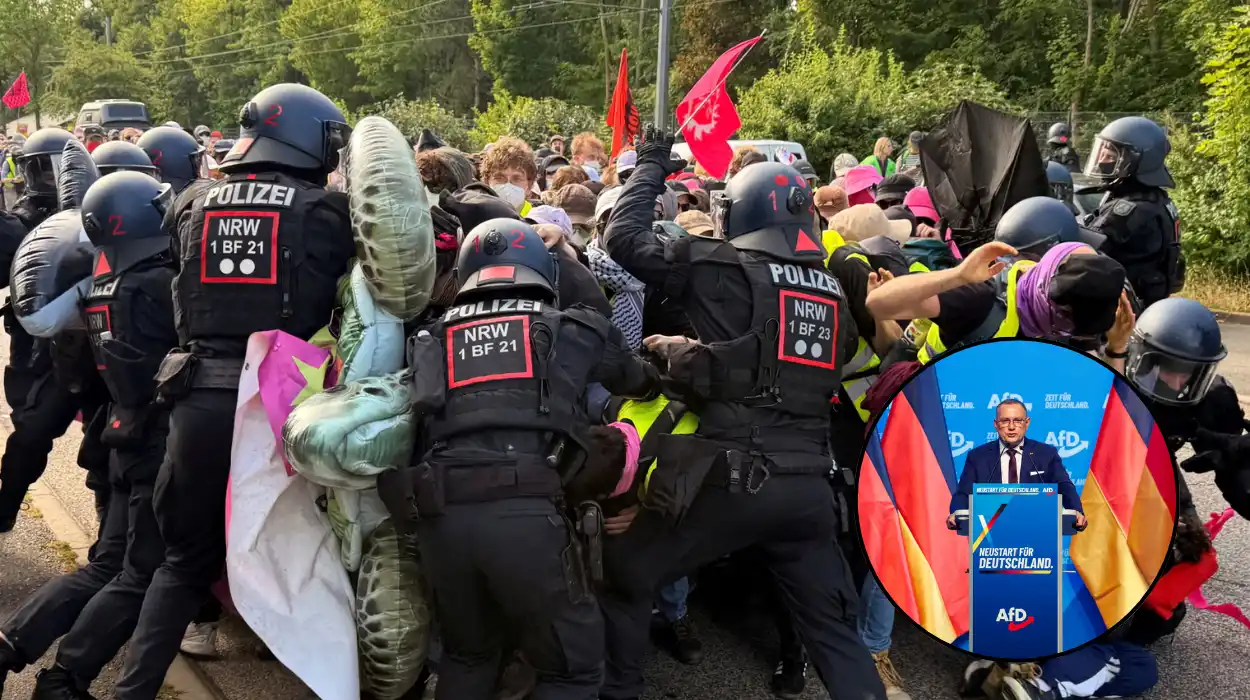
- Riot police clashed with demonstrators in Erfurt, eastern Germany, as thousands attempted to block delegates from reaching the far-right Alternative für Deutschland (AfD) party’s biennial leadership conference.
- Police put the number of protesters at roughly 20,000, though other outlets reporting from the scene estimated the crowd at closer to 15,000.
- A Thuringian court had overturned an attempted ban on the gathering shortly beforehand, forcing police to switch from blocking the event to escorting AfD delegates through the city.
- Demonstrators sat in rows across access roads, occupied central squares, abseiled from a motorway bridge and glued themselves to tram tracks in an effort to disrupt the congress.
- Despite the disruption, several hundred delegates reached the conference centre before dawn and proceedings began on schedule.
- Co-leaders Alice Weidel and Tino Chrupalla are expected to be re-elected, positioning the party ahead of state elections in Saxony-Anhalt and Mecklenburg-Vorpommern.
- The timing of the conference, close to the 100th anniversary of a Nazi party meeting near Weimar, has drawn accusations of deliberate provocation, which the AfD denies.
- Government ministers and campaign groups including “Grandmas Against the Right” joined a separate march organised by the Standing Together alliance.
Erfurt (Britain Today News) July 04, 2026 — Riot police clashed with opponents of the far-right Alternative für Deutschland on the streets of Erfurt on Saturday, as thousands of demonstrators attempted to block roads and prevent AfD delegates from reaching the party’s national conference to elect its leadership. Police said around 20,000 protesters had turned out in the eastern city, although separate estimates from reporters on the ground put the figure closer to 15,000. The demonstrations came as co-leaders Alice Weidel and Tino Chrupalla prepared to seek re-election at the head of the party, ahead of state elections in which the AfD could win power at regional level for the first time.
- Key Points
- What happened in Erfurt on Saturday?
- Why did the AfD choose Erfurt for its conference?
- What tactics did demonstrators use to block the conference?
- What have protesters said about their reasons for demonstrating?
- Why does the conference date carry historical significance?
- What is at stake in the upcoming state elections?
- What happens next for the AfD and its opponents?
What happened in Erfurt on Saturday?
Thousands of officers were deployed across the city as opponents of the AfD staged sit-in blockades in the centre in an attempt to stop the party’s roughly 600 delegates from reaching the conference grounds at the Messe Erfurt fairground. Some protesters abseiled from a motorway bridge, while others glued themselves to tram tracks to disrupt traffic further. Footage from the scene showed officers using batons against demonstrators who ran towards police lines, while other officers struggled to hold back crowds elsewhere in the city.
A Thuringian police spokesperson later described the protest overall as broadly non-violent, telling Die Zeit that just under 100 offences had been recorded, the majority relating to property damage from graffiti. Separately, according to reporting via Welt, the AfD’s local “Bürgerbüro” constituency office was targeted with pyrotechnics and paint during the day, one of several flashpoints as police worked to keep rival groups apart.
Why did the AfD choose Erfurt for its conference?
The AfD holds a national conference every two years to elect its leadership, and this year’s gathering fell in Erfurt, the capital of Thuringia, a state where the party already commands significant support. The congress comes ahead of state elections in Saxony-Anhalt and Mecklenburg-Vorpommern, contests the AfD hopes will help extend its momentum toward power at national level. Weidel and Chrupalla have led the party jointly for four years and were seeking to extend that arrangement at the two-day event.
How many protesters and police were involved?
Figures varied depending on the source. Police put the total number of demonstrators at around 20,000, while other estimates from journalists covering the protests placed the crowd closer to 15,000. Regardless of the precise count, the scale of the operation was significant: thousands of police officers were deployed to Erfurt, including reinforcements drafted in from other parts of Germany, reflecting the scale of the security operation surrounding the event.
What tactics did demonstrators use to block the conference?
Protesters, organised in part through the “Resistance” alliance — also referred to as Widersetzen, meaning “Resist” — attempted a range of tactics to disrupt delegates’ access to the venue. These included coordinated sit-in blockades of roads and tram lines leading to the conference centre, individuals abseiling from a motorway bridge, and others gluing themselves to tram tracks. Protesters also succeeded in occupying several key public squares in the city centre, creating what amounted to a physical barrier between parts of the city and the venue.
How did the courts and police respond to the planned protests?
A Thuringian court had overturned an attempted ban on the AfD’s congress shortly before it was due to begin, ruling that the security concerns raised did not meet the legal threshold required to prohibit a political assembly outright. Under German constitutional law, freedom of assembly can only be restricted where there is a direct and imminent danger to public safety that cannot be managed through other policing measures; the court found that threshold had not been met in this instance.
That ruling forced Erfurt police to abandon any prohibition strategy and instead mount a high-security escort operation, moving AfD delegates’ buses into the city centre under direct police protection so they could reach the venue despite the crowds occupying central squares. Despite the disruption, a spokesperson for the AfD said 540 delegates had reached the conference centre before 5am, and that the congress had begun on schedule.
What have protesters said about their reasons for demonstrating?
Demonstrators cited a mixture of concerns, from opposition to the AfD’s stance on immigration and its rhetoric on national identity, to specific anger over party figures downplaying Nazi-era crimes. As reported by Agence France-Presse, one protester, 19-year-old Lene Krug from Gera, said it was important to “send a signal against the shift to the right,” describing the AfD as an anti-democratic party that she said spreads hatred.
Another demonstrator, among those who had glued themselves to tram tracks, told AFP that the period from 1933 to 1945 “must never happen again,” a reference to the years the Nazis held power in Germany. A third protester, who gave only her first name, Ella, 44, argued that mainstream democratic parties needed to consider banning the AfD outright.
Separately, a spokesperson for the anti-AfD umbrella group Widersetzen said the aim of the protest was to make clear that the rise of far-right politics in Germany would not be tolerated, framing the demonstration as a stand for equal rights and social solidarity.
How has the AfD responded to the protests?
In his opening address to the conference, Tino Chrupalla accused demonstrators of protesting against democratic decision-making, saying they believed they held a monopoly on democracy. He told delegates that the right to hold a party conference was guaranteed, and, according to Die Zeit’s reporting, described the protesters as “the last line of defence” for the party’s political rivals.
Chrupalla also urged supporters to help deliver an outright majority for the AfD in the Saxony-Anhalt state election, arguing that such a result would send the right message to what he called “the democracy-haters” who had sought to prevent the conference from taking place. He characterised his leadership partnership with Weidel as one of the most effective in recent German politics, telling delegates the pair stood for unity rather than division.
The AfD has also pushed back on suggestions that the date of its conference was chosen deliberately to coincide with a historically sensitive anniversary, describing critics of the timing as fixated on what the party called the “weaponisation” of history.
Why does the conference date carry historical significance?
The conference falls close to the 100th anniversary of a Nazi party meeting held in nearby Weimar, an event at which Adolf Hitler unveiled the Hitler Youth movement and introduced the Hitler salute. Historians and political opponents argue that holding a national AfD gathering so close to that anniversary, and in the same region, amounts to a deliberate provocation. The AfD rejects that characterisation, and has accused its critics of exploiting historical symbolism for political ends.
Who else took part in the demonstrations?
Beyond the sit-in blockades organised through Widersetzen, a separate march was staged by the Standing Together alliance, drawing a broader coalition of opponents including trade unionists, civil society groups and left-wing parties. Attendees included federal environment minister Carsten Schneider and Thuringia’s interior minister, Georg Maier. Campaigners from the “Grandmas Against the Right” group were also present, carrying homemade placards as part of the wider demonstration against the party.
Explore More about World:
Americans Born on July 4 Reflect on 250th Anniversary
World Bank Approves $70m Loan for Connected Punjab Digital Drive
What is at stake in the upcoming state elections?
The AfD has opened a substantial lead in national opinion polls over Chancellor Friedrich Merz’s conservatives, built on a platform combining nationalist rhetoric, calls for tougher immigration controls and appeals to voters frustrated by years of economic stagnation under successive governments. The party is aiming for a strong result in the Saxony-Anhalt state election, scheduled for September, with some projections suggesting it could secure 40 per cent or more of the vote there. A result of that scale could put the AfD within reach of an outright majority, or in a position to attract defectors from other parties — either outcome would mark the party’s first opportunity to govern at state level.
Mainstream German parties continue to rule out any formal cooperation with the AfD, a policy commonly referred to as the “firewall,” designed to keep the party out of governing coalitions despite its growing electoral strength.
What happens next for the AfD and its opponents?
With the leadership contest expected to confirm Weidel and Chrupalla for a further term, attention will now turn to the state election campaigns in Saxony-Anhalt and Mecklenburg-Vorpommern, both seen as key tests of whether the AfD’s national polling lead can translate into governing power at regional level for the first time. Opponents of the party, including the Widersetzen and Standing Together alliances, are likely to continue mobilising ahead of those votes, while the “firewall” policy adopted by mainstream parties is expected to remain a central point of contention in German politics in the months ahead.