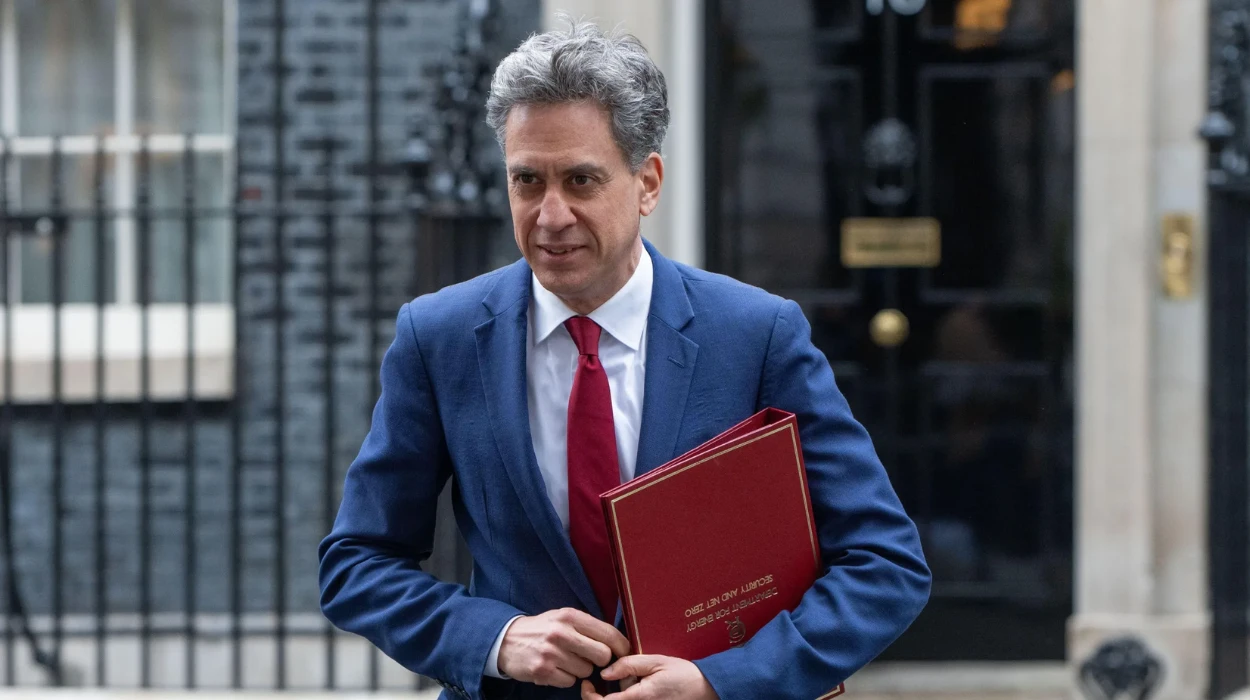
Ed Miliband is the Labour Member of Parliament for Doncaster North and the Secretary of State for Energy Security and Net Zero. Speculation that he could become the next Chancellor of the Exchequer emerged in June 2026, following Prime Minister Keir Starmer’s resignation announcement on 22 June 2026. The speculation centers on Andy Burnham, the frontrunner to succeed Starmer, and whether Miliband would replace Rachel Reeves at the Treasury if Burnham becomes prime minister. This article explains the background, the people involved, the process for choosing a new Labour leader, and the economic implications of the speculation.
- Who Is Ed Miliband?
- Why Is Ed Miliband Being Linked to the Chancellor Role?
- What Triggered the Current Labour Leadership Crisis?
- How Did Andy Burnham Become the Frontrunner to Replace Starmer?
- What Is the Process for Choosing Labour’s Next Leader?
- Who Is Rachel Reeves, and Why Is Her Position at Risk?
- What Would Make Ed Miliband a Notable Choice for Chancellor?
- What Are the Concerns About Ed Miliband Becoming Chancellor?
- How Have Financial Markets Reacted to the Political Uncertainty?
- What Happens Next in the Leadership and Cabinet Process?
Who Is Ed Miliband?
Ed Miliband is a British Labour politician, former Labour Party leader, and current Cabinet minister who has served as an MP for Doncaster North since 5 May 2005. He led the Labour Party from 2010 to 2015 and currently serves as Secretary of State for Energy Security and Net Zero.
Edward Samuel Miliband was born on 24 December 1969 in Fitzrovia, London. He is the son of Ralph Miliband, a Belgian-born Marxist sociologist, and Marion Kozak, a Polish-born human rights campaigner. He studied philosophy, politics, and economics at Corpus Christi College, Oxford, then completed a master’s degree at the London School of Economics. He began his political career as a special adviser to Chancellor Gordon Brown in 1997. He was elected MP for Doncaster North in 2005 and entered Cabinet in 2008 as Secretary of State for Energy and Climate Change, a role in which he oversaw the Climate Change Act 2008. That law made the United Kingdom the first country to set legally binding national carbon reduction targets. In 2010, he was elected Labour leader, narrowly defeating his older brother, David Miliband, becoming the youngest Labour leader since the 1940s at age 40. He resigned as leader on 8 May 2015 after Labour lost the general election to the Conservative Party. He returned to the front bench under Keir Starmer in 2020 and rejoined Cabinet as Energy Secretary after Labour’s 2024 general election victory.
Why Is Ed Miliband Being Linked to the Chancellor Role?
Ed Miliband is being linked to the Chancellor role because Andy Burnham, the frontrunner for Labour leader, is reportedly considering him as a replacement for Rachel Reeves at the Treasury. Reports describe tension between Miliband and Starmer over departmental funding cuts.
The speculation surfaced in mid-June 2026, days before Starmer’s resignation. Reports from British outlets, including GB News, described friction between Miliband and Starmer over proposed reductions to the Energy Department’s budget, which the government wanted to redirect toward defence spending. Miliband reportedly avoided some of Starmer’s calls during the dispute, though a source close to Miliband denied this and said the two men did speak. Miliband ultimately accepted a one percent cut to his department’s Net Zero funding. During this same period, Miliband was reportedly preparing to back Burnham’s leadership bid rather than support Starmer, and was named as a potential Chancellor if Burnham succeeded in replacing Starmer as prime minister. Burnham has not publicly confirmed any shadow cabinet or cabinet appointments. The speculation is therefore based on political reporting and unconfirmed sourcing, not on an official announcement.
What Triggered the Current Labour Leadership Crisis?
The Labour leadership crisis was triggered by Labour’s poor performance in the May 2026 local elections, mounting resignations from ministers, and growing public pressure on Keir Starmer to resign as prime minister. The crisis culminated in Starmer’s resignation on 22 June 2026.
By mid-May 2026, more than 95 Labour MPs had publicly called on Starmer to either resign or set a timetable for departure. Cabinet minister Wes Streeting, then Health Secretary, resigned in protest, along with four junior ministers, including Jess Phillips, and four ministerial aides. According to LabourList, a tracking website, 159 Labour members showed support for Starmer at one point in May 2026, while 98 called for his resignation or a departure timetable, and 146 remained unaligned. The crisis deepened in June 2026 after disputes over the government’s defence spending plans. Defence Secretary John Healey resigned, along with Armed Forces minister Al Carns and ministerial aide Pamela Nash, all citing disagreements with the defence investment plan. Public dissatisfaction was reinforced by polling after the May 2026 local elections, which found that in England, only 5% of 2024 Labour voters switched to Reform UK, while 32% switched to the Green Party or Liberal Democrats. Unite the Union, one of Britain’s largest trade unions, cut its financial affiliation with Labour by 40% in March 2026, citing dissatisfaction over the government’s handling of a bin collection strike in Birmingham.
How Did Andy Burnham Become the Frontrunner to Replace Starmer?
Andy Burnham became the frontrunner to replace Starmer by winning a parliamentary seat through a specially arranged by-election in Makerfield on 18 June 2026, which gave him the eligibility required to challenge for the Labour leadership.
Burnham, the Mayor of Greater Manchester since 2017, was not a sitting Member of Parliament, which barred him from contesting the Labour leadership directly. Labour MP Josh Simons, who held the Makerfield constituency in Greater Manchester, resigned his seat specifically to trigger a by-election that Burnham could contest. This was the first time since the 1965 Leyton by-election that a UK by-election was triggered specifically to create a vacancy for a person not yet in Parliament. Burnham won the Makerfield by-election with almost 25,000 votes, securing 54.8% of the vote and a majority exceeding 9,200, outperforming pre-election polling projections. He defeated a candidate from Reform UK, the right-wing party led by Nigel Farage. Burnham was sworn in as an MP days later and travelled to London to take his seat. Four days after the by-election, Starmer announced his resignation. Burnham announced his candidacy for the Labour leadership on the same day. Former Health Secretary Wes Streeting, seen as Burnham’s most serious potential rival, said he would back Burnham rather than stand against him. Burnham had previously been blocked from contesting an earlier vacancy, the January 2026 Gorton and Denton by-election, in an 8–1 vote by Labour’s National Executive Committee, a decision Deputy Prime Minister Angela Rayner later called a mistake.
What Is the Process for Choosing Labour’s Next Leader?
The process for choosing Labour’s next leader follows a formal timetable set by the party’s National Executive Committee, with candidate nominations opening on 9 July 2026 and the contest required to conclude before Parliament’s summer recess.
Keir Starmer remains prime minister and Labour leader throughout the contest under UK constitutional convention, since a sitting government does not lose office until a successor is confirmed. To stand for the leadership, a candidate must secure nominations from a minimum threshold of fellow Labour MPs, generally cited in this contest as 81 backers, a figure tied to the parliamentary party’s internal nomination rules. Once nominations close, the contest typically proceeds to a vote among Labour Party members and affiliated supporters, with the winner becoming both Labour leader and, by convention, prime minister, since Labour holds a parliamentary majority. As of the announcement, Burnham was the only declared candidate, though other senior figures, including Foreign Secretary David Lammy, Home Secretary Shabana Mahmood, Wes Streeting, Angela Rayner, and Ed Miliband, had been named in media reports as potential contenders. Under UK law, the next scheduled general election does not need to occur until 2029, five years after the 2024 general election, meaning the new Labour leader becomes prime minister without facing voters in a fresh national poll.
Who Is Rachel Reeves, and Why Is Her Position at Risk?
Rachel Reeves is the current Chancellor of the Exchequer, the Cabinet minister responsible for the UK Treasury and economic policy. Her position is reportedly at risk because her economic agenda became closely associated with Starmer’s leadership, and a change of prime minister typically brings a new Chancellor.
The Chancellor of the Exchequer is the UK government’s chief finance minister, responsible for the Treasury, tax policy, public spending decisions, and the annual Budget statement to Parliament. Reeves became Chancellor following Labour’s July 2024 general election victory and was central to the party’s strategy of rebuilding credibility with financial markets after years of Conservative-led fiscal turbulence. Financial analysts, including Nigel Green of the deVere Group, have said that investors are watching closely for signals about whether Reeves’s fiscal framework will survive under new Labour leadership, since her tenure became tied to Starmer’s broader economic strategy. Multiple reports named Reeves as the minister most likely to be moved if Burnham wins the leadership contest, with several potential successors floated, including Wes Streeting, Yvette Cooper, Pat McFadden, John Healey, and Ed Miliband.
What Would Make Ed Miliband a Notable Choice for Chancellor?
Ed Miliband would be a notable choice for Chancellor because of his decades of Cabinet and Treasury-adjacent experience, his standing among Labour’s membership, and his association with interventionist economic policy, particularly around state involvement in energy markets.
Miliband previously worked as a special adviser inside the Treasury under Gordon Brown before entering Parliament, giving him direct experience with fiscal policymaking. As Energy Secretary since July 2024, he has overseen Britain’s energy security and Net Zero strategy, including responsibility for industrial energy pricing and the public ownership debate around national infrastructure. Political commentary, including analysis published by The Spectator, has described Miliband as bold, experienced, and capable of articulating a clear alternative economic direction if Burnham’s stated ambition to move beyond what Burnham has called decades of neo-liberal economic policy is to be implemented in government. Miliband is generally regarded as belonging to the soft left of the Labour Party. Supporters argue his profile and experience exceed those of several other potential candidates for the role.
What Are the Concerns About Ed Miliband Becoming Chancellor?
The primary concern about Ed Miliband becoming Chancellor is that financial markets could react negatively, given his association with higher state spending, expanded borrowing, and interventionist industrial policy, particularly in the energy sector.
Critics, including commentary in The Spectator, have argued that Miliband’s record as Energy Secretary correlates with the UK developing the highest industrial energy prices among major economies and with measurable deindustrialisation in energy-intensive sectors. These critics argue that appointing Miliband as Chancellor would signal a sharp leftward shift in fiscal policy, characterized by a larger state role in the economy, increased government borrowing, and higher taxation, and that this signal alone could prompt capital outflows from UK markets. This argument reflects one viewpoint within British political and financial commentary; other observers, including some Labour-aligned figures, argue that bolder economic intervention is necessary given Labour’s local election losses and the rise of Reform UK. Financial markets have shown a documented sensitivity to UK leadership uncertainty in 2026: British government bond yields and the pound experienced volatility around Starmer’s resignation announcement, separate from any specific reaction to Cabinet appointment speculation.
Explore More about Politics:
Who Will Replace Keir Starmer? Front-Runners List
Who Is Count Binface? Meaning, History & Political Role Explained
How Have Financial Markets Reacted to the Political Uncertainty?
Financial markets reacted to Starmer’s resignation announcement with modest, mixed movement in the pound and UK government bonds, reflecting relief that political uncertainty had been resolved rather than a verdict on any specific successor or future Cabinet appointment.
On 22 June 2026, the day of Starmer’s resignation announcement, the pound traded at approximately $1.319 against the US dollar and 86.76 pence per euro, according to Reuters reporting. The UK’s 10-year government bond, known as a gilt, traded at a yield of approximately 4.85%, a slight increase on the day, while the FTSE 100 stock index was marginally lower. Bloomberg reported a slightly different reading shortly after, with the pound recovering to $1.3244, a 0.1% gain, and the 10-year gilt yield easing four basis points to 4.80%, suggesting two-way volatility rather than a one-directional sell-off. The pound had already lost approximately 3% of its value since February 2026 as pressure mounted on Starmer’s leadership. Analysts at the Wealth Club and the deVere Group both noted that the relatively calm market response reflected relief at the removal of leadership uncertainty rather than confidence in any specific successor. Analysts said markets were specifically watching for signals on taxation, public spending, government borrowing levels, and whether Rachel Reeves’s existing fiscal framework would continue under new leadership, since these factors directly affect sterling and UK gilt valuations.
What Happens Next in the Leadership and Cabinet Process?
The next stage in the process is the formal Labour leadership contest, with nominations opening on 9 July 2026, followed by a vote among party members, and the formation of a new Cabinet once a successor to Starmer is confirmed.
Once Labour’s National Executive Committee finalizes the leadership timetable, candidates meeting the nomination threshold will campaign ahead of a vote among Labour Party members and affiliated supporters. The process is required to conclude before Parliament breaks for summer recess, giving the contest a compressed multi-week window. If Burnham wins, as multiple analysts and his current frontrunner status suggest is likely, he would be expected to form a new Cabinet, at which point any reshuffling involving the Chancellor role, including the speculation involving Ed Miliband, would be confirmed or dismissed. Until that point, Rachel Reeves continues serving as Chancellor of the Exchequer, and Ed Miliband continues serving as Secretary of State for Energy Security and Net Zero, under the existing Starmer government, which remains in office in a caretaker capacity throughout the leadership contest. Financial markets, foreign governments, and UK industry groups are expected to monitor the outcome closely, given its implications for fiscal policy, energy policy, and Britain’s broader economic direction heading toward the next general election, which is not constitutionally required until 2029.