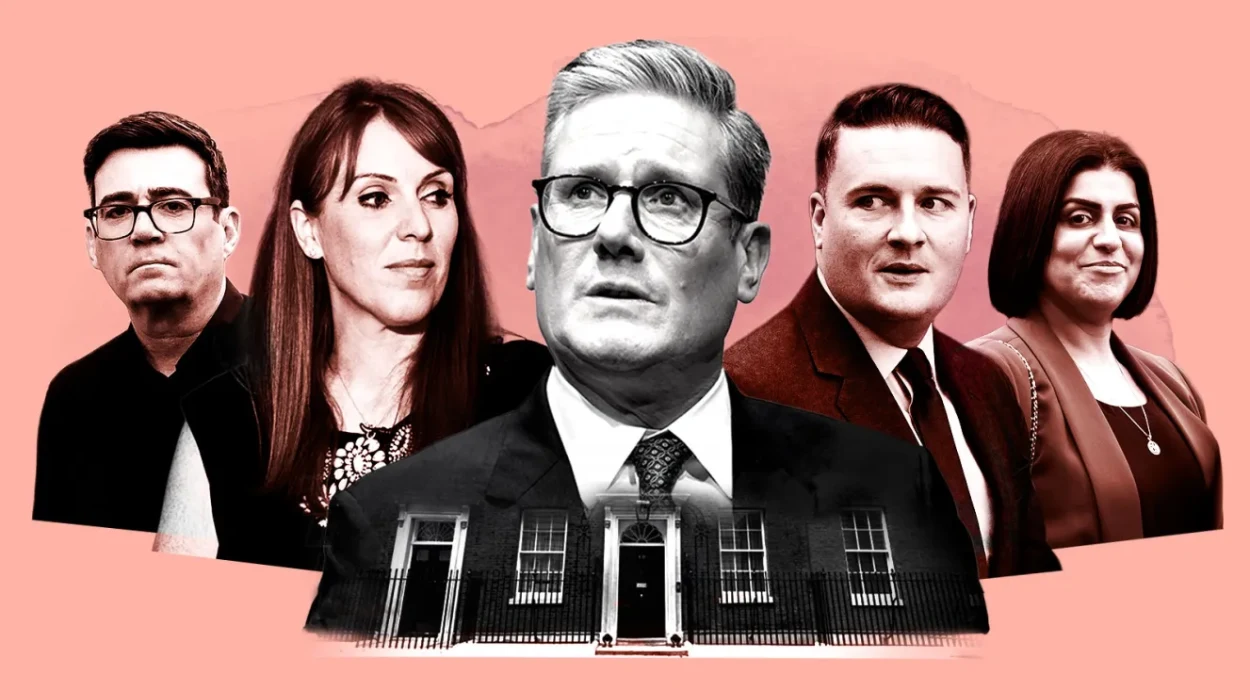
Keir Starmer became UK Prime Minister on 5 July 2024 after Labour won a 172-seat majority. By mid-2026, his leadership faced the most serious internal challenge in modern Labour Party history. Over 95 Labour MPs publicly called for his resignation by May 2026. Six frontline figures emerged as potential successors: Andy Burnham, Wes Streeting, Angela Rayner, David Lammy, Shabana Mahmood, and Ed Miliband. This article defines each candidate, explains the leadership contest process, and outlines the political mechanics that will determine Britain’s next Labour leader and potentially its next Prime Minister.
- Why Is Keir Starmer Facing Pressure to Resign?
- How Does a Labour Leadership Challenge Work?
- Who Are the Main Candidates to Replace Keir Starmer?
- Who Is Andy Burnham?
- Who Is Wes Streeting?
- Who Is Angela Rayner?
- Who Is David Lammy?
- Who Is Shabana Mahmood?
- Who Is Ed Miliband?
- What Do Opinion Polls Show About the Candidates?
- What Happens If Starmer Loses a Leadership Contest?
- What Are the Risks of a Leadership Change for Labour?
Why Is Keir Starmer Facing Pressure to Resign?
Keir Starmer faces resignation pressure due to historic local election losses, cabinet resignations, and a cost-of-living crisis. In the 2026 local elections, Labour lost control of 35 councils and nearly 1,500 councillors, roughly 60% of contested seats. Polling placed Starmer among Britain’s most unpopular Prime Ministers.
Starmer led Labour to a landslide victory in the 2024 general election, ending 14 years of Conservative government. His majority of 172 seats was the largest for Labour since 1997. Despite this scale of victory, Starmer’s personal approval ratings declined sharply within 18 months of taking office.
Multiple factors drove this decline. The government faced a prolonged cost-of-living crisis, with persistent inflation and stagnant wage growth. Tax increases announced by Chancellor Rachel Reeves drew criticism from the political right. Welfare reform proposals and the government’s stance on the Gaza war drew criticism from the political left. The party also faced scandals involving senior figures, including the resignation of Deputy Prime Minister Angela Rayner in September 2025 over an underpaid stamp duty bill of £40,000 on a second home.
The 2026 local elections marked a turning point. The BBC’s projected national vote share placed Labour at 17%, tied for third place with the Conservatives and down nearly half from its 2024 general election result. Reform UK, led by Nigel Farage, and the Green Party, led by Zack Polanski, made substantial gains. Following the results, Starmer appointed former Prime Minister Gordon Brown and Labour peer Harriet Harman to advisory roles in an attempt to reset his premiership. Labour MPs criticised the move as out of touch with voter concerns in former Labour strongholds including Wigan, Wandsworth, Salford, and Sunderland.
How Does a Labour Leadership Challenge Work?
A Labour leadership challenge requires backing from 81 MPs, equal to 20% of the party’s 406 members of Parliament. Each additional candidate must independently secure the same threshold. Starmer automatically appears on the ballot if he chooses to contest it, and he remains Prime Minister throughout the process.
Labour’s leadership election rules are set out in the party’s rulebook, overseen by the National Executive Committee (NEC). To trigger a contest against a sitting leader, a challenger needs the signed support of 81 Labour MPs, representing one-fifth of the parliamentary party. This is a higher bar than a simple internal vote of no confidence; it requires public, recorded backing from sitting legislators.
Once a contest is triggered, the process opens to multiple candidates, but each one must independently clear the same 81-MP threshold before appearing on the ballot. A Labour MP can only formally back one candidate at a time, which caps the number of credible contenders the sitting leader can face simultaneously. After the nomination stage closes, the contest moves to a vote among full Labour Party members and members of affiliated trade unions. This stage typically takes several weeks to complete.
In Labour’s 126-year history, no sitting Prime Minister from the party has faced a formal internal leadership challenge while in office. Harold Wilson, James Callaghan, and Tony Blair all left office through resignation rather than a contested defeat. The mechanics of a 2026 challenge against Starmer would therefore set a new institutional precedent for the party.
Who Are the Main Candidates to Replace Keir Starmer?
The leading candidates to replace Keir Starmer are Andy Burnham, Wes Streeting, Angela Rayner, David Lammy, Shabana Mahmood, and Ed Miliband. Andy Burnham is widely viewed as the front-runner following his by-election win in Makerfield on 18 June 2026, securing 54.8% of the vote.
Each candidate represents a distinct wing of the Labour Party, with different policy priorities, regional bases, and public profiles. The sections below define each figure’s background, current role, and standing within the party.
Who Is Andy Burnham?
Andy Burnham, born 7 January 1970 in Aintree, Liverpool, served as Mayor of Greater Manchester from May 2017 until June 2026. He studied English at Fitzwilliam College, Cambridge, and joined the Labour Party at age 14. Before becoming mayor, Burnham was MP for Leigh from 2001 to 2017 and held several cabinet posts under Gordon Brown, including Chief Secretary to the Treasury, Culture Secretary, and Health Secretary.
As Greater Manchester mayor, Burnham built a regional brand known as “Manchesterism,” combining pro-enterprise policy with redistribution toward working communities. His tenure included the creation of the Bee Network, an integrated public transport system covering bus, tram, and bicycle travel launched in September 2023, and the return of Greater Manchester’s buses to public control through franchising in 2025, the first such move in England in 40 years.
Because mayors cannot simultaneously serve as MPs, Burnham resigned the mayoralty on 19 June 2026 after winning the Makerfield by-election. The by-election was triggered when sitting MP Josh Simons resigned specifically to create a vacancy and clear Burnham’s path back into Parliament. Burnham defeated Reform UK’s candidate, securing 54.8% of the vote. A separate by-election to choose his mayoral successor was scheduled for 30 July 2026, with Paul Dennett, Salford’s mayor and Burnham’s deputy, serving as acting mayor in the interim.
Burnham identifies as a socialist and is associated with Labour’s soft left faction. According to Ipsos polling conducted between 5 and 9 June 2026, Burnham was the most popular sitting Labour politician in the country and led Starmer by 25% to 12% on the question of who would make a better Prime Minister, although 50% of respondents expressed no preference or wanted neither.
Who Is Wes Streeting?
Wes Streeting, born 21 January 1983 in Stepney, London, has served as MP for Ilford North since 2015. He read history at the University of Cambridge and later served as president of the National Union of Students from 2008 to 2010. He represents Labour’s centrist, reform-oriented wing.
Streeting served as Secretary of State for Health and Social Care from July 2024 until his resignation in May 2026. He resigned in direct response to Labour’s losses in the 2026 local elections, the Scottish Parliament election, and the Senedd election, stating in his resignation letter that he no longer had confidence in Starmer’s leadership and calling for a leadership contest with “the best possible field of candidates.”
Streeting’s resignation letter was widely interpreted as an acknowledgement that he did not yet have the 81 MP nominations required to trigger a contest independently. He has stated he intends to stand if a contest takes place but chose to wait for Burnham to secure a parliamentary seat first, saying a contest without Burnham would lack legitimacy. According to Ipsos polling from June 2026, only 18% of Britons said they would be more likely to vote Labour if Streeting became leader, with a net favourability rating among the public of negative figures, reflecting limited recognition outside Westminster compared with Burnham.
Who Is Angela Rayner?
Angela Rayner, born in Stockport in 1980, served as Deputy Prime Minister, Housing Secretary, and Labour’s elected Deputy Leader from July 2024 until September 2025. A former care worker and trade unionist, Rayner became a mother at 16 and is associated with Labour’s working-class, union-connected base.
Rayner resigned all three positions in September 2025 after the Prime Minister’s independent ethics adviser, Sir Laurie Magnus, found she had breached the ministerial code by underpaying £40,000 in stamp duty on an £800,000 second home in Hove. Magnus concluded that Rayner had acted with integrity throughout but had still failed to meet the required standard. Her resignation triggered a cabinet reshuffle in which David Lammy became Deputy Prime Minister, Yvette Cooper became Foreign Secretary, and Shabana Mahmood became Home Secretary.
Despite leaving government, Rayner has remained politically active and has spoken publicly about the need for Labour to address factionalism. In a May 2026 speech to the Communication Workers Union conference in Bournemouth, she said voters had turned to populist and nationalist parties because Labour had “not done enough to fix it.” She has been discussed as a possible candidate to stand against Wes Streeting, drawing on her base among union-affiliated members. Ipsos polling from June 2026 recorded her public favourability rating at negative 31 points.
Who Is David Lammy?
David Lammy, elected MP for Tottenham in a 2000 by-election, served as Foreign Secretary in the Starmer government before being appointed Deputy Prime Minister and Justice Secretary in September 2025, replacing Angela Rayner. He has held junior ministerial roles dating back to the New Labour government of the 2000s.
Lammy has been reported as a potential “unifier” candidate capable of bridging Labour’s internal factions, a characterisation that appeared in The Independent in October 2025. Unlike Burnham, Streeting, or Rayner, Lammy has not been strongly associated with either the party’s soft left or its Blairite centrist wing, which analysts suggest gives him broader internal acceptability but a less defined public profile.
Who Is Shabana Mahmood?
Shabana Mahmood, elected MP for Birmingham Ladywood in the 2010 general election, serves as Home Secretary. She previously served as Justice Secretary before the September 2025 reshuffle. She has reportedly urged Starmer privately to set out a timetable for departure, placing her among senior cabinet figures applying internal pressure rather than openly campaigning for the leadership herself.
Mahmood’s profile is built on legal expertise and justice policy experience. Labour has never elected a woman as permanent party leader, a historical fact relevant to assessing Mahmood’s, Rayner’s, or Yvette Cooper’s prospects. Ipsos polling in June 2026 placed her public favourability at negative 25 points, with 15% of Britons viewing her favourably and 40% unfavourably.
Who Is Ed Miliband?
Ed Miliband, elected MP for Doncaster North in the 2005 general election, currently serves as Secretary of State for Energy Security and Net Zero. He previously served as Leader of the Labour Party from 2010 to 2015, losing the 2015 general election to David Cameron’s Conservatives.
Miliband’s prior tenure as leader makes him a known quantity to the electorate, which cuts both ways: name recognition is high, but so is association with a past electoral defeat. Ipsos polling from June 2026 recorded his public favourability at negative 26 points, with only 20% of Britons saying they would be more likely to vote Labour under his leadership.
What Do Opinion Polls Show About the Candidates?
Andy Burnham polls strongest among Labour leadership contenders, beating Starmer 25% to 12% on the question of who would make a better Prime Minister. All other named contenders, including Streeting, Rayner, Miliband, and Mahmood, recorded negative net favourability ratings among the wider public as of June 2026.
| Politician | Public Favourability | Net Rating | Source Period |
|---|---|---|---|
| Andy Burnham | Highest among Labour figures | Positive | 5–9 June 2026 |
| Wes Streeting | 18% favourable | Negative | 5–9 June 2026 |
| Angela Rayner | 18% favourable, 49% unfavourable | -31 | 5–9 June 2026 |
| Ed Miliband | 19% favourable, 45% unfavourable | -26 | 5–9 June 2026 |
| Shabana Mahmood | 15% favourable, 40% unfavourable | -25 | 5–9 June 2026 |
| Yvette Cooper | 17% favourable, 38% unfavourable | -21 | 5–9 June 2026 |
| Rachel Reeves | 15% favourable, 57% unfavourable | -42 | 5–9 June 2026 |
This data comes from Ipsos’s Political Pulse survey, conducted online among 2,247 British adults aged 18 and over between 5 and 9 June 2026. The figures show a consistent pattern: Burnham is the only Labour figure with a positive public profile strong enough to outperform Starmer directly, while every other named successor candidate carries a net negative rating with the wider electorate, even if they hold support within the parliamentary party or among Labour members specifically.
What Happens If Starmer Loses a Leadership Contest?
If Starmer loses a Labour leadership contest, the winning candidate would become Labour leader and Prime Minister without a general election. The UK’s parliamentary system permits a governing party to change its leader mid-term, transferring the premiership directly to the new party leader.
This mechanism differs fundamentally from a US presidential transition. Because the Prime Minister holds office as the leader of the party that commands a majority in the House of Commons, a change of party leader during a parliamentary term automatically transfers the premiership, without requiring a new national vote. This occurred multiple times in recent British history, including when Boris Johnson replaced Theresa May in 2019 and when Liz Truss and then Rishi Sunak replaced Johnson in 2022.
If a 2026 contest concluded with a new Labour leader, that person would be sworn in as Prime Minister by the monarch and would form a new cabinet. Andy Burnham, as the current front-runner, would become the seventh UK Prime Minister in a decade if he won, following Cameron, May, Johnson, Truss, Sunak, and Starmer. The timeline for such a contest, if triggered, was expected to run through the summer of 2026, with an aim to conclude before the Labour Party’s annual conference at the end of September.
Explore More about Politics:
Who Is Count Binface? Meaning, History & Political Role Explained
Cameron Thomas MP Suspended After Police Investigation
What Are the Risks of a Leadership Change for Labour?
A contested leadership change risks deepening party division, delaying policy delivery, and unsettling financial markets during an active parliamentary term. Political analysts have also questioned whether any single successor candidate has a fully tested governing record at national level.
Tim Bale, a politics professor at Queen Mary University of London, described Burnham as having functioned as a “fantasy leader” prior to entering Parliament, a screen onto which different factions could project differing expectations, given that he had not yet been tested in a UK-wide campaign or a Westminster portfolio since 2010. This observation applies more broadly: a leadership change introduces uncertainty over which faction’s policy priorities, on tax, welfare, immigration, and foreign policy, would dominate a new administration.
A contest also carries institutional risk specific to Labour. Because no sitting Labour Prime Minister has faced a formal internal challenge before, the party has no precedent for managing the parliamentary, financial, and diplomatic disruption that an extended leadership race could cause while a government remains in office. Over 110 Labour backbenchers signed a letter arguing that a leadership challenge should not proceed at all, reflecting concern within the party itself about the stability cost of a contest, separate from any judgment on Starmer’s individual performance.
Keir Starmer’s position as Labour leader and Prime Minister faced sustained internal pressure through 2026, driven by historic local election losses, cabinet resignations, and declining personal popularity. Labour’s leadership rules require any challenger to secure backing from 81 MPs before a formal contest can proceed, with Starmer guaranteed a place on the ballot if he chooses to fight. Andy Burnham emerged as the clearest front-runner following his Makerfield by-election win, supported by the strongest public favourability ratings among any current Labour figure. Wes Streeting, Angela Rayner, David Lammy, Shabana Mahmood, and Ed Miliband each represent alternative paths for the party, drawing on different factional bases, but each carries either a negative public profile, a recent scandal, or limited name recognition outside Westminster. The outcome of any contest would determine not only Labour’s leadership but, under the UK’s parliamentary system, the next occupant of 10 Downing Street.