Key Points
- President Donald Trump accused Iran of shooting down a US Apache helicopter over the Strait of Hormuz on Tuesday
- Two pilots were involved in the incident and both are safe and uninjured according to Trump
- Trump wrote on social media that the United States “must, of necessity, respond to this attack”
- CENTCOM earlier stated the cause of the incident was under investigation and soldiers were rescued within approximately two hours
- The helicopter went down Monday evening near the coast of Oman while patrolling regional waters
- Rescue crews from US Naval Forces Central Command and the 82nd Airborne Division retrieved the crew members who are now in stable condition
- The incident threatens the truce that has been pushed to the brink by repeated skirmishes across the region
- This escalation comes after the US military disabled an Iranian oil tanker in the Gulf on Monday
- Iran fired missiles at Israel in response to Israeli bombing of Beirut, marking the first direct Iranian attack on Israel since April ceasefire
- Israel carried out strikes inside Iran against Trump’s calls for restraint
- Since the truce came into effect on April 6, it has come under strain by repeated attacks and counter-attacks
- Earlier this month, US military carried out strikes against Iran’s Qeshm Island to which Tehran responded with missile launches against a US base in Kuwait
- A drone hit Kuwait’s international airport killing one person, but Iran denied responsibility for that attack
- Iranian forces have not taken responsibility for downing the helicopter
- Top officials in Tehran argue that US naval siege on Iranian ports and ongoing Israeli attacks in Lebanon constitute a violation of the ceasefire
Oman (Britain Today News) June 9, 2026 – President Donald Trump has made a dramatic accusation against Iran, claiming that Iranian forces shot down a highly sophisticated United States Apache helicopter while it was patrolling over the critically important Strait of Hormuz, and he has vowed that the United States will respond to what he characterized as an attack.
- Key Points
- What Did Trump Say About the Helicopter Incident?
- Where Exactly Did the Helicopter Crash Occur?
- How Were the Pilots Rescued?
- What Is CENTCOM’s Official Statement?
- Was the Helicopter Actually Shot Down by Iran?
- What Is the Broader Context of Middle East Violence?
- How Have Iran and Israel Exchanged Fire?
- What Strikes Did Israel Conduct Inside Iran?
- When Did the Ceasefire Begin and Is It Holding?
- What Happened at Kuwait’s Airport?
- What Is Tehran’s Position on the Ceasefire?
- What Happened on Qeshm Island?
- What Is the IRGC’s Response?
- What Message Did Trump Send About Peace Deal Timing?
- What Response Will the United States Make?
- What Is the Strategic Importance of the Strait of Hormuz?
- What Does This Mean for Regional Stability?
- What Is the Current Status of the Helicopter Investigation?
- What Message Does This Send to Iran?
What Did Trump Say About the Helicopter Incident?
According to a social media post by Trump on Tuesday,
“I have just been informed by our Great Military that last night the Iranians shot down one of our highly sophisticated Apache Helicopters while patrolling over the Strait of Hormuz,”
Trump continued in his post, stating,
“There were two pilots involved, both are safe and uninjured. Nevertheless, the United States must, of necessity, respond to this attack.”
Speaking on the runway at John F. Kennedy International Airport before returning to Washington, D.C., Trump provided additional details about the pilots’ condition. Trump said there was “nobody injured” and added that the administration would issue a report later on Tuesday. The New York Times reported late on Monday that a U.S. Army Apache helicopter gunship went down near the Strait of Hormuz on Monday and its two crew members were safely rescued, citing two people briefed on the incident.
Where Exactly Did the Helicopter Crash Occur?
The aircraft went down Monday evening near the coast of Oman while patrolling regional waters, as CENTCOM confirmed in a statement on X, according to reporters at Stars and Stripes. Within two hours, rescue crews from U.S. Naval Forces Central Command and the 82nd Airborne Division retrieved the two crew members, who are now in stable condition, the statement added.
How Were the Pilots Rescued?
The two crew members were located by an unmanned surface vessel, or drone boat, from the Navy’s Task Force 59, as CENTCOM spokesman Capt. Tim Hawkins confirmed to reporters at Stars and Stripes. This drone-assisted rescue is an apparent first for the Navy and the task force, which focuses on integrating unmanned systems and artificial intelligence with maritime operations for the 5th Fleet, according to the detailed reporting.
What Is CENTCOM’s Official Statement?
The Middle East-based Central Command (CENTCOM) of the US military had said earlier that the cause of the incident was under investigation.
“The Soldiers were safely rescued within approximately two hours and are in stable condition,”
CENTCOM said in its official statement. The pair were rescued within about two hours and were in stable condition, Centcom said in a statement.
Was the Helicopter Actually Shot Down by Iran?
It was not immediately clear whether the Apache had been shot down by Iranian fire, experienced mechanical failure, or encountered another problem. Asked if he knew what had brought the helicopter down, Trump said a report would be issued later on Tuesday, according to Gulf Today. A direct Iranian attack on US troops appears to be a step up the escalatory ladder, but Iranian forces have not taken responsibility for downing the helicopter, as analysts noted in their coverage.
What Is the Broader Context of Middle East Violence?
The incident is the latest outburst of violence threatening the truce, which has been pushed to the brink by repeated skirmishes across the region, as multiple journalists reported. The latest escalation comes after the US military said that it disabled an Iranian oil tanker in the Gulf on Monday, according to US forces reporting. Earlier, US forces fired upon a vessel attempting to approach an Iranian port in breach of the blockade, rendering the ship inoperable. Washington has since forcibly halted six vessels it claims were attempting to violate the blockade established on April 13, as Al Jazeera reported.
How Have Iran and Israel Exchanged Fire?
Fighting also had erupted between Iran and Israel over the past days, with Iran firing missiles at Israel in response to the bombing of Beirut by the Israeli military, as reported by journalists covering the Iran-Israel conflict. Iran fired missiles at Israel on Sunday, the first attack since April’s ceasefire, after Israel struck Beirut, as reported by Republic World. Israel intercepted them as Trump urged restraint and mediators pushed talks while regional airspace closed and tensions escalated.
Iran’s state broadcaster confirmed the launches, while the administration in Tehran closed the nation’s western airspace in anticipation of possible retaliation, according to Republic World. The Iranian government had issued stern warnings after Israel targeted the Lebanese capital without prior notice, despite reported requests from Washington in recent days for restraint, as Republic World reported. US had asked Israel to not hit Beirut. President Donald Trump said he will tell Israeli Prime Minister Benjamin Netanyahu not to respond to the Iranian attack.
“I am going to call Bibi right now and tell him not to retaliate. Each of them had their fun. Israel had its strike, and Iran had its strike. We don’t need more shooting,”
Trump said.
What Strikes Did Israel Conduct Inside Iran?
In turn, Israel carried out strikes inside Iran against Trump’s calls for restraint, as multiple news sources reported. Israel struck back hard after Iran launched ballistic missiles at Israel overnight Sunday, attacking multiple targets in Iran, as reported by The Western Journal. Israel-Iran Conflict Explodes Again As Netanyahu Ignores Trump’s Restraint Call, according to ET Now, with tensions in the Middle East surging once again after Israel launched fresh strikes on targets inside Iran despite US President Donald Trump’s public calls for restraint. Trump had reportedly urged Israeli Prime Minister Benjamin Netanyahu not to retaliate following recent Iranian missile attacks, warning that further escalation could jeopardise ongoing diplomatic efforts with Tehran, as ET Now reported.
When Did the Ceasefire Begin and Is It Holding?
Since the truce came into effect on April 6, it has come under strain by repeated attacks and counter-attacks in the region, as journalists tracking the ceasefire noted. Iran rejected a ceasefire agreement with the United States to pause the war and “reopen” the Strait of Hormuz on April 6, according to Institute for the Study of War. Iran’s rejection of the latest ceasefire proposal marked a significant setback in diplomatic efforts to de-escalate the conflict, as ISW reported. Earlier, US had asked Israel to not hit Beirut, but Israel struck Beirut’s southern suburbs, a Hezbollah stronghold, the Lebanese health ministry announced that the strike on a residential building killed 2 people and wounded 20, as Republic World reported.
What Happened at Kuwait’s Airport?
A drone also hit the country’s international airport, killing one person, but Iran has denied responsibility for that attack. Kuwait’s state news agency KUNA reported that drones and missiles targeted the country’s international airport on Wednesday morning, inflicting significant damage to various airport facilities and halting operations, according to Al Jazeera’s comprehensive coverage. The Iranian offensive resulted in at least 63 injuries, including airport staff and travelers, according to a separate statement from the Iranian health ministry. Kuwait’s defense ministry reported detecting 30 ballistic missiles and drones launched by Iran, according to the detailed coverage. These were intercepted several residential, resulting debris falling, said defense ministry spokesperson Saud Abdulaziz al-Atwan, as Al Jazeera reported.
What Is Tehran’s Position on the Ceasefire?
Top officials in Tehran have repeatedly argued that the US naval siege on Iranian ports as well as the ongoing Israeli attacks in Lebanon constitute a violation of the ceasefire, as journalists covering Iranian government statements reported. Iran’s foreign ministry, on Wednesday, condemned what it termed attacks on Iranian oil in the Hormuz and a telecommunications facility on Qeshm Island, asserting that these actions violated both a ceasefire agreement and international law. The ministry placed “direct and clear responsibility” for the incidents on Kuwait and Bahrain, alleging their territories were used to facilitate US military operations against Iran. Tehran maintained its right to self-defense, indicating that it would employ all available means to retaliate, including targeting the origin of any future assaults.
What Happened on Qeshm Island?
Earlier this month, the US military carried out strikes against Iran’s Qeshm Island to which Tehran responded with missile launches against a US base in Kuwait, according to Al Jazeera’s detailed reporting. The Iranian Islamic Revolutionary Guard Corps (IRGC), in a statement reported by the official IRNA news agency, claimed responsibility for striking US Navy Fifth Fleet Bahrain and airbase in the region as retaliation for the attack on Qeshm Island, as Al Jazeera reported. This claim was refuted by US Central Command (CENTCOM), according to the comprehensive coverage. Qeshm Island, strategically located in the Strait of Hormuz, serves as a crucial shipping route for oil and gas from the Gulf region, which Iran has effectively closed since the onset of the US-Israel conflict against Iran in late February.
Explore More about World:
Dubai Investment Opportunities Attract French Investors
House Republicans Push $70 Billion Plan for Trump Immigration Crackdown
What Is the IRGC’s Response?
The IRGC announced on Wednesday that it had attacked a US base in Kuwait and the headquarters of the US Fifth Fleet in Bahrain as a retaliatory measure for a US overnight strike on its communications tower in southern Qeshm Island, as Al Jazeera reported. The IRGC took responsibility for the strike on Kuwait, asserting it was in retaliation for US attacks in the Strait of Hormuz and on Qeshm Island.
“In response to aggression, Ali Al Air Base in Kuwait, which accommodates, as well as the headquarters of the Fleet in Bahrain, were struck with missiles and drones by the Guards’ forces,”
the IRGC stated via Telegram, according to Al Jazeera’s detailed coverage.
What Message Did Trump Send About Peace Deal Timing?
President Trump said a deal with Iran could be signed in “two or three days,” speaking with reporters in New York, as CNN reported. He also said the pilots were unharmed after a military helicopter crash in the region, according to CNN’s coverage. Trump confirmed the crash while speaking to reporters at New York’s JFK Airport early Tuesday, saying:
“The pilots are fine. Yeah. Nobody injured. We are going to issue a report tomorrow, but the pilots are fine,”
as reported by New York Post. Trump weighed in on the war in Iran and confirmed 2 Apache helicopter crew members were rescued after a crash near the Strait of Hormuz, according to CBS News.
“The pilots are fine, yeah. And what happened? Nobody injured. Uh we are going to issue a report tomorrow about uh the pilots are fine, yeah,”
Trump said, as CBS News reported.
What Response Will the United States Make?
Nevertheless, the United States must, of necessity, respond to this attack, Trump declared in his social media post, as reported by multiple news outlets covering the President’s statement. As reported by NPR, Trump remarked,
“The pilots are fine. Yeah. Nobody injured. We will release a report tomorrow. But the pilots are fine.”
On Tuesday, President Donald Trump declared that the United States will “react” after accusing Iran of downing an Apache helicopter that was conducting patrols over the Strait of Hormuz, according to CNBC. Speaking on April 5, 2026, Donald Trump amps up pressure on Iran to open the Strait of Hormuz, threatening in an expletive-laden social media post to target the country’s power plants and bridges if the shipping lane is not reopened.
What Is the Strategic Importance of the Strait of Hormuz?
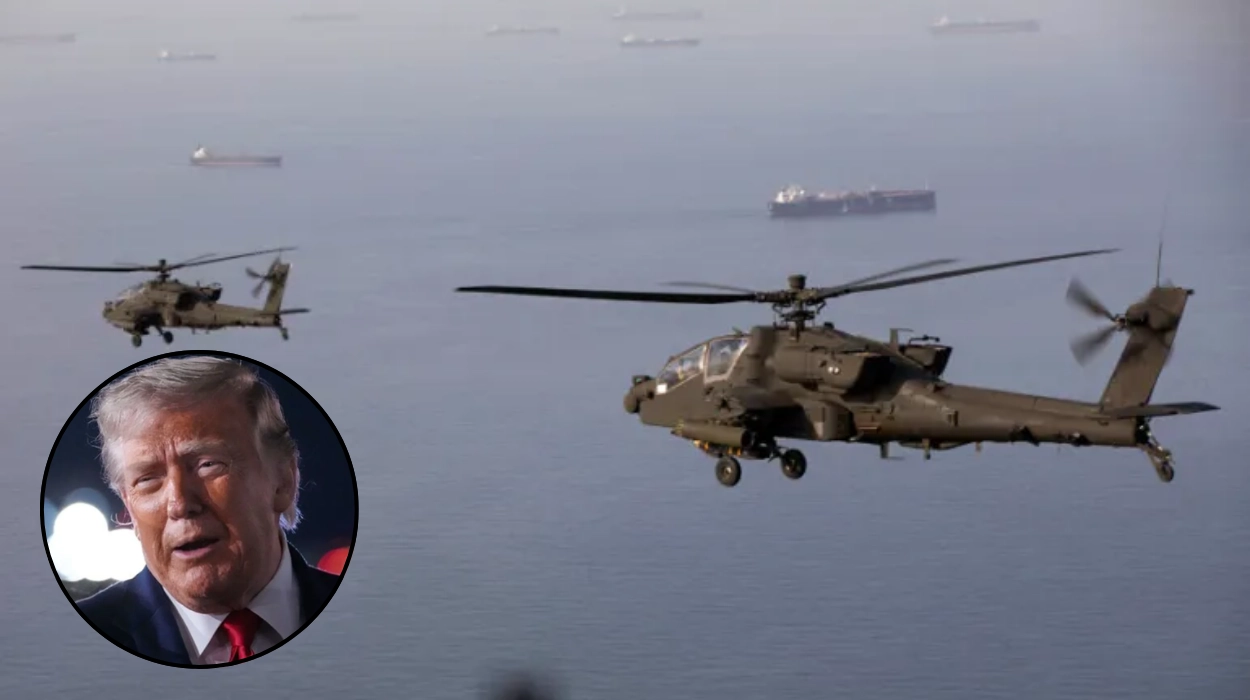
The Strait of Hormuz remains heavily influenced by Iran and is a crucial maritime passage for oil and gas from the Gulf region, which Iran has effectively closed since the onset of the US-Israel conflict against Iran in late February, as Al Jazeera reported. Qeshm Island, strategically located in the Strait of Hormuz, serves as a crucial shipping route for oil and gas from the Gulf region, according to Al Jazeera’s comprehensive analysis. An attacker helicopter flies above the Strait of Hormuz during patrol as the US continues imposing a blockade, according to Dawn News. CENTCOM Releases Images of Apaches ‘Over’ Strait of Hormuz as tensions escalate, according to The Aviationist.
What Does This Mean for Regional Stability?
A direct Iranian attack on US troops appears to be a step up the escalatory ladder, Middle East analysts noted in their coverage. The developments suggest that the recent escalation and conflicts in the Gulf are being framed by Iran as a response to what they describe as “US aggression” against the nation, as Al Jazeera’s Asmig Alruaid reported from Tehran. The spokesperson for the parliament’s National Security Committee stated that the United States comprehends the language of missiles better than that of diplomacy, according to Al Jazeera’s reporting from Tehran. It remains uncertain whether this escalation will completely halt talks or merely pause the exchange of communications between the parties, as Al Jazeera’s reporter noted.
What Is the Current Status of the Helicopter Investigation?
The administration would issue a report later on Tuesday, Trump added, speaking on the runway at John F. Kennedy International Airport, as The Straits Times reported. It was not immediately clear whether the Apache was shot down by Iranian fire, experienced mechanical failure, or encountered some other problem, as The Japan Post noted in its reporting. The cause of the incident remains under investigation, according to CENTCOM’s earlier statement. Speaking on the runway, Trump said there was “nobody injured,” as The Straits Times reported. The administration would issue a report later on Tuesday, he added, according to The Straits Times.
What Message Does This Send to Iran?
Trump has expressed optimism over the possibility of a deal with Iran, while simultaneously vowing response to what he calls an attack, as multiple journalists reported. The President’s dual approach of threatening response while suggesting peace talks could be imminent creates uncertainty about the United States’ actual intentions, according to Middle East analysts. They already agreed ‘re not to have nuclear weapon,” Trump mentioned during an interview on the “Pod Force One” podcast, addressing a key point of contention in the discussions with Iran, as Al Jazeera reported. Iran’s foreign ministry condemned what it termed attacks, asserting violations of ceasefire and international law, placing direct responsibility on Kuwait and Bahrain.
The helicopter incident represents a significant escalation in the already volatile Middle East situation, with President Trump accusing Iran of a direct attack on US military forces while simultaneously suggesting that a peace deal could be signed within days. The unresolved question of whether the helicopter was actually shot down by Iranian fire or experienced mechanical failure adds another layer of complexity to the situation, as journalists from multiple news organizations have reported.
The broader context of Iran-Israel exchanges, US strikes on Iranian territory, and the strained ceasefire since April 6 all contribute to an increasingly dangerous situation that threatens regional stability and global oil supplies through the critically important Strait of Hormuz. An Iranian drone hits Kuwait’s main airport after US strikes Qeshm Island, as Al Jazeera reported on June 3, 2026, marking continued escalation in the region. Tensions in the Gulf region have intensified, with diplomatic efforts yielding minimal results, according to Al Jazeera. Reports from Bahrain and Kuwait indicate assaults attributed to Iran following the US military’s strikes on Iran’s Qeshm Island.