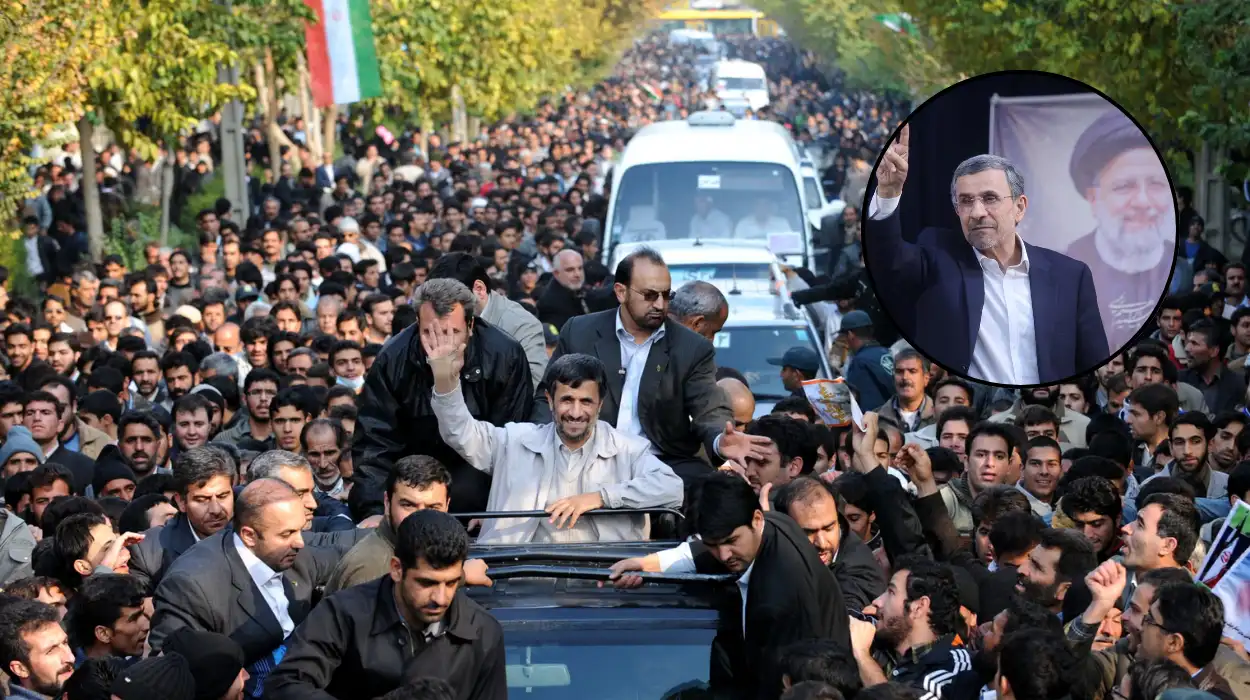
Key Points
- US and Israeli plans reportedly aimed to install former president Mahmoud Ahmadinejad as Iran’s leader, according to a New York Times report.
- An Israeli airstrike on 28 February targeted a security outpost near Ahmadinejad’s home in Narmak, north-east Tehran; satellite imagery confirmed the hit.
- US and Israeli planners allegedly hoped the strike would enable Ahmadinejad to escape house arrest and assert authority, but he reportedly grew uneasy about the operation.
- The episode exposed overestimation of domestic opposition to Iran’s supreme leader and of US–Israeli capacity to effect regime change through airpower.
- President Donald Trump has weighed further strikes to compel Tehran to meet US demands, but postponed action after Gulf leaders intervened.
- Trump stated he had delayed attacks and described his relationship with Benjamin Netanyahu as close, while suggesting military options remained.
- Iran denies Ahmadinejad was under house arrest; Iranian media treated the NYT account with scepticism, though official agencies later reported he suffered minor injuries in the aftermath.
- Ahmadinejad’s past rhetoric against Israel, his later break with Supreme Leader Ali Khamenei, and his attempts to return to politics are detailed; his suitability as an ally for Netanyahu is questioned given his prior Holocaust denial and hostility to Israel.
- The US has enacted a counter-blockade of Iranian ports; Iran’s Revolutionary Guards warn of widening the conflict if attacks resume.
- The episode is presented variously as implausible, disinformation, or evidence of miscalculation by US and Israeli planners.
Washington (Britain Today News) May 20, 2026 — US and Israeli officials considered using an early Israeli airstrike on 28 February to facilitate the release and political ascendancy of former president Mahmoud Ahmadinejad, an episode that has prompted renewed debate over Western attempts to influence Iran’s domestic politics and exposed misjudgements about Tehran’s internal dynamics.
- Key Points
- Why do the New York Times’ revelations matter?
- What exactly happened at Narmak on 28 February?
- What do US officials say about further military options?
- How has Tehran responded to the report and to wider pressure?
- Did the strikes achieve their intended goals?
- What are the regional economic and strategic consequences?
- How do Ahmadinejad’s recent activities complicate the narrative?
- What do experts conclude about disinformation and miscalculation?
Why do the New York Times’ revelations matter?
Planners in both Washington and Jerusalem believed that debilitating strikes against Tehran’s security infrastructure could create enough chaos to free Ahmadinejad from a reported house arrest and position him as a populist alternative to Iran’s current leadership. Baker wrote that
“the strikes were intended, in part, to give Ahmadinejad an opening to challenge the ruling establishment,”
a claim that, if accurate, suggests a far more ambitious set of objectives than previously acknowledged.
What exactly happened at Narmak on 28 February?
Israeli jets struck a security outpost near Ahmadinejad’s residence in the Narmak district of north‑east Tehran. Iranian media initially reported that Ahmadinejad had been killed, but later accounts said he suffered only minor injuries while some of his bodyguards were killed. Iranian state broadcasters gave conflicting accounts, and officials there have since rejected the notion that Ahmadinejad was ever under house arrest. As reported by Peter Baker of the New York Times,
“the building adjacent to his home was hit, producing chaos and speculation about whether the moment would be seized for a power move.”
Could Ahmadinejad realistically have been an Israeli ally?
Ahmadinejad’s record complicates any notion of him as a reliable partner for Israel. His presidency from 2005 to 2013 was characterised by vehement anti‑Israel rhetoric and controversial statements, including Holocaust denial. Yet, after falling out with Iran’s supreme leader, Ali Khamenei, Ahmadinejad recast himself as a critic of the ruling elite and a champion of the poor — positions that some US and Israeli strategists reportedly thought might win him domestic backing. As the New York Times noted,
“his post‑presidential posture was sometimes at odds with hardline Tehran, making him appear, to some foreign planners, as a potential instrument of political disruption.”
What do US officials say about further military options?
President Donald Trump told reporters he had delayed a fresh attack after interventions from Gulf leaders, but did not rule out further strikes. Trump said he had a lengthy phone call with Israel’s prime minister, Benjamin Netanyahu, which included discussions of possible resumption of hostilities. Speaking to the press, Trump said:
“Netanyahu will do whatever I want him to do. He’s a great guy. To me he is a great guy.”
He added that he was not rushing to action but left military options on the table, saying he preferred limited strikes if necessary:
“Ideally I would like to see a few people killed as opposed to a lot. We can do it either way,”
according to the New York Times’ account.
How has Tehran responded to the report and to wider pressure?
Iranian officials and state media have treated aspects of the New York Times account with scepticism. Tehran disputes that Ahmadinejad was under house arrest and highlights inconsistencies in foreign reporting. The Islamic Revolutionary Guard Corps has warned that renewed assaults would broaden the conflict beyond the region, while Iran continues to resist US demands over domestic uranium enrichment and seeks sanctions relief in exchange for halting its blockade of the Strait of Hormuz. The New York Times article underscores Tehran’s view that the US and its partners have misread the balance of domestic forces and overestimated the appetite for an externally encouraged leadership change.
Explore More about World:
Surrey Police Investigate Epstein-Linked Historical Abuse Allegations 2026
Oil Prices Keep Swinging, Stocks Stay Uneasy 2026
Did the strikes achieve their intended goals?
The burst of violence in late February did not produce the regime‑changing outcome some planners hoped for. Analysts quoted in the New York Times suggested the operation demonstrated an overestimation of both internal opposition to Khamenei and the ability of remote strikes to catalyse rapid political realignment. The attack on the Narmak outpost produced confusion and speculation but not the decisive break in Iran’s governance. As reported by the New York Times,
“the episode exposed the limits of airpower to shape complex political outcomes inside a resistant state.”
What are the regional economic and strategic consequences?
In response to the wider confrontation, the US has implemented measures intended to curb Iran’s oil exports, including a counter‑blockade of Iranian ports aimed at stopping shipments largely destined for China. Tehran, whose export revenue depends heavily on oil sales, sees the squeeze as an attempt to force compliance. Gulf leaders’ diplomatic interventions that influenced President Trump’s decision to postpone strikes underscore the fraught calculations regional states face between deterrence, escalation and economic stability.
How do Ahmadinejad’s recent activities complicate the narrative?
Ahmadinejad’s political trajectory — from confrontational president to outsider critic — is central to why some Western planners might have seen him as a variable in Tehran’s politics. After publicly criticising the government, he was arrested in 2018 and repeatedly barred from running in subsequent presidential contests, including 2024. His public positions have softened at times; in 2025 he issued only muted criticism of Israeli strikes on Iran and reportedly visited Hungary to give a talk, a trip described by some observers as signalling a thaw in his posture toward the West. Yet his earlier record of hostility toward Israel and incendiary statements remains an obstacle to any straightforward alignment with Netanyahu’s interests.
What do experts conclude about disinformation and miscalculation?
Commentators and analysts cited in the New York Times warned that the story could reflect either genuine plans or disinformation — possibly circulated by Ahmadinejad allies or intelligence actors — intended to shape public perception. Even if elements of the account are exaggerated, the narrative serves to highlight the fragility of assumptions underlying attempts to engineer political change in Iran. As the New York Times put it, the episode
“revealed more about US and Israeli hopes and misreadings than about immediate prospects for a change in Tehran.”