Key Points
- Volkswagen CEO Oliver Blume warned workers on Tuesday that up to 50,000 more jobs could be cut worldwide, on top of about 50,000 cuts already agreed across the 10-brand VW Group.
- Blume told around 10,000 employees at the Wolfsburg plant that about half of the required adjustments would likely be made in Germany, putting the long-term future of three VW plants and one Audi factory in doubt.
- Volkswagen says continuing operations in Germany “as we have been” would leave the company with a permanent €1.5 billion annual cost disadvantage, with overheads about 30% higher than those of rivals.
- VW Works Council head Daniela Cavallo accused management of poor communication and said trust in the executive board and Blume had been “damaged”.
- IG Metall leader Christiane Benner acknowledged pressure from Chinese competition and US tariffs but called for cost-cutting measures that do not involve job losses and rejected plant closures.
- Volkswagen has flagged Emden, Hannover, Zwickau and Audi’s Neckarsulm plant as unlikely to reach competitive capacity in the 2030s, although no formal closure decisions have been made.
- Any job cuts must be negotiated under Germany’s co-determination system, under which workers hold half the seats on supervisory boards and Lower Saxony also has representation.
- BMW and Mercedes-Benz have moved production to lower-cost Hungary, where operating costs can be up to 70% lower than at their German facilities.
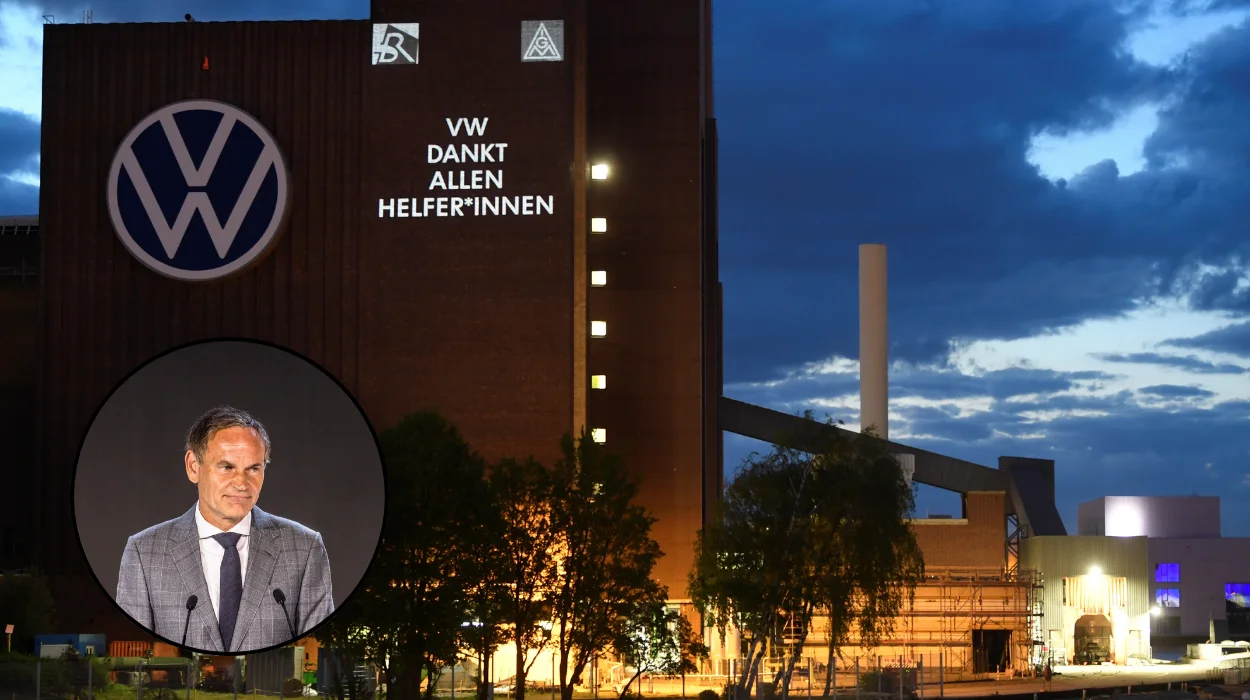
Wolfsburg (Britain Today News) August 25, 2026 – Volkswagen’s chief executive Oliver Blume has told employees to prepare for thousands more job losses as the crisis‑hit carmaker pushes ahead with drastic cost‑cutting to survive intensifying global competition. Speaking before around 10,000 workers at the company’s Wolfsburg factory on Tuesday, Blume said roughly half of the required adjustments would probably be in Germany, while casting fresh doubt on the future of three VW plants and an Audi site.
- Key Points
- What job cuts is Volkswagen planning and how many roles are at risk?
- Why does Volkswagen say Germany is a cost disadvantage?
- Which German plants could be closed or scaled back?
- How have unions and workers reacted to the job‑cut plans?
- What is IG Metall demanding instead of mass layoffs?
- How does co‑determination affect Volkswagen’s restructuring?
- How are rivals like BMW and Mercedes‑Benz responding to cost pressure?
- What role do China and US tariffs play in Volkswagen’s crisis?
- What happens next in Volkswagen’s restructuring process?
What job cuts is Volkswagen planning and how many roles are at risk?
Volkswagen has already agreed to about 50,000 job cuts across its 10‑brand group, mostly at VW, Audi and Porsche, but management now says another 50,000 could be needed worldwide to slash costs and restore competitiveness. Blume stressed that the
“frequently cited figure of around 50,000 jobs worldwide is not a fixed target”
but an indicator derived from the cost gap with rivals, as reported by Reuters. Agreements have already been reached with about 37,000 employees under existing programmes, according to company statements cited by multiple outlets.
Why does Volkswagen say Germany is a cost disadvantage?
Blume warned that if VW “carried on in Germany as we have been”, the company would suffer a permanent annual disadvantage of €1.5bn ($1.75bn), underlining that “we are under real pressure to act”. In an earlier interview seen by Reuters, he said Volkswagen’s overhead costs were about 30% above those of competitors, making big structural changes unavoidable. The CEO framed the situation as “more than critical”, telling staff the car sector’s problems would only intensify in coming years.
Which German plants could be closed or scaled back?
Management has flagged four German sites as unlikely to reach competitive capacity utilisation in the 2030s: VW plants in Emden, Hannover and Zwickau, plus Audi’s Neckarsulm factory. Blume told workers there was “no decision yet on specific plant closures”, describing closures as a “last and most expensive resort”, but added he could not currently see a way for those sites to remain profitable beyond the 2030s. The group already shut its “Transparent Factory” in Dresden in December 2025, the first domestic vehicle plant closure in its 88‑year history, according to company‑linked reports.
How have unions and workers reacted to the job‑cut plans?
Unions have accused VW of failing to be straight with workers after the latest plans appeared in the media before being communicated internally. VW Works Council head Daniela Cavallo said in an intranet post that “relevant information” on how the cuts would fall “was unfortunately still lacking” and that Blume had “missed his chance to explain things as they are”. Cavallo added that
“our trust in this company’s executive board, and especially in its CEO Oliver Blume, has been damaged – not yet beyond repair, but damaged nonetheless”.
According to excerpts shared by the works council.
What is IG Metall demanding instead of mass layoffs?
IG Metall union leader Christiane Benner, in a radio interview, acknowledged the difficulties created by Chinese competition and US tariffs but advocated cost‑cutting measures other than job losses. Benner has called the prospect of another 50,000 job cuts a “hard provocation”, rejected plant closures and questioned management’s ambition of achieving an operating return on sales of around 9%, as reported by industry outlets. She insisted that German factories remained “an integral part” of the group and demanded concrete proposals rather than broad warnings.
How does co‑determination affect Volkswagen’s restructuring?
Any cuts at Volkswagen must be negotiated rather than imposed, setting up protracted and difficult talks under Germany’s co‑determination system. Labour representatives hold half the seats on supervisory boards at large companies, giving unions significant leverage over restructuring plans. The German state of Lower Saxony – a shareholder that is home to several VW plants including Wolfsburg – also holds seats on the board, further complicating any push for rapid closures or imposed layoffs.
How are rivals like BMW and Mercedes‑Benz responding to cost pressure?
Other carmakers have warned that German auto plants need to learn to do more with less as pressure has risen from Chinese brands and US tariffs. BMW opened a new plant in Hungary last year, where costs are lower, and Mercedes‑Benz unveiled an extension to its Hungarian Kecskemét plant last month, making it the firm’s largest in Europe. Mercedes‑Benz CEO Ola Källenius said last month there was a cost gap of about 70% between the company’s Hungarian and German operations, underlining the competitive challenge for German‑based production.
Explore More about the World:
France and Saudi Arabia Confirm €6bn Dragon Ball Theme Park Near Paris
French Council Defends Right to Conscientious Objection for Catholics and Pharmacists as Euthanasia Law Begins
What role do China and US tariffs play in Volkswagen’s crisis?
Volkswagen has struggled with Chinese competition, US tariffs and patchy demand in Europe, including for its electric vehicles, according to multiple reports. Collapsing sales in China have started to look less like a blip and more like the new normal, even as Chinese competitors such as Chery and BYD gain market share in Europe. Blume has positioned hard decisions on job cuts and capacity as necessary for survival in the face of these global headwinds.
What happens next in Volkswagen’s restructuring process?
Blume is holding a series of staff meetings at Wolfsburg, Zwickau and Emden to explain the company’s plans and defend the savings programme. The next major milestone is a supervisory board meeting where the restructuring package will be scrutinised by labour, management and Lower Saxony representatives. Negotiations are expected to be lengthy, with unions pushing for alternatives to mass layoffs and plant closures while management insists deep cuts are essential to close the cost gap with rivals.