Key Points
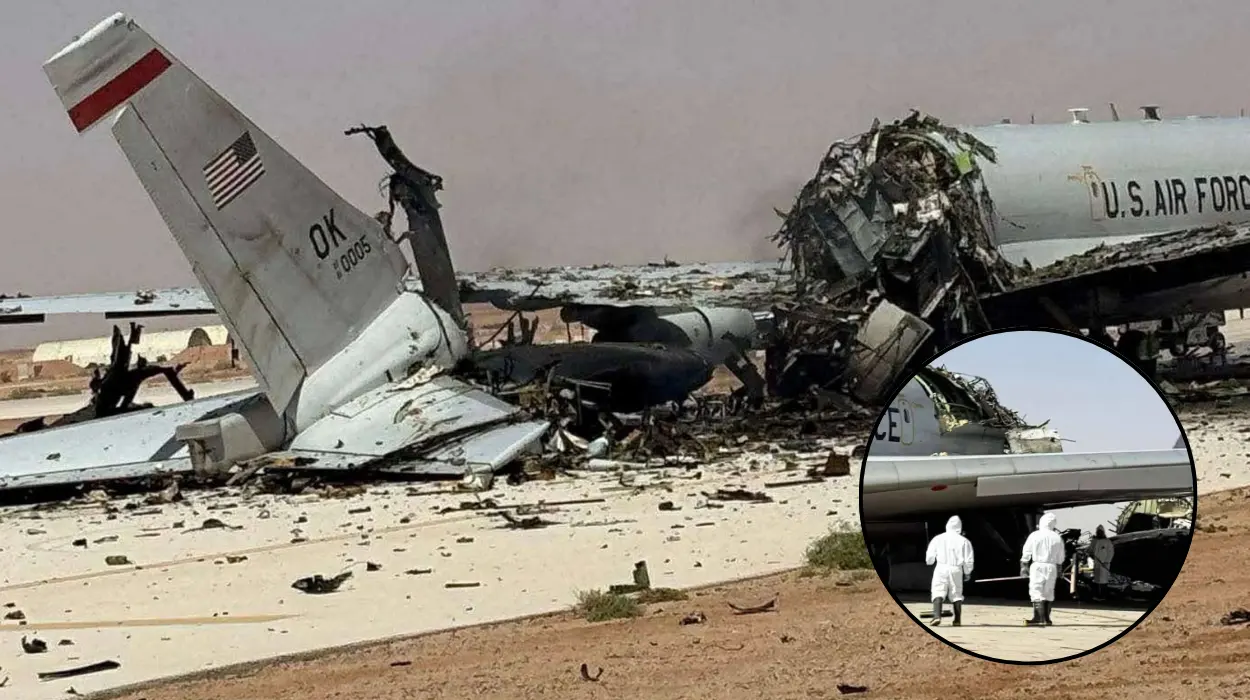
- A US E-3 Sentry AWACS aircraft was destroyed in an Iranian strike at Prince Sultan Airbase in Saudi Arabia on 27 March 2026.
- Several US personnel were injured and other aircraft, including refuelling tankers, sustained damage.
- Ukraine alleged that a Russian satellite photographed the base before the attack, implying Moscow’s possible intelligence sharing with Tehran.
- The US E-3 fleet, built in the 1960s, is ageing and suffering from low mission readiness rates.
- Experts described the plane’s loss as a major blow to US air surveillance capacity in the region.
- Iran’s action raises renewed concerns about its ability to strike precise, high-value targets amid Western air campaigns.
- Russia denied any role in assisting Iran, while analysts suggest the attack signals Tehran’s strategy to target key enablers of US airpower.
- Satellite imagery and witness reports show the missile hit the E-3’s radar dome directly, indicating pinpoint accuracy.
- The event is expected to heighten regional tension, testing US deterrence policy and Saudi defence preparedness.
Riyadh (Britain Today News) March 31, 2026 — The destruction of a United States Air Force E-3 Sentry airborne warning and control system (AWACS) aircraft in an Iranian missile attack on the Prince Sultan Airbase in Saudi Arabia has sent shockwaves through defence circles and reignited debate about Tehran’s growing long-range strike capabilities.
- Key Points
- How did the strike unfold?
- What was Ukraine’s role in exposing Russian involvement?
- What does the attack reveal about Iran’s missile precision?
- Why is the loss of the E-3 significant for US operations?
- Did the strike mark an escalation in Iran’s regional campaign?
- How are the US and Saudi Arabia responding?
- What could happen next?
According to US military officials cited by The Guardian, the strike occurred on 27 March, damaging multiple aircraft and injuring a number of service members. Satellite photos emerging online show the distinctive radar dome of the E-3 shattered — a direct hit that suggests a high degree of precision.
How did the strike unfold?
The missile assault was part of a continuing escalation following weeks of US and Israeli air operations against Iranian targets across the region. The E-3 Sentry, parked on the tarmac when struck, was one of six such aircraft temporarily stationed at the base as part of routine rotational deployment in the Gulf.
Analysis by Air and Space Forces reported that the E-3 fleet has long faced maintenance difficulties, with mission-capable rates in 2024 dropping to just 56%. Each E-3 acts as an “airborne command post,” guiding fighters and monitoring threats over a wide area. The loss of one further shrinks America’s limited reconnaissance capacity in the region.
Heather Penney, Director of Studies and Research at the Mitchell Institute for Aerospace Studies, told Air and Space Forces that
“the loss of this E-3 is incredibly problematic, given how crucial these battle managers are to everything from airspace deconfliction, targeting, and providing other effects across the battle space.”
What was Ukraine’s role in exposing Russian involvement?
In a sharp twist, Ukrainian President Volodymyr Zelenskyy claimed that his country’s intelligence services had detected Russian satellite activity over the Saudi base before the strike. Speaking to reporters in Kyiv, he said the satellite had photographed the airbase on 20, 23, and 25 March, just days before the attack occurred.
“We know that if they make images once, they are preparing. If they make images a second time, it’s a simulation. The third time means that in one or two days, they will attack,”
Zelenskyy stated, accusing Moscow of sharing imagery with Tehran.
These claims echo earlier reports that alleged intelligence cooperation between Russia and Iran in the Middle East. However, Russia’s Foreign Minister Sergei Lavrov vehemently denied any such link, describing the accusations as “groundless political theatre.”
What does the attack reveal about Iran’s missile precision?
Experts observing imagery of the strike told Reuters that the projectile appeared to have hit the E-3’s radar dome directly — the most valuable part of the aircraft — leaving the tail section and fuselage mangled. This indicates Iran’s growing mastery of precision-guided munitions capable of targeting isolated assets across hundreds of kilometres.
According to analysts at the International Institute for Strategic Studies (IISS), the attack demonstrates Tehran’s shifting strategy after suffering significant infrastructure losses under Western bombardment.
“We are seeing a move away from saturation fire towards selective, high-precision engagements,”
said Dr Ali Ansari, a senior research fellow at IISS.
Why is the loss of the E-3 significant for US operations?
The destroyed aircraft was one of only 16 operational E-3s worldwide. Its absence is expected to weaken the US’s ability to detect aerial threats and manage complex air operations across the Middle East.
Each E-3 can monitor up to 600 simultaneous targets, providing real-time situational awareness to pilots and ground controllers. Its destruction therefore deprives US Central Command (CENTCOM) of one of its most crucial surveillance platforms.
Military historian Dr Thomas Withington told BBC Defence Correspondent Jonathan Beale that the episode
“marks a symbolic and tactical setback for US airpower, exposing vulnerabilities in its forward-deployed assets that few assumed would be reachable.”
Did the strike mark an escalation in Iran’s regional campaign?
Pentagon analysts noted that while Iran’s pace of missile launches had slowed after intense raids earlier in the year, the precision and timing of this latest strike revealed deliberate resource management. Tehran seems to be conserving its arsenal while reserving capacity for higher-impact, symbolic attacks.
As quoted by The Washington Post, a senior US defence official said the strike was
“likely intended to send a political message as much as achieve a tactical gain.”
The official added,
“Iran wants to show that despite our pressure, it holds the upper hand in choosing the time and place of escalation.”
With Israeli and US air raids reportedly damaging numerous Iranian missile storage sites, Tehran’s redirection toward sabotage and selective targeting suggests a long-term strategic adaptation.
How are the US and Saudi Arabia responding?
US Central Command stated that an investigation is underway into the base’s defences and intelligence warning systems. The Saudi defence ministry has tightened airspace restrictions and radar surveillance around its southern and eastern installations.
A CENTCOM spokesperson declined to comment on operational details but confirmed that
“measures are being implemented to prevent recurrence of such an incident.”
Regional observers noted that the strike has intensified calls within Washington to accelerate the retiring of the ageing E-3 fleet in favour of the newer E-7 Wedgetail, which uses more advanced radar and electronic systems.
What could happen next?
Strategic analysts warn that the episode may trigger a new wave of reciprocal strikes. Tehran views the attack as retaliation for US and Israeli operations earlier this month that killed several senior Iranian commanders in Syria.
According to independent journalist Elisabeth Blunt, writing for The Guardian,
“the destruction of the E-3 underscores how Iran is methodically eroding Western reconnaissance and air management capacity — a sophisticated and patient counter-strategy.”
Both Washington and Riyadh have vowed to restore deterrence, but the incident amplifies uncertainty in a volatile region where even a single miscalculation could ignite wider conflict.