Key Points
- Iran fired a barrage of ballistic missiles at American forces in the Middle East after the United States and Saudi Arabia jointly struck Iranian-backed militias inside Iraq.
- At least 20 fighters were killed and 32 wounded in the overnight US-Saudi strikes on eastern Iraq, according to the Popular Mobilisation Forces.
- Six Iranian military advisers were also killed in the strikes, two Iraqi militia officials said.
- Iran’s Revolutionary Guard said it fired ballistic missiles at Jordan’s Muwaffaq Salti Air Base, a key US military hub in the region.
- Jordan’s military confirmed it intercepted and destroyed five Iranian missiles.
- Drone strikes set fire to two natural gas vessels at Egypt’s Damietta port; responsibility has not been established.
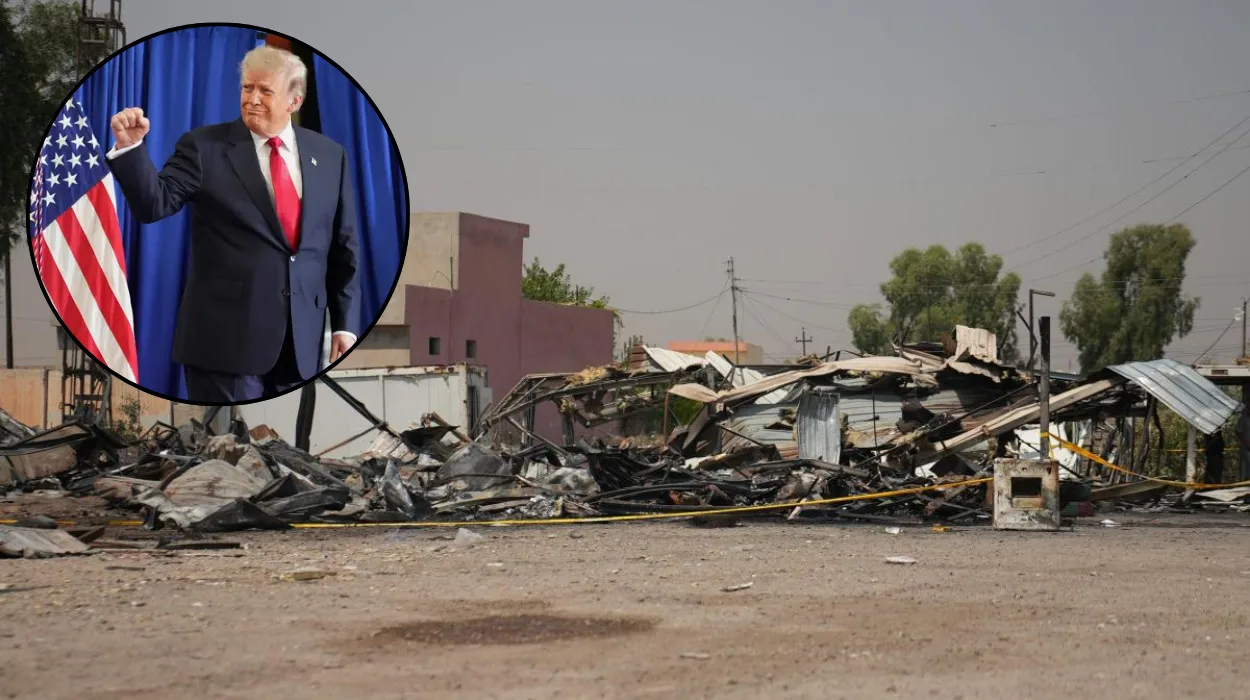
- President Donald Trump said the United States would “hit back hard” and would strike Iranian interests “very hard”.
- Saudi Arabia accused Iraqi militias of drone attacks on its oil facilities over the preceding two days.
- Yemen’s Houthi rebels claimed a separate attack on Saudi energy facilities.
- Iraq’s presidency and National Security Council condemned the US-Saudi strikes as a violation of Iraqi sovereignty.
- Mediators had been working to revive a collapsed ceasefire before the latest escalation.
- Brent crude oil prices jumped 3.1% to 84.58 dollars a barrel following the flare-up.
Baghdad (Britain Today News) July 29, 2026 — Iran has launched a barrage of missiles at American forces stationed across the Middle East, after the United States joined forces with Saudi Arabia to strike Tehran-backed militias inside neighbouring Iraq, killing at least 20 fighters in the process. The overnight escalation, coming after several days of relative calm, has reignited fears of a wider regional war and further complicated efforts to end a five-month conflict that has already rattled global energy markets and stretched American military resources thin.
- Key Points
- What happened in the overnight missile and air strikes?
- Who was killed in the US-Saudi strikes on Iraq?
- What happened at the Egyptian port of Damietta?
- Why did Iran launch missiles at Jordan’s Muwaffaq Salti Air Base?
- How did Jordan respond to the missile attack?
- What did President Trump say about the escalation?
- Why did Saudi Arabia accuse Iraqi militias of drone attacks?
- How did the Houthi rebels factor into the escalation?
- What is the status of the ceasefire negotiations?
- How did the Iraqi government react to the strikes?
- What impact has the escalation had on oil prices?
- What are the wider implications of the escalation?
What happened in the overnight missile and air strikes?
The exchange began when American and Saudi fighter aircraft struck multiple logistics hubs and weapons depots in eastern Iraq. The strikes were described by the US military as a direct response to alleged drone attacks on Saudi energy infrastructure carried out over the previous two days. In turn, Iran’s paramilitary Revolutionary Guard confirmed it had fired ballistic missiles at American forces stationed in the region, framing the move as retaliation. The rapid back-and-forth marked one of the most serious escalations in months and raised concerns that a fragile period of calm was unravelling fast.
Who was killed in the US-Saudi strikes on Iraq?
The Popular Mobilisation Forces, a coalition made up primarily of Shiite, Iran-backed armed groups that operates nominally under the command of the Iraqi military, said at least 20 of its fighters were killed and a further 32 wounded in the overnight strikes. Separately, two Iraqi militia officials said six Iranian military advisers were also killed in the same strikes, underlining the direct involvement of Iranian personnel embedded with the militias operating on Iraqi soil.
The Popular Mobilisation Forces trace their origins to the fight against the so-called Islamic State group, which they joined after the extremist organisation seized large swathes of Iraqi territory in 2014. The Iraqi government has since designated the coalition an “independent military formation” within its official armed forces, though in practice many of the constituent militias retain significant operational autonomy — autonomy that has, on previous occasions, extended to attacks on American facilities in the country.
What happened at the Egyptian port of Damietta?
Away from Iraq, drone strikes ignited fires on two natural gas vessels docked at the Egyptian port of Damietta, according to Ambrey, a British maritime security firm that monitors shipping risk in the region. The vessels targeted were a US-owned floating storage facility and a Greek-owned tanker. No injuries were reported in connection with the fires. It was not immediately clear who was responsible for the strikes, and no group had claimed the attack at the time of writing, leaving a significant gap in the emerging picture of who is driving the wider campaign against energy infrastructure across the region.
Why did Iran launch missiles at Jordan’s Muwaffaq Salti Air Base?
According to a statement carried by Iran’s state-run IRNA news agency, the Revolutionary Guard said it had fired ballistic missiles specifically at Jordan’s Muwaffaq Salti Air Base, which serves as a key hub for US military operations in the region. The choice of target underscores the extent to which American basing arrangements across multiple countries — not just inside Iraq — have become potential flashpoints in the broader confrontation between Washington and Tehran.
How did Jordan respond to the missile attack?
Jordan’s military said that five Iranian missiles had been intercepted and destroyed before they could strike their intended target. The successful interception prevented what could have been a significant escalation on Jordanian soil, though the incident nonetheless demonstrates the geographic spread of the conflict beyond Iraq and the Gulf, drawing in a country that has traditionally sought to avoid direct entanglement in Iran-US hostilities.
What did President Trump say about the escalation?
A Fox News reporter said on air that he had spoken with President Donald Trump, who, using a series of vulgarities, told him that the United States would hit back hard in response to the Iranian attacks. Later, during an event in the Oval Office, President Trump was asked directly whether Iran was responsible for the strikes on the natural gas vessels at Damietta. He replied:
“It’s a little more of the same.”
President Trump went on to suggest that the situation would soon stabilise, stating:
“It’s going to be straightening out.”
He added a pointed warning aimed at Tehran:
“In the meantime, we’re going to be hitting them very hard because it’s our turn to hit them. They know it’s coming. They’re asking us not to do it.”
The remarks suggest the administration views the current exchange as part of an ongoing cycle of retaliation rather than an isolated incident, and that further American strikes against Iranian interests may follow in the coming days.
Why did Saudi Arabia accuse Iraqi militias of drone attacks?
Saudi Arabia had accused Iraqi militias of firing drones at its oil facilities over the two days preceding the US-Saudi strikes, framing the Iraqi strikes as a direct and proportionate response. An umbrella group representing the Iraqi militias initially denied the allegations, disputing Saudi Arabia’s account of events and rejecting responsibility for the drone attacks on Saudi soil.
The Saudi Defence Ministry, for its part, issued a statement making clear that it
“does not seek escalation but will respond to any aggression,”
a formulation intended to present the kingdom’s strikes as defensive rather than as an opening move in a wider campaign, even as the practical effect has been to draw Riyadh further into the confrontation.
How did the Houthi rebels factor into the escalation?
Adding a further layer of complexity, Yemen’s Houthi rebels — another Iran-backed armed group, though separate from the Iraqi militias — said they had themselves attacked Saudi energy facilities. The Houthis characterised this as part of a related but distinct conflict, illustrating how multiple Iranian-aligned actors across different countries appear to be operating in parallel against Saudi and American interests, even where their campaigns are not formally coordinated.
The overlapping claims from the Iraqi militia umbrella group and the Houthis have made it more difficult for outside observers to establish a clear chain of responsibility for the string of attacks on Saudi energy infrastructure, complicating any potential diplomatic response.
What is the status of the ceasefire negotiations?
Before this latest eruption of violence, mediators had expressed cautious optimism about the prospects of bringing the United States and Iran back to the negotiating table. An interim agreement between the two sides had collapsed in recent weeks amid renewed fighting in the Strait of Hormuz — a critical waterway for global energy supplies that Iranian attacks have once again effectively closed to shipping.
A regional official said that mediators are “still trying with both sides” to restore calm and to get the collapsed ceasefire back on track, suggesting that diplomatic channels remain open even as the military situation on the ground continues to deteriorate. Whether the latest strikes and counter-strikes will derail those efforts entirely, or simply delay them, remains to be seen.
How did the Iraqi government react to the strikes?
The office of Iraqi President Nizar Amidi condemned Wednesday’s US-Saudi air strikes in strong terms, describing them as
“an unacceptable attack and a blatant violation of Iraq’s sovereignty, targeting its official security institutions.”
The statement reflects growing frustration within the Iraqi government at being caught between the competing interests of Washington, Riyadh and Tehran, even as fighting continues to take place largely on Iraqi territory.
Iraq’s National Security Council went further, issuing its own condemnation of the strikes. In a statement, the council said the strikes had been carried out
“while the Iraqi government was in contact with relevant parties to investigate and address all the concerns raised by the Saudi and American sides,”
suggesting that Baghdad believed diplomatic engagement was still under way at the very moment the strikes took place. The council added that “a number of innocent people” had been killed and wounded in the attacks, a claim that adds a further dimension to the mounting casualty toll from the overnight violence.
Explore More about World:
Mahama urges fast passage of public officers bill
Florida Pastor Sues OpenAI Over Near-Fatal ChatGPT Health Advice
What impact has the escalation had on oil prices?
The renewed hostilities sent global oil prices sharply higher, with Brent crude, the international benchmark, jumping 3.1% to reach 84.58 dollars a barrel. The price spike reflects mounting concern among traders that the conflict could further disrupt supply routes through the Strait of Hormuz and beyond, at a time when the broader five-month conflict has already jolted the world economy.
Analysts have long warned that any disruption to shipping through the strait — through which a significant proportion of the world’s seaborne oil passes — carries the potential to push energy prices sharply higher, with knock-on effects for consumers and businesses far beyond the immediate region.
What are the wider implications of the escalation?
The flare-up across multiple fronts — Iraq, Jordan, the Red Sea and Egyptian waters — after several days of relative calm has raised the risk of a return to all-out war between Iran and the United States and its regional partners. It has also underscored the sheer difficulty of winding down a conflict that has already run for five months, disrupted the global economy, and proven increasingly unpopular among the American public.
The renewed fighting is also likely to add to concerns within US defence circles that American forces are further drawing down already diminished stockpiles of sophisticated munitions needed to defend bases and allies across the region. With multiple simultaneous fronts now active — from Iraqi territory to Jordanian airspace to Egyptian waters — the strain on American logistics and matériel is expected to intensify should the cycle of strikes and counter-strikes continue.
For now, both the diplomatic track and the military escalation appear to be running in parallel, with mediators continuing their efforts even as strikes continue on the ground. How the two tracks interact in the days ahead is likely to determine whether the region moves back towards a fragile calm or further towards the all-out conflict that officials on multiple sides say they wish to avoid.