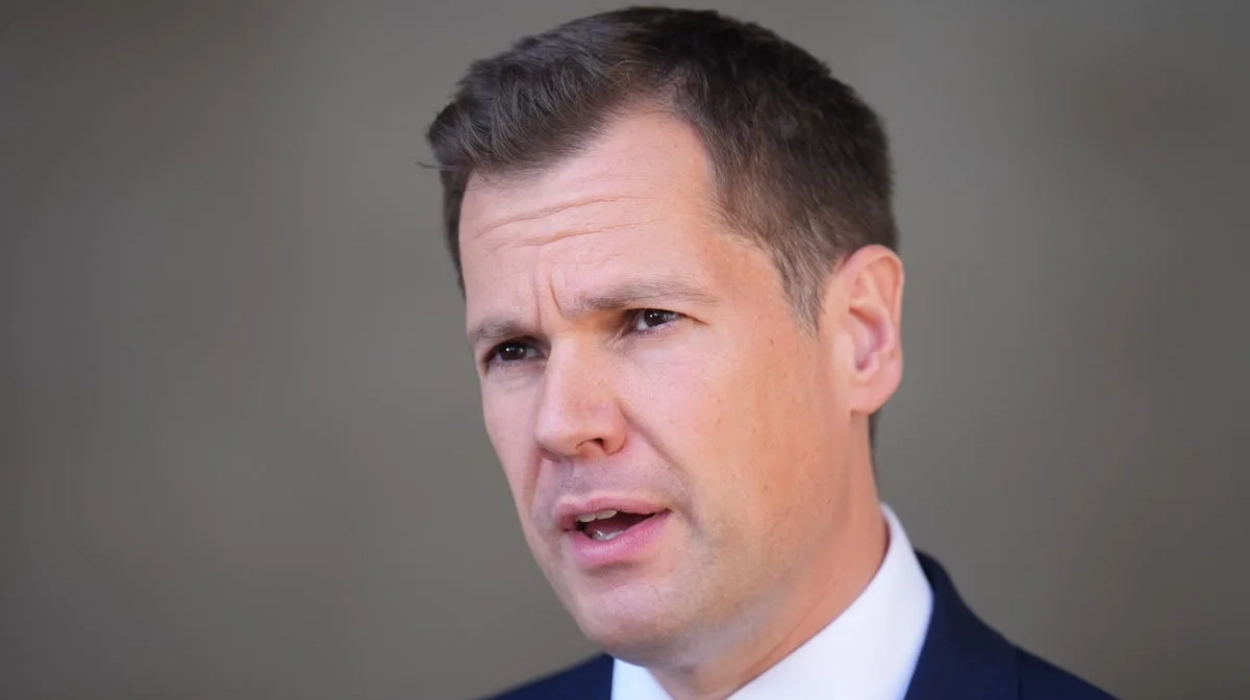
Robert Jenrick is the Member of Parliament for Newark and the Treasury spokesperson for Reform UK. He joined Reform UK in January 2026 after serving as a Conservative MP since 2014. Jenrick has held senior government roles under three prime ministers and is now positioned as Reform UK’s pick for Chancellor of the Exchequer. His shift from the Conservative Party to Reform UK marks one of the most significant defections in recent British politics and has driven policy realignment across immigration, justice, welfare, and the economy.
- Who Is Robert Jenrick?
- What Is Robert Jenrick’s Political Background?
- Why Did Robert Jenrick Join Reform UK?
- What Role Does Robert Jenrick Hold in Reform UK?
- What Are Robert Jenrick’s Key Policy Positions?
- How Has Robert Jenrick’s Immigration Stance Evolved?
- What Controversies Has Robert Jenrick Faced in 2026?
- What Is Robert Jenrick’s Relationship With Nigel Farage?
- What Impact Could Robert Jenrick Have on UK Politics?
Who Is Robert Jenrick?
Robert Edward Jenrick, born 9 January 1982 in Wolverhampton, is the MP for Newark, a solicitor by training, and Reform UK’s Treasury spokesperson since February 2026, after 12 years as a Conservative MP. He studied history at St John’s College, Cambridge, then political science at the University of Pennsylvania. He qualified as a solicitor in 2008 before entering politics.
Jenrick won the Newark by-election on 5 June 2014 with a majority of 7,403 votes, replacing Patrick Mercer, who resigned following a cash-for-lobbying scandal. Newark is a constituency in Nottinghamshire, England. Jenrick has represented it continuously since his by-election victory, retaining the seat in subsequent general elections, including 2024.
Before his defection to Reform UK, Jenrick built a reputation as a senior Conservative figure with experience across the Treasury, housing, health, and immigration briefs. This breadth of ministerial experience distinguishes him from many other MPs who defected to Reform UK, most of whom did not hold equivalent cabinet-level government experience.
What Is Robert Jenrick’s Political Background?
Jenrick held four ministerial posts under Conservative prime ministers: Exchequer Secretary to the Treasury (2018–2019), Secretary of State for Housing, Communities and Local Government (2019–2021), Minister of State for Health (2022), and Minister of State for Immigration (2022–2023).
As Exchequer Secretary to the Treasury under Theresa May, Jenrick worked on tax and spending matters within HM Treasury, the UK government department responsible for public finances. He then served as Secretary of State for Housing, Communities and Local Government under Boris Johnson from 24 July 2019 to 15 September 2021, overseeing planning policy, local government funding, and housing supply targets.
In September 2022, under Liz Truss, Jenrick briefly served as Minister of State for Health before moving to the Home Office as Minister of State for Immigration on 25 October 2022 under Rishi Sunak. He held the immigration brief until 6 December 2023, when he resigned. Jenrick stated his resignation followed disagreements with the government’s Rwanda asylum plan, a policy under which asylum seekers arriving in the UK would be relocated to Rwanda for processing. He argued the plan did not go far enough to reduce illegal immigration.
After Labour’s victory in the 2024 general election, Jenrick contested the Conservative Party leadership. He came second in the members’ vote on 9 October 2024, receiving 41,388 votes (43.5%) against Kemi Badenoch’s 53,806 votes (56.5%). Badenoch became Conservative Party leader and appointed Jenrick as Shadow Secretary of State for Justice and Shadow Lord Chancellor, a role he held from 4 November 2024 until 15 January 2026.
Why Did Robert Jenrick Join Reform UK?
Jenrick defected to Reform UK on 15 January 2026 after Conservative leader Kemi Badenoch dismissed him from the shadow cabinet, removed the party whip, and suspended his membership upon discovering his defection plans. Badenoch learned of the plan through leaked copies of his resignation speech and an internal media strategy document.
Reform UK is a British political party founded in 2018, originally as the Brexit Party, and relaunched under its current name in 2021. Nigel Farage has led the party since 2024. Jenrick’s move followed four days after fellow Conservative Nadhim Zahawi announced his own defection to Reform UK, suggesting a coordinated wave of departures from the Conservative Party in early 2026.
Reports at the time described internal Reform UK communications referring to Jenrick as “the new sheriff in town,” with aides characterizing his move as the largest defection story in the party’s history. Jenrick had previously criticized senior Conservative colleagues, including Mel Stride and Priti Patel, over their handling of welfare reform and immigration policy while those areas were under Conservative government control. Badenoch publicly dismissed Jenrick following the defection, stating it was not a loss for the party.
What Role Does Robert Jenrick Hold in Reform UK?
Jenrick serves as Reform UK’s Treasury spokesperson, a position confirmed on 17 February 2026, and has been named the party’s selected candidate for Chancellor of the Exchequer if Reform UK wins the next UK general election. The Chancellor of the Exchequer is the UK government minister responsible for economic and financial policy, including taxation and public spending.
Jenrick’s Voting Record Since Joining Reform UK
On 4 February 2026, Jenrick voted alongside fellow Reform UK MP Suella Braverman in favor of a government bill to restrict Universal Credit, a UK welfare payment that combines several benefits into a single monthly payment for working-age households. This vote indicated alignment between Reform UK’s welfare stance and government-backed restrictions on benefit eligibility.
Jenrick’s Public Profile Within Reform UK
Polling by YouGov, a British market research and data analytics firm, identified Jenrick as the top pick among Conservative Party members to succeed Badenoch, even after his departure from the party. Within Reform UK, Jenrick has stated publicly and repeatedly that he supports Farage’s leadership and has no ambitions to challenge for the top position, despite continued media speculation about his long-term prospects.
What Are Robert Jenrick’s Key Policy Positions?
Jenrick’s core policy positions center on 3 areas: immigration enforcement, judicial and sentencing reform, and reduced public spending, including a proposed £47 billion cut announced under Conservative policy platforms he helped shape. These positions have carried over into his current role advising Reform UK’s economic and enforcement agenda.
Immigration Policy
Jenrick has called for stricter enforcement of immigration rules, including the deportation of foreign nationals who fail to meet economic contribution tests. While serving as Shadow Justice Secretary, he proposed abolishing the Judicial Appointments Commission, the independent body responsible for selecting judges in England and Wales, and transferring appointment powers to the Lord Chancellor, the cabinet minister responsible for the courts system. He also proposed abolishing existing immigration tribunals, the specialist courts that hear appeals on asylum and immigration decisions.
In May 2026, a public disagreement emerged between Jenrick and Zia Yusuf, Reform UK’s home affairs spokesperson, over deportation policy. Jenrick stated in a broadcast interview that a Reform UK government would not deport foreign nationals solely for living in social housing, provided they met other legal residency requirements. Yusuf publicly contradicted this position on social media, stating that any foreign national in social housing at taxpayer expense would fail Reform UK’s economic test and face deportation. This exchange illustrated internal inconsistency within Reform UK’s immigration proposals as the party refined its platform ahead of a general election.
Judicial and Sentencing Reform
As Shadow Justice Secretary, Jenrick campaigned to abolish the Sentencing Council, the independent, non-departmental public body responsible for issuing sentencing guidelines to courts in England and Wales. He argued the council’s 2023 guidance, which advised judges to consider an offender’s ethnic, cultural, or faith background when deciding whether to request a pre-sentence report, created unequal treatment under the law. The disputed guidance was withdrawn following political pressure, and the government subsequently passed legislation requiring ministerial approval for future sentencing guidance changes.
Jenrick also proposed removing judges found to engage in political activism from the bench, assigning investigative powers to the Judicial Conduct Investigations Office, the body that examines complaints against judges in England and Wales. He additionally sought legislation compelling the government to publish quarterly crime statistics broken down by offender nationality, visa status, and immigration status, citing similar data practices in Denmark.
Economic and Welfare Policy
Jenrick’s stated economic principles, first published in August 2024, describe a preference for market-driven economic growth and a smaller state. As Reform UK’s Treasury spokesperson, he supports proposals to reduce public spending by approximately £47 billion and to establish a dedicated removals enforcement force modeled on the United States Immigration and Customs Enforcement agency, a US federal agency responsible for immigration enforcement.
How Has Robert Jenrick’s Immigration Stance Evolved?
Jenrick was initially viewed as a centrist Conservative aligned with former prime minister David Cameron’s policy approach, before adopting increasingly restrictive immigration positions from 2024 onward, particularly during his Conservative leadership campaign. This shift accelerated after his December 2023 resignation as Immigration Minister over the Rwanda asylum plan.
Media coverage from 2024, including reporting by The Guardian, described Jenrick’s transformation from a self-identified “Cameron Remainer” to a vocal immigration hardliner. In January 2025, ahead of a parliamentary vote on a national inquiry into group-based child sexual exploitation cases, Jenrick linked the rise in such cases to what he described as mass migration into the UK. Opposition politicians, including Liberal Democrat Deputy Leader Daisy Cooper, criticized these remarks as an attempt to exploit the issue politically. Jenrick’s office described the criticism as a distraction from child protection concerns.
By the time of his Reform UK defection in January 2026, Jenrick’s public policy platform closely mirrored the party’s existing hardline immigration stance, which had been a defining feature of Reform UK’s political identity since Farage assumed leadership in 2024.
What Controversies Has Robert Jenrick Faced in 2026?
Jenrick faced scrutiny in July 2026 after confirming on national broadcast interviews that George Cottrell, a convicted fraudster and Farage’s long-standing aide, funded Farage’s staff, security, and housing before Farage became an MP in 2024. The disclosures triggered a referral to the Parliamentary Commissioner for Standards.
George Cottrell is a British former UK Independence Party volunteer who was convicted of wire fraud in the United States in 2017. Reporting by The Sunday Times, published on 5 July 2026, stated that Cottrell recruited and paid three staff members to manage Farage’s social media output before the 2024 general election and allowed Farage to stay in a five-storey Georgian townhouse near Buckingham Palace that Cottrell rented in Westminster.
Jenrick, appearing on the BBC’s Sunday with Laura Kuenssberg program and on Sky News, confirmed the core facts of the Sunday Times report. He stated that no parliamentary rules were broken because the financial support occurred before Farage became a Member of Parliament, and that personal friends are permitted to provide gifts of this nature without disclosure obligations under the rules applicable at the time. Under those rules, new MPs were required to register gifts worth more than £300 received in the preceding 12 months, except where a gift could not reasonably be linked to their political activity.
Liberal Democrat MP Josh Babarinde formally referred Farage to the Parliamentary Commissioner for Standards over the non-disclosure. Labour Health Secretary James Murray described Farage’s approach to financial transparency as inconsistent. Jenrick, in response to media questioning about the story, characterized the coverage as an attempt to distract from what he described as public dissatisfaction with the two main parties, rather than addressing the substance of the disclosure directly.
What Is Robert Jenrick’s Relationship With Nigel Farage?
Jenrick serves directly under Nigel Farage, Reform UK’s leader since 2024, as the party’s Treasury spokesperson and prospective Chancellor of the Exchequer, and has publicly defended Farage during the 2026 financial disclosure controversy involving George Cottrell. Nigel Farage is a British politician who co-founded the Brexit Party in 2018 and has led Reform UK since taking over the party leadership in 2024.
Jenrick’s defection strengthened Reform UK’s parliamentary presence by adding a former cabinet minister with direct experience in housing, health, treasury, and immigration policy. In return, Farage’s leadership team elevated Jenrick to one of the party’s most prominent frontbench roles within one month of his arrival. During the July 2026 Cottrell disclosures, Jenrick consistently defended Farage’s conduct in broadcast interviews, describing Cottrell as an old personal friend of Farage’s rather than a formal party affiliate.
Explore More about Politics:
Who Is Morgan McSweeney? Power Behind Labour’s Shift
Who Will Replace Keir Starmer? Front-Runners List
What Impact Could Robert Jenrick Have on UK Politics?
Jenrick’s combination of cabinet-level government experience and Reform UK’s rising public support positions him as a central figure in any future Reform UK government, particularly in shaping economic and immigration policy if the party wins a general election. His prior ministerial record across four government departments gives Reform UK institutional credibility it previously lacked among senior recruits.
Jenrick’s proposed changes to the Sentencing Council, judicial appointments process, and immigration tribunal system would represent a substantial restructuring of the UK justice system if enacted. His support for a £47 billion reduction in public spending and an enforcement agency modeled on US immigration authorities would mark a significant departure from current government fiscal and border policy.
Internal disagreements, such as the May 2026 dispute with Zia Yusuf over social housing deportations, indicate that Reform UK’s policy platform remains under active development. The extent to which Jenrick’s individual positions become official party policy will depend on continuing negotiations within Reform UK’s frontbench team ahead of the next general election.