Nigel Farage resigned as Member of Parliament for Clacton on 7 July 2026. The resignation followed a parliamentary standards investigation into undeclared financial gifts. Farage triggered a by-election in Clacton and confirmed he will stand as a candidate to reclaim the seat.
- Why Did Nigel Farage Resign as an MP?
- Who Is Nigel Farage?
- What Is Reform UK and How Large Is Its Influence?
- What Reaction Did Farage’s Resignation Receive from Political Opponents?
- What Happens Next in the Clacton By-Election?
- How Does This Resignation Fit into the Wider UK Political Context of 2026?
- What Are the Broader Implications of Farage’s Resignation for Reform UK?
Why Did Nigel Farage Resign as an MP?
Nigel Farage resigned as MP for Clacton on 7 July 2026 to force a by-election after a parliamentary standards investigation into undeclared financial gifts, including a £5 million payment from crypto investor Christopher Harborne, threatened his political standing.
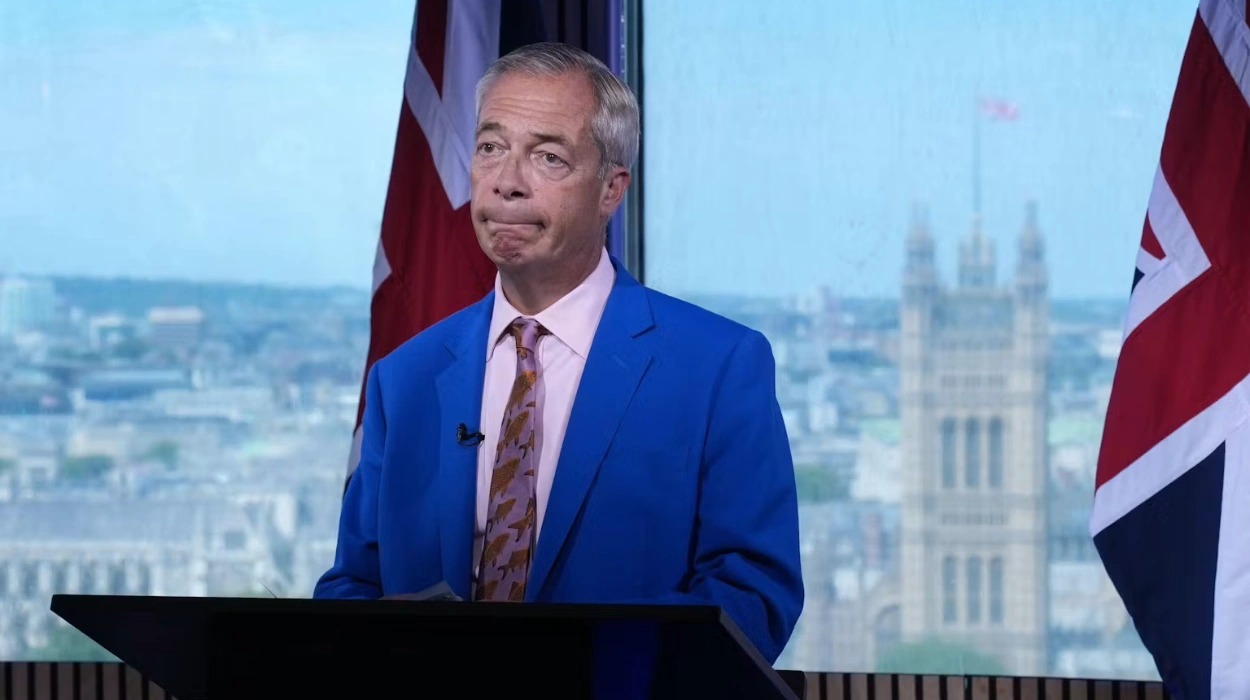
Farage announced his resignation in a televised statement at Millbank Tower in London. The speech lasted approximately 20 minutes and was broadcast across his social media channels. He framed the decision as a direct appeal to voters in Clacton-on-Sea, the Essex constituency he has represented since July 2024. Farage stated that the people of Clacton, not Westminster investigators, should judge his conduct. He described the coming contest as a fight between ordinary people and the political establishment.
The resignation came amid an active inquiry by Parliament’s Parliamentary Commissioner for Standards. Commons rules require newly elected MPs to declare gifts and financial benefits connected to their political activity received in the 12 months before election. Investigators examined whether Farage should have disclosed a £5 million gift from Christopher Harborne, a Thailand-based cryptocurrency investor and major Reform UK donor. Farage denied any breach of parliamentary rules and denied any wrongdoing in his personal finances.
By resigning, Farage automatically suspended the standards investigation. Under parliamentary protocol, the probe remains paused until the by-election outcome is confirmed. If Farage wins re-election, the standards commissioner decides separately whether to resume the inquiry. If he loses, the case may proceed regardless of his parliamentary status.
The Immediate Trigger: The Harborne Gift Controversy
The Sunday Times reported days before the resignation that Farage had failed to disclose gifts and payments connected to British businessman George Cottrell. Cottrell was indicted by United States authorities in 2016 on charges including conspiracy to commit money laundering, wire fraud, blackmail, and extortion. He served eight months in prison under a plea deal with US prosecutors. Farage has previously acknowledged a personal friendship with Cottrell, including a 2024 trip to Florida partly financed by him.
Farage argued publicly that parliamentary ethics rules govern only an MP’s public conduct, not private financial dealings. He stated that earning money through business activity, including promotional work for financial products and social media, does not constitute wrongdoing.
Who Is Nigel Farage?
Nigel Paul Farage, born 3 April 1964 in Farnborough, Kent, is a British politician and current leader of Reform UK. He served as a Member of the European Parliament from 1999 to 2020 and became MP for Clacton in 2024.
Farage entered politics through the Conservative Party, of which he was a member from 1978 to 1992. He left over opposition to the Maastricht Treaty, which advanced European economic and political integration. Farage became a founding figure in the UK Independence Party (UKIP), a political party formed in 1993 to campaign for British withdrawal from the European Union.
Farage led UKIP twice: from 2006 to 2009, and again from 2010 to 2016. Under his leadership, UKIP won the second-highest vote share in the UK at the 2009 European Parliament election. He was elected to the European Parliament for South East England in 1999 and held that seat until Britain’s formal withdrawal from the EU in January 2020, a process commonly known as Brexit.
Farage resigned as UKIP leader in 2016, shortly after the UK’s Brexit referendum result was confirmed. Roughly 51.9% of voters backed leaving the EU in the June 2016 referendum. Farage is widely credited as one of the primary campaigners behind that outcome.
From the Brexit Party to Reform UK
In 2018, Farage co-founded the Brexit Party alongside Catherine Blaiklock, who served as its initial leader. The party registered with the Electoral Commission in February 2019 to contest UK and European elections. It won the most votes of any party in the UK at the 2019 European Parliament election, becoming the single largest party group in that parliament with 29 seats.
The Brexit Party was rebranded as Reform UK in 2021. Farage stepped back from day-to-day leadership for several years before resuming control in June 2024. At a news conference on 3 June 2024, he confirmed he would both lead Reform UK and stand as its candidate in Clacton, reversing an earlier statement that he would not contest the general election.
Farage won the Clacton seat with 46.2% of the vote, defeating the Conservative candidate, who received 27.9%. His majority was 8,405 votes on a turnout of 58.7%. Reform UK secured five parliamentary seats overall in the 2024 general election, its first MPs in the House of Commons.
What Is Reform UK and How Large Is Its Influence?
Reform UK is a right-wing populist party founded in 2018 as the Brexit Party. It holds eight House of Commons seats, 34 Senedd members, 17 Scottish Parliament members, and control of 26 local councils in England as of mid-2026.
Reform UK positions itself to the right of the Conservative Party on immigration, taxation, and national sovereignty. Its parliamentary presence grew through both election wins and defections. Lee Anderson, elected as a Conservative MP in 2019, defected to Reform UK in March 2024, becoming its first sitting MP. Sarah Pochin added a seat after winning the Runcorn and Helsby by-election in 2025. In January 2026, three Conservative MPs, Robert Jenrick, Andrew Rosindell, and Suella Braverman, defected to Reform UK, expanding the party’s Commons total to eight seats.
Reform UK recorded significant gains in devolved and local elections. In the 2026 local elections in England, the party won more than 1,400 council seats. In the same election cycle, Reform UK won 17 seats in the Scottish Parliament and 34 seats in the Welsh Senedd.
Internal Party Tensions
Reform UK experienced internal disputes during its growth. Rupert Lowe, elected as a Reform MP in 2024, was suspended from the party in March 2025 after publicly criticizing Farage’s leadership. Lowe later founded a separate party, Restore Britain, formally launched in February 2026. Several Reform UK councillors defected to the new party following its creation. James McMurdock, another Reform MP, stepped down from the party in July 2025 after admitting to prior business misconduct.
What Reaction Did Farage’s Resignation Receive from Political Opponents?
Political rivals characterized Farage’s resignation as an attempt to avoid scrutiny. Labour, the Liberal Democrats, the Green Party, and Conservative leader Kemi Badenoch each issued public statements questioning the timing and motive behind the move.
Outgoing Labour Prime Minister Keir Starmer described the resignation as a “desperate stunt,” stating that Farage was attempting to divert attention from financial scrutiny. A Labour Party spokesperson said Farage was engulfed in controversy and was using the by-election to change the subject.
Liberal Democrat leader Ed Davey characterized the resignation as a pattern of avoiding accountability. Green Party leader Zack Polanski argued that Reform UK, despite its anti-establishment messaging, functions as part of the political establishment itself. Conservative leader Kemi Badenoch argued that Farage was reacting to pressure rather than facing the ongoing standards investigation directly, and criticized the cost of holding an unscheduled by-election.
Rupert Lowe, the former Reform MP who left the party in 2025, said the by-election would impose an unnecessary financial burden on taxpayers and suggested Farage cover the associated costs personally.
What Happens Next in the Clacton By-Election?
A by-election in Clacton will be scheduled following Farage’s formal resignation from Parliament. Farage will stand as the Reform UK candidate, seeking to reclaim the seat he won in 2024 with a majority of 8,405 votes.
A by-election is a special election held to fill a parliamentary seat that becomes vacant between general elections, typically triggered by resignation, death, or disqualification of the sitting MP. Formal resignation from the UK Parliament requires an MP to apply for a nominal Crown office, such as Steward of the Chiltern Hundreds, since MPs cannot resign directly under UK parliamentary procedure.
Clacton is a constituency in Tendring, Essex, in the East of England. It is a strongly pro-Brexit area, with an estimated 73% of the constituency voting to leave the EU in the 2016 referendum. The seat has a median voter age of approximately 53 years, based on 2021 Census data, and around 71.6% of homes in the constituency are owner-occupied.
| Election Metric | Figure |
|---|---|
| Farage’s 2024 vote share | 46.2% |
| Conservative 2024 vote share | 27.9% |
| 2024 majority | 8,405 votes |
| 2024 turnout | 58.7% |
| Estimated 2016 Leave vote in Clacton | 73.0% |
Reform UK entered the by-election period with strong national polling momentum, having led council election results across England, Scotland, and Wales through 2025 and into 2026. The outcome of the by-election will determine whether the parliamentary standards investigation into the Harborne gift resumes.
How Does This Resignation Fit into the Wider UK Political Context of 2026?
Farage’s resignation occurred one month after Prime Minister Keir Starmer announced his own resignation, with Labour expected to select former Manchester mayor Andy Burnham as his successor. Both events reflect a period of sustained political instability in UK national politics.
Reform UK’s rise through 2025 and 2026 placed sustained pressure on both major parties. The party’s growth in council seats, its performance in devolved elections in Scotland and Wales, and defections from sitting Conservative MPs all contributed to a shifting political landscape ahead of the next scheduled UK general election.
Farage’s resignation and the pending by-election introduce direct consequences for his political trajectory. If Farage loses the Clacton seat, he would be removed from Parliament and unable to pursue the office of Prime Minister without securing a different constituency in a future election. A defeat would also represent a setback for Reform UK’s broader strategy of positioning Farage as the primary challenger to Labour’s incoming leadership.
Farage has also faced separate scrutiny in 2026 connected to his party’s financial backers. In February 2026, reports linked Reform UK treasurer Nick Candy to files associated with convicted sex offender Jeffrey Epstein. Farage stated that Candy had no connection to Epstein’s conduct. These separate controversies, alongside the Harborne gift investigation, have contributed to sustained media and parliamentary scrutiny of Reform UK’s funding sources during 2026.
Explore More about Politics:
Robert Jenrick: Career, Reform UK Role, and Policy Changes Explained
Who Is Morgan McSweeney? Power Behind Labour’s Shift
What Are the Broader Implications of Farage’s Resignation for Reform UK?
Farage’s resignation tests Reform UK’s electoral strength in a constituency it already holds and tests public tolerance for scrutiny of the party’s financial backers. The by-election result will shape the party’s national standing ahead of future general elections.
A comfortable Reform UK victory in Clacton would reinforce the party’s polling advantage and validate Farage’s strategy of directly appealing to voters over parliamentary process. Reform UK’s polling in Clacton, based on aggregated projections, showed the party with a substantial lead over the Conservatives heading into the contest, consistent with its performance in the 2025 and 2026 local and devolved elections.
A narrow win or unexpected loss would raise questions about the durability of Reform UK’s support and could embolden internal critics, including figures connected to Rupert Lowe’s Restore Britain party. The result would also affect the timing and intensity of the parliamentary standards investigation into the Harborne gift, since that inquiry remains suspended pending the by-election outcome.
The resignation represents a defining moment in Farage’s decades-long political career, spanning the Conservative Party, UKIP, the Brexit Party, and Reform UK. It links directly to his central political identity as a self-described outsider challenging established institutions, applied in this case to Parliament’s own standards process rather than to the European Union.