Key Points
- A controversial bonfire in Londonderry’s Bogside has been termed “reckless” and “hate-filled sectarianism” by Minister for Infrastructure Liz Kimmins.
- The fire was started on the Lecky Road flyover, which is a key transport corridor leading into and out of the area.
- Various flags, including the Israeli flag, were tied to the bonfire, as were images of First Minister Michelle O’Neill and union flags.
- Police Service of Northern Ireland (PSNI) have classified effigies and other material as sectarian-motivated hate crimes.
- The bonfire was constructed under the flyover with almost 500 pallets taken under it.
- The Department for Infrastructure said the pallets posed a great fire hazard as gas mains are below the road.
- Disturbances, road closures and a petrol bomb attack on police followed the removal operation, which was carried out with the assistance of PSNI.
- Sinn Féin, the Social Democratic and Labour Party, the Ulster Unionist Party, the Alliance Party and the Democratic Unionist Party have all condemned some of the bonfires.
- Political officials have demanded more stringent control, more secure venues and more accountability in the hands of the organiser.
- In nationalist parts of Northern Ireland, bonfires are lit on 15 August, and 11 July is a common time for bonfires in the loyalist communities.
- The bonfire stuff was taken away, and it is “right and proper,” Michelle O’Neill said.
- There were other fires, and fires were reportedly lit in the Creggan and Top of the Hill areas.
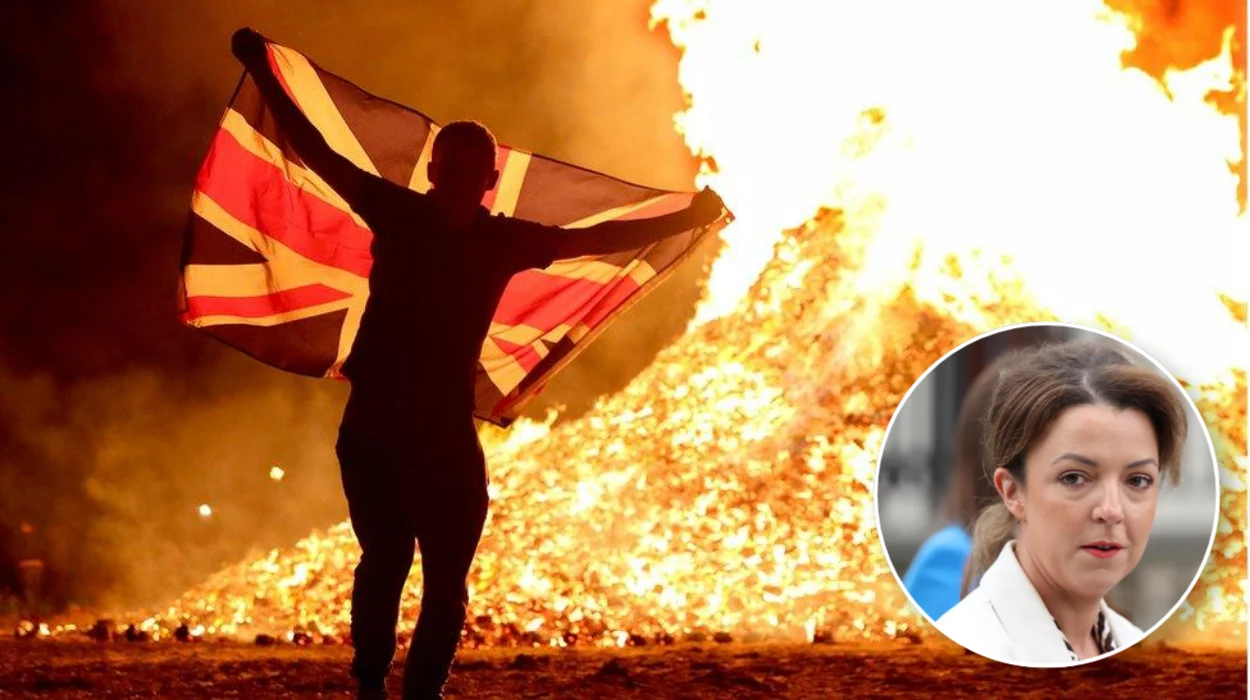
London (Britain Today News) August 17, 2026 — A controversial bonfire built on the Lecky Road flyover in the Bogside has been condemned by Northern Ireland’s infrastructure minister as “reckless”, “totally unacceptable” and an example of “hate-filled sectarianism”. The fire was built beside one of the main roads in and out of the area and was lit after images of First Minister Michelle O’Neill, flags and other political symbols had been attached to it.
- Key Points
- Why has the Bogside bonfire caused controversy?
- What did Liz Kimmins say about the fire?
- Why were the pallets removed?
- What did Michelle O’Neill say?
- How has Sinn Féin responded?
- What have unionist politicians said?
- What did other parties and councillors say?
- What happened when the bonfire was lit?
- What is the wider Northern Ireland context?
- What could happen next?
- What are the main facts to remember?
Why has the Bogside bonfire caused controversy?
The bonfire attracted widespread criticism because of its location, the material placed on it and the potential danger to people living nearby and travelling through the area.
According to Keiron Tourish and Adam Mandeville of BBC News NI, photographs of Michelle O’Neill were attached to the structure alongside union flags, Israeli flags, references to the Parachute Regiment, Somme remembrance and Northern Ireland flags. Police are treating the burning of the effigies and materials as sectarian-motivated hate crimes.
The fire was built on or beside the Lecky Road flyover, a major thoroughfare used by residents and motorists. The location meant that the flames, smoke and burning debris were close to a busy route and infrastructure carrying underground services.
Infrastructure Minister Liz Kimmins said the bonfire had endangered public safety and obstructed the road.
“It was putting people at risk, it was blocking roads, and certainly it’s not where any of us want to be,”
Kimmins said.
She described the display as “hate-filled sectarianism” and said it was “totally unacceptable”. Kimmins also stressed that the bonfire did not represent the majority of people in Londonderry.
What did Liz Kimmins say about the fire?
Kimmins’s criticism focused on both the sectarian nature of the display and the decision to build it on a public road.
The minister said the construction of the fire was “reckless” because it put members of the public at risk. She argued that bonfires should not be built in locations where they could block roads, damage public infrastructure or threaten nearby homes and businesses.
The fire also caused visible damage to the flyover, according to the BBC’s report. The incident has therefore raised questions about who should pay for any repairs and how similar structures should be dealt with before they become dangerous.
Kimmins’s comments came after a week of escalating tension over wooden pallets stored beneath the flyover. The material was removed by the Department for Infrastructure with assistance from the PSNI, but the subsequent disturbances intensified debate about whether authorities should intervene earlier.
Why were the pallets removed?
The Department for Infrastructure said the pallets had been stored illegally beneath the flyover and posed a significant fire-safety risk.
More than 450 pallets, and in some reports almost 500, were removed during the operation. The material had reportedly been stored in a concealed area beneath the Lecky Road flyover, close to underground gas mains.
A Department for Infrastructure spokesperson told the BBC that the unauthorised storage created a “significant fire safety risk” because gas infrastructure was located beneath the road.
The operation was conducted with PSNI support after the department sought assistance to prevent a breach of the peace. The PSNI said public safety was its foremost concern and that officers were working with partner agencies, community representatives and landowners on safety issues involving bonfires.
Michelle O’Neill welcomed the removal of the material. During a visit to a Derry cultural centre, the First Minister said it was “appropriate and necessary” to remove the pallets and other items.
She later described the operation as “right and proper”, saying communities should not be subjected to anti-social bonfires.
Did the removal lead to unrest?
The removal of the pallets was followed by several incidents in Londonderry, including road closures, fires and disorder.
The Lecky Road was temporarily closed after police reported that some items had been set alight on the road. It was later closed again when pallets and a mattress were burned on the flyover. A motorbike was also seen on fire.
A petrol bomb was thrown at police officers in the Bishop Street area. Police reported some anti-social behaviour incidents between approximately 20:00 and 23:30 BST.
PSNI Chief Superintendent Gillian Kearney said the removal of the material had “triggered the initial incidents” but added that tensions around the Fountain Estate and Bishop Street interface had also contributed to the disorder.
Kearney appealed for calm and warned that people involved in the disturbances could face consequences.
“We hope to avoid a recurrence of last night’s events,”
She said.
“However, I want to assure the community that we will allocate the necessary resources to identify and deter those accountable and ensure public safety.”
She added:
“We call for calm. There is neither a reason nor a benefit to disrupting local communities, and there will be repercussions for those found to be involved.”
What did Michelle O’Neill say?
O’Neill condemned sectarianism and said she would not be intimidated by the burning of her image.
In a social media statement reported by Keiron Tourish and Adam Mandeville, she said she would “not be deterred, distracted or intimidated”.
“I will continue to call out sectarianism, anti-community activity and destruction wherever it comes from,”
O’Neill said.
“These bonfires are a blight on our community.”
The First Minister also said that the removal of the pallets was justified because of the risks posed by the material and the nature of the proposed fire.
O’Neill has argued that cultural celebrations should not involve the burning of flags, political symbols or effigies. She has also said that communities should be able to mark important dates without creating danger or encouraging hatred.
Her comments placed the controversy within a wider debate over how Northern Ireland’s political and cultural traditions should be expressed in public spaces.
How has Sinn Féin responded?
Sinn Féin representatives described the burning of O’Neill’s image as anti-democratic and sectarian.
North Belfast MP John Finucane called the bonfire “hate-filled sectarianism” and said it represented the opposite of the inclusive Irish cultural identity promoted at events such as the Belfast Féile and Derry Féile.
Finucane said the bonfires.
“disgracefully imitate the most offensive aspects of loyalist bonfires in their sectarianism, their criminality and recklessness”.
He also argued that only a small number of young people and children were involved, and that some were being manipulated by people who remained out of public view.
“The small number of young people and children involved, often manipulated by others who stand in the shadows, are not representative of the majority of young people who are engaged in positive and productive cultural activities all year round,”
Finucane said.
He said the isolated fires in Derry had no place in the future of the island of Ireland and contrasted them with cultural festivals that celebrate identity without targeting other communities.
Sinn Féin MP Chris Hazzard also called for tighter controls on bonfires across Northern Ireland. He described sectarian fires as “hate-filled pyres” and said it was time to “move beyond them”.
Hazzard said political leaders needed to adopt a united position and establish proper management and regulation for bonfires across the region.
What have unionist politicians said?
Unionist politicians have also condemned the burning of images and symbols, although some have questioned whether a complete ban would be practical or enforceable.
Ulster Unionist Party leader Jon Burrows called the Bogside fire a “pyre of sectarian hatred” and described it as “absolutely disgraceful”.
Burrows called for councils, police, the fire service and community organisations to be involved in planning bonfires at an earlier stage. He said organisers should agree safe locations, meet safety standards and follow clear rules.
“I think all bonfires should be safe, respectful and lawful,”
He said.
He added that organisers should be held accountable when standards were breached. Burrows also said authorities should intervene where a bonfire posed a risk to life or property, while recognising that police often had difficult operational decisions to make.
DUP MP Gregory Campbell said the burning of O’Neill’s image was “unacceptable”. However, he said a blanket ban could be difficult to enforce because most bonfires pass without serious incident.
Campbell said police should explain how they intended to deal with the smaller number of bonfires that caused problems. He also called for an analysis of the policing response and plans.
In an earlier statement, Campbell said the Bogside bonfire had a “recent history of provocative behaviour”.
“There has to be total condemnation of this and hopefully action taken within the community and by the police to try and bring those responsible to justice,”
He said.
Campbell added that symbols of hate should not appear on bonfires, whether the fires were lit on 11 July or 15 August.
What did other parties and councillors say?
Alliance MLA Peter McReynolds said he was “completely horrified and disgusted” by the bonfires.
“These bonfires and the hatred and sectarianism don’t represent the people of Derry,”
McReynolds said.
He criticised the involvement of young people, saying they were being encouraged by adults to participate in actions that could damage their prospects.
“We see this year on year, young people being manipulated by people who should know better into taking part in acts that will potentially ruin their futures,”
He said.
SDLP councillor John Boyle described the burning of images and flags as “blatant sectarianism”.
Boyle said there was “nothing positive” about the bonfires seen over the weekend and during the previous months.
He also warned that the fire had been built close to a major gas pipeline. Boyle said the pipeline was only a short distance beneath the roadway, creating a serious risk to life and property if the fire reached the infrastructure.
Boyle said residents had been surprised by the quantity of pallets stored beneath the flyover. He said more than 450 pallets had been hidden in a bay or tunnel beneath the structure.
He urged the Department for Infrastructure to explain whether the same approach would be taken when bonfire materials were stored on private land or in other locations.
What happened when the bonfire was lit?
The Lecky Road bonfire was lit shortly before 23:00 BST after young people placed pallets near the bottom of the flyover.
Fireworks were reportedly launched at about 22:45 before the fire was started. A large crowd gathered to watch the blaze, while police monitored events from the city walls overlooking the Bogside.
For a short period on Saturday night, rival groups exchanged sectarian abuse. A small number of missiles were thrown by people on both sides, after which police moved about 30 people away from part of the city walls.
PSNI Area Commander for Derry City and Strabane, Chief Superintendent Gillian Kearney, said items placed on bonfires around the city included flags, poppy wreaths, banners, political material, sashes, football shirts and other objects.
The police investigation is examining whether the burning of those objects amounts to sectarian-motivated hate crime. Police have not indicated that every person present at the bonfire was involved in criminal activity, and the investigation remains focused on the specific actions and materials identified.
Were other bonfires lit in Londonderry?
The Bogside fire was not the only bonfire lit in Londonderry.
Two other bonfires were reported in the Creggan and Top of the Hill areas. Flags and effigies were placed on those structures before they were set alight.
The presence of several fires has increased pressure on political parties and public authorities to develop a consistent approach to bonfires across Northern Ireland. Representatives from different parties have argued that the rules should apply regardless of whether the fire is associated with nationalist or unionist communities.
Political leaders have repeatedly said that the display or burning of flags and effigies can inflame tensions. They have also raised concerns about the use of public roads, the risk to firefighters and police officers, and the possibility of damage to homes, vehicles and public infrastructure.
What is the wider Northern Ireland context?
Bonfires are associated with different cultural and political traditions in Northern Ireland.
In some nationalist areas, fires are lit on 15 August to mark the Feast of the Assumption. In unionist communities, bonfires are commonly held around 11 July as part of the celebrations linked to the Twelfth.
Many bonfires take place without major incidents. However, controversy has arisen when fires include flags, political materials, effigies or symbols viewed as threatening or sectarian.
The Londonderry dispute follows criticism of a bonfire in County Tyrone that was topped with a replica mosque. That structure was lit before police could remove it, prompting renewed debate about whether authorities should have stronger powers to intervene.
The latest events have also revived questions about the balance between cultural expression, public safety and the prevention of hate crime.
Explore More about Politics:
Reform Proposes Benefits Ban for Foreign Nationals in the UK
British Prime Minister Andy Burnham Reportedly Messaged White House, Impostor
What could happen next?
The PSNI is expected to continue examining the material displayed on the bonfire and the disorder that followed the removal of the pallets.
Police have called for calm and warned that those responsible for criminal damage, attacks on officers or other offences could face legal consequences. The force has also indicated that resources will be used to identify people involved in the disturbances.
Political pressure is likely to continue for a regulated framework covering the planning, construction and lighting of bonfires. Proposals raised by politicians include designated sites, advance consultation with councils and emergency services, safety inspections and clear responsibility for organisers.
The dispute also highlights the difficulty of removing bonfire materials when intervention may itself trigger disorder. Authorities must weigh public safety, fire risks and possible damage to infrastructure against the risk of confrontation at the site.
The immediate disagreement remains unresolved, but there is broad political criticism of the use of sectarian imagery and the construction of a major fire on a busy road.
Why is the issue politically sensitive?
The bonfire controversy touches on identity, community relations and Northern Ireland’s history of conflict.
The burning of Michelle O’Neill’s image was condemned by politicians across several parties, although the wider debate remains divided over enforcement. Some representatives want bonfires to be prohibited where they are unsafe or openly sectarian, while others believe that legal and regulated sites would be more practical than a total ban.
The incident has also raised concerns about children and young people becoming involved in activities organised or encouraged by adults. Finucane and McReynolds said young participants did not represent the wider youth population and could be exploited by people seeking to provoke confrontation.
For residents, the central concerns include road access, public safety, fire damage, disorder and the effect of sectarian displays on community relations. For authorities, the challenge is to respond consistently while preventing further escalation.
The Lecky Road fire therefore represents more than a single bonfire. It has become a test of how political leaders, police, councils and communities deal with public celebrations that cross into danger, intimidation or hate crime.
What are the main facts to remember?
The bonfire was built on the Lecky Road flyover in the Bogside area of Londonderry and was lit after images, flags and other symbols were attached to it.
Infrastructure Minister Liz Kimmins called it “reckless”, “totally unacceptable” and “hate-filled sectarianism”. Police are treating the burning of effigies and materials as sectarian-motivated hate crimes.
Almost 500 pallets had earlier been removed from beneath the flyover because officials said they posed a significant fire risk near underground gas mains. That operation was followed by disturbances, road closures and a petrol bomb attack on police.
Michelle O’Neill defended the removal of the material, while politicians from Sinn Féin, the SDLP, the Ulster Unionist Party, the Alliance Party and the DUP condemned the sectarian elements of the fire. The parties differ over whether a ban is practical, but several have called for safer locations, clearer rules and stronger accountability.